Sliding Glass Door Smart Lock Guide for Patio and Sliding Doors
A practical sliding glass door smart lock guide covering narrow-stile fit, keyless options, security, installation, and choosing a lock for patio and sliding glass doors.
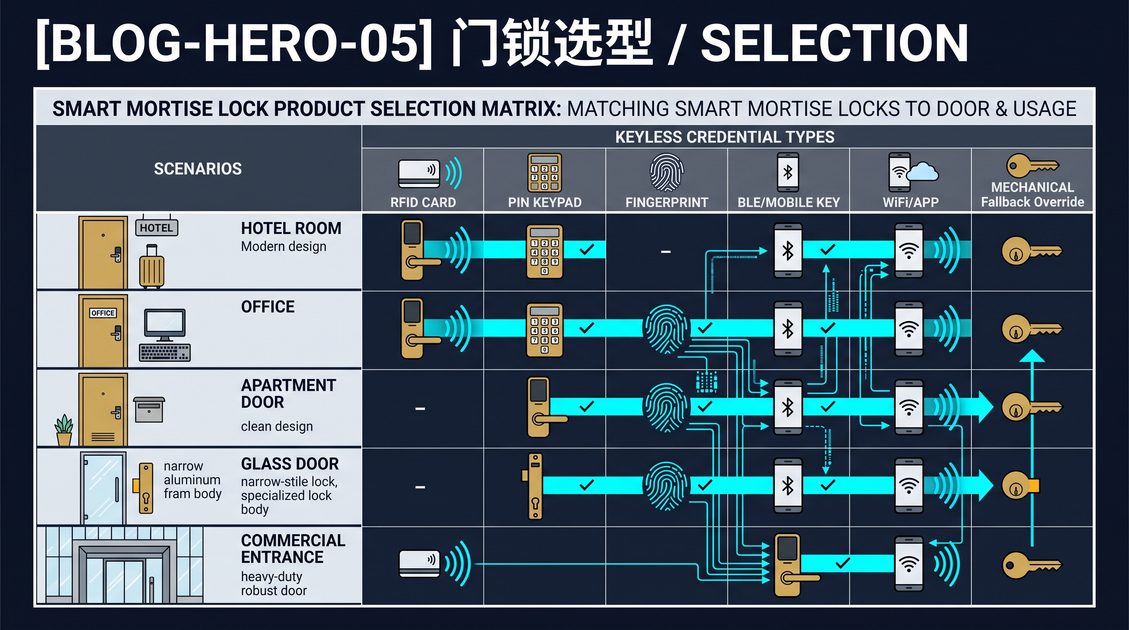
A sliding glass door smart lock is an electronic lock designed for the narrow vertical stile of a sliding glass or patio door, providing keyless access where a standard deadbolt or mortise lock cannot fit. Sliding doors are a common security weak point because their latches are easy to defeat, and they are also physically constrained: the narrow stile, the thin glass panels, and the sliding mechanism limit what hardware can be mounted. This sliding glass door smart lock guide explains how these locks work, how to confirm a lock will fit a sliding door, what keyless credentials to choose, and how to install and secure the door as a complete assembly.
Sliding Glass Door Smart Lock Guide: Why Sliding Doors Need a Special Lock
Sliding glass and patio doors cannot accept a standard deadbolt or mortise lock because the locking area is a narrow vertical stile, often only a few centimeters wide, and the door slides horizontally rather than swinging. A typical electronic lock body is too deep or too wide for this space. A sliding glass door smart lock is engineered for this geometry, with a compact body and a lock mechanism that engages the sliding panel rather than a frame-mounted strike.
The security case is strong. A sliding door latch can often be lifted or defeated from outside, and sliding glass is frequently the easiest entry point in a home. Replacing a flimsy latch with a smart lock that positively secures the sliding panel, combined with a track reinforcement or a security bar, closes a real gap. For a home, rental, or patio-facing commercial space, a sliding glass door smart lock is a meaningful upgrade over the factory latch.
A sliding glass door smart lock is an electronic lock designed for the narrow vertical stile of a sliding glass or patio door, providing keyless access where a standard deadbolt or mortise lock cannot fit because the locking area is too small and the door slides horizontally. Sliding door latches are a common security weak point because they can often be lifted or defeated, so a smart lock that positively secures the sliding panel, paired with track reinforcement, closes a real gap. The lock must be engineered for the narrow stile geometry and must engage the sliding panel rather than only a frame strike. For homes, rentals, and patio-facing commercial spaces, this is a meaningful upgrade over the factory latch.
Sliding Glass Door Smart Lock Guide: Confirm the Fit
Before choosing a lock, measure the stile width, the glass panel, the track, and the gap between the fixed and sliding panels. Confirm that the lock body fits within the stile, that the locking mechanism reaches and positively engages the sliding panel, and that the installation does not stress the glass. Some sliding door locks mount on the stile surface, while others use a concealed or recessed design; the correct choice depends on the door profile and whether the door is single-panel or multi-panel.
Check whether the door is left- or right-opening and whether it has a fixed panel on one side. Note the height and reach to the lock, and whether the sliding panel can be removed for maintenance. For a rental or a retrofit, confirm the lock can be installed without permanent damage to the door and that it does not interfere with the track or the seal. A lock that fits one sliding door may not fit another, so rely on the exact model dimensions rather than a generic claim.
Sliding Glass Door Smart Lock Guide: Keyless Credentials and Power
Choose the credential mix that fits how the door is used. A keypad is convenient for a patio door because no card or phone is needed. Bluetooth or mobile access suits users who always have a phone. A card or fob works for a rental or shared door. Whatever the credential, require a fallback path because a patio door that cannot open from inside, or a guest who cannot get in, is a real inconvenience.
Power and emergency access matter on a sliding door. Confirm the battery arrangement, the low-battery warning, and the recovery path, such as a backup power terminal or a mechanical release. Because a sliding door is often at the rear of a property, plan so that a dead battery does not strand a user outside. A sliding glass door smart lock with clear battery reporting and a documented emergency method is far more dependable than one with no recovery path.
Sliding Glass Door Smart Lock Guide: Installation and Complete Security
Install the lock so it positively secures the sliding panel and cannot be defeated by lifting the door off its track. Reinforce the track or use a security bar so an intruder cannot simply lift the door out. Test the lock with valid, invalid, and expired credentials, confirm the inside release works immediately, and check that the door still slides freely and seals properly. For a rental, ensure reversible installation and an approved approach.
This sliding glass door smart lock guide is general information. A sliding glass door is glass and, in some settings, a fire or emergency opening, so confirm local building, accessibility, privacy, and egress requirements with qualified professionals, and pair any smart lock with robust track reinforcement for genuine security.
Not sure which sensor fits your project?
Talk to our mmWave application engineers for a free consultation.
Specify your hotel project with our engineers
Send your room count, ceiling type, and protocol preference. We will return a sample plan and quote within 24 business hours.
- Move from general guidance into a product or application discussion.
- Use RFQ when pricing, drawings, MOQ, or launch timing needs structure.
- Keep a direct contact path visible for fast clarifications and handoff.