RFID Door Locks for Hotels: RFID Card and Hotel Lock System Guide
How RFID door locks and an RFID hotel lock system work, the card technology, security against cloning, and choosing RFID hotel door locks for new builds and retrofits.
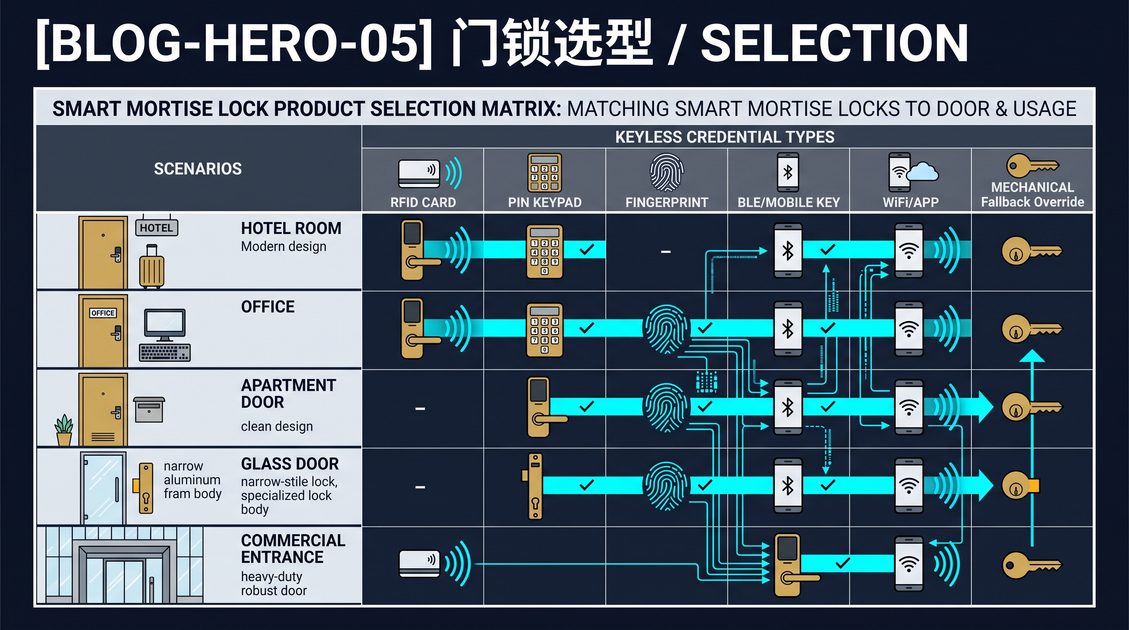
An RFID hotel door lock is an electronic mortise lock that a guest opens by tapping an RFID card or fob on a contactless reader, instead of using a mechanical key. It is the dominant credential standard in hotels because RFID cards are fast, durable, inexpensive, and instantly revocable, and an RFID hotel lock system manages the cards, the doors, and the audit trail centrally. This guide explains how RFID door locks and an RFID hotel lock system work, the card technology behind them, how they resist cloning, and how to choose RFID hotel door locks for a new build or a retrofit.
How RFID Hotel Door Locks Work
An RFID hotel door lock reads the credential stored on a card or fob when it is brought near the reader, most commonly over 13.56 MHz, and unlocks if the credential is valid for that door and that time. The card is encoded by a front-desk encoder or the management system with a validity period and a door assignment, so a guest card works only during the stay and only for the assigned room. When the stay ends or a card is lost, the credential is revoked centrally, and the same lock body continues to serve the next guest.
The RFID hotel lock system ties these locks and cards together. The software issues cards at check-in, revokes them at check-out, manages the door locks in the fleet, and maintains a timestamped audit of every entry. It can also support multiple access levels, so a housekeeper's card differs from a guest's, and it integrates with the property-management system so card issuance is automatic. This system layer is what makes RFID practical for a hotel, turning a set of locks into a managed access operation.
Card Technology and Security Against Cloning
The security of an RFID door lock hinges on the card technology and encryption. The standard to prefer is 13.56 MHz with encrypted, diversified keys, where each card is encoded with a key derived for the specific lock and property, so a simple reader cannot read a raw card number and clone it. A lock and card system without this encryption, especially older low-frequency cards, can be cloned with inexpensive tools, which is a genuine vulnerability in a hotel setting.
Beyond cloning resistance, an RFID hotel door lock should secure the encoding and communication. The encoder should authenticate to the system, the card should store the credential in a protected way, and the audit trail of who encoded which card should be protected. This guide recommends choosing an RFID hotel lock system with encrypted, diversified card keys, central authentication, and a documented encryption specification, and treating the card security as a first-order selection criterion rather than an assumption.
Choosing an RFID Hotel Lock System
When choosing RFID door locks for a hotel, apply the full framework: card security, offline reliability, battery, management, PMS integration, form factor, and supplier. Confirm the encrypted card standard and cloning resistance; confirm the lock authenticates locally so a card works through a network outage; confirm central battery reporting and a fallback, such as a mobile key or mechanical key; confirm the management platform handles multi-level access and audit and integrates with your PMS; and confirm the mortise lock fits your door for new build or retrofit. A supplier that documents the encryption, the cycle-tested lock body, and the after-sales support is worth more than a lower price.
An RFID hotel lock system is the right backbone for most hotels because it is fast, durable, inexpensive, and secure when implemented with encrypted cards. Pair it with a mobile key option for guests who want contactless arrival, and keep a mobile key or mechanical key as a fallback for lost cards. Match the system to the property size, require encrypted cards and local authentication, and an RFID hotel door lock will be a reliable, secure, and efficient choice for years.
Not sure which sensor fits your project?
Talk to our mmWave application engineers for a free consultation.
Specify your hotel project with our engineers
Send your room count, ceiling type, and protocol preference. We will return a sample plan and quote within 24 business hours.
- Move from general guidance into a product or application discussion.
- Use RFQ when pricing, drawings, MOQ, or launch timing needs structure.
- Keep a direct contact path visible for fast clarifications and handoff.