Retrofit Smart Lock Guide for Existing Deadbolts and Doors
A practical retrofit smart lock guide covering compatibility, installation, credentials, security, and when a retrofit upgrade fits an existing deadbolt or mortise door.
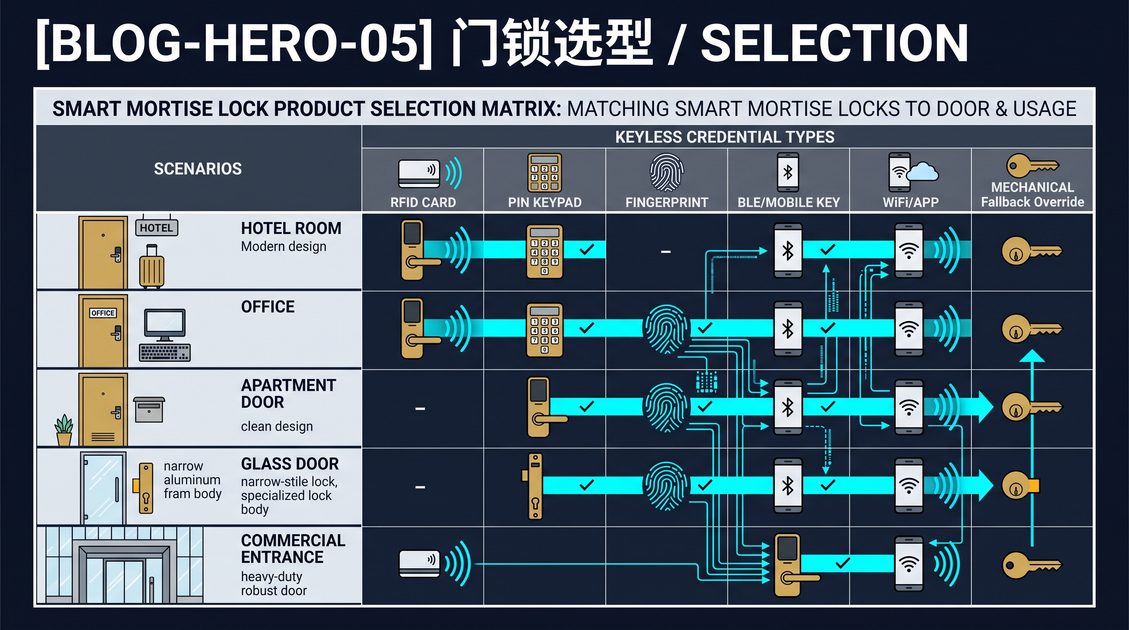
A retrofit smart lock is an electronic lock that upgrades an existing mechanical door, most commonly by fitting over an existing deadbolt or into an existing mortise pocket, so the owner gains keyless access without replacing the entire door hardware. Retrofit is the most common route to a smart door lock because most upgrades happen on doors that are already installed. This retrofit smart lock guide explains the main retrofit approaches, how to confirm a lock will fit your door, the credential and power considerations, and how to make a retrofit secure and reversible.
Retrofit Smart Lock Guide: The Main Retrofit Approaches
There are two dominant retrofit paths. The first is a retrofit smart deadbolt that bolts over an existing deadbolt and preserves the key mechanism underneath; it is quick, keeps the original lock, and is a good choice for a North American cylindrical door. The second is an electronic mortise lock that drops into an existing mortise pocket, preserving the handle set and appearance; it suits commercial, hotel, and European doors. A third, less common path is a smart cylinder or smart lock that replaces only the cylinder core.
Each approach balances ease, appearance, and capability. The retrofit deadbolt is the simplest and most reversible but leaves the original deadbolt in place, so the electronic mechanism rides on top. The electronic mortise retrofit is more integrated but depends on the existing pocket matching the new case. The correct choice depends on the door structure, the existing hardware, and whether the owner wants a fully electronic mechanism or a fast upgrade over a working lock.
A retrofit smart lock upgrades an existing mechanical door without replacing all the hardware, most commonly by fitting over an existing deadbolt or into an existing mortise pocket. The two dominant paths are a retrofit smart deadbolt that bolts over an existing deadbolt and keeps the key underneath, quick and reversible but with the electronic mechanism on top, and an electronic mortise lock that drops into an existing mortise pocket, more integrated and preserving the handle set. A smart cylinder is a third option that replaces only the core. The choice depends on door structure, existing hardware, and whether the owner wants a fast upgrade or a fully electronic mechanism.
Retrofit Smart Lock Guide: Confirm Compatibility
Before ordering, measure the door thickness, backset, and the existing deadbolt or mortise geometry, and confirm the lock accepts the door's handedness. For a retrofit deadbolt, check that the lock matches the bolt spacing and that the exterior trim covers the existing holes. For an electronic mortise retrofit, confirm the new case fits the existing pocket, faceplate, and strike without enlarging a rated or metal door. A retrofit that requires drilling into a fire-rated or emergency door should be reviewed by a qualified professional.
Confirm the retrofit does not compromise the existing mechanical key. A common retrofit failure is a lock that installs over a deadbolt but cannot be opened with the key when the electronics fail. Verify that the mechanical key remains a working fallback, and that the retrofit preserves the door's egress. A retrofit smart lock should make the door easier to manage without removing the reliable fallback of the original mechanism.
Retrofit Smart Lock Guide: Credentials, Power, and Security
Choose credentials that fit the users. A keypad, card, fingerprint, or mobile credential each has different convenience and recovery implications, and the retrofit lock should combine one of them with the retained mechanical key. Confirm the battery arrangement, the low-battery warning, and the emergency path, whether the mechanical key, a backup power terminal, or a secondary credential. A retrofit deadbolt that drains batteries quickly because it is an add-on mechanism needs a clear replacement plan.
A retrofit upgrade should genuinely improve security. Confirm the electronics cannot be bypassed, that the retained mechanism is still robust, and that the lock is certified and encrypted. A retrofit that only adds an app to a weak original lock may not meaningfully raise the security level. Test the complete assembly, the valid and invalid credentials, the mechanical key, power loss, and egress before relying on it daily.
Retrofit Smart Lock Guide: Installation and Reversibility
For a rental or a cautious owner, prefer a retrofit that is reversible and does not permanently damage the door. Keep the original hardware so the door can be returned to its mechanical state at move-out or resale. Follow the manufacturer's installation and torque instructions, and test that the door still closes, seals, and operates the original key. This retrofit smart lock guide is general information; confirm local fire, accessibility, electrical, privacy, and emergency-egress requirements with qualified professionals.
Not sure which sensor fits your project?
Talk to our mmWave application engineers for a free consultation.
Specify your hotel project with our engineers
Send your room count, ceiling type, and protocol preference. We will return a sample plan and quote within 24 business hours.
- Move from general guidance into a product or application discussion.
- Use RFQ when pricing, drawings, MOQ, or launch timing needs structure.
- Keep a direct contact path visible for fast clarifications and handoff.