Mortise Lock Selection Guide
A practical mortise lock selection guide for matching door geometry, duty, security, and service requirements.
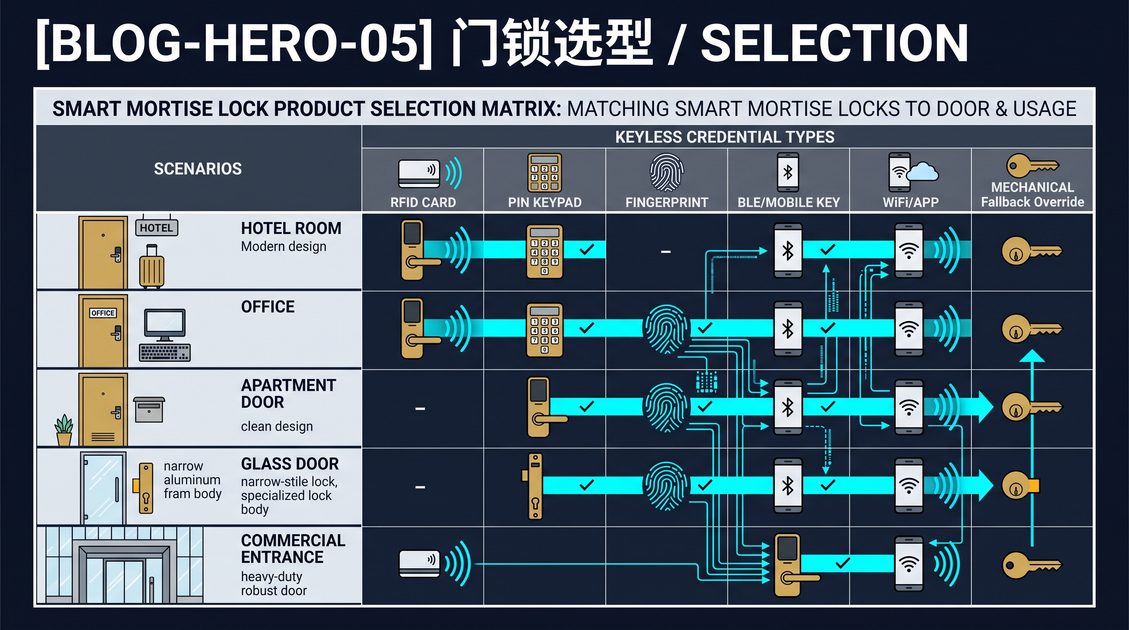
What a mortise lock selection guide should establish
A mortise lock selection guide is a documented method for choosing a lock case and trim that fit the door, satisfy the opening’s security and egress intent, and remain maintainable through their service life. Begin with verified measurements rather than a catalogue photograph: record case height and depth, backset, faceplate, door thickness, handing, strike location, spindle height, cylinder preparation, and available edge clearance. Confirm whether the opening is interior or exterior, low or high traffic, dry or exposed, and controlled by a key, credential, passage function, or schedule. A decision should also identify the applicable building, fire, accessibility, and electrical requirements, because those obligations can change which functions are permissible. The output is a traceable selection record, not merely a model number.
A useful selection record separates mandatory constraints from preferences. A narrow stile may limit case depth; an existing strike may dictate faceplate geometry; a panic route may rule out a function that appears convenient. Ask the installer to photograph both faces and the door edge, then reconcile those photographs with measured dimensions. Drawings should show the centerline of the spindle, cylinder, lever, and strike. When a replacement is planned, retain the removed hardware until the new assembly has passed a complete operational test.
Door geometry and mortise case fit
A mortise lock case is a recessed mechanism whose dimensions must align with the pocket, edge preparation, strike, trim, and door construction. For reliable fit, verify the pocket envelope, case depth, backset, faceplate shape, latch projection, deadbolt travel, spindle height, and handing against an approved drawing before machining or ordering. Door thickness alone does not prove compatibility: reinforced steel, aluminum, timber, composite, and fire-rated assemblies may use different preparations and fasteners. Check stile width, glazing proximity, hinge edge clearances, and the relationship between the case and internal reinforcement. Compare the selected strike with the frame material and required shimming range. If dimensions are uncertain, treat them as an engineering hold point and request a physical sample or field template rather than assuming nominal compatibility.
Measure from a stable datum, preferably the finished door edge and the finished floor, and record units consistently. A small error in spindle elevation can make a lever appear to work while preventing the latch from retracting fully. The frame should be inspected for twist, loose anchors, paint buildup, and previous repairs. Any condition that forces the door to lift, drag, or slam will transfer load into the lock and obscure whether the mechanism itself is correctly selected.
Function, security, and user movement
A lock function defines how the latch, deadbolt, lever, outside trim, and inside release behave during normal use and emergencies. Choose the function by mapping real movement scenarios: entry, exit, occupied privacy, authorized passage, loss of power, lost credential, fire alarm, and maintenance access. A storeroom, guest room, office, classroom, and shared entrance may require different outside lever states and different inside release behavior. Confirm whether the door must be free egress, controlled egress, or mechanically secured under a documented procedure. Security is not improved by adding a deadbolt that conflicts with evacuation, accessibility, or automatic door equipment. Put the intended sequence into a test script so installers and operators can verify the same behavior.
Distinguish resistance against casual misuse from resistance against a determined attack. Protection may involve the case, strike reinforcement, cylinder choice, hinge security, door construction, credential policy, audit controls, and monitoring. A stronger lock body cannot compensate for a weak frame or an unmanaged master credential. Require a risk review for sensitive openings and ask the responsible professional to confirm local code interpretations before procurement.
Credentials and access administration
A credential system authorizes a person, device, or service to request an opening; it does not replace the mechanical and electrical design of the lock. Compare keypad, RFID, NFC, Bluetooth, mobile, biometric, and physical-key options by considering enrollment, revocation, offline behavior, reader placement, privacy, cleaning, and recovery. Define who may create credentials, who may approve them, how temporary access expires, and how events are retained. If a cloud or building-management connection is planned, document the source of truth and failure behavior. A lock that continues to accept a stale credential after revocation may be unsuitable for a high-risk opening, while a lock that refuses all access during a network outage may be unsuitable for a remote site.
Use least privilege for administrators and separate commissioning accounts from ongoing operational accounts. Record firmware versions, credential formats, time settings, and timezone assumptions during handover. Test a valid credential, an expired credential, a revoked credential, a wrong credential, and an offline condition. Do not publish unverified encryption claims or assume that a familiar card technology has identical security behavior across every reader and controller.
Power, egress, and emergency planning
Power planning covers the lock’s operating source, expected current demand, cable path, backup behavior, and safe response when power is absent. A battery lock needs a replacement interval based on traffic, reader activity, temperature, motor work, and radio use; a wired lock needs a supervised supply and a documented route that preserves fire and access requirements. Determine whether the selected function is fail-secure, fail-safe, mechanically overrideable, or governed by a separate emergency release. A nominal voltage label is not a complete electrical specification: confirm operating range, inrush, polarity, cable length, protection, and commissioning measurements with the responsible installer. The emergency plan should explain how authorized occupants exit, how responders gain access, and how the opening is returned to normal service.
Never conceal a battery compartment or emergency interface behind a trim piece that cannot be reached during a service event. Label isolators and provide a controlled method for power cycling. Where a lock interfaces with an alarm, access controller, or door position sensor, define which device has authority and how conflicting commands are resolved.
Environment, duty, and material choices
Environmental selection matches the lock and trim to temperature, humidity, salt, dust, cleaning chemicals, water exposure, and traffic. An indoor office opening may tolerate a different finish and seal strategy than a coastal entrance, washroom corridor, laboratory, or unconditioned store. Ask for the manufacturer’s stated operating envelope and installation limitations; do not infer an ingress rating, corrosion class, cycle rating, or fire performance from appearance. Consider condensation on metal surfaces, grit in the latch path, disinfectant residue on touchpoints, and thermal movement of the door and frame. Heavy traffic also changes maintenance frequency, alignment risk, and the value of event monitoring.
Finish selection is both visual and functional. A coating can affect cleaning practice, tactile wear, and replacement matching. Keep a sample or finish code in the project record, but do not treat a finish code as evidence of material composition. For exterior or marine conditions, require a written compatibility review for fasteners, frame, strike, and trim as a complete assembly.
Integration and offline behavior
Integration planning defines how the lock exchanges identity, permission, time, and event information with other systems. List interfaces explicitly: reader, hub, access controller, elevator, room-management platform, video intercom, fire input, or building-management system. For each interface, state protocol, direction, authentication, latency expectation, retry behavior, and ownership. An offline lock should have a deliberate local policy for clock drift, cached permissions, denied events, and later synchronization. A networked lock should not be treated as continuously available merely because a radio icon is present. Verify behavior during controller restart, wireless loss, cloud unavailability, time-source failure, and partial power loss.
Data minimization matters when access events can identify employees, residents, guests, or visitors. Define retention, export, deletion, and administrator access before connecting the lock to a wider platform. Use a staging environment for integration tests, and keep production credentials out of installer notes and photographs.
Installation readiness and acceptance
Installation readiness means the door, frame, tools, drawings, wiring, credentials, and responsible trades are prepared before cutting begins. Protect the door finish, confirm handing, mark the centerlines, and dry-fit the case, faceplate, strike, spindle, cylinder, and trim. The mortise pocket should be square, clean, and deep enough without weakening the stile. Fasteners must match the substrate and be tightened without distorting the case. Align the strike with the latch path; forcing the door against a misaligned strike can create a false impression of motor or battery failure.
Acceptance should be witnessed and recorded. Test the door from both sides, with the door open and closed, under normal and abnormal conditions. Include manual operation, electronic release, credential denial, deadbolt movement, inside egress, mechanical override, door position reporting, power interruption, and recovery. Capture measurements or observations that explain pass or fail decisions, then correct the root cause before sign-off.
Lifecycle, procurement, and handover
A lifecycle decision compares purchase effort with service effort over the expected operating period. Request documentation for replacement parts, firmware policy, battery access, cylinder format, trim availability, warranty boundaries, and support escalation. Ask which functions are configurable, which require a different case, and which changes invalidate an approval or field test. Procurement should identify long-lead components and preservation requirements for spare hardware without inventing a guaranteed delivery date. The responsible buyer should also verify taxes, shipping, local labor, and code review separately from any equipment quotation.
Handover is complete when another trained person can operate, diagnose, and safely isolate the opening without relying on the original installer’s memory. Provide as-built photos, measured dimensions, keying or credential records, programming instructions, emergency contacts, maintenance intervals, test results, and a change log. Schedule a post-occupancy review to capture nuisance denials, alignment drift, battery performance, and user training gaps.
Troubleshooting decisions after selection
Troubleshooting should begin with symptoms and conditions, not with immediate part replacement. A latch that retracts with the door open but not when closed usually points toward alignment, preload, strike geometry, or door movement. A reader that works intermittently may involve credential placement, radio interference, battery state, clock policy, or a damaged reader rather than the lock case. A controller event without physical movement calls for checking power, output timing, wiring, and mechanical binding in sequence. Preserve logs and record the exact door position, credential type, temperature, and recent maintenance action.
Do not bypass an interlock, defeat an emergency feature, or leave a door unsecured to hide a fault. Isolate the opening under the site’s safety procedure, inform affected users, and use an approved temporary control. After repair, repeat the acceptance cases that could have been affected and update the maintenance record.
Conclusion: mortise lock selection guide
A sound mortise lock selection guide turns measurements, movement scenarios, security objectives, electrical conditions, integration boundaries, and service ownership into a verifiable choice. Select the case and function only after the opening and emergency strategy are understood. Then confirm credentials, power, environment, installation quality, acceptance tests, documentation, and lifecycle support. The most dependable project is not the one with the longest feature list; it is the one whose behavior remains predictable when the door is misaligned, the network is unavailable, a credential is revoked, or an occupant needs to exit.
Not sure which sensor fits your project?
Talk to our mmWave application engineers for a free consultation.
Specify your hotel project with our engineers
Send your room count, ceiling type, and protocol preference. We will return a sample plan and quote within 24 business hours.
- Move from general guidance into a product or application discussion.
- Use RFQ when pricing, drawings, MOQ, or launch timing needs structure.
- Keep a direct contact path visible for fast clarifications and handoff.