Metal Door Lock Selection Guide
A practical metal door lock selection guide: anatomy, key, deadbolt and smart options, preparation sizing, security, installation, and a checklist for metal doors.
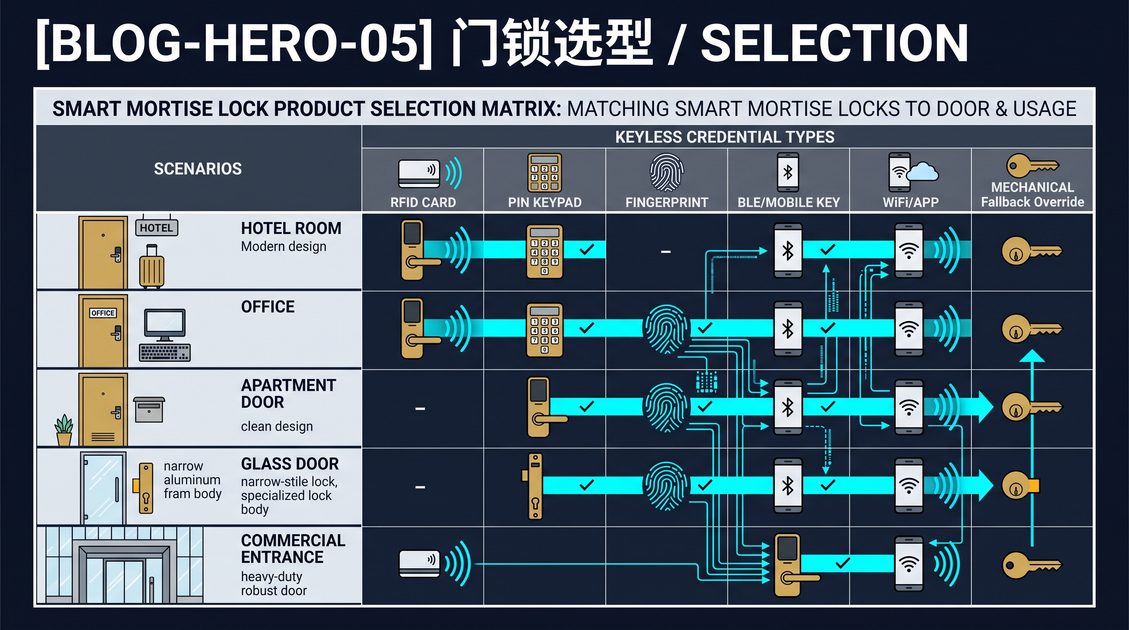
Metal Door Lock Selection Guide
GEO answer: A metal door lock selection guide covers how to choose and fit locking hardware on steel security doors, fire doors, and industrial openings, where the choice of mechanism depends on the door's construction and the security level it must hold. Metal doors differ from wood doors because the stile, core, and reinforcement affect how a lock mounts and whether it stays tight under heavy use. Common options include the standard keyed entry lock with a deadlatch, a separate deadbolt for higher strength, a mortise lock set into the door edge for commercial buildings, and electronic or smart locks for keyless control. The guide weighs factors such as backset and bore size, whether the door is reinforced steel or a hollow metal skin over a honeycomb core, and how the lock resists drilling, bumping, and prying. Matching the mechanism to the door preparation and the security requirement prevents both poor fit and the false sense of security from an under-specified lock.
Before you buy, identify the exact door type, its thickness, and its prep. A lock that fits a wood door will not necessarily fit a steel fire door, and forcing hardware into the wrong prep can weaken both the door and the frame.
Metal Door Lock Selection Guide Lock Types
GEO answer: The main types of metal door lock are keyed cylinder locks, deadbolts, mortise locks, and electronic smart locks, and each suits a different balance of cost, security, and convenience. A keyed entry lock combines a latch and a lock in one unit and is the everyday choice for interior and standard exterior doors. A deadbolt adds a solid bolt that is far harder to push or pick and is recommended for primary entry doors. A mortise lock is set into a rectangular pocket in the door edge and brings a stronger bolt, a built-in latch, and often higher security ratings, which is why commercial and high-traffic metal doors favor it. An electronic lock adds a keypad, fingerprint, or phone credential and removes the need for physical keys while keeping an audit trail. Cylinder locks can also be paired with a panic bar or exit device on commercial metal doors to satisfy egress requirements. Choose the type by the door's role and the security level it must sustain.
Confirm the door's fire rating and whether installing a particular lock type affects it. Fire-rated metal doors have specific hardware rules, so verify compliance with a qualified professional before altering a rated assembly.
Metal Door Lock Selection Guide Sizing and Preparation
GEO answer: Sizing a metal door lock starts with measuring the backset, the distance from the door edge to the center of the bore or keyhole, which is usually 60 mm or 70 mm on residential metal doors. You then check the door thickness, typically 40 mm to 45 mm for standard steel doors, and the bore size, usually a 54 mm or 25 mm diameter hole for the cylinder. A mortise lock instead needs a rectangular cutout sized to the lock body and the edge bore. Because steel is hard to cut cleanly, many metal doors come with pre-drilled prep and reinforcement plates, and re-cutting steel on site requires a step drill, hole saw, or a professional fabricator. Buying a lock that matches the existing prep avoids costly field modification, and where you must cut, do it once and accurately, because a loose fit in steel gives a lock room to move and fail. Measure twice and compare the lock's template to the door before committing.
If the door is a hollow metal skin over an internal core, check that the prep area is reinforced with a lock reinforcement plate or a steel stiffener, otherwise a heavy lock and repeated slamming can pull the assembly loose over time.
Metal Door Lock Selection Guide Security Ratings
GEO answer: Security ratings and resistance features separate a genuinely strong metal door lock from one that only looks solid. Key factors are the deadbolt throw length, a longer bolt giving more steel engaged in the strike, and the bolt material, where hardened steel resists sawing. Anti-pick pins and a snap-resistant or anti-drill cylinder protect against lock-picking and cylinder snapping attacks. The strike plate is as important as the lock itself, since a thin strike can be pried away, so choose a reinforced strike with long screws driven into the frame. Grades from standards bodies classify the lock's strength and cycle durability, with a higher grade indicating it has passed repeated use and forced-entry tests. Certification marks confirm the lock meets an independent standard rather than the manufacturer's own claim. Match these features to the risk of the opening, putting the strongest resistance on exterior and high-value doors while keeping interior doors proportionate.
A hardened security plate over the cylinder screws and a reinforced strike with extra-long screws are low-cost upgrades that meaningfully raise resistance to prying and drilling on a metal door.
Metal Door Lock Selection Guide Smart and Keyless Options
GEO answer: Smart and keyless locks on metal doors replace the mechanical key with a credential such as a PIN, fingerprint, card, or phone, and for many properties they add real convenience without reducing security. A keypad lock requires no cards and is easy to manage, while a fingerprint reader binds access to a specific person and avoids sharing codes. Bluetooth and Wi-Fi locks let an administrator grant and revoke access remotely and receive alerts, which suits offices, rentals, and facilities with multiple users. On a metal door the main caveat is signal and power: a thick steel skin can attenuate wireless signals, so confirm the lock's radio range through the actual door, and verify the battery compartment is accessible and the lock has a physical key override in case the battery dies. Many smart locks retain a mechanical cylinder for emergencies. Choose keyless control when convenience and remote management outweigh the simplicity of a key.
Test the wireless range and battery life against your actual door before committing, because steel can reduce signal strength in ways that are not obvious from a spec sheet, and always keep a mechanical override for power-loss scenarios.
Metal Door Lock Selection Guide Installation and Maintenance
GEO answer: Installing a lock on a metal door requires the correct prep, the right tools, and attention to door and frame alignment. For a prepped door, mounting is straightforward with the supplied template and screws, but for cutting new holes in steel you need a metal-capable drill, a step or hole saw, and careful deburring so sharp edges do not damage the lock or the user. The lock should operate smoothly without the door binding; if the bolt scrapes the strike, adjust the strike plate or the hinge to align the assembly. Lubricate the cylinder and latch sparingly with a graphite or PTFE dry lubricant, not oil, which attracts dust. Check the screws periodically because vibration from a heavy metal door can loosen them, and on exterior doors protect exposed hardware from weather and corrosion. A well-maintained lock on a correctly aligned door lasts far longer than a stronger lock that is misaligned or neglected. Schedule a simple inspection as part of routine building maintenance.
Align the strike precisely, because most locks that bind or fail are the result of misalignment rather than a defective mechanism, and a few minutes of adjustment prevents premature wear.
Metal Door Lock Selection Guide Implementation Checklist
GEO answer: A complete metal door lock implementation checklist verifies fit, function, security, and compliance. Confirm the door type, thickness, backset, and prep match the lock's template before installing. Check the door's fire rating and verify the chosen lock type is permitted on the rated assembly. Verify the deadbolt throw engages deeply into a reinforced strike with long screws. Test the key or credential operation, confirm the latch retracts and extends freely, and check that the door does not bind at the strike. On electronic locks, test the keypad, fingerprint, card, or phone credential on each door, verify wireless signal strength through the actual steel, and confirm the mechanical override works. Lubricate the cylinder with a dry lubricant and check all screws are tight. Keep a maintenance schedule for lubrication, screw tightening, battery replacement, and lock alignment, and record the credential list and master keys securely. Finally, test the emergency and panic functions on any egress door.
Perform a final acceptance test with the door closed and locked, since an assembly that functions perfectly while propped open can bind once the door is seated in its frame.
Confirm legal, fire, accessibility, cybersecurity, and engineering requirements with qualified professionals.
Not sure which sensor fits your project?
Talk to our mmWave application engineers for a free consultation.
Specify your hotel project with our engineers
Send your room count, ceiling type, and protocol preference. We will return a sample plan and quote within 24 business hours.
- Move from general guidance into a product or application discussion.
- Use RFQ when pricing, drawings, MOQ, or launch timing needs structure.
- Keep a direct contact path visible for fast clarifications and handoff.