Keypad Door Lock Selection Guide for Commercial and Residential Doors
Use this keypad door lock selection guide to compare door fit, credential control, power resilience, privacy, accessibility, connectivity, and long-term service needs.
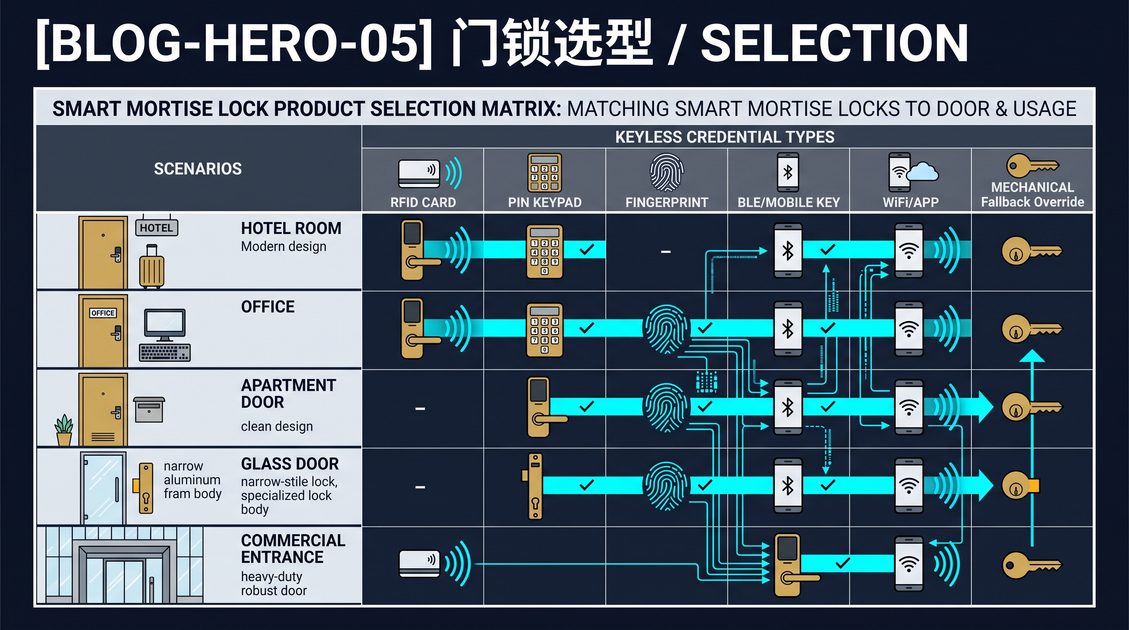
A keypad door lock is an access-control device that accepts a personal identification number through a physical or touch keypad and then releases a mechanical latch or motorized lock. The best choice depends first on door construction and life-safety requirements, not on the number of advertised features. Measure door thickness, backset, handing, mortise or bore pattern, frame, and strike before comparing models. Then evaluate unique PINs, time schedules, audit events, battery warnings, offline behavior, emergency override, inside egress, and administrator recovery. Battery-powered locks commonly use alkaline or rechargeable cells and need a tested replacement plan; connected models may use Bluetooth, Wi-Fi, Z-Wave, or another platform with different range and outage behavior. A suitable keypad door lock preserves secure closing, supports the intended users, and remains manageable when power, networks, credentials, or staff change.
Keypad door lock selection guide: define the opening and users
Start with the opening rather than the product catalog. Record whether the door is wood, metal, glass, fire-rated, exterior, interior, single-leaf, or paired. Note the door thickness, backset, latch type, hinge side, frame clearance, closer, weather exposure, and available space on both faces. A mortise lock replacement has different constraints from a cylindrical lock or a narrow-stile aluminum door. A keypad may fit the face but still fail to retract the correct latch or align with the strike.
Identify the people and workflows the lock must support. A private residence may need a few household codes and temporary guest access. A rental, office, hotel, or staff entrance may require separate credentials, schedules, event history, and quick revocation. Decide who administers access, how identity is verified before a code is issued, and what happens when an employee leaves or a guest loses a code. This operational definition prevents a low-cost shared PIN from becoming an unmanaged master key.
Keypad door lock selection guide: create a measurement record
Photograph the opening, measure with a reliable tool, and retain the existing hardware specifications. Ask the supplier for a compatibility drawing rather than relying on a generic “fits most doors” statement. Include the frame and strike because a strong lock body cannot compensate for poor alignment, a loose frame, or a door that does not close fully.
Keypad door lock selection guide: compare credentials and access policy
A keypad door lock is only as controlled as its credential policy. Prefer individual PINs when accountability matters, with separate codes for residents, cleaners, contractors, managers, and emergency personnel where appropriate. Shared codes reduce administration but make it difficult to determine who entered and increase the impact of disclosure. Confirm the number of stored users, PIN length, duplicate-code rules, temporary-code support, and whether schedules can limit access by date or time.
Review how codes are created, delivered, changed, and revoked. A code sent through an insecure channel can undermine an otherwise well-designed lock. Do not print permanent credentials in visible locations or reuse a master PIN across multiple openings. If the lock stores an event log, check whether it records successful entries, failed attempts, manual overrides, low-battery events, and administrator changes. Also ask how timestamps are maintained when the lock is offline and whether logs can be exported without exposing unnecessary personal data.
Keypad door lock selection guide: evaluate keypad behavior
Test the keypad in the conditions users will encounter. Backlit keys help in dim corridors, while tactile separation can help users wearing gloves or working by touch. Touchscreens may be clean and flexible but can be harder to operate with wet fingers, cold hands, or limited dexterity. Look for clear lockout behavior after repeated incorrect entries and confirm that a legitimate user can recover without creating a denial-of-service problem.
Keypad door lock selection guide: check power and connectivity
Power behavior deserves the same attention as normal unlocking. Battery models should provide early low-battery warnings, a predictable replacement method, and a mechanical key, external contacts, or another documented emergency recovery path. Ask how many operations the manufacturer estimates under stated conditions, then set a conservative maintenance interval because temperature, door friction, radio use, and battery quality affect results. A battery estimate is not a guarantee for every installation.
Wired models require an appropriate supply, protected cabling, and a defined response to power loss. Verify whether the lock remains locked, unlocks, or follows a configured fail-safe or fail-secure mode. The correct choice depends on the opening, risk assessment, and applicable life-safety rules. Never assume that a preferred security behavior is acceptable for an exit door.
Connected locks can simplify remote administration, but connectivity adds dependencies. Bluetooth may require a nearby phone or gateway. Wi-Fi can support remote changes but depends on network coverage, credentials, and cloud availability. An offline-capable lock should state how long local permissions remain valid and how changes synchronize after reconnection. Document what users can do during an internet outage and who can restore administrator access.
Keypad door lock selection guide: use a comparison table
| Selection factor | Questions to verify | Why it matters |
|---|---|---|
| Power | Battery type, warning lead time, emergency method, outage mode | Prevents avoidable lockouts |
| Connectivity | Local operation, gateway need, sync timing, cloud dependency | Sets realistic outage expectations |
| Credentials | User count, schedules, revocation, audit events | Supports accountability and turnover |
| Hardware | Door thickness, backset, latch, strike, handing | Determines physical compatibility |
| Egress | Inside release, no-key exit, closer interaction | Protects safe exit and usability |
Keypad door lock selection guide: protect privacy and accessibility
Access data can reveal when people arrive, leave, work, or sleep. Before procurement, identify what the lock collects, where it stores data, who can view it, how long it is retained, and how an account is deleted. Use administrator roles with the least privilege needed. Protect management accounts with strong passwords and multi-factor authentication when available. Review supplier security updates, support access, encryption claims, and procedures for a lost administrator phone.
Accessibility should be tested with real users, not inferred from a specification sheet. Consider keypad height, reach range, contrast, font size, audible or tactile feedback, operating force, glare, and the ability to enter a code without a smartphone. Keep an alternative process for users who cannot operate the keypad. For public, workplace, healthcare, or lodging applications, obtain qualified advice on applicable accessibility and privacy obligations rather than making unsupported compliance claims.
Keypad door lock selection guide: separate security from convenience
A PIN does not strengthen a weak door, exposed hinges, damaged frame, or unreliable closer. Inspect the entire opening, maintain the strike, and control physical keys used for override. Convenience features should support a clear policy, not replace one. Treat manufacturer certifications as configuration-specific evidence and confirm the exact model, firmware, installation, and jurisdiction covered by the claim.
Keypad door lock selection guide: install and commission carefully
Before installation, approve the compatibility drawing, wiring plan if applicable, administrator ownership, and recovery procedure. Use a qualified installer when drilling, modifying a fire-rated assembly, changing egress hardware, or integrating with an access-control system. After fitting the lock, verify smooth latch operation with the door closed, correct strike engagement, weather sealing where relevant, and proper interaction with a closer.
Commission representative openings instead of testing only a workbench sample. Test a valid PIN, expired PIN, revoked PIN, wrong PIN, repeated failures, manual override, low battery, power interruption, network interruption, door-position status, and inside release. Confirm that the door cannot be left unsecured by a misaligned latch. Change default installer credentials, assign named administrators, record firmware and configuration, and train the people responsible for issuing and removing access.
Keypad door lock selection guide: document acceptance criteria
Create a handover record with measurements, serial numbers, code policy, emergency contacts, battery type, service interval, test results, and approved exceptions. Keep recovery instructions accessible to authorized operators without displaying active credentials. A short pilot period can reveal glare, poor radio coverage, confusing prompts, or door movement that was missed during installation.
Keypad door lock selection guide: maintain and review the system
Maintenance is part of selection because every lock becomes an operating asset. Schedule battery checks, clean the keypad according to the manufacturer’s instructions, inspect screws and strike alignment, and test the inside release. Review failed attempts, low-battery warnings, connectivity alerts, and support requests for patterns. Update firmware through a controlled process and preserve a rollback or recovery plan where the platform allows it.
Reassess the installation after tenant turnover, renovation, a change in insurance requirements, or a new threat model. Remove dormant users promptly and verify that temporary credentials expire as intended. Run a recovery drill while the system is healthy rather than waiting for an actual outage. The strongest decision is not necessarily the lock with the most integrations; it is the one that fits the opening, serves its users, and can be operated responsibly for its full service life.
Not sure which sensor fits your project?
Talk to our mmWave application engineers for a free consultation.
Specify your hotel project with our engineers
Send your room count, ceiling type, and protocol preference. We will return a sample plan and quote within 24 business hours.
- Move from general guidance into a product or application discussion.
- Use RFQ when pricing, drawings, MOQ, or launch timing needs structure.
- Keep a direct contact path visible for fast clarifications and handoff.