Keyless Entry Door Lock Selection Guide for Reliable Access
A practical keyless entry door lock selection guide covering lock types, credentials, power, connectivity, security, installation, and lifecycle planning for homes and managed buildings.
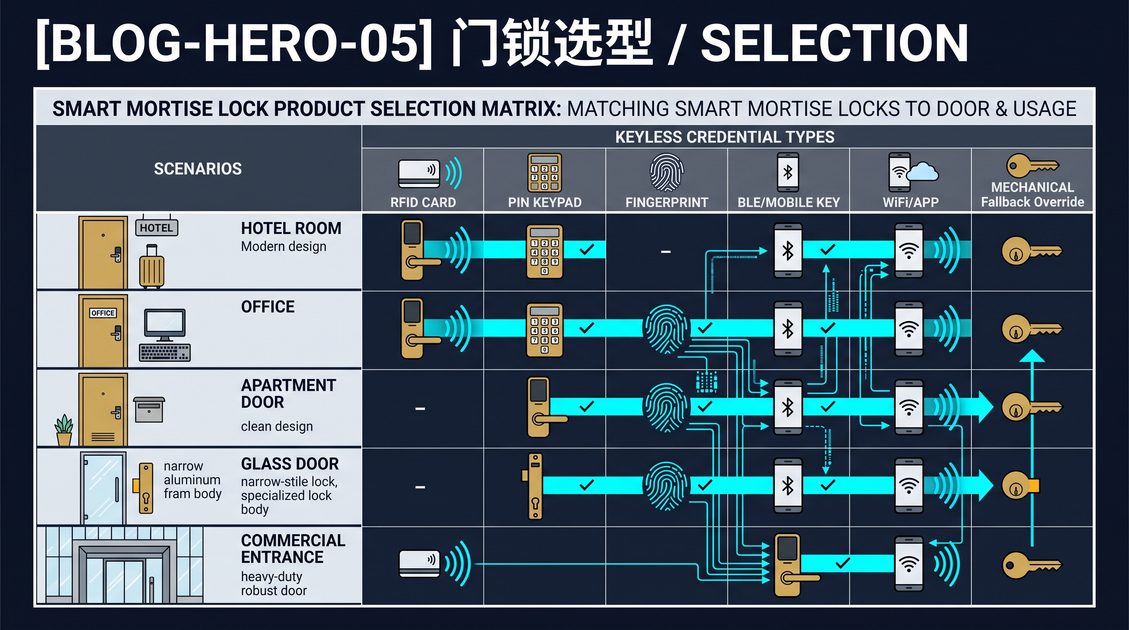
A keyless entry door lock is an access device that verifies a digital credential and releases a compatible latch or bolt without a conventional key. A keyless entry door lock selection guide becomes necessary because these products differ in lock body, credential technology, power source, connectivity, and fail-over behavior. A PIN pad is only the visible interface; behind it sit a solenoid or motor, a controller, batteries or wiring, an override option, and often a networked platform. The right choice depends on door construction, backset and bore preparation, user turnover, emergency egress, battery logistics, network design, privacy, and administration. Connected models simplify revocation and audit but add dependencies on accounts, firmware, and service availability. Offline models reduce network exposure but require a tested mechanical override and disciplined code management. This guide walks through each decision in order so that convenience never undermines safety.
Keyless entry door lock selection guide: identify the opening and its constraints
A responsible keyless entry door lock selection guide begins with the door itself, because a reader cannot correct an unsuitable lock case, weak frame, or unsafe egress arrangement. Record the door material, thickness, handing, swing, frame condition, hinge position, closer presence, existing backset, bore size, cylinder format, strike alignment, and trim. Note whether the door is fire-rated, part of a required exit route, accessible to people with disabilities, or exposed to weather and vandalism. Measure the distance from the door edge to the center of the bore rather than assuming a standard dimension. A retrofit device designed for a 60 mm backset will not fit a door prepared differently without significant modification. Inspect for warping, swollen edges, loose hinges, and seals that add resistance. Every one of these details determines whether a keyless entry door lock selection ends with a clean retrofit or an expensive re-drill. Treat the lock as one component of a complete opening rather than judging it from a photograph.
Begin by writing what the opening protects, who needs access, when access is allowed, and how exceptions are handled. A private residence may need simple PINs and predictable battery service. A rental unit may need temporary codes for cleaners and contractors with auditable lifecycles. A commercial or mixed-use building may require role-based administration, event records, common-area scheduling, and integration with an existing platform. Identify life-safety exits, exterior doors exposed to rain or salt air, doors shared by many people, and doors where preserving the existing finish matters. Documenting these constraints up front prevents the common mistake of choosing a credential technology first and discovering later that the lock body, fire rating, or egress arrangement cannot accept it. A door survey with photographs, measurements, and a short latch-engagement test is worth more than a long specification sheet.
Keyless entry door lock selection guide: understand lock body types
The lock body determines how the credential decision becomes physical motion, so a keyless entry door lock selection guide must distinguish the main families. A keypad or smart lever replaces a standard latchset and retracts a spring latch when the credential is accepted; it is common on residential doors and some interior staff doors. A keypad or electronic deadbolt adds a separate locking bolt that throws horizontally into a strike, offering stronger resistance against common prying when the door is closed. A mortise lock fits into a rectangular pocket and carries both a latch and a deadbolt within one case, typical on heavier commercial and European doors. A rim lock mounts on the surface of the door and operates a vertical bolt, used on some commercial and heritage openings. An electrified strike is not a lock itself but releases the latch remotely. Choosing among these depends on the existing preparation, the traffic level, the threat model, and the local building rules.
Each lock body has distinct strengths and limits. Electronic levers are convenient and simple to retrofit but rely on a spring latch that can be manipulated if the door is not firmly closed. Electronic deadbolts add a positive bolt but require accurate strike alignment and a bolt that throws fully without binding. Mortise locks are robust and repairable but more expensive and harder to retrofit because of the cut pocket. Rim locks suit specific door and frame combinations and are less common in modern residential work. Electrified strikes integrate with access controllers but need reliable power and a correctly adjusted latch throw. Verify that the chosen lock body accepts the intended credential module and override, and confirm that the mechanism has an accessible service path. A lock that authenticates correctly but cannot throw its bolt reliably provides little real protection.
| Lock body | Typical mounting | Primary function | Common fit challenge |
|---|---|---|---|
| Electronic lever | Replaces a latchset | Retracts spring latch | Backset, handing, bore size |
| Electronic deadbolt | Bore above or within latch | Throws separate bolt | Strike alignment, throw depth |
| Mortise lock | Rectangular case pocket | Latch plus bolt | Pocket cut, follower, spindle |
| Rim lock | Surface mounted | Vertical bolt | Strike depth, door thickness |
| Electrified strike | Frame edge | Releases latch remotely | Power, latch projection, alignment |
Keyless entry door lock selection guide: compare credential options
Credentials determine how a user proves authorization, so a keyless entry door lock selection guide should compare them by lifecycle and accountability, not just convenience. PINs are simple, need no personal device, and are easy to assign, but shared codes weaken accountability and can be observed. Cards, fobs, and tags are familiar in hotels and managed buildings yet create inventory, replacement, and lost-credential workflows. Mobile credentials reduce physical distribution but depend on phone access, application permissions, and a recovery path when a phone is lost or changes. Biometric factors such as fingerprints improve convenience for some users but require enrollment controls, privacy analysis, fallback credentials, and a way for people who cannot or will not enroll. A credential is not automatically safer because it is more advanced. Ask how it is issued, stored, transmitted, revoked, recovered, and logged, and whether the system supports least privilege and separate administrator roles.
For every credential type, document the full lifecycle: request, approval, enrollment, activation, daily use, temporary extension, suspension, revocation, replacement, and deletion. A keyless entry door lock program treats these lifecycle events as operational controls rather than one-time setup. Grant each user the least access needed and give every permission an owner and an expiry rule. Protect administrator accounts with named identities and strong authentication. Change credentials after suspected disclosure, personnel departure, or a defined risk event. Remove departed staff and contractors promptly. A capable reader cannot compensate for a former tenant still holding an active authorization, so build revocation into the onboarding and offboarding routines from the first day.
Keyless entry door lock selection guide: plan power and battery strategy
Power continuity determines whether a keyless entry door lock selection remains usable during an outage, so define the strategy before choosing a model. Battery-powered locks are easy to retrofit and need no wiring, but they require a low-battery warning that users actually notice, a safe emergency power method, a replacement schedule, and a record of who services them. Wired locks need a protected power supply, appropriate conductors, and tested behavior during both brief interruptions and extended outages. Understand the difference between fail-safe and fail-secure behavior: fail-safe unlocks or releases on power loss, while fail-secure stays locked. That choice has life-safety implications and must be reconciled with fire, accessibility, and egress requirements through qualified review. A lock that cannot open during a fire alarm is unacceptable on a required exit path.
Model expected usage rather than trusting a headline battery claim. Entry frequency, credential type, motor load, temperature, door friction, wireless traffic, and configuration changes all influence service intervals. Set a conservative inspection cadence during the first operating period, collect device health information where available, and revise the schedule using observed evidence. Keep spare cells and a controlled procedure for disposal. Define a recovery drill that covers a flat battery, a failed reader, a network outage, a cloud outage, an administrator lockout, and a lost credential. People should know which action is safe and authorized rather than improvising with forced entry. Record drill outcomes and keep emergency contact lists current.
Keyless entry door lock selection guide: address authentication and privacy
Authentication design in a keyless entry door lock selection guide should follow the principle of least privilege. A resident may need access to a dwelling and selected common areas, while a cleaner may need a recurring schedule and a facilities administrator may need management rights without ordinary entry authority. Avoid one master code used everywhere for convenience; if a master credential is unavoidable during commissioning, protect it, record its owner, and replace or disable it before handover. Consider threats such as credential guessing, shoulder surfing, stolen phones, cloned tokens, compromised administrator accounts, exposed application interfaces, physical tampering, social engineering, and denial of service. Map each threat to a control: rate limiting, unique credentials, multifactor administration, secure enrollment, tamper response, offline policy, backups, and staff training.
Review what data the system retains. Event records may include credential identifiers, door names, timestamps, administrator actions, and device health. Determine retention, export, deletion, and access policies before deployment. Provide a clear privacy notice and restrict log access to authorized administrators. If a cloud service is involved, ask where data is processed, how accounts are recovered, and what happens if connectivity or subscription status changes. Do not state that a vendor is compliant with a specific law or certification without current, verifiable documentation. Collect only what the operating purpose requires, and make the audit trail useful to someone who actually reviews it. The goal is proportionate risk reduction, not a checklist detached from the property.
Keyless entry door lock selection guide: secure the mechanical assembly
Electronic authorization does not replace sound mechanical security, so a keyless entry door lock selection guide treats the latch, bolt, strike, frame, hinges, cylinder, escutcheon, and fasteners as one assembly. A lock that authenticates correctly but sits in a weak frame does not provide balanced protection. Ensure the latch or bolt fully enters the strike under normal alignment and that the door closer, weather seals, and hinges do not prevent reliable operation. Consider manipulation and forced-entry resistance in context: external readers should not reveal more information than necessary, and wiring and mounting points should be protected where practical. If a mechanical key override is retained, control key blanks, duplicates, custody, and emergency use. If no override is retained, define how authorized responders regain entry during a dead battery or electronics failure.
Do not drill or alter a rated door assembly without confirming that the modification is permitted. Fire and smoke doors, accessibility hardware, emergency exits, and panic arrangements can have specific constraints. Use long, suitable fasteners and reinforce the strike into solid frame material rather than thin trim. Repair gaps that allow manipulation and keep hinges protected where the door swings outward. A qualified locksmith, door hardware consultant, or code professional should verify the complete assembly where consequences are significant. Physical attack resistance comes from the complete door, not the digital interface in isolation, and honest documentation helps operators choose mitigations that match their resources.
Keyless entry door lock selection guide: choose connectivity and offline behavior
Connectivity can support remote administration, event synchronization, firmware updates, and integration with property systems, but a keyless entry door lock selection guide must also account for the dependencies it introduces. Networked models depend on network availability, identity providers, cloud service status, mobile permissions, and administrator accounts. Decide which functions must work offline. A door may need to validate already-issued credentials locally, while new permissions may wait for synchronization. Document the maximum acceptable delay and how conflicting changes are resolved. Prefer secure, maintainable network design: segment access devices where practical, restrict outbound and inbound paths to required services, protect administrator accounts with multifactor authentication, and monitor unusual login or device behavior.
Keep firmware and service dependencies in an asset inventory and establish an ownership plan for certificates, application keys, and integration credentials; undocumented secrets become operational liabilities. Before selecting a platform, ask how data is backed up and exported, whether an account can be recovered without one individual, and whether the property can continue operating if a service is unavailable. Avoid treating a vendor dashboard as the only copy of configuration. Maintain a change record and a current door-to-permission map. Interoperability also means future maintenance: ask whether credentials can be migrated, whether hardware can be serviced by qualified providers, and whether the door can be returned to a conventional state when tenancy or ownership changes.
Keyless entry door lock selection guide: install and commission correctly
Installation in a keyless entry door lock selection guide should be treated as a controlled change, not a quick hardware swap. Confirm the approved door schedule, record the pre-install condition, protect finishes, and verify that the installer has the correct templates and hardware. After mounting, test latch or bolt engagement, inside egress, outside authorization, credential rejection, privacy modes, manual override, door position sensing, and any connected release equipment. Commission with representative users and edge cases: a valid credential at the right time, an expired credential, a revoked credential, an invalid PIN, repeated failures, a partially open door, and a power interruption. Check timestamps and time-zone settings and, if the lock supports schedules, test daylight-saving changes or the applicable local time policy.
Create handover materials covering the as-built door list, device identifiers, administrator roles, recovery contacts, the battery or power schedule, the approved firmware process, privacy guidance, and emergency instructions. Change temporary installer credentials before handover. Obtain sign-off from the responsible owner rather than assuming that a successful unlock test proves the project is complete. A pilot on representative doors, not only the easiest door, can reveal cold-weather, high-traffic, or accessibility issues before a site-wide rollout. Measure installation time, user success, support volume, battery or power observations, log usefulness, and recovery performance, then set a go/no-go review before expanding.
Keyless entry door lock selection guide: administer for managed properties
Administration is a recurring service, so a keyless entry door lock selection guide should define who can approve access, who can issue it, who can audit it, and who can respond to incidents. Separation of duties is especially useful where one person should not silently create and use a privileged credential. Use named accounts, remove departed staff promptly, review dormant administrators, and protect recovery channels. For rentals and shared buildings, standardize common events such as move-in, move-out, maintenance visits, emergency entry, lost phones, lost fobs, suspected code sharing, and device replacement. Templates reduce mistakes while preserving case-by-case approval. Temporary credentials should have a start and end time, a clear purpose, and an owner responsible for closure.
Event logs are useful only when operators know how to interpret them. Establish alert thresholds that are actionable, such as repeated rejected attempts at a sensitive door or administrator changes outside expected hours, and avoid collecting every possible alert if no one can review them. Retain logs for a defined period and restrict exports. Review access lists against employment or tenancy records on a scheduled basis. Train front-line staff to recognize a low battery, jammed latch, locked-out user, and suspected code disclosure. The result is a dependable access service rather than an isolated gadget, and disciplined administration reduces the support calls that erode the convenience a keyless system promises.
Keyless entry door lock selection guide: integrate with other systems
Integration may connect the lock to property management, visitor systems, intercoms, alarms, or identity directories, so a keyless entry door lock selection guide should define the authoritative source for each data element before connecting systems. Decide whether a resident record creates access automatically or whether a human approval remains necessary. Map failure states such as a deleted user, a delayed synchronization, duplicate records, and an unavailable application interface. Use documented interfaces and least-privilege service accounts, and test in a non-production environment when possible. Version-control configuration and record which system made each change. If a platform lacks a needed integration, avoid unsafe workarounds such as sharing administrator passwords or scraping a private dashboard; a manual process with a clear checklist can be safer than an opaque integration.
Interoperability also extends to the human workflow. Ask whether credentials can be migrated when a vendor changes, whether hardware can be serviced by independent providers, and whether the door can be returned to a conventional state. A reversible deployment preserves options when ownership, tenancy, or operating requirements change. Document who owns each integration credential and what happens if that person leaves. Test the complete chain from directory update to door release, including the reverse path of revocation. Keep an up-to-date asset inventory so that firmware, certificates, and service dependencies are never forgotten. A well-integrated lock is easier to maintain, and a poorly documented one becomes an expensive surprise during an outage or an audit.
Keyless entry door lock selection guide: ensure accessibility and usability
A secure lock still needs to be usable by the people it serves, so a keyless entry door lock selection guide must consider reach range, lighting, tactile feedback, audible feedback, language, gloves, mobility aids, visual impairments, hearing impairments, and cognitive load. Offer an alternative credential or assistance path where a single interface excludes users, and do not assume a mobile phone is always available or charged. Evaluate the complete journey from approach to entry: is the reader visible, can a user tell whether a credential was accepted, does the door require a second action, and can someone safely exit without a credential? Are instructions short enough to follow under stress? Conduct tests with representative users and incorporate their feedback without weakening egress or privacy.
Accessibility improvements often improve security because users are less likely to create unsafe workarounds such as propping the door open. Provide clear labels, visual and audible confirmation, reachable mounting, adequate lighting, and an alternative process for people who cannot operate the keypad. For shared spaces, communicate what information is collected and whom to contact. Avoid revealing whether a particular person has access through overly specific error messages. Where gloves, rain, glare, or low vision are expected, test the interface under those conditions. A keyless entry door lock selection that ignores usability will be bypassed in practice, so treat human factors as a core requirement rather than a cosmetic afterthought.
Keyless entry door lock selection guide: assess total cost of ownership
Compare total operating cost rather than purchase price alone, because a keyless entry door lock selection guide is most useful when it exposes hidden expenses. Include door preparation, installation, network or gateway needs, credential issuance, batteries, inspections, support, software service, training, replacement parts, recovery procedures, and eventual decommissioning. Request a bill of assumptions from each bidder so that apparently different proposals can be compared fairly. Ask suppliers for applicable technical documentation, environmental limits, supported door configurations, maintenance guidance, update policy, data handling terms, and independent test evidence where relevant. Verify claims for the exact model and configuration under consideration, because a general product-family statement may not apply to the selected trim or firmware.
Procurement should include acceptance criteria and a pilot. Avoid invented performance promises and reject claims that cannot be measured or tied to the proposed installation. Compare complete installed cost, including controller, power supply, cabling, door preparation, commissioning, training, subscriptions, and future credential administration. Ask vendors to demonstrate the exact door hardware and failure scenarios rather than a laboratory setup. Choose the simplest system that meets risk, accountability, user, and lifecycle requirements; extra features are valuable only when an owner can operate and maintain them. A responsible buyer treats the service contract as part of the product, because an abandoned lock is worse than a well-managed conventional one.
Keyless entry door lock selection guide: evaluate vendor support and spare parts
A keyless entry door lock selection guide that stops at the sales price misses the support reality that determines long-term reliability. Ask which spare parts are available, how long the manufacturer plans to keep supplying them, and whether parts can be sourced locally. Confirm the warranty terms, what they cover, and how a claim is filed, because a defective motor or battery module is more common than a catastrophic failure. Ask how firmware updates are delivered and verified, and whether an update can be rolled back if it introduces a regression. Establish who can service the device: the vendor, a network of installers, or only a single contractor. Understand the software and subscription obligations, including what happens if a service is discontinued or a subscription expires. A lock that cannot be repaired or updated is a liability regardless of how capable it was on day one.
Document the support chain in the handover materials and keep contact details current. Determine how long after an outage a replacement can arrive and whether loaner hardware exists. Verify that credentials can be exported and migrated if the platform changes. Ask about the expected service life and end-of-life policy, including how devices are decommissioned and recycled. Treat the supplier relationship as part of the product, because an abandoned system strands both users and administrators. A responsible buyer writes the support, spare-parts, and end-of-life expectations into the procurement decision rather than discovering them after installation.
Keyless entry door lock selection guide: review regulatory and compliance needs
Regulatory review is a non-negotiable part of a keyless entry door lock selection guide, because the wrong choice can violate fire, accessibility, electrical, or privacy rules. Determine whether the door is fire-rated, part of a required exit path, or covered by accessibility requirements, and confirm that any modification preserves the rating. Understand fail-safe and fail-secure expectations for the specific occupancy and confirm the behavior through qualified review. Check electrical installation rules for wired devices, including voltage, conductor protection, and separation from other services. Review privacy obligations for event data, camera or sensor features, and cloud processing, and confirm how retention and deletion work. Confirm which certifications or listings apply in the target market and request current, verifiable documentation rather than accepting a marketing claim.
Compliance is location- and occupancy-specific, so rely on qualified professionals for the actual site rather than on generic product descriptions. Fire and smoke doors, panic hardware, accessible openings, and workplace exits may require listed hardware and approved field modifications. Never add a second cylinder or an access-control feature merely to increase resistance without confirming that occupants can exit legally and quickly. Document the regulatory review and keep the records with the door schedule. A product that works well in one building may be unsuitable in another, and the selection guide should treat local requirements as binding constraints rather than optional notes.
Keyless entry door lock selection guide: weigh retrofit against new construction
The starting condition of the opening shapes a keyless entry door lock selection guide, because retrofit and new construction present different constraints. On an existing door, measure the prepared bores, backset, handing, and mortise before choosing hardware, and confirm that the new device covers the old holes. If the current lock is oversized, worn, or from a discontinued line, plan for door repair or re-drilling before adding electronics. On new construction, select the lock early so that the door manufacturer can provide the correct preparation and, where needed, hardware that is listed for the assembly. Consider whether the project wants a single keying plan or code system across many doors and whether the doors are supplied by more than one fabricator.
Retrofit projects often benefit from a reversible installation that allows a return to conventional hardware. New construction offers the chance to standardize a few lock models and document a single administration process. In both cases, coordinate with the door manufacturer, installer, and any fire or code reviewer before committing. A lock that is easy to install but hard to maintain creates ongoing cost, while one that is complex to fit but standardized across a site can be efficient. Weigh these trade-offs explicitly, and pilot on a representative door before committing the whole project. The physical fit is the least glamorous part of access control and often the most expensive to get wrong.
Keyless entry door lock selection guide: plan smart home and tenant experience
A keyless entry door lock selection guide should also account for the daily experience of residents, tenants, and guests, because an interface that confuses users invites unsafe workarounds. Decide how users receive credentials and instructions, whether that means a welcome email, a printed card, an app invite, or a temporary code issued by front desk staff. Provide simple guidance on what to do when a credential fails, a battery drains, or a door will not close. Keep the recovery path obvious and lawful, and make sure a person is not locked out during a power or network outage. Consider whether the property wants guests to manage their own codes or whether staff will issue them. Match the credential workflow to the actual users, and test it with representative people before wide deployment.
The experience extends to administrators and maintenance teams as well. Make revocation quick, audit review straightforward, and battery service predictable so that the system remains convenient to operate. Communicate privacy practices clearly and tell users what information is collected. A keyless entry door lock selection that ignores the human experience will be bypassed in practice, so treat onboarding, recovery, and everyday usability as core requirements. A system that is pleasant to use reduces support calls, builds trust, and keeps doors actually closed and locked rather than propped open for convenience.
Keyless entry door lock selection guide: run tests and maintain over time
Maintenance begins after installation, so a keyless entry door lock selection guide should schedule physical inspection, cleaning that follows the manufacturer’s instructions, fastener checks, latch alignment checks, battery or power review, firmware review, credential audit, and emergency-drill refresh. Keep a record of defects and recurring failures, because trends can reveal a door-closer problem or user-flow issue before it becomes an outage. Test security controls periodically: confirm revoked credentials fail, temporary permissions expire, administrator roles remain appropriate, and backups can be restored. Review network exposure and service notices. If a firmware update changes behavior, repeat the relevant acceptance tests instead of assuming backward compatibility.
Do not force a sticking lock; determine whether the cause is hinge sag, strike displacement, swollen material, a worn mechanism, or an incorrect installation. Lubricate only according to the manufacturer’s instructions, because improper oils can collect dust or damage sensitive components. Replace weak springs, damaged trim, bent strikes, and compromised fasteners rather than masking the problem with excessive force. For electronic sets, track battery age, firmware status, connectivity, and the last successful emergency-access test. Maintain a simple service record containing the opening identifier, date, defect, action, technician, and follow-up date. Audit keys and codes when occupants, employees, contractors, or vendors change. A yearly review is a reasonable baseline for lightly used doors, while high-traffic openings may need quarterly checks.
Keyless entry door lock selection guide: prepare for incidents and recovery
Every keyless entry door lock selection guide should end with a written recovery plan, because failures are certain even when products are reliable. Run a drill that covers a flat battery, a failed reader, a network outage, a cloud outage, an administrator lockout, a lost credential, and a suspected forced entry. People should know which action is safe and authorized rather than improvising. Keep a mechanical or supervised override appropriate to the risk and life-safety design, and document where emergency keys or credentials are secured. Test that an authorized responder can actually regain entry without damaging the door. Record drill outcomes, update contact lists, and revise the procedure when hardware, staffing, or building use changes.
Have a decommissioning procedure as well. Remove credentials, export records according to policy, revoke integrations, recover physical keys or tokens, wipe or reset devices when appropriate, and document the final door condition. Disposal is part of access control. Review the whole design after incidents, ownership changes, or major renovations. The best keyless entry door lock selection is the one that remains secure, usable, supportable, and recoverable throughout its service life. Treat the lock as one component in a door, identity, power, network, and operations system, make assumptions explicit, validate claims for the exact installation, and keep a safe path for authorized entry and emergency egress.
Keyless entry door lock selection guide: final checklist and decision
Use this sequence as a practical starting point for any keyless entry door lock selection guide. Define the door’s function, users, threats, and life-safety constraints. Survey the complete door and hardware assembly. Choose credential types and document their lifecycle. Decide power, offline, connectivity, privacy, and recovery requirements. Confirm compatibility with qualified hardware and code professionals. Pilot on representative doors with written acceptance criteria. Commission edge cases, egress, outage behavior, and administration. Train users and staff, and remove temporary credentials. Monitor maintenance, events, service dependencies, and user feedback. Review the design after incidents, ownership changes, or major renovations.
Before final approval, confirm that the chosen model matches the measured backset, bore, thickness, handing, and strike, and that it is compatible with the fire rating and egress rules for the opening. Verify that an authorized person can be added and revoked promptly, that the door releases as required in every tested condition, that administrators can recover access without unsafe bypasses, and that logs are protected and retained appropriately. Confirm that the organization can source batteries, parts, support, and configuration records for the expected service life. A keyless entry door lock is a single component in a larger access program, and a disciplined decision process keeps convenience from becoming an unmanaged dependency. Written answers to these questions make the purchase auditable and the deployment repeatable.
Not sure which sensor fits your project?
Talk to our mmWave application engineers for a free consultation.
Specify your hotel project with our engineers
Send your room count, ceiling type, and protocol preference. We will return a sample plan and quote within 24 business hours.
- Move from general guidance into a product or application discussion.
- Use RFQ when pricing, drawings, MOQ, or launch timing needs structure.
- Keep a direct contact path visible for fast clarifications and handoff.