Hotel Door Lock System Selection Guide: RFID, Mobile Key and Management
A buyer-oriented hotel door lock system selection guide: RFID vs mobile key, PMS integration, offline operation, management software, battery, security, and supplier selection.
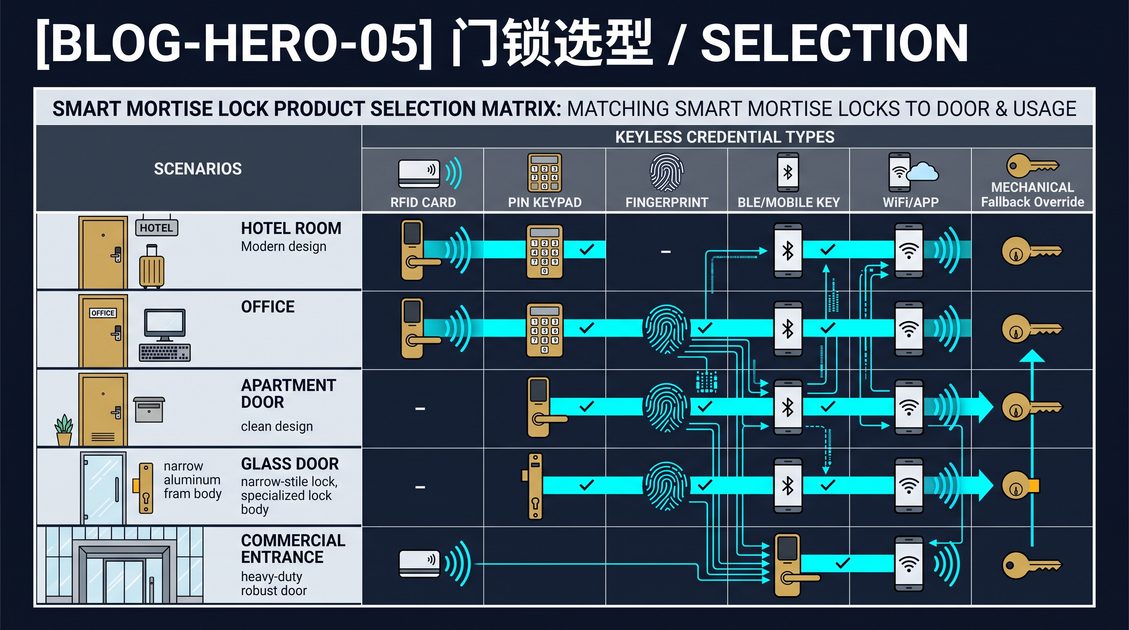
A hotel door lock system is the electronic access-control network that protects every guest room and manages who can enter which door at which time, replacing mechanical keys and, increasingly, the printed key card model. The physical lock is typically an electronic mortise lock fitted to the guest-room door, authenticated by an RFID card, a mobile key, or a PIN, and managed by software that issues, schedules, and revokes credentials and records an audit trail. This hotel door lock system selection guide is written for hotel owners, operators, project managers, and importers who are specifying a system for a new-build or a retrofit and need to compare solutions on operational criteria rather than brand claims. A hotel door lock is an investment that stays in place for years and touches every guest stay, so choosing correctly matters enormously, and the decision spans hardware, software, integration, reliability, security, and the supplier relationship.
What Is a Hotel Door Lock System and How It Works
A hotel door lock system is a coordinated combination of electronic door locks, credentials, and management software that controls access to guest rooms and other hotel areas. Each guest-room door carries an electronic mortise lock with an embedded reader; the front desk or a check-in kiosk issues a credential, most commonly an RFID card or a mobile key, that is authorized only for the guest's stay; and the management software sets the validity period, assigns the door, and records every entry. When a guest presents the credential, the lock validates it against its authorization table and unlocks the door if the credential is valid for that door and that time window.
The system has three interacting layers. The first is the hardware: the mortise lock body, the reader, the actuator, and the door furniture. The second is the credential, the physical or digital token the guest carries. The third is the software, which ranges from a single front-desk encoder to a networked property-management-system integration that issues credentials automatically at check-in and revokes them at check-out. The power of a hotel door lock system is that these layers work together: the guest never sees the complexity, only a card that works for the room during the stay and stops working the moment it should.
For a hotel, the system is operational infrastructure, not a security gadget. It determines check-in speed, the ability to respond to a lost card in seconds, the auditability of who entered a room and when, and the integration with housekeeping, energy management, and building access. A hotel door lock system that is fast, reliable, and well-integrated improves the guest experience and the operation's efficiency; one that is slow, flaky, or isolated creates friction at the front desk, lockouts in the corridor, and disputes about room access. This is why the selection process for a hotel lock system is a system-design exercise, not a product purchase.
A hotel door lock system is a coordinated network of electronic mortise locks, credentials, and management software that controls guest-room access. Each door carries an electronic mortise lock with a reader; the front desk or kiosk issues a credential, most commonly an RFID card or mobile key, valid only for the guest's stay; and software sets validity, assigns doors, and records entries. The system has three layers: hardware, the lock body, reader, actuator, and door furniture; the credential; and the software, from a single encoder to a networked property-management-system integration that issues credentials at check-in and revokes them at check-out. For a hotel, the system is operational infrastructure: it determines check-in speed, response to lost cards, auditability of room access, and integration with housekeeping and energy management. Selection is a system-design exercise, not a product purchase.
RFID Card vs Mobile Key on Hotel Mortise Locks
The credential is the most visible decision in a hotel door lock system, and the two dominant options are the RFID card and the mobile key. An RFID card is a contactless credential, most commonly operating at 13.56 MHz, that the guest presents to a reader on the lock. It is fast, durable, inexpensive to produce, and familiar to guests worldwide, and it works for any guest with any phone, which makes it the default for most hotels. A mobile key is a digital credential delivered to the guest's smartphone, usually over Bluetooth Low Energy, that unlocks the door by proximity or a tap in the app, enabling self-service check-in without a stop at the front desk.
The choice is not strictly either-or, because most modern systems support both and use them together. A hotel typically offers an RFID card at the desk for the majority of guests and a mobile key for guests who opt into contactless arrival. The operational difference is in the front-desk flow: a card-based system requires the desk to encode a card per guest, while a mobile-key system lets guests check in online and go straight to the room. Mobile keys reduce front-desk load and support a fully contactless experience, but they depend on the guest having a charged, compatible phone and on the app being reliable, so a card fallback is almost always retained.
For a hotel operator, the credential decision should be driven by the guest mix and the operation's ambition. A business hotel or a tech-forward brand may push mobile keys to streamline arrival; a leisure or international hotel with guests of varying technical comfort should lead with the RFID card and offer mobile as an option. Security also matters: modern hotel cards use encrypted, diversified keys that cannot be cloned by a simple reader, and a mobile key should use secure transport and a one-time or time-limited credential. This guide recommends choosing a system that supports both RFID and mobile key natively, so the hotel can match the credential to the guest rather than forcing one.
The two dominant credentials are the RFID card and the mobile key. An RFID card, most commonly 13.56 MHz, is presented to a reader, is fast, durable, inexpensive, and works for any guest with any phone, making it the default for most hotels. A mobile key is a digital credential delivered to the smartphone over Bluetooth Low Energy, unlocking by proximity or tap and enabling self-service check-in without the front desk. Most modern systems support both and use them together: a card at the desk for the majority and a mobile key for guests who opt into contactless arrival. Choose the mix by guest type, offering card-led for international or less technical guests and mobile for contactless arrival. Security requires encrypted, diversified card keys that cannot be cloned and secure, time-limited mobile credentials.
PMS Integration: How the Hotel Door Lock Talks to Your Systems
The property-management system, or PMS, is the operational heart of a hotel, and a hotel door lock system is only fully useful when it integrates with it. Integration means the door-lock software exchanges data with the PMS so that check-in issues the room credential automatically, check-out revokes it, and the status of each room stays in sync. Without integration, the front desk must encode cards manually and manage the door-lock software as a separate silo, which doubles the work and invites errors, especially for the check-in and check-out events that define a hotel's day.
The depth of integration varies. The minimum is a shared interface or middleware that passes the essential events, such as check-in, check-out, room change, and extension. More sophisticated integration also passes housekeeping status, enables remote audit, and synchronizes with other systems such as energy management, which can put the room in an unoccupied state to cut HVAC use when a guest leaves. A well-integrated hotel door lock system reduces front-desk labor, eliminates the error of issuing a credential for the wrong room, and supports faster, more automated check-in.
For a buyer, integration capability should be verified, not assumed, and this guide treats it as a top-three selection criterion. Ask which PMS platforms the system integrates with, how the integration is delivered, whether it is bidirectional and real-time, and whether the vendor provides the interface and support. A system that claims "PMS integration" but requires custom development, a proprietary middleware with recurring fees, or manual export-import is weaker than one with a proven, plug-in integration to the PMS brands you run. Because the PMS is the system of record for a hotel, the door lock must fit into it cleanly or the operation will carry the cost of the mismatch every day.
PMS integration is a top-three selection criterion. It means the door-lock software exchanges data with the property-management system so check-in issues the room credential automatically, check-out revokes it, and room status stays in sync, eliminating manual card encoding and the errors that come with a siloed system. The minimum is a shared interface passing check-in, check-out, room change, and extension events; deeper integration also passes housekeeping status and enables synchronization with energy management, which can set a room unoccupied to cut HVAC use. Verify, not assume: ask which PMS platforms the system integrates with, whether the integration is bidirectional and real-time, how it is delivered, and whether it carries recurring middleware fees. A proven plug-in integration to the PMS brands you run beats a claim that requires custom development or manual export-import.
Offline Operation, Battery, and Reliability in the Corridor
A hotel door lock must work when nothing else does, because a guest standing at a locked room door with luggage has no patience for a network outage. Hotel mortise locks are therefore designed to authenticate locally: the lock validates the credential against its own authorization table without needing a live network connection, and the reader, processor, and actuator run on batteries inside the door. This offline-first design is what makes a card issued at the desk work immediately and keeps the system functional even if the WiFi, the server, or the cloud platform fails. The trade-off is that offline locks must be updated, typically by an encoder or a master card at the front desk or by a periodic sync, and audit data accumulates on the device until it is collected.
Battery management is a defining operational concern for a hotel lock fleet. A hotel mortise lock typically runs on batteries, commonly AA cells, for a period that depends on unlock frequency, reader type, and radio use; a high-traffic hotel door can drain batteries in several months to about a year, while a low-traffic door lasts longer. A system must report low-battery status centrally, and many locks provide a low-battery warning to the guest on the lock itself and to maintenance via the software. Some designs support a backup power terminal so a dead battery does not strand a guest, and the mechanical key override remains the universal final fallback.
Reliability in the corridor is the sum of offline authentication, battery planning, and mechanical quality. This guide recommends specifying a system with robust local authentication, central battery reporting, a documented emergency-access path including a mechanical override and backup power, and hardware that has been cycle-tested for the volumes a hotel generates. Ask the supplier for the specified battery life at your unlock frequency, the battery-reporting mechanism, and the emergency-access options. A hotel door lock system that is fast at the desk but unreliable in the corridor is a failure, because the corridor is where the guest lives.
Hotel door locks must work when nothing else does, so they authenticate locally: the lock validates the credential against its own table without a live network, running on batteries inside the door, which keeps the system functional through a network, server, or cloud outage. The trade-off is that offline locks are updated by an encoder, master card, or periodic sync, and audit data accumulates until collected. Battery management is a defining concern: a hotel mortise lock runs on batteries, commonly AA, for several months to about a year at high traffic, and a system must report low-battery centrally while offering a backup power terminal and a mechanical key override as fallbacks. Reliability in the corridor is the sum of offline authentication, battery planning, and cycle-tested mechanical quality. Specify central battery reporting, a documented emergency-access path, and hardware tested for hotel volume.
Management Software, Audit Trails, and Multi-Level Access
The management software is the layer that turns a set of door locks into a hotel system, and its quality determines how much the operation benefits. A hotel lock management platform lets an administrator enroll locks, define users and groups, set validity periods, manage multi-level access, and read audit logs. Multi-level access matters in a hotel because different staff need different rights: a housekeeper may access a defined set of rooms during a shift, a supervisor may access all rooms on a floor, and management may access everything. The software should model these roles cleanly so that credentials are issued with the correct scope and revoked when a role or shift ends.
Audit trails are a non-negotiable feature for a hotel door lock system. A timestamped, user-attributed record of every entry supports guest-safety investigations, dispute resolution, insurance, and operational reviews, and it can be a liability protection for the hotel. This guide recommends requiring centralized audit logs with user attribution and a clear retention policy, and testing the actual reporting interface rather than accepting a spec-sheet claim. An audit trail that lives only on each lock and must be collected door by door is nearly useless in a large hotel, so the platform should aggregate logs centrally and make them searchable.
The management platform also controls the guest and staff credential lifecycle at scale. A front-desk encoder issues a guest card or mobile key in seconds at check-in; a lost card is reissued by revoking the old credential and encoding a new one; a check-out revokes access. The smoother this lifecycle, the faster the desk operates and the fewer lockouts occur. This guide recommends choosing a platform with an intuitive front-desk workflow, configurable staff roles, centralized audit, and a proven deployment at hotels of your size, and to budget the platform as recurring software cost that is part of the total system price.
The management software turns locks into a hotel system and determines operational benefit. It lets an administrator enroll locks, define users and groups, set validity, manage multi-level access, and read audit logs. Multi-level access models hotel roles: a housekeeper accesses a defined room set during a shift, a supervisor a floor, and management everything, with credentials scoped and revoked as roles end. Audit trails are non-negotiable: a timestamped, user-attributed record of every entry supports safety investigations, dispute resolution, and insurance, and must be centralized, searchable, and retained under a clear policy rather than left scattered per lock. The platform also manages the credential lifecycle at scale, issuing, reissuing, and revoking guest and staff credentials from the desk. Choose an intuitive front-desk workflow, configurable roles, centralized audit, and proven deployments at your hotel's size, and budget the platform as recurring software cost.
Security for Hotel Mortise Locks: Encryption and Standards
Security in a hotel context means preventing unauthorized room entry, protecting guest privacy, and resisting credential cloning and lock bypass. A hotel door lock system resists cloning through encrypted, diversified card keys: each card is encoded with a key derived for the specific lock and property, so a simple RFID reader cannot read a raw card number and reproduce it. This is a critical distinction, because unencrypted low-frequency hotel cards can be cloned with inexpensive tools. The system should also secure the radio communication, whether between the lock and the encoder, the mobile key over Bluetooth, or the wireless management link, with encryption.
Protecting guest privacy and the hotel's data exposure follows from secure design. Credentials, audit logs, and guest information should be stored and transmitted securely, and the management platform should enforce role-based access so that only authorized staff see who entered which room. For hotels handling personal data, compliance with data-protection regulations matters, and a system that stores data on a local server or in a compliant cloud with proper access controls is preferable to one that exposes data through weak interfaces.
Mechanical and hardware security complete the picture. The mortise lock body should be strong enough to resist forced entry, with a robust bolt, strike, and mounting, and the electronics should resist tampering. Certification gives independent verification: CE and FCC cover safety and radio requirements, RoHS restricts hazardous substances, and higher mechanical and security claims are graded by standards such as UL, ANSI/BHMA, or equivalent national norms. This guide recommends requesting the certifications and the encryption specification, and verifying that the exact model is covered, because the difference between a secure hotel lock and a vulnerable one is exactly this engineering detail.
Security means preventing unauthorized entry, protecting guest privacy, and resisting cloning and bypass. A hotel system resists cloning through encrypted, diversified card keys, each encoded with a key derived for the specific lock and property, so a simple RFID reader cannot clone a card; unencrypted low-frequency cards are vulnerable and should be avoided. Radio communication, between lock and encoder, mobile key over Bluetooth, and the wireless management link, must be encrypted. Guest privacy and data protection require secure storage of credentials, audit logs, and guest information, with role-based access so only authorized staff see entry records, and compliance with data-protection regulations. Mechanical and hardware security require a robust bolt, strike, and mounting and tamper-resistant electronics. Certification, CE, FCC, RoHS, and higher grades such as UL or ANSI/BHMA, verifies these claims; request certificates and confirm the exact model is covered.
New Build vs Retrofit: Choosing and Fitting Hotel Door Locks
The physical installation context shapes the hotel door lock decision, and the two cases, new build and retrofit, lead to different choices. In a new build, the door and the lock are specified together, so the hotel has the widest freedom to choose a mortise lock form factor, the finish, the handle set, and the electronic configuration, and the lock can be specified to fit the exact door specification from the start. New build also means the hardware can be installed cleanly during construction, with power and network infrastructure planned in advance if the design uses wired or gateway-based connectivity.
A retrofit is the more common and more constrained case, because most hotels upgrade an existing door. The key question in a retrofit is whether the existing door has a mortise pocket and whether the new lock drops into it, or whether the door must be modified. A retrofit is cleanest when the new electronic mortise lock uses the existing cutout, backset, and strike, preserving the handle set and the door's appearance; it is harder when the form factor changes, which requires cutting a new pocket, and this is a job for a professional on a solid-core or fire-rated door. The existing door's condition, thickness, and fire rating all affect what can be fitted.
For a hotel operator, this guide recommends a door audit before selecting any system. Survey the room doors to confirm the lock body family, backset, thickness, handedness, and fire rating, and identify which doors already have a mortise pocket that an electronic lock can reuse. Use the audit to decide whether the project is a straightforward drop-in or a modification project, and budget accordingly. A new-build or clean-retrofit project can adopt a full electronic mortise lock system with handle sets; a difficult retrofit may favor a simpler upgrade path. In all cases, professional installation on fire-rated doors is essential to preserve the fire rating and the warranty.
New build and retrofit lead to different choices. In a new build, door and lock are specified together, giving the widest freedom to choose mortise form factor, finish, handle set, and electronic configuration, with power and network planned in advance. Retrofit is more common and constrained: the key question is whether the existing door has a mortise pocket that the new lock drops into, which preserves the handle set and appearance, or whether the form factor change requires cutting a new pocket, a professional job on solid-core or fire-rated doors. Conduct a door audit before selecting a system, confirming lock body family, backset, thickness, handedness, and fire rating, and deciding drop-in versus modification. A clean retrofit adopts a full electronic mortise system with handle sets; a difficult one favors a simpler path. Professional installation on fire-rated doors preserves the fire rating and warranty.
Door Types, Finishes, and Compatibility on Hotel Locks
A hotel property contains more than one type of door, and a hotel door lock system must fit them all. Beyond standard guest-room mortise locks, a hotel typically needs locks or latches for corridor doors, stairwell doors, fire doors, service and housekeeping rooms, and the main entrance, and each may require a different device or credential scope. Guest-room doors are almost always electronic mortise locks; corridor and service doors may use the same system with different access rights, while fire doors require hardware that preserves the fire rating and often a fail-safe or fail-secure configuration. The main entrance may use a different device, such as a reader or a lobby door, integrated with the same credential ecosystem.
Compatibility also spans the physical furniture and finish. A hotel brand usually has an aesthetic, and the lock finish, handle set, and trim must match the interior design while meeting durability requirements for heavy guest use. This guide recommends specifying the finish and handle design as part of the selection, because the hardware is visible in every room and replacing an unattractive or poorly finished lock later is expensive. Durability matters as much as appearance: a hotel door lock is used dozens of times a day and must survive years of cycling without loosening, fading, or failing.
Integration with other hotel systems completes the compatibility picture. Beyond the PMS, a hotel may want the door lock to work with energy management, to set a room unoccupied and cut HVAC when a guest leaves, and with building access, so staff credentials work across rooms, floors, and entrances. This guide recommends asking how the lock integrates with energy management and building access, and preferring a system from one supplier or a certified-integration partner so the components work together. A hotel door lock system is only as good as its fit across the whole property, and specifying for door types, finishes, and system integration up front avoids a costly patchwork later.
A hotel property spans multiple door types, and a hotel door lock system must fit them all: guest-room electronic mortise locks, corridor and stairwell doors, fire doors requiring fail-safe or fail-secure hardware that preserves the fire rating, service rooms with limited access, and the main entrance integrated with the same credential ecosystem. Compatibility also spans finish and furniture: the lock finish, handle set, and trim must match the brand aesthetic and survive dozens of daily cycles without loosening, fading, or failing, so specify finish and handle design as part of selection because the hardware is visible in every room. Integration with energy management, to set a room unoccupied and cut HVAC when a guest leaves, and with building access, so staff credentials work across rooms, floors, and entrances, completes the picture. Prefer one supplier or certified-integration partners so components work together, avoiding a costly patchwork later.
Choosing a Hotel Door Lock Supplier and Managing Cost
The supplier relationship is as important as the hardware in a hotel door lock project, and this guide treats it as a core decision. A hotel system is deployed once and operated for years, so the supplier's reliability, support, spare-parts availability, and after-sales responsiveness matter more than a small price difference. For a hotel that buys directly or through an importer, verify the manufacturer's credentials, request reference installations at hotels of comparable size, ask about warranty, spare parts, technical documentation, and training, and confirm that the supplier can support the full lifecycle of the system.
Cost in a hotel door lock project has several layers. There is the hardware cost per door, which scales with the lock body, the credential readers, and the finish. There is the installation cost, which depends on new build or retrofit and on professional labor. There is the credential cost, the RFID cards or mobile-key licenses, which recur as guests consume them. And there is the software cost, often a recurring per-door or per-property fee for the management platform and its updates and support. This guide recommends calculating a total cost of ownership per door over a realistic planning horizon, such as five years, rather than comparing only the unit price of the lock.
For volume buyers and importers, the economic levers are MOQ, lead time, customization, and supply. Confirm the MOQ for the standard hotel mortise lock and for a customized version with branding or a specific finish, because the custom MOQ is usually higher. Commit the lead time in writing, clarify the payment terms, and understand the after-sales parts supply. A hotel lock system is a long-term partnership, and the supplier who is accountable for the hardware, the certification, and the support from a single source is worth more than the lowest first-unit price. Buying directly from a manufacturer of smart mortise locks gives the hotel a single accountable partner across the project.
The supplier relationship is core to a hotel lock project. Verify the manufacturer's credentials, request reference installations at hotels of comparable size, and confirm warranty, spare parts, technical documentation, and training, because the system is deployed once and operated for years. Cost has several layers: hardware per door, installation, recurring credential costs such as RFID cards or mobile-key licenses, and recurring software fees for the management platform and support. Calculate a five-year total cost of ownership per door rather than comparing unit price. For volume buyers, confirm the MOQ for standard and customized locks, commit lead time in writing, clarify payment terms, and understand parts supply. A supplier accountable for hardware, certification, and support from a single source is worth more than the lowest first-unit price, and buying directly from a manufacturer gives the hotel one accountable partner.
FAQ: Hotel Door Lock System Selection Guide
RFID card or mobile key for my hotel?
Most systems support both and use them together. Lead with an RFID card for the majority of guests, since it works with any phone and is familiar worldwide, and offer a mobile key for guests who opt into contactless arrival. Choose the mix by your guest profile.
Do I need PMS integration?
PMS integration is a top-three criterion. It automates check-in and check-out, issuing and revoking credentials without manual card encoding, and keeps room status in sync. Verify the system integrates with the PMS brands you run, bidirectionally and in real time.
What happens if the network goes down?
Hotel mortise locks authenticate locally, so a card issued at the desk works even through a network or server outage. Ensure central battery reporting, a backup power terminal, and a mechanical key override as emergency fallbacks.
How long do hotel lock batteries last?
At high guest traffic, batteries commonly last from several months to about a year, depending on unlock frequency, reader type, and radio use. A system should report low-battery status centrally so maintenance replaces cells on schedule.
How do I secure against card cloning?
Require encrypted, diversified card keys that cannot be cloned by a simple reader, and avoid unencrypted low-frequency cards. Encrypt radio communication and mobile-key transport, and confirm certification such as CE, FCC, RoHS, and higher grades like UL or ANSI/BHMA.
Can I retrofit my existing hotel doors?
Yes, if the existing door has a mortise pocket that a new electronic mortise lock reuses. Conduct a door audit of lock body, backset, thickness, handedness, and fire rating to decide drop-in versus modification, and use a professional on fire-rated doors.
Conclusion: Choose a Hotel Door Lock System That Runs Your Operation
This hotel door lock system selection guide has covered the credential mix, PMS integration, offline reliability, battery, management software, security, installation, door compatibility, and supplier economics. The unifying recommendation is to choose a system that authenticates reliably at the door, integrates cleanly with your PMS, manages credentials and audits centrally, and comes from a supplier accountable for the whole lifecycle. A hotel door lock system is operational infrastructure, and the best choice is the one that disappears into smooth, fast, secure guest stays.
Apply this guide as a specification. Confirm the offline-first mortise lock and its battery and emergency-access design, choose an RFID and mobile-key credential mix matched to your guests, verify real PMS integration, require centralized audit and multi-level access, specify a finish and handle set that fits your brand, audit your doors for retrofit, and select a manufacturer you can hold accountable for years. Budget for the full lifecycle, including credentials, battery replacement, and the management-platform subscription, so the system is sustainable operationally as well as technically. A well-chosen hotel door lock system tied to a certified electronic mortise lock is a lasting asset for any hotel property, and it protects both the guest experience and the operation's security posture over years of service.
Not sure which sensor fits your project?
Talk to our mmWave application engineers for a free consultation.
Find the right presence sensor for your hotel project
Compare the 3 protocols, check hotel-specific case studies, and download the installation guide
Related products
1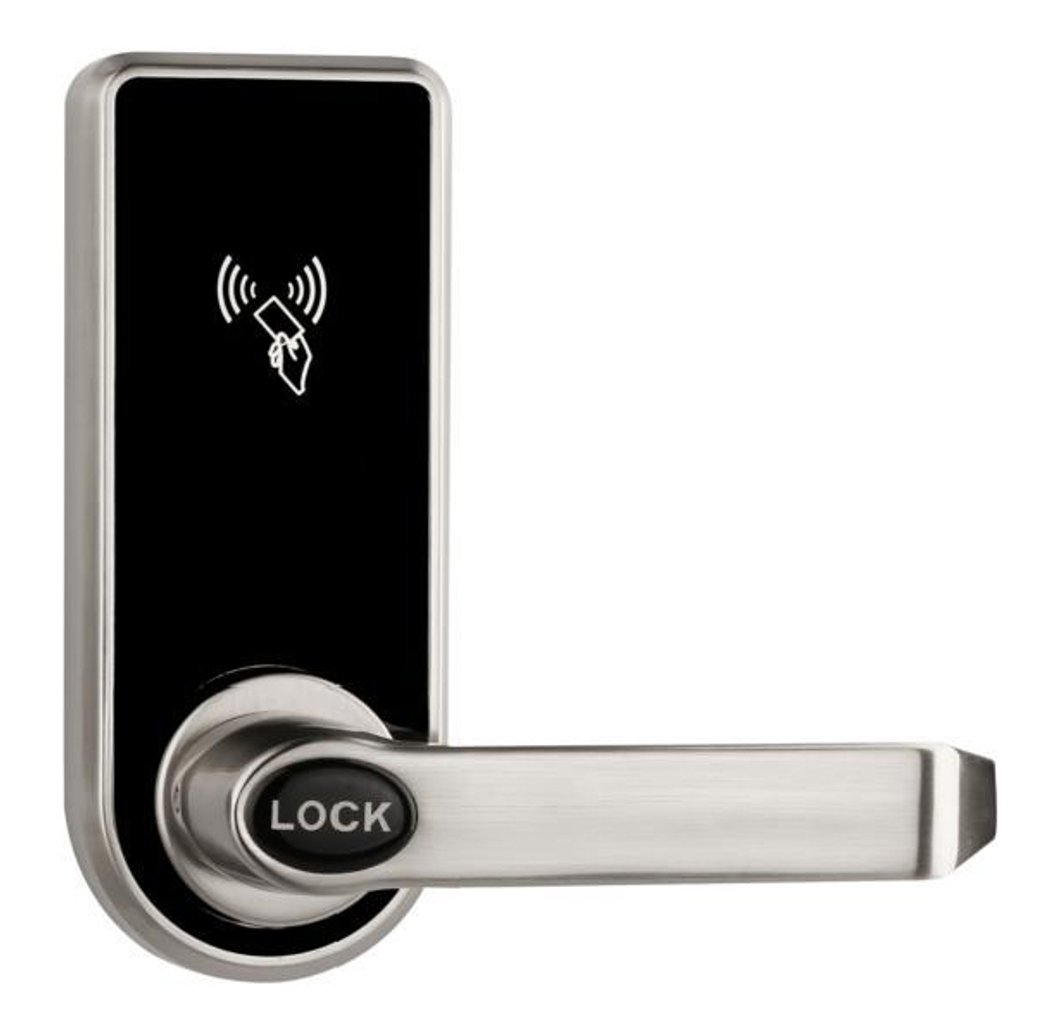
Hotel Smart Lock EK818 — RFID Card Mortise Lock for Guest Rooms
EK818 hotel smart lock: RFID card and mechanical key unlocking, zinc alloy panel in silver, single latch mini mortise, hotel or stand-alone PCB. 270+ hotel lock models. CE RoHS. OEM/ODM.
This page already points to it as the next recommended reference.
Related blog posts
2
Fingerprint Door Lock Selection Guide: How to Choose a Biometric Lock
A buyer-oriented fingerprint door lock selection guide: sensor types, recognition speed, accuracy, security, battery, certifications, and choosing a biometric lock for home and business.
It supports the same product context: Hotel Smart Lock EK818 — RFID Card Mortise Lock for Guest Rooms.
Smart Door Locks Selection Guide: How to Choose the Right Electronic Lock
A complete buyer-oriented smart door locks selection guide: opening methods, connectivity, battery, security, standards, and retrofit considerations for home and commercial doors.
It supports the same product context: Hotel Smart Lock EK818 — RFID Card Mortise Lock for Guest Rooms.
Specify your hotel project with our engineers
Send your room count, ceiling type, and protocol preference. We will return a sample plan and quote within 24 business hours.
- Move from general guidance into a product or application discussion.
- Use RFQ when pricing, drawings, MOQ, or launch timing needs structure.
- Keep a direct contact path visible for fast clarifications and handoff.