Hotel Access Control System: Security, Software, and Integration
How a hotel access control system works, the lock and credential layers, security, and choosing a hotel access control system that is reliable, integrated, and secure.
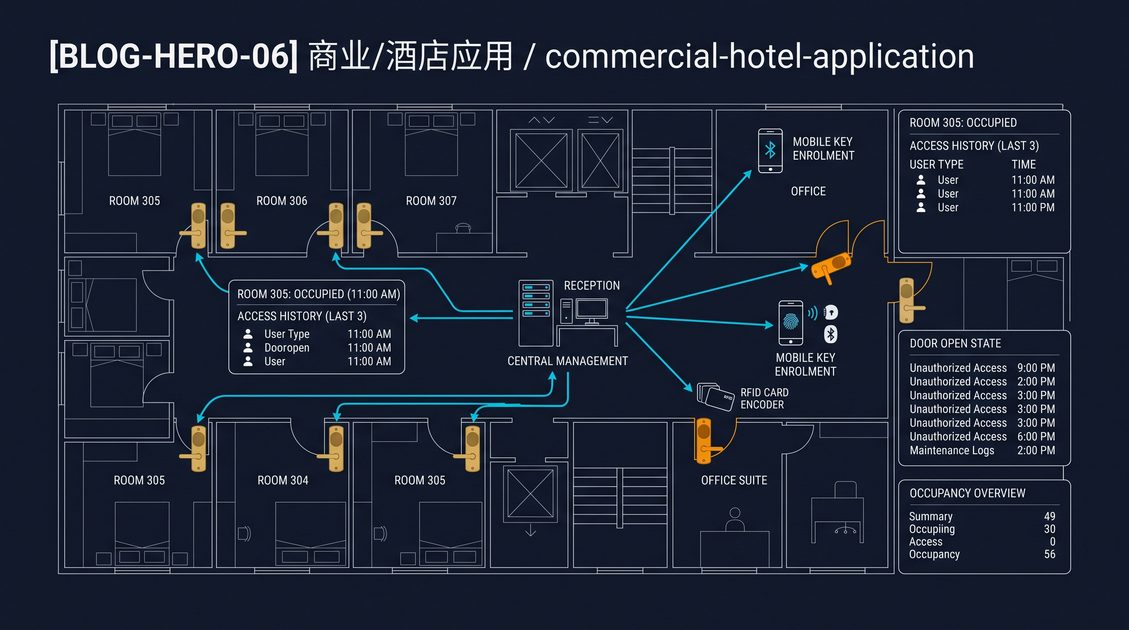
A hotel access control system is the complete network that controls who can enter which guest room, corridor, and service area at which time, combining electronic mortise locks, credentials, and management software. It protects guests, staff, and property, determines the speed of check-in, and provides the audit trail that answers who-entered-which-room questions. This guide explains how a hotel access control system works, the lock and credential layers, how security is maintained, and how to choose a system that is reliable, integrated, and secure.
The Layers of a Hotel Access Control System
A hotel access control system operates across three layers. The first is the hardware: the electronic mortise locks on guest-room and service doors, the readers, and the door furniture. The second is the credential: the RFID card, mobile key, or PIN that a guest or staff member uses, issued with a defined validity and scope. The third is the software: the management platform that enrolls locks, issues and revokes credentials, sets multi-level access, and records an audit, and that integrates with the property-management system for automated check-in and check-out.
The strength of a hotel access control system is that these layers work as one. A guest receives a card or mobile key valid only for the room and the stay; a housekeeper receives access to defined rooms during a shift; management can view and control the whole property from one dashboard. The system is operational infrastructure, and its quality determines whether the front desk moves fast, whether a lost card is resolved in seconds, and whether the hotel can defend a question about room access.
Security, Audit, and Reliability
Security in a hotel access control system rests on encrypted credentials, local authentication, and centralized audit. Credentials should be encrypted, diversified keys that cannot be cloned by a simple reader, and the lock should authenticate locally so a card works even through a network outage. A centralized, timestamped audit log with user attribution supports guest safety, dispute resolution, and insurance. Reliability requires local authentication, central battery reporting, and a mechanical key or backup power as an emergency path.
The system should also protect its own data. Credentials, audit logs, and guest information should be stored and transmitted securely, with role-based access so only authorized staff see entry records, and compliance with data-protection regulations. A hotel access control system that exposes data through weak interfaces, or that stores plaintext credentials, undermines the security of the whole operation regardless of the lock quality.
Choosing a Hotel Access Control System
When choosing a hotel access control system, evaluate the locks, the credentials, the software, the integration, and the supplier together. Confirm the mortise locks are certified, cycle-tested, and fit your door for new build or retrofit; confirm the credential mix, encrypted RFID and mobile key, matches your guests; confirm the software manages multi-level access and audit and integrates with your PMS bidirectionally and in real time; and select a supplier accountable for hardware, certification, support, and after-sales parts.
A hotel access control system is the right backbone for any hotel that values speed, security, and accountability, and it pays for itself in front-desk efficiency and the prevention of access disputes. Match the system to the property size, require encrypted credentials, local authentication, centralized audit, PMS integration, and a reliable supplier. Apply these criteria, and a hotel access control system will run your operation cleanly and securely for years.
A hotel access control system is judged over years, not at installation, so the review should continue after go-live. Recheck staff permissions as roles change, verify that audit logs are being read rather than merely stored, and re-test emergency recovery after every firmware or platform update. A system that is well configured today and poorly governed tomorrow drifts into both inconvenience and risk, so assign clear owners for credentials, logs, and maintenance and review them on a fixed schedule.
Confirm the system includes a tested path for a guest who arrives with a dead phone, a lost card, or a language barrier, and that front-desk staff can resolve these quickly without compromising security. A hotel access control system is measured by how it handles the exceptional guest, not only the routine one. Review incident handling, staff training, and the speed of reissuing credentials so every guest, whatever their device or situation, reaches the room without friction.
Part of this article content is generated by AI and optimized for professional accuracy and readability.
Not sure which sensor fits your project?
Talk to our mmWave application engineers for a free consultation.
Specify your hotel project with our engineers
Send your room count, ceiling type, and protocol preference. We will return a sample plan and quote within 24 business hours.
- Move from general guidance into a product or application discussion.
- Use RFQ when pricing, drawings, MOQ, or launch timing needs structure.
- Keep a direct contact path visible for fast clarifications and handoff.