Face Recognition Door Lock and Facial Recognition Lock: A Guide
How a face recognition door lock and facial recognition lock work, what to compare for accuracy and privacy, and whether a face-recognition electronic lock fits your door.
A face recognition door lock is an electronic lock that unlocks when it recognizes an enrolled face, using a camera and facial-recognition software to identify the user without a key, card, or code. It is the hands-free cousin of the fingerprint door lock, offering the most convenient possible access because there is nothing to carry or touch. This guide explains how a face recognition door lock and the wider facial recognition lock category work, what to compare for accuracy and privacy, and whether a face-recognition electronic lock is the right choice for your door.
How Face Recognition Works on a Door Lock
A face recognition door lock uses a camera on the outside of the lock to capture a face, converts it into a facial template, and compares it against enrolled templates to authenticate the user before driving the bolt. When a registered user approaches, the lock recognizes the face and unlocks automatically, which is the source of its hands-free convenience. The recognition runs on the device's processor, and a lock with a fast, accurate algorithm unlocks smoothly, while a weak one hesitates or misreads.
Facial recognition differs from a fingerprint in a key way: it works at a distance and without contact. A user walks up, is identified, and the door opens, with nothing to present. This makes a face recognition door lock extremely convenient for frequent users. The trade-offs are that a camera and processing hardware cost more and draw more power than a fingerprint sensor, and that a face can be affected by lighting, glasses, hats, or changed appearance, so good locks enroll multiple angles and handle varied conditions well.
Accuracy, Speed, and Privacy
The key technical criteria for a facial recognition lock are recognition accuracy, speed, and privacy. Accuracy is expressed by the false-acceptance rate, the chance an unenrolled face is wrongly accepted, and the false-rejection rate, the chance an enrolled face is wrongly rejected; a good lock keeps false acceptance very low and false rejection acceptably low. Speed is the time from approach to unlock, which must be fast enough to feel seamless. Recognition should be reliable across lighting, poses, and accessories.
Privacy is the dimension unique to facial recognition. A face is sensitive biometric data, so a face recognition door lock should store templates encrypted on-device, never transmit raw facial images to an uncontrolled service, and process recognition locally where possible. Because a face cannot be changed like a password, template protection and local processing are essential to avoid an irreversible compromise. A buyer should ask where the facial template is stored, whether it is encrypted, and whether the device operates offline, before choosing.
Comparing Face Recognition Lock Selection
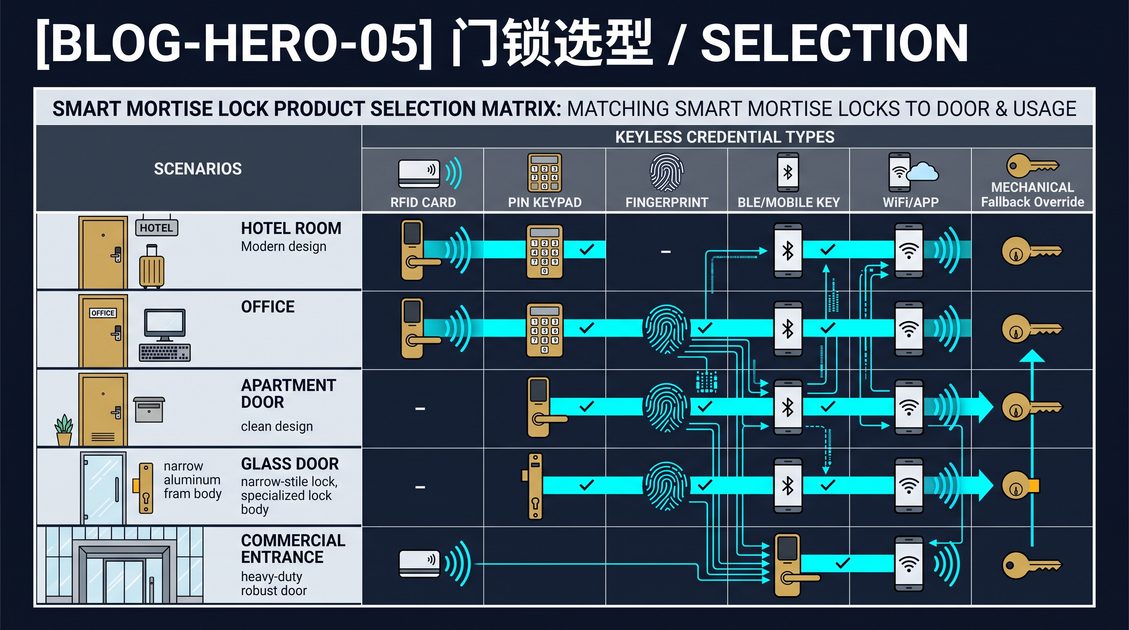
When comparing a face recognition door lock, combine the recognition criteria with the fundamentals of any electronic lock. Confirm the form factor fits the door, whether mortise or cylindrical. Confirm a fallback credential, such as a keypad, fingerprint, card, or mechanical key, because a user in changed appearance, poor lighting, or with a covered face needs another way in. Confirm the power arrangement, because a camera and processor draw more power than a simpler sensor, and require battery reporting. Confirm certification, such as CE, FCC, and RoHS, and, where available, biometric-specific standards.
A face recognition door lock is the right choice when hands-free convenience matters most and the user is almost always an enrolled person, such as a home resident or a staff door. It is less clearly right for a door with many occasional or unenrolled users, where a code, card, or fingerprint serves better and costs less. Match the sophistication to the door, require a fallback, local and encrypted template storage, and certification, and a face recognition lock will deliver the most seamless access of any door lock available.
Evaluate a facial recognition lock in the actual conditions of the doorway before committing, because lighting, distance, and surrounding movement affect recognition more than a datasheet reveals. Confirm the enrollment process for each household member, the behavior in low light, and the fallback for a covered face or a visiting guest who is not enrolled. Keep the stored face data protected and local, and publish who can view recognition events so the convenience does not come at an unexamined privacy cost.
Not sure which sensor fits your project?
Talk to our mmWave application engineers for a free consultation.
Specify your hotel project with our engineers
Send your room count, ceiling type, and protocol preference. We will return a sample plan and quote within 24 business hours.
- Move from general guidance into a product or application discussion.
- Use RFQ when pricing, drawings, MOQ, or launch timing needs structure.
- Keep a direct contact path visible for fast clarifications and handoff.