Electronic Mortise Lock Body Guide for Smart Door Hardware
A practical electronic mortise lock body guide covering case design, latch and bolt movement, credentials, power, door compatibility, integration, testing, and maintenance.
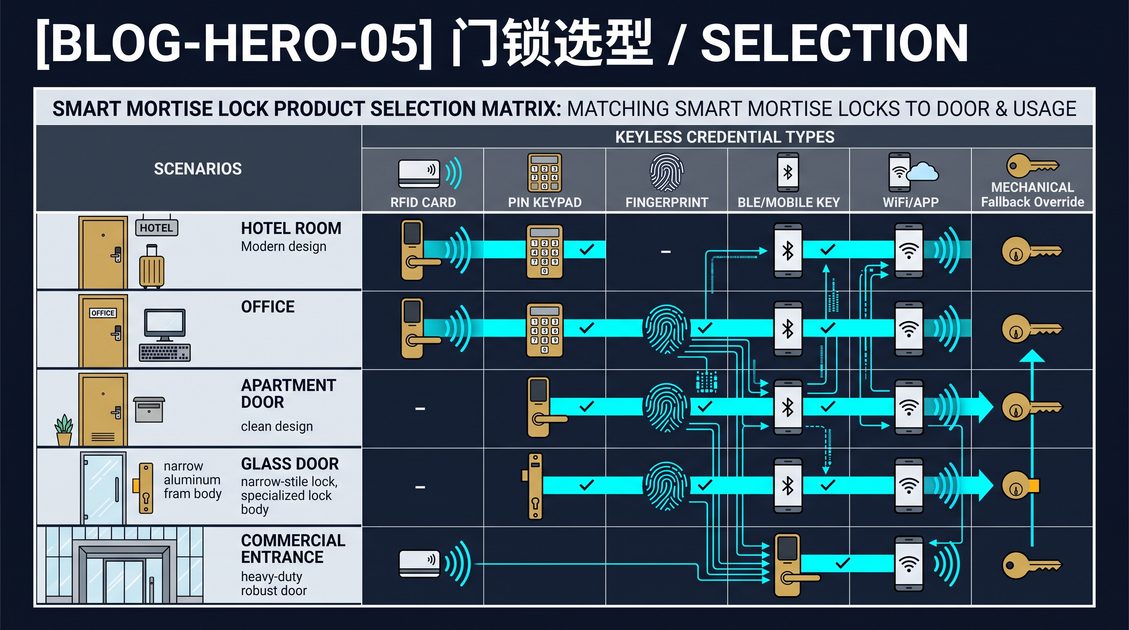
An electronic mortise lock body is the motorized case installed inside a rectangular pocket in a door edge, combining a latch, bolt, actuator, controller, and often a cylinder or reader interface in one assembly. Unlike an electronic trim that only controls a handle, the mortise lock body directly moves the locking elements and must be matched to the door, frame, strike, handle, and access-control system. This guide explains how the body works, which dimensions and operating modes matter, and how to specify, install, test, and maintain one without assuming that a universal case exists.
Electronic Mortise Lock Body: Case and Door Compatibility
The case is the foundation of the system. Confirm height, width, depth, backset, faceplate, latch and bolt positions, spindle height, cylinder position, and handedness against the door survey and the manufacturer’s dimensional drawing. The pocket must hold the complete case without forcing it, and the faceplate should sit flush with the edge. A mismatch can cause rubbing, incomplete bolt travel, or an actuator that works against excessive resistance.
Compatibility includes the frame and strike. The strike must align with the latch and bolt when the door is closed, while a closer, seal, or warped frame can add pressure that a motorized lock cannot overcome reliably. Rated doors, emergency exits, metal doors, and glass assemblies may require specialist review before modification.
Electronic Mortise Lock Body: Latch, Bolt, and Actuator
An electronic mortise lock body typically contains a spring latch, a deadbolt or locking latch, and a motor or solenoid that changes their state after authentication. Some designs allow passage mode, privacy mode, or fail-safe and fail-secure behavior. These modes must be selected for the opening’s use and life-safety requirements, not chosen casually from a menu.
Test the mechanical operation before connecting electronics. The handle should retract the latch smoothly, the bolt should extend fully, and the strike should not scrape. If the door is misaligned, correct the opening first instead of increasing motor force or changing timing settings.
Electronic Mortise Lock Body: Power and Access Integration
The body may be battery powered or wired to a controller, reader, gateway, or building access panel. Battery systems need a serviceable compartment, low-power warning, and a backup power or mechanical recovery path. Wired systems need protected conductors, strain relief, and a documented response to power interruption. The access interface may be a keypad, RFID reader, fingerprint module, mobile credential, or external controller.
For a networked installation, define what the body does offline, how credentials are cached, and when events synchronize. A reliable electronic mortise lock body should continue the locally permitted operation through a communication outage while preserving the configured security behavior.
Electronic Mortise Lock Body: Specification and Commissioning
Specify the body by measured dimensions, operating mode, door type, credential architecture, power arrangement, and required integration rather than by a generic name. Request the current drawing, wiring information, installation instructions, environmental limits, and service procedure for the exact configuration. Do not assume a lock family’s specifications apply to every variant.
Commission the complete door with valid, invalid, expired, and revoked credentials. Test inside release, auto-lock, manual override, power loss, network loss, door position, and repeated cycles. Record the body identifier, configuration, administrator, and maintenance owner. Check alignment, fasteners, handle movement, battery condition, and permissions during service visits.
This electronic mortise lock body guide is general information. Confirm local fire, accessibility, electrical, privacy, building, and emergency-egress requirements with qualified professionals before installation or modification.
Electronic Mortise Lock Body Guide: Door Monitoring and Diagnostics
A complete electronic mortise lock body installation should account for door monitoring as well as the lock command. Where the hardware supports door-position sensing, the controller can distinguish an authorized unlock from a door that remains open, a latch that fails to engage, or a strike that is misaligned. This information is valuable in hotels, offices, and multifamily properties because an administrator can investigate repeated exceptions instead of treating every event as a successful entry. Sensor status, actuator response, and credential events should be labeled consistently in the management platform.
Diagnostics should be tested during commissioning and service. Disconnect the communication path, simulate an invalid credential, open the door without a valid release, and inspect which events are recorded locally and centrally. Confirm how the system reports a low battery, blocked bolt, communication failure, or controller fault. Keep diagnostic access separate from daily user permissions, and document who is authorized to change firmware or configuration.
Electronic Mortise Lock Body Guide: Procurement Questions
Before ordering, ask for the exact case drawing, compatibility list, wiring diagram, installation template, environmental limits, maintenance instructions, and replacement-part policy. Clarify whether the reader, handle, cylinder, controller, and power supply are included or supplied separately. Ask how the body behaves during power loss and whether a mechanical override remains available. For a multi-door project, request a representative sample and validate it on the actual door construction before committing to a larger order.
A good procurement record also captures the intended use, door rating, credential method, integration interface, service owner, and recovery procedure. This prevents a generic electronic mortise lock body from being ordered for an opening with special life-safety or accessibility constraints.
Not sure which sensor fits your project?
Talk to our mmWave application engineers for a free consultation.
Specify your hotel project with our engineers
Send your room count, ceiling type, and protocol preference. We will return a sample plan and quote within 24 business hours.
- Move from general guidance into a product or application discussion.
- Use RFQ when pricing, drawings, MOQ, or launch timing needs structure.
- Keep a direct contact path visible for fast clarifications and handoff.