Door Knob and Deadbolt Set Guide for Secure Door Selection
This door knob and deadbolt set guide explains how to match hardware, door preparation, access needs, egress rules, installation details, and maintenance plans.
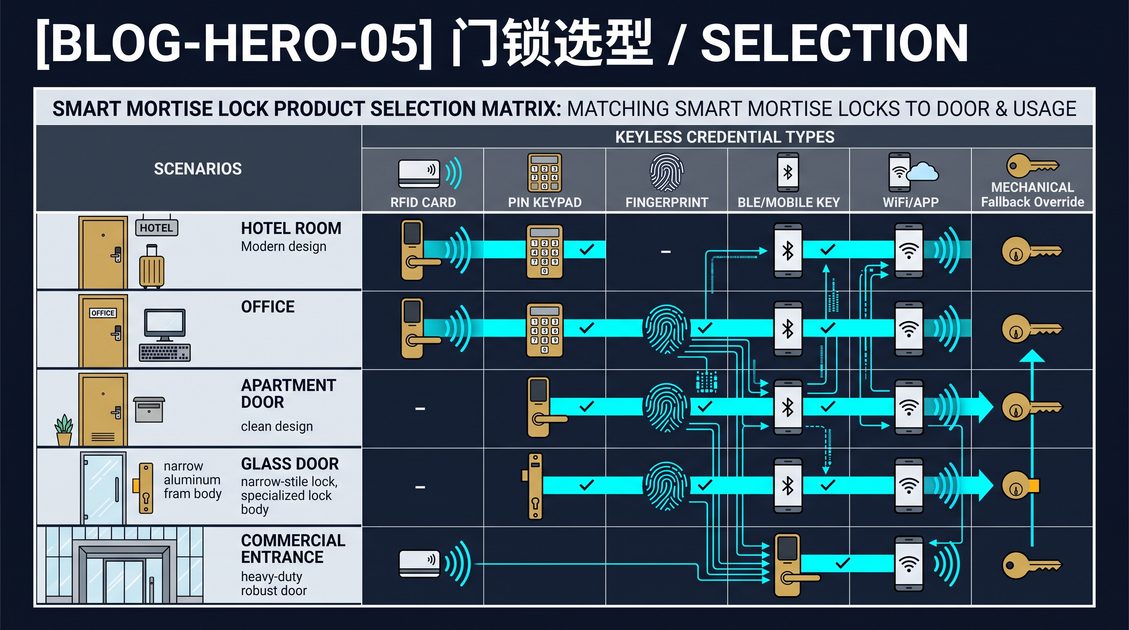
A door knob and deadbolt set guide helps owners choose coordinated locking functions rather than judging hardware by appearance alone. The knob or lever normally controls passage through a spring latch, while the deadbolt adds a longer locking bolt that resists common spreading and prying forces when the door is closed. A suitable combination still depends on the door, frame, hinges, strike, users, and local safety rules. Before ordering, identify the door material, thickness, backset, bore size, handing, and existing preparation. Then decide whether the opening needs keyed access, a thumb-turn, keypad entry, or managed credentials. The strongest set cannot compensate for a weak frame or loose hinges. This guide provides a practical sequence for comparing fit, security, usability, installation, and ongoing service without treating a residential-looking product as automatically suitable for every opening.
Door knob and deadbolt set functions
A door knob and deadbolt set separates daily latching from deliberate locking. The spring latch engages when the door closes and can be retracted from the inside by turning the knob or lever. It is convenient, but it is not the primary security barrier. The deadbolt is extended manually or electronically and should enter a properly reinforced strike in the frame. That distinction matters in bedrooms, offices, rental units, and staff areas where users may close a door without locking it.
Choose a knob or lever based on grip, clearance, and traffic. Levers generally require less wrist rotation and can be easier for people with limited dexterity, while knobs may suit existing architectural hardware. A single-cylinder deadbolt typically uses a key outside and a thumb-turn inside. Double-cylinder designs require a key on both sides and may create an egress concern, especially where a key is not immediately available. Electronic deadbolts add scheduling and audit options, but they need a clearly documented mechanical override and power-loss procedure.
Door knob and deadbolt set measurements
A door knob and deadbolt set is compatible only when its dimensions match the opening and its trim covers the prepared holes. Measure the backset, usually the distance from the door edge to the center of the bore, rather than assuming a standard size. Record door thickness, bore diameter, cross-bore spacing, edge-bore shape, and the distance between the knob and deadbolt. Check whether the door is left- or right-handed and whether the existing latch can be reversed.
Inspect the frame before selecting a replacement. The deadbolt should project into a strike pocket with adequate depth and solid material behind the screws. Short screws installed only into thin trim provide little reinforcement. Look for frame splitting, hinge-side movement, warped doors, and weather-related swelling. On metal, composite, fire-rated, or glazed doors, do not drill or alter the preparation without approval from the door manufacturer or a qualified installer.
| Measurement or condition | Why it matters | Verification method |
|---|---|---|
| Backset | Aligns latch and deadbolt with the existing bore | Measure edge to bore center |
| Door thickness | Determines spindle, cylinder, and trim fit | Measure the slab, excluding trim |
| Frame depth | Allows the bolt to extend without binding | Test the closed door and strike pocket |
| Strike reinforcement | Transfers force into the frame | Check material and screw engagement |
| Handing and clearance | Prevents handle interference | Swing the door through its full arc |
Door knob and deadbolt set security choices
A door knob and deadbolt set provides useful security only when the cylinder, strike, frame, and credential policy work as one system. Mechanical keyed sets can be simple to service and do not depend on batteries or networks. Their risks include copied keys, uncontrolled master keys, and slow revocation after loss. Rekeyable cylinders can reduce replacement time when occupancy changes. For higher control, keypad or smart versions may support individual codes, temporary access, event logs, and remote administration, but those capabilities introduce battery, firmware, network, privacy, and recovery requirements.
Compare the actual cylinder and bolt construction, not just a marketing grade or finish. Ask how many locking combinations exist, whether restricted keyways are available, how the interior release works, and whether replacement cylinders can be sourced locally. Electronic products should specify low-battery warnings, offline behavior, emergency power access, and a non-network fallback. Keep credentials unique to people or roles where practical, remove departed users promptly, and protect administrative accounts with strong authentication.
Security also includes the surrounding opening. Use long, suitable fasteners, keep hinges protected where the door swings outward, and repair gaps that allow manipulation. A coordinated set improves convenience, but it should be evaluated as part of a complete door assembly.
Door knob and deadbolt set usability and egress
A door knob and deadbolt set must remain understandable and operable during stress, darkness, and power loss. The person inside should know which motion releases the latch and which motion retracts the deadbolt. Thumb-turns and interior electronic controls should not require a phone, network connection, or unfamiliar sequence for normal exit. Check turning force, reach range, clearance from adjacent walls, and visibility of labels. Test the opening with the intended users, including people with limited grip strength or mobility.
Emergency egress requirements vary by occupancy, door location, occupant load, and jurisdiction. A locking arrangement that is acceptable on a private storage room may be inappropriate on a sleeping room, assembly space, workplace, or public facility. Never add a second cylinder or access-control feature merely to increase resistance without confirming that occupants can exit legally and quickly. Fire-rated assemblies may require listed hardware and approved field modifications.
For managed properties, document who can unlock the door, what happens when a credential fails, and where emergency keys are secured. A responsible procedure balances security with privacy and life safety: authorized staff should be able to recover access, while routine users should not be trapped by a depleted battery or misconfigured schedule.
Door knob and deadbolt set installation checks
Installation of a door knob and deadbolt set is a fit-and-alignment task, not simply a matter of tightening visible screws. The installer should verify that the door sits squarely, the hinges hold the slab without sag, and both latch and bolt enter their strikes without lifting, pushing, or slamming. Mark the final positions, use the supplied template only after confirming measurements, and keep chips or debris out of the latch mechanism. The strike should be secured into sound material with fasteners appropriate to the frame.
After installation, test the door from both sides at least several times. Confirm that the knob or lever retracts fully, the deadbolt throws smoothly with the door closed, and the inside release works without a key when required. Test with weather seals engaged and with normal door pressure; a system that works only while the door is held open is not aligned correctly.
For electronic hardware, test code creation, deletion, low-battery alerts, manual override, outage behavior, and any connected integration. Record the installed model, cylinder type, keying plan, battery date, and administrator responsible for changes. Photographing the completed strike and frame can support future service without exposing credential information.
Door knob and deadbolt set maintenance plan
A door knob and deadbolt set needs scheduled inspection because alignment changes gradually as hinges wear, frames settle, and seasonal humidity moves wood. At each service interval, operate the latch and deadbolt with the door open and closed, inspect mounting screws, check strike tightness, and look for rubbing marks or a bolt that stops short. Do not force a sticking lock; determine whether the cause is hinge sag, strike displacement, swollen material, a worn mechanism, or an incorrect installation.
Lubricate only according to the hardware manufacturer’s instructions. Improper oils can collect dust or damage sensitive cylinder components. Replace weak springs, damaged trim, bent strikes, and compromised fasteners rather than masking the problem with excessive force. For electronic sets, track battery age, firmware status, connectivity, and the last successful emergency-access test.
Maintain a simple service record containing the opening identifier, date, defect, action, technician, and follow-up date. Audit keys and codes when occupants, employees, contractors, or vendors change. A yearly review is a reasonable baseline for lightly used doors, while high-traffic openings may need quarterly checks. Confirm the schedule with the manufacturer, facility manager, and applicable code professional.
Door knob and deadbolt set purchasing checklist
Use this final door knob and deadbolt set guide checklist before approving a purchase:
- Confirm backset, door thickness, bore dimensions, handing, and strike compatibility.
- Inspect the door, hinges, frame, and reinforcement instead of evaluating the lock alone.
- Select knob, lever, cylinder, keypad, or smart features for the actual user group.
- Verify inside egress, fire-rating compatibility, accessibility, and local building requirements.
- Define key control, credential revocation, emergency override, and privacy procedures.
- Request installation instructions, replacement parts, warranty terms, and service support.
- Pilot the exact configuration on a representative opening before a larger rollout.
- Record the final model, keying or code policy, maintenance owner, and inspection interval.
A qualified professional should review unusual, high-risk, fire-rated, commercial, or public openings. Good hardware supports a reliable opening; it cannot replace sound construction and disciplined operation.
Not sure which sensor fits your project?
Talk to our mmWave application engineers for a free consultation.
Specify your hotel project with our engineers
Send your room count, ceiling type, and protocol preference. We will return a sample plan and quote within 24 business hours.
- Move from general guidance into a product or application discussion.
- Use RFQ when pricing, drawings, MOQ, or launch timing needs structure.
- Keep a direct contact path visible for fast clarifications and handoff.