Digital Lock and Electronic Lock for Door: What You Get
What a digital lock and an electronic lock for a door actually include, how they compare across form factors, and how to choose a digital door lock that fits your door.
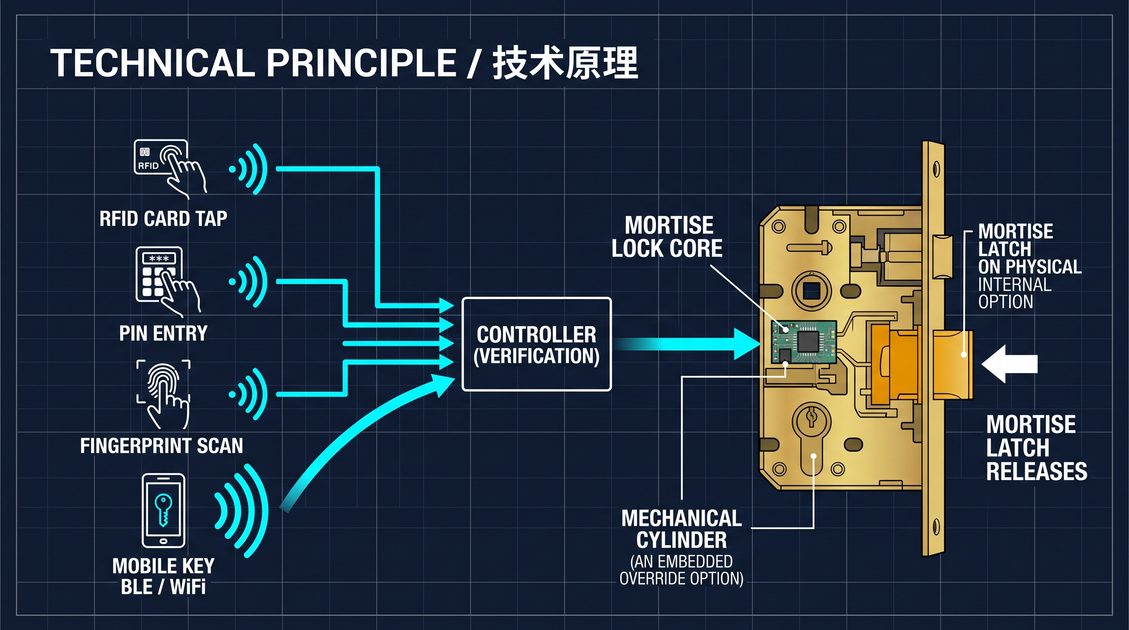
A digital lock is an electronic lock for a door that replaces a mechanical key with a digital credential, such as a code, a card, a fingerprint, or a phone. It is the broad category that includes the keypad lock, the smart lock, and the biometric lock, and it covers every form factor from a cylindrical deadbolt to an electronic mortise lock. This guide explains what a digital lock and an electronic lock for a door actually include, how they compare, and how to choose a digital door lock that genuinely fits your door and your users.
What a Digital Lock Includes
A digital lock contains an electronic credential reader, a controller, an actuator, and a power source, packaged in a lock body. The reader accepts the credential, the controller validates it, and the actuator moves the bolt to unlock. Many digital locks combine several readers, such as a keypad plus a card reader, so a user can choose the most convenient credential. The mechanism can be a mortise lock, which carries a latch and deadbolt in one body and dominates commercial and European doors, or a cylindrical deadbolt, which is common in North America.
The term electronic lock for a door is used broadly to mean the same thing, an electronic mechanism that controls entry without a key. The distinction among digital locks is the credential, the form factor, and the connectivity. A keypad digital lock verifies a code; a smart lock adds an app and possibly remote or networked control; a biometric lock adds a fingerprint or face. Choosing among them is choosing the credential and the management model your users need.
Choosing a Digital Door Lock
When choosing a digital door lock, apply the same framework as any electronic lock: door structure, opening method, connectivity, battery and emergency access, security, form factor, and management. The door structure decides whether you need a mortise or a cylindrical lock. The opening method decides which credentials your users will carry or remember. The connectivity decides whether you need remote or networked control. Battery and emergency access decide reliability, with a fallback credential and a mechanical key or backup power essential. Security and certification decide trust, and management decides whether you can administer one door or many.
The right digital lock is the one matched to your situation. For a single front door, a keypad or smart lock with a fallback and app control is a strong pick. For a rental or a business, a lock with managed credentials and instant revocation is better. For a commercial or multifamily building, a networked electronic mortise lock with central management is the reliable backbone. This guide recommends choosing a digital door lock with a fallback, certified security, battery reporting, and a form factor that fits the door, and treating a digital lock as an upgrade only when it is implemented as reliably as the mechanical lock it replaces.
The practical difference between a good and a poor digital door lock is how it behaves at the edges, at low battery, during an outage, and with a forgotten credential. Choose a lock that reports its own health, keeps a mechanical or backup-power recovery path, and stores permissions in a way the owner can inspect. A digital door lock that is easy to administer and honest about its condition will outlast one chosen purely for the number of advertised features.
Confirm the digital door lock meets the accessibility needs of the people who use the door, such as clear feedback, reachable controls, and an alternative to a screen for users with limited vision or dexterity. A digital lock that is technically capable but hard for the intended users defeats its purpose. Match the reader height, the type of feedback, and the credential options to the actual household or workforce, not to a generic specification.
Whatever the form factor, the goal is the same: a lock that is secure when it should be and convenient when it can be.
Not sure which sensor fits your project?
Talk to our mmWave application engineers for a free consultation.
Specify your hotel project with our engineers
Send your room count, ceiling type, and protocol preference. We will return a sample plan and quote within 24 business hours.
- Move from general guidance into a product or application discussion.
- Use RFQ when pricing, drawings, MOQ, or launch timing needs structure.
- Keep a direct contact path visible for fast clarifications and handoff.