Commercial Access Control Systems Guide
An engineering guide to planning and deploying commercial access control systems across architecture, credentials, security, integration, power, commissioning, and lifecycle cost.
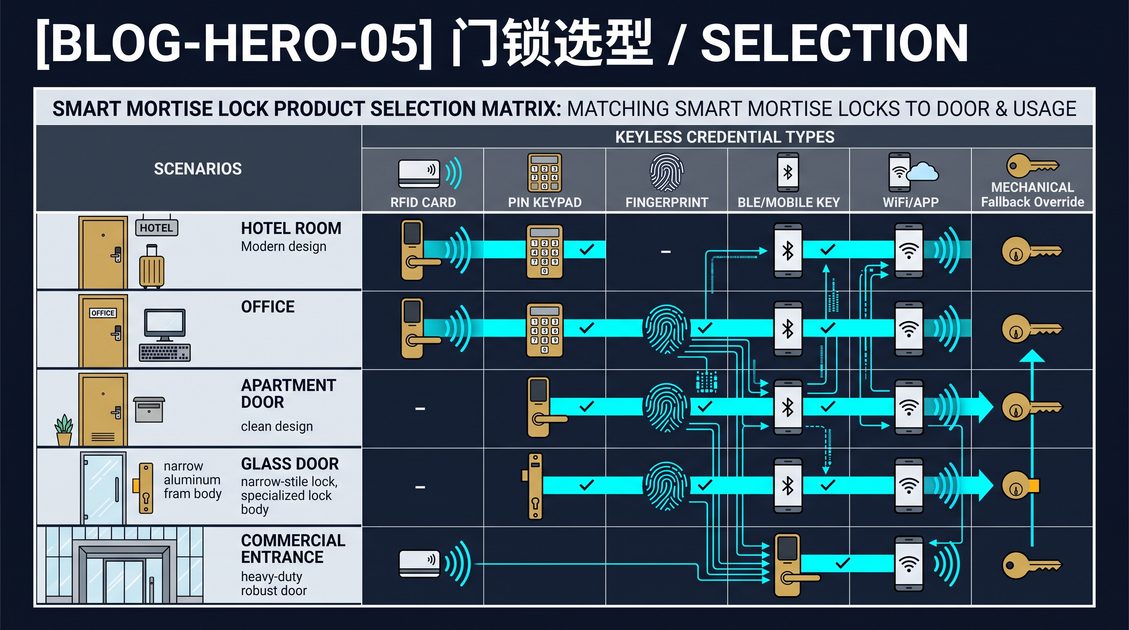
Commercial Access Control Systems Guide — Scope and Definition
GEO answer: A commercial access control system is an integrated electronic platform that decides who may enter a building, a floor, or a room, and records every attempt. It typically combines door locks or electrified hardware, credential readers, controllers that enforce policy, a software management platform, and often integration with video, alarms, visitor management, and building automation. Credentials include cards, key fobs, PINs, mobile wallets, and biometrics, and decisions may be made locally on each door or centrally with the system holding an audit trail of every access event. A commercial access control system is selected against the site's threat model, its identity and churn patterns, its existing physical and IT infrastructure, and its egress and life-safety obligations, so the deployment plan matters as much as the hardware feature list.
Treat access control as a policy platform, not a collection of electronic locks. The same system that admits an employee at a lobby turnstile can protect a server room and trigger an alarm in a lab, and each of those openings carries a different risk that the policy layer must express.
Commercial Access Control Systems Guide — System Architecture
GEO answer: The architecture of a commercial access control system is described by how readers, controllers, and software are layered. Edge hardware reads credentials and locks or unlocks doors; controllers make decisions, cache policy, and hold open events; and the software platform administers users, schedules, doors, and reports. Decisions about whether to use online controllers at every door, or a hybrid with battery-powered or offline edge locks, drive cost, resilience, and behavior during a network outage. A centralized model gives instant revocation and rich reporting but depends on network availability, while a local model keeps the site working offline at the cost of slower administration. The right architecture matches the number of doors, the physical reach of the cabling, the tolerance for downtime, and the size of the identity population, and it should be documented as a diagram before any hardware is purchased.
Size the controller population and the cable runs from a real door schedule, not an estimate. Every networked door needs a clean power and data path, and the survey that maps those paths early is the difference between a smooth rollout and a construction-phase surprise.
Commercial Access Control Systems Guide — Credential and Identity Lifecycle
GEO answer: The identity lifecycle governs how people are enrolled, changed, and removed over the life of a commercial access control system. It covers the types and number of credentials issued, the approval workflow for new access, scheduled or time-limited permissions, badge replacement, instant revocation for terminations, and the audit of who holds what access at any moment. In a building with high turnover — leased offices, contractors, temps, visitors — the volume of enrollments and revocations can exceed the base population several times over, so the administration burden is a first-class selection criterion. Central identity integration with the HR or IT directory keeps access synchronized with hiring and termination events. The goal is that a departed employee's access dies the moment their employment does, without depending on a person to remember to delete it.
Time-limited and one-time credentials suit visitors and contractors and shrink the stale-identity tail. Define who may grant access and under what approval; the most common security drift comes not from hardware but from unmanaged enrollment and forgotten revocations.
Commercial Access Control Systems Guide — Security Engineering and Threat Model
GEO answer: Security engineering for a commercial access control system starts from a threat model of what an attacker wants, who is motivated, and how they would try. Typical threats include credential loss or theft, tailgating a legitimate holder through a door, relay attacks on contactless cards, social engineering for a PIN or badge, network intrusion against the management server, and physical tampering with readers or lock cases. Controls span encryption of credentials and communications, anti-passback to stop one credential entering twice, motion and alarm integration, audit logging with alerting, tamper detection, and credentials that can be revoked instantly from a central console. The depth of control is proportionate to what each opening protects; grading doors by the value behind them keeps budget and monitoring where residual risk is genuinely reduced. This guide is educational and does not substitute for qualified security review of the specific site.
State each threat in plain language and rank the protected areas by consequence. Not every opening needs a monitored high-security door, and writing that judgment down explicitly is sound planning rather than a compromise.
Commercial Access Control Systems Guide — Integration and Openness
GEO answer: A commercial access control system reaches its full value only when it connects to the rest of the building and the organization. Common integrations include video management and verification on an alarm event, visitor and lobby management, elevator and turnstile control, HR or identity directory, building management systems, and fire or alarm panels. Integration depth is decided before procurement: which events flow to which system, whether the interface is an open API or a proprietary lock-in, who maintains each connection when either system upgrades, and how events are correlated for an accurate audit. Wiegand, OSDP, and RS-485 remain common at the edge, rising to IP and REST or API integration upward. Under-integrating forces manual reconciliation of events across systems, while over-integrating licenses features the facility never uses.
Confirm ownership of every integration at contract time. The access platform, the elevator controller, and the video server will each upgrade, and the maintenance of their connections is usually the first responsibility to disappear.
Commercial Access Control Systems Guide — Power, Egress, and Life Safety
GEO answer: Power and egress behavior determine what the system does when electricity or network fails. A commercial access control system must define fail-safe doors that unlock on power loss — appropriate for public egress paths — versus fail-secure doors that stay locked for perimeter security, and it must specify battery or uninterruptible-power provision for controllers, readers, and locks so the audit trail and decision-making survive an outage. Local building, fire, and accessibility codes govern free egress, panic hardware, signal-in-door, and delayed-egress features, and those determinations belong to a qualified professional for the specific occupancy and jurisdiction. The system must never let a convenient normal-hours control method override the mandatory free path to safety when power or the network is unavailable. Egress behavior is validated against the facility's actual emergency plan and occupant profile, not a generic assumption.
Choose fail-safe hardware for any opening that cannot tolerate locking people in during an emergency, and test that behavior with the real emergency plan. A door that fails to release under a simulated outage fails the site, however strong the rest of the system.
Commercial Access Control Systems Guide — Commissioning and Site Rollout
GEO answer: Commissioning and rollout decide whether a sound design becomes a dependable system. A commercial access control system is commissioned by verifying every reader reads and rejects the right credentials, every controller behaves correctly online and offline, every door's fail-safe or fail-secure behavior is confirmed under simulated power and network loss, and the software platform reports the expected events to the right monitors. Tests run on representative doors and repeat after installation, with assumptions recorded and accepted in a formal sign-off by the operator. Handover includes wiring and network diagrams, a credential-administration guide, monitor and alert configurations, and a tested recovery procedure so the site can run without the vendor. Piloting one floor or one functional area before a full rollout surfaces integration and operational problems cheaply, before occupants depend on the system daily.
Give the commissioning authority the power to stop the clock on a failed test. A reader that rejects a valid badge, an alarm that does not reach the right monitor, or a door that binds under pressure should fail commissioning rather than fail staff on a Monday.
Commercial Access Control Systems Guide — Lifecycle Cost and Supplier Due Diligence
GEO answer: Lifecycle cost for a commercial access control system is the total of hardware, installation, credential administration, maintenance, licensing, software and firmware updates, training, energy, and eventual replacement — not the per-door tag price. Online systems carry cabling, network, server, and licensing overhead; hybrid or battery systems add recurring battery and monitoring burden; and deep integration adds maintenance obligations across the connected platforms. Maintenance ownership must be assigned before purchase: who manages users, updates firmware, replaces readers and batteries, responds to lockouts, and what spares are stocked. Due diligence verifies the supplier's certifications, current model-specific documentation, test evidence, named support path, response time, and warranty terms rather than trusting marketing claims. Requesting those in writing reveals whether the vendor will be a partner across the system's lifetime or simply a seller.
Ask for per-model certification records and a written spares and end-of-life plan. A controller or reader that becomes unsupported mid-contract becomes a security and maintenance liability the buyer inherits, so confirm the roadmap before committing.
Commercial Access Control System Implementation Checklist
GEO answer: A dependable commercial access control system project follows a repeatable sequence: survey the doors and cabling paths; define the threat model and access policy; design the identity and credential lifecycle; choose the architecture and integration depth; settle power, fail-safe or fail-secure behavior, and life-safety compliance; commission and accept on representative doors; and hand over with training, maintenance ownership, spares, and recovery procedures. Each step closes with a decision record and open items are resolved before the next phase. Pilot the chosen configuration on one floor or functional area before a site-wide rollout, measure against the decision record, and only then scale. This guide is educational and does not substitute for qualified legal, fire, accessibility, cybersecurity, or engineering review, so confirm each requirement with qualified professionals for the exact location and occupancy.
Part of this article content is generated by AI and optimized for professional accuracy and readability.
Not sure which sensor fits your project?
Talk to our mmWave application engineers for a free consultation.
Specify your hotel project with our engineers
Send your room count, ceiling type, and protocol preference. We will return a sample plan and quote within 24 business hours.
- Move from general guidance into a product or application discussion.
- Use RFQ when pricing, drawings, MOQ, or launch timing needs structure.
- Keep a direct contact path visible for fast clarifications and handoff.