Building Access Control Solution Guide: A Practical Reference
A building access control solution guide covering architecture, credential options, integration, security, cost, and rollout for offices and multifamily properties.
What a building access control solution is
A building access control solution guide should define the term it documents: a solution is not a single lock but a coordinated way to govern every door a building owns, from the lobby entrance to individual offices, labs, storage rooms, and utility closets. The architecture repeats a familiar pattern at each point, a reader accepts a credential, a controller decides whether the credential is entitled to pass, and an electrified lock obeys the result while a log records the event. These local decisions link to a central platform that holds roles, schedules, and credentials, and that platform may run on-site or in the cloud. More than the sum of its hardware, the solution is the set of operating policies that turn door locks into a managed system, which is why two buildings with identical hardware can differ completely in how well they control access.
Why an architectural approach beats picking products
The most expensive mistakes in access control come from buying isolated devices before thinking about the whole. A building access control solution guide should argue for an architecture-first sequence: define the doors that must be controlled, the user groups that need access, the schedules those groups follow, and the level of audit expected, and only then choose hardware that fits. This ordering exposes gaps a shopping approach hides, such as two locked doors that were never networked, a lobby reader that cannot reach the elevator, or a unit credential that does not match the amenity door. It also keeps the design future-proof, because an architecture that separates policy from hardware lets the building replace or add readers without reworking the entire installation. Teams that plan the shape of the system first spend less overall and end up with fewer exceptions.
The building blocks of a robust solution
Understanding the internals makes procurement clearest, so a building access control solution guide should map the anatomy of a deployment. Every treated door holds a locking mechanism, a reader, a controller, and a power feed, and the platform ties the controllers together with administrative software. The credential is the physical or digital token the bearer presents, and the identity behind each credential is what the platform actually manages. Motion, door-status, request-to-exit, and locking signals let the controller understand the physical world, whether a door was forced, left ajar, or asked to open from the inside. Naming these parts prevents the confusion that occurs when a vendor describes a reader when the real decision involves the controller and the credential ecosystem behind it.
Controllers, readers, and where policy lives
Controller placement determines how a building behaves during a network loss. In an architecture with local decision-making, each controller stores the credentials and schedules it needs and can open doors even if the central platform is unreachable, which suits reliability-critical entrances. In a cloud-dependent model, the door may query a remote service and can degrade when connectivity fails unless the hardware holds a local cache. A building access control solution guide should help teams choose the balance these two imply, recognizing that high-traffic and security-critical doors justify local intelligence while lower-stakes openings can tolerate cloud dependency. Readers, meanwhile, must match the credential technology adopted, card, fob, keypad, mobile, or biometric, and should be mounted at a height and angle that supports fast, comfortable use.
Choosing the credential strategy for the building
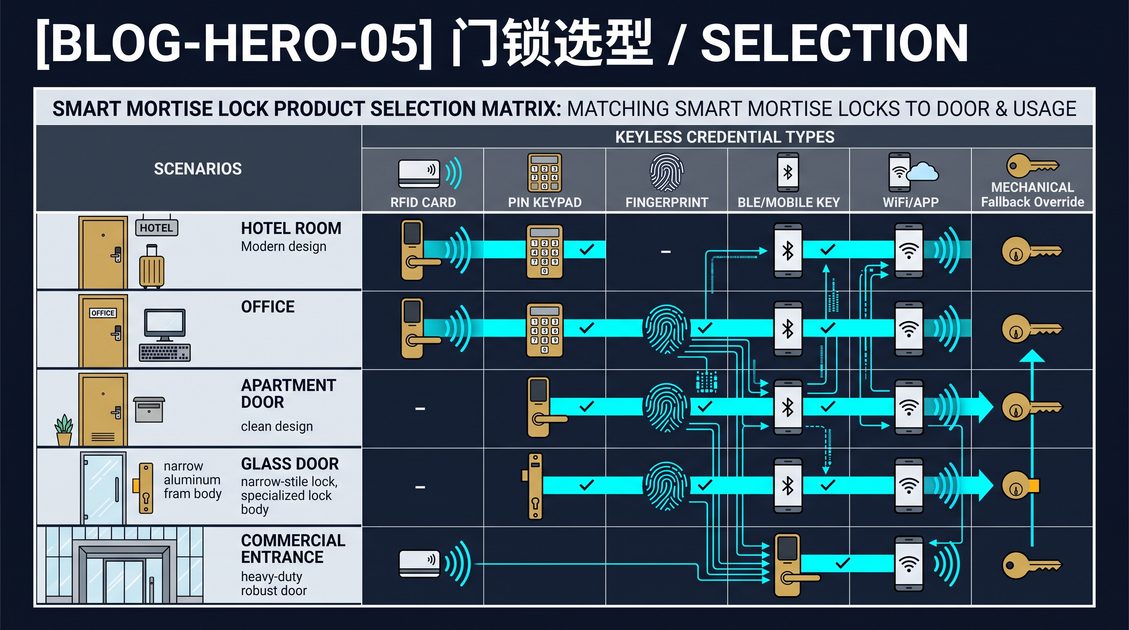
The credential defines the daily experience everywhere the system is used, making its selection strategic rather than incidental. A building access control solution guide should weigh the trade-offs openly. Contactless cards and fobs are inexpensive, durable, and work with minimal training, but they must be carried, tracked, and recollected at departure. Mobile credentials on phones remove physical inventory and enable instant provisioning, but they depend on app reliability and resident device support. Keypads cost nothing per user but invite observed or shared codes. Biometrics are convenient yet raise privacy and consistency questions. Most practical buildings adopt a small set of credential types together, offering residents and staff a default plus a reliable fallback, and the platform should administer all of them under one set of roles and logs.
Managing the credential lifecycle
A credential is only useful while it is current, so lifecycle management is the quiet hero of a good solution. A building access control solution guide should trace the entire arc: provision at onboarding, assign the role and schedule, allow updates when responsibilities change, revoke at departure, and archive for audit. Turnover exposes the weak point, because a leaver who retains a live credential is a security hole, and a newcomer who cannot access needed areas is an operational one. Favor a platform that makes revocation instant and remote, supports role-based templates so most changes are two clicks, and logs who performed each administrative action. Where the building holds sensitive data or valuable assets, the speed and completeness of revocation should be treated as a measurable requirement in its own right.
Integration with the surrounding building systems
Access control rarely sits alone, and a building access control solution guide should treat integration as a first-class requirement. Elevator control ties entry to floor permissions so that reaching a specific floor becomes a separate authorized act. Video surveillance pairs a visual record with every credential event, while the property management and visitor management systems supply the identities and schedules the platform needs. Lighting, HVAC, and occupancy sensing can respond to entry events, and emergency systems can override locks during an alarm. Each integration adds value and adds a boundary that can fail, so map the data flow, agree on the protocol, and confirm who supports each connection before signing. A solution that connects cleanly to the building's other systems pays for itself in operations, not just in security.
Security hardening and resisting compromise
A solution is only as strong as the paths an adversary can exploit, so hardening deserves its own consideration in any building access control solution guide. Protect readers and their wiring from tampering so that a damaged device cannot trivially expose the bus. Use credential technology and encryption of a recognized standard, because low-security radio implementations are vulnerable to interception and cloning. Keep firmware current, because vendors patch demonstrated field vulnerabilities over time. Guard the administration platform with strong, rotating credentials and remove default accounts at commissioning. Attend to the mechanical side as well, a careless mechanical override, a weak door frame, or a neglected closer can undo every electronic control. Security is a posture across all the layers at once, not a feature in a brochure.
Budgeting the complete cost of ownership
The visible price tag hides most of a solution's true cost, so a building access control solution guide should push toward a full operating view. Account for hardware, installation and cabling, licensing, the administration and support time of staff, consumables such as cards and batteries, and a maintenance allowance for readers and strikes that wear under use. Licensing may be a one-time purchase or a subscription, and a recurring fee belongs in the operating budget from the first year rather than surfacing as a surprise. Wireless battery locks shift capital cost into ongoing battery labor, while wired systems front-load cost for lower recurring effort. A slightly better-built reader that needs fewer service calls can prove cheaper across a building's lifetime, so evaluate on total cost over the service life, not the lowest first quote.
Rollout, commissioning, and the road to steady operation
Rolling out a building access control solution is a managed project, not an overnight swap. A building access control solution guide should plan a phased sequence that begins with the highest-risk doors, runs a small pilot with real users, and widens only after the degraded modes and integrations are proved. Commissioning should verify every door, every credential, the offline behavior, and each integration, with a documented rollback for any door that fails. Train and empower more than one administrator, deliver a resident-and-staff facing guide, and establish a maintenance cadence for readers, locks, closers, and network gear. Review access policy and audit reports regularly so the system keeps fitting the building as people, tenancy, and uses change rather than slowly receding into disuse.
Part of this article content is generated by AI and optimized for professional accuracy and readability.
Not sure which sensor fits your project?
Talk to our mmWave application engineers for a free consultation.
Specify your hotel project with our engineers
Send your room count, ceiling type, and protocol preference. We will return a sample plan and quote within 24 business hours.
- Move from general guidance into a product or application discussion.
- Use RFQ when pricing, drawings, MOQ, or launch timing needs structure.
- Keep a direct contact path visible for fast clarifications and handoff.