Bluetooth Door Lock and Bluetooth Smart Lock: Pros, Cons, and Fit
How a Bluetooth door lock and Bluetooth smart lock work, the pros and cons of Bluetooth before WiFi or fingerprint, and which doors it fits.
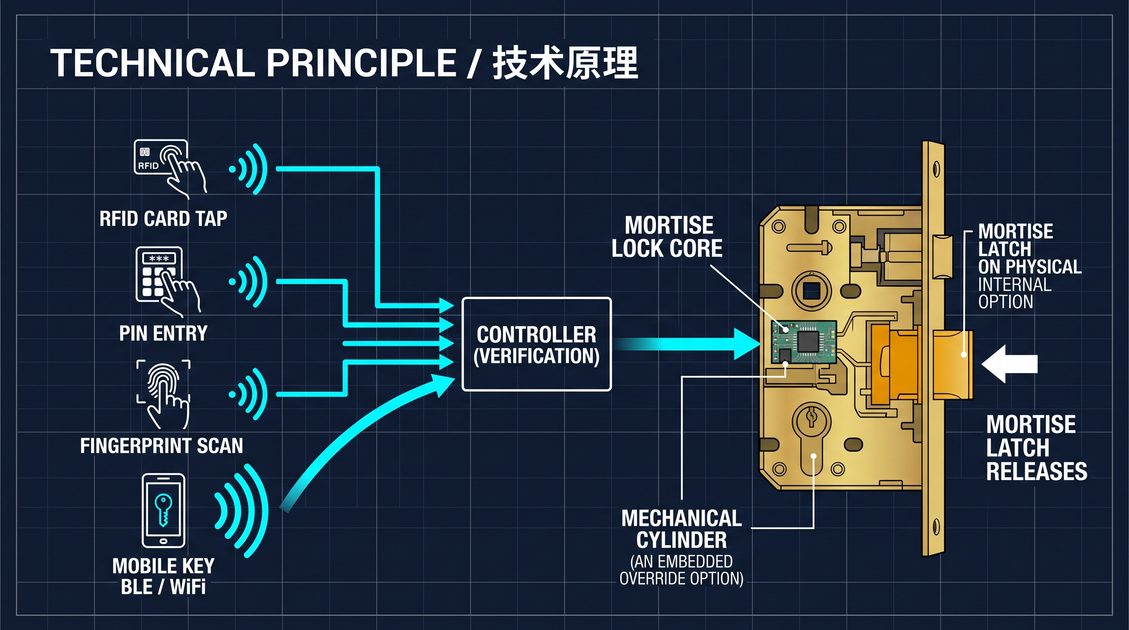
A Bluetooth door lock is a smart lock that unlocks using Bluetooth Low Energy, typically when the user's phone is near the door, without a code, card, or key. It is the baseline of the mobile-lock family and the building block of mobile key systems, and it is often the most battery-friendly connected option available. This guide explains how a Bluetooth door lock and the wider Bluetooth smart lock family work, weighs the pros and cons against WiFi and fingerprint locks, and helps you decide which doors a Bluetooth door lock fits best.
How a Bluetooth Door Lock Works
A Bluetooth door lock communicates with a phone over Bluetooth Low Energy, a low-power short-range radio. When the phone with the app and the authorized mobile key is within range, the phone and the lock authenticate, and the lock unlocks, either automatically as you approach or with a tap in the app. Because Bluetooth Low Energy is designed to use very little power, a Bluetooth door lock typically enjoys longer battery life than a WiFi lock, which is a major practical advantage.
The Bluetooth smart lock family extends beyond the single door: a phone can hold credentials for many Bluetooth locks, so one hub in the app manages several doors, and mobile credentials can be issued and shared. Bluetooth is also the transport behind mobile access control systems. The defining limitation is range: Bluetooth works only when the phone is near the door, so it offers no remote control from another location, which is the main reason a buyer chooses WiFi instead.
Pros, Cons, and Comparison
The pros of a Bluetooth door lock are low cost, long battery life, and hands-free or app convenience at the door. The cons are the lack of remote control, the dependence on a charged phone, and the need for a fallback if the phone is dead or lost. Compared to a WiFi lock, a Bluetooth lock is cheaper and saves battery but cannot be controlled remotely. Compared to a keypad, a Bluetooth lock is more convenient for a phone user but leaves you stranded without the phone and a fallback. Compared to a fingerprint lock, Bluetooth is cheaper but less personal and can still be locked out without the phone.
The right fit for a Bluetooth door lock is a door where the user is usually at the door with a phone and rarely needs remote control. For a single-family home with a tech-savvy household, a Bluetooth lock with a keypad or mechanical fallback is a strong, economical pick. For a rental, a Bluetooth lock that issues and revokes mobile keys remotely is convenient. For a setting where remote control from anywhere is required, a WiFi or gateway-based lock is the better choice, and for a setting where many people must access without phones, a keypad, card, or fingerprint may serve better.
Choosing a Bluetooth Door Lock
When comparing a Bluetooth door lock, the key criteria are the fallback, battery reporting, mobile credential management, and security. A Bluetooth lock must pair Bluetooth with a keypad, card, or mechanical key, so a dead phone never causes a lockout. It should report battery level to the app, manage mobile credentials centrally, and encrypt the Bluetooth link so the mobile key cannot be intercepted or cloned. A lock that is Bluetooth-only with no fallback and no battery warning is risky even if the Bluetooth itself is excellent.
A Bluetooth door lock is a reliable, economical choice when you value battery life and door-side convenience and do not need remote control. Apply the same framework as any smart lock, require a fallback, battery reporting, credential management, and encrypted transport, and a Bluetooth smart lock will serve its door simply and dependably for years.
A Bluetooth door lock performs best when its role is clear and its limits are documented. Decide in advance who can issue mobile keys, what happens to a key when a device is lost, and how a guest receives and loses access. Pair the Bluetooth channel with a visible low-battery warning and a tested recovery path, and confirm that the lock accepts a fallback credential so a dead phone is an inconvenience rather than a lockout.
Part of this article content is generated by AI and optimized for professional accuracy and readability.
Not sure which sensor fits your project?
Talk to our mmWave application engineers for a free consultation.
Specify your hotel project with our engineers
Send your room count, ceiling type, and protocol preference. We will return a sample plan and quote within 24 business hours.
- Move from general guidance into a product or application discussion.
- Use RFQ when pricing, drawings, MOQ, or launch timing needs structure.
- Keep a direct contact path visible for fast clarifications and handoff.