Best Keyless Entry Door Locks for Home and Business in 2026
A shortlist of the best keyless entry door locks: keypad, Bluetooth, WiFi, and fingerprint options compared on security, battery, and fit for home and business doors.
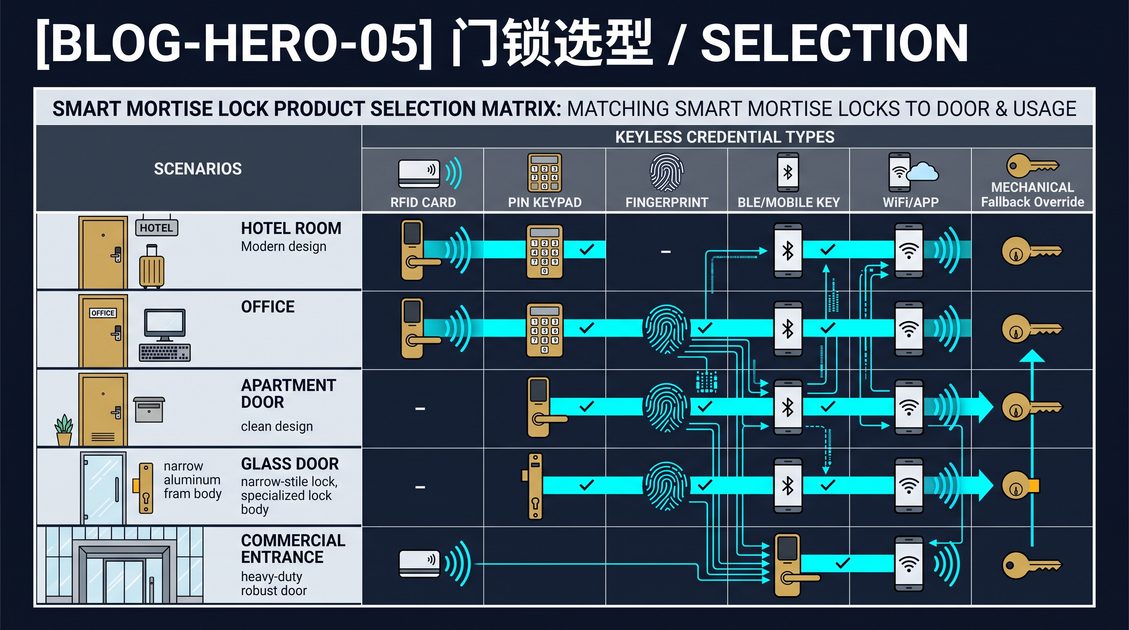
The best keyless entry door locks are the ones that match your specific door and your specific users, not the most expensive or most advertised model. A keyless entry door lock is any electronic lock that unlocks without a physical key, using a code, card, fingerprint, phone, or a combination. This guide compares the main lock families by use case so you can match a lock to a front door, rental, office, or commercial opening.
How the Best Keyless Entry Door Locks Are Compared
A fair comparison of the best keyless entry door locks uses door structure, opening method, connectivity, battery and emergency access, security, certification, and management. Door structure decides whether a lock is a mortise, cylindrical, or specialty fit. Opening method decides the credential. Connectivity decides remote control and ecosystem integration. Battery and emergency access decide reliability. Security and certification decide trust, while management decides whether one door or many can be administered. Scoring without these criteria is marketing rather than selection.
The practical ranking is by use case because a lock that suits a single-family front door may be wrong for a commercial property. Across every category, require a fallback credential, a mechanical key or backup power, and documented security engineering. No single opening method is universally best; a well-designed combination is safer than a feature-heavy lock with no recovery path.
Keypad Keyless Entry Door Locks
A keypad keyless entry door lock is the most affordable and universal family. The user types a code, needs nothing to carry, and a code can be issued to many users. This suits homes, rentals, and situations where sharing and revoking a code is easier than handing out keys. The trade-off is that a code can be shared or observed, so code length, failed-attempt handling, and administrator control matter.
The best keypad keyless entry door locks add a mechanical key override, backup power terminal, battery reporting, and time-based scheduling. A landlord can create a guest code, limit its validity to a booking, and revoke it without rekeying. A keypad lock on a mortise or cylindrical body is often the most practical choice for budget-conscious buyers and property managers.
Bluetooth, WiFi, and Fingerprint Keyless Entry Door Locks
Bluetooth locks unlock by phone proximity or an app tap and generally use less power than WiFi. WiFi locks add remote control from anywhere, allowing an owner to unlock for a guest or delivery while away, but they draw more power and depend on network reliability. Fingerprint locks authenticate a person directly and are convenient for frequent users, but they cost more and need a fallback for wet, dry, worn, or injured fingers.
The strongest convenience-oriented keyless entry door locks combine one of these methods with a keypad or mechanical override. Bluetooth suits a tech-savvy home where users are normally at the door. WiFi suits a rental or business that needs remote control. Fingerprint suits a frequent-user office or staff door where identity and audit matter. Redundancy is the deciding factor: a single-credential lock is riskier than one with a documented fallback.
The Best Keyless Entry Door Lock Shortlist by Use Case
For a single-family front door, choose a keypad or Bluetooth lock with app control, mechanical override, and battery reporting. For a rental, choose a keypad lock with time-limited guest codes and instant revocation. For a small business, choose a fingerprint or card lock with audit capability and a fallback. For a commercial or multifamily property, choose a networked electronic mortise lock with central management, because only a managed system can issue, revoke, schedule, and audit credentials across many doors.
A shortlist is not a substitute for measuring the door. Confirm backset, thickness, handing, strike alignment, and the required lock body before ordering. Verify the security implementation and certification for the exact model, and ask how batteries, credentials, and support are handled over the service life.
Conclusion
Choosing the best keyless entry door locks means matching the door, users, credentials, connectivity, and management model. Decide the physical fit first, then opening method, connectivity, battery recovery, security, and administration. A certified lock with a reliable fallback is a better selection than a cheaper lock with impressive but unverified features.
Part of this article content is generated by AI and optimized for professional accuracy and readability.
Not sure which sensor fits your project?
Talk to our mmWave application engineers for a free consultation.
Specify your hotel project with our engineers
Send your room count, ceiling type, and protocol preference. We will return a sample plan and quote within 24 business hours.
- Move from general guidance into a product or application discussion.
- Use RFQ when pricing, drawings, MOQ, or launch timing needs structure.
- Keep a direct contact path visible for fast clarifications and handoff.