Alexa Smart Lock and Smart Door Locks That Work with Alexa
How a smart door lock works with Alexa, voice control, and the essentials for the best smart locks that work with Alexa in 2026.
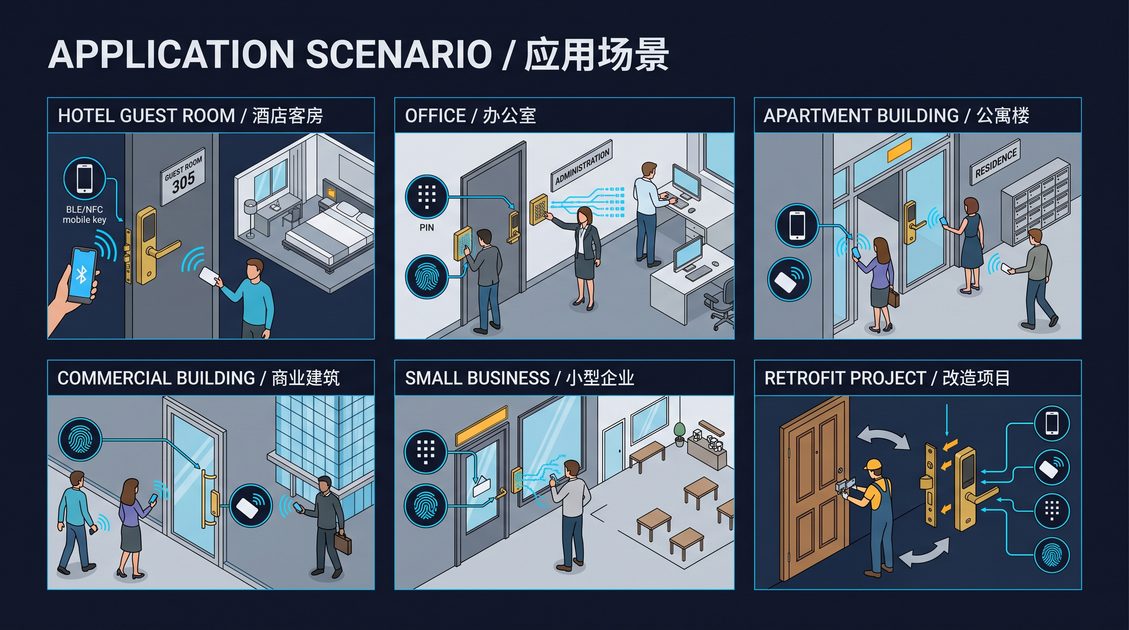
An Alexa smart lock is a smart door lock that works with Amazon Alexa, so you can check and, where the platform allows it, control the lock with your voice or through routines, plus monitor its status in the Alexa app. Choosing the best smart locks that work with Alexa is not just about voice control; it is about integration quality, security, and the fundamentals of a good lock. This guide explains how Alexa control of a smart door lock works, what to verify for compatibility, and which locks genuinely fit the Alexa experience.
How Alexa Control of a Smart Door Lock Works
A smart door lock works with Alexa when it connects to the Alexa platform through a supported protocol, most commonly Matter or a native Alexa skill. Once linked, the lock appears in the Alexa app, and you can check whether the door is locked and, with the appropriate permission, lock or unlock it by voice or through a routine. Matter is the key to compatibility, because a Matter lock works across Amazon Alexa, Google Home, and Apple Home through one protocol rather than vendor-specific integrations.
Voice control of a lock carries a real security consideration, which is why Alexa adds confirmation and approval layers. Because a voice command to a lock is a high-stakes action, Alexa requires a voice profile to identify the speaker and limits who can control the lock. A buyer should understand these controls, because the best smart locks that work with Alexa are the ones that pair voice convenience with strong authentication and a clear record of lock actions.
Comparing Alexa-Compatible Locks
When comparing an Alexa smart lock, verify the integration standard, the confirmation controls, and the lock fundamentals. Confirm the lock is Matter-based or natively Alexa-compatible, so it reliably appears and works in the app rather than claiming compatibility without substance. Understand the voice-profile and confirmation settings, and require the ability to restrict voice control to authorized users. Then apply the full lock criteria, door structure, opening method, battery, emergency access, security, and management, because Alexa control is a convenience layer on top of a lock that must still be reliable, secure, and well-fitted.
The trade-off is the dependence on the Alexa platform and the network. An Alexa smart lock is worth it when you use Alexa frequently and benefit from checking and controlling the lock in routines or by voice; it is not a substitute for a reliable lock mechanism or a fallback credential. This guide recommends a Matter-based Alexa smart lock with voice-confirmation controls, a fallback credential, battery reporting, and certification, so you get the Alexa experience without compromising security, and choosing Alexa control because it genuinely adds convenience, not just because a product is marketed as compatible.
A practical approach is to make Alexa the convenience layer rather than the security core. Confirm that the voice interface cannot accidentally unlock the door, that an authorized person must approve high-stakes actions, and that the lock still works with a keypad, card, fingerprint, or mechanical key when the network or the voice assistant is unavailable. Choose a lock that reports its status honestly to the app, because a status that cannot be trusted is worse than no status at all.
Choose an Alexa lock that also works as an ordinary smart lock, because the voice and routine features are an addition rather than a replacement. Verify that the lock shows a truthful status, that unlocking requires the approved authorization, and that the door can be opened without a voice assistant or network. A well-integrated Alexa lock is a convenience; a poorly governed one is an extra way for an unintended person to gain entry, so review the access controls before enabling routines.
When in doubt, treat the lock as the source of truth and the assistant as a helper, and configure the assistant not to override the lock's access decisions.
Part of this article content is generated by AI and optimized for professional accuracy and readability.
Not sure which sensor fits your project?
Talk to our mmWave application engineers for a free consultation.
Specify your hotel project with our engineers
Send your room count, ceiling type, and protocol preference. We will return a sample plan and quote within 24 business hours.
- Move from general guidance into a product or application discussion.
- Use RFQ when pricing, drawings, MOQ, or launch timing needs structure.
- Keep a direct contact path visible for fast clarifications and handoff.