智能插芯锁技术指南:工程、选型与部署全解析
基于场景的智能插芯锁技术指南,涵盖兼容性、凭证、供电、安全、集成、安装、测试与全生命周期规划。
智能插芯锁是一种电子锁,其电机驱动锁体、斜舌、方舌、读卡器与控制器集成于一个矩形壳体中,嵌入在门边开凿的锁体内。它是商用、酒店、欧洲住宅及多户住宅门最主流的锁体形态,因为插芯锁体在一个组件中同时集成了斜舌和方舌,并支持完整的执手面板。本技术指南阐述智能插芯锁的工作原理、区分可靠硬件与玩具级产品的工程维度,以及选型、安装、调试与维护的完整流程。由于智能插芯锁通常部署在众多门体上并长期运行,本指南将兼容性、凭证、供电、安全性、集成与全生命周期服务视为一个相互关联的系统,而非简单的功能清单。
智能插芯锁技术指南:锁体与门体
智能插芯锁必须先适配物理门洞,之后才谈得上电子层面的决策。锁壳的高度、宽度与深度必须契合门边开凿的锁体孔位;偏芯距,即门边到执手或锁芯中心的距离,必须对齐;前面板必须与门边齐平。门框上的锁扣板必须与门关闭时的斜舌和方舌对准,且门的左右开向必须可通过机械方式或软件进行配置。锁壳对孔位来说过大、对偏芯距来说过小,或与锁扣板不对齐,无论电子部分多么强大,都无法可靠运行。
新建项目会将锁具与门体一同选型,在锁体、表面处理、执手面板和锁扣板方面拥有最大的选择自由度。改造项目则受到更多限制:现有孔位决定了可安装的锁具,因此可重复利用现有开孔的直插式电子插芯锁是最简洁的升级方案,而更换锁体形态则需要开凿新孔位,并在防火门或金属门上实施专业作业。在选型任何智能插芯锁之前,应勘察门厚、锁体孔位、偏芯距、锁扣板、门框、闭门器及防火等级,并以实测开孔尺寸核对具体型号图纸。
智能插芯锁是一种电子锁,其电机驱动锁体、斜舌、方舌、读卡器与控制器集成于一个矩形壳体中,嵌入在门边开凿的锁体内,是商业、酒店、欧洲住宅及多户住宅门最主流的锁体形态。在任何电子决策之前,锁具必须先适配门洞:锁壳必须契合孔位,偏芯距必须对齐,前面板必须齐平,锁扣板必须与斜舌和方舌对准。新建项目将锁具与门体一同选型以获得最广泛的选择,而改造项目则利用现有孔位实现最简洁的直插式升级。应首先勘察门厚、锁体孔位、偏芯距、锁扣板、门框、闭门器及防火等级,并以实测尺寸核对精确型号图纸。同时记录左右开向、间隙余量,以及门框是否能承受指定锁扣板而不削弱整体结构。
智能插芯锁技术指南:凭证与读卡器
凭证是用户看得见、摸得着的交互界面,正确的凭证组合取决于用户群体与安全策略。最常见的选项包括 PIN 键盘、13.56 MHz RFID 卡或钥匙扣、指纹读头,以及通过蓝牙低能耗或 NFC 实现的移动钥匙。键盘成本最低且无需携带任何物品,但密码可能被分享或被窥视。RFID 卡快速、耐用且可即时吊销,是酒店和办公场景的标准配置。指纹对高频用户而言最具个性化和便利性,但成本较高,且需要为干燥或磨损的手指提供备用方案。移动钥匙支持非接触式进门和集中式凭证下发,但依赖手机电量。
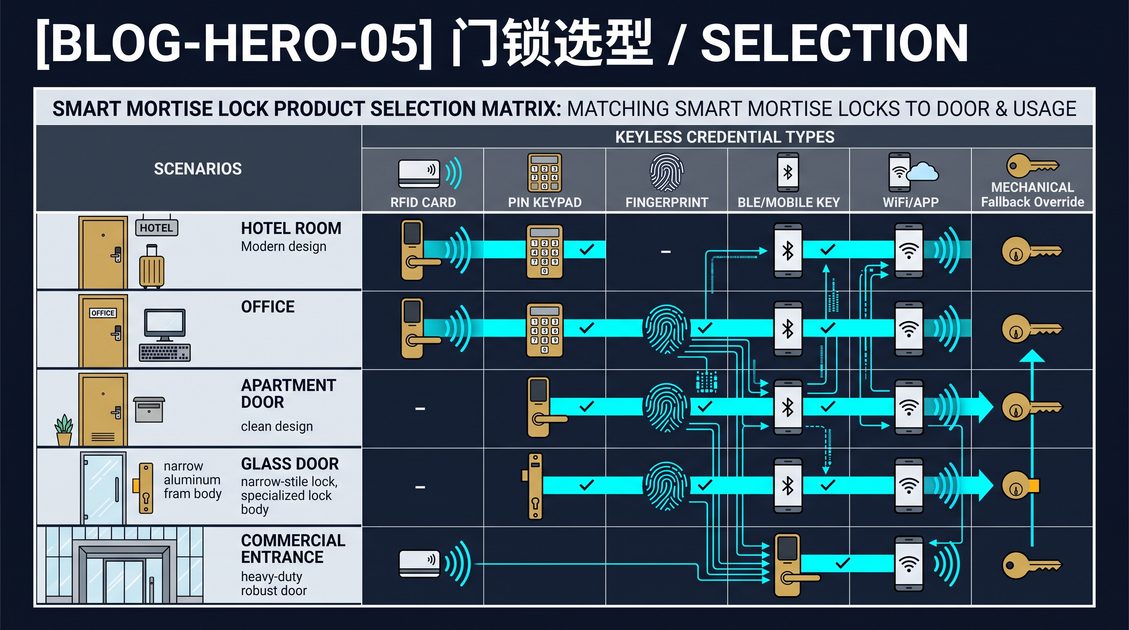
大多数专业级智能插芯锁会组合两种或两种以上的凭证,确保单一故障不会将用户锁在门外。正确的组合应与部署场景匹配:酒店门锁通常提供卡加移动钥匙,办公门锁提供卡、移动钥匙,有时加指纹,住宅门锁则提供键盘、移动钥匙,有时加指纹。每种凭证的安全性取决于具体实现。键盘的安全性取决于密码策略,RFID 卡的安全性取决于加密强度及每卡分散密钥,指纹的安全性取决于活体检测和误识率,移动钥匙的安全性取决于传输通道和平台认证。
凭证是用户看得见、摸得着的交互界面。常见选项包括 PIN 键盘、13.56 MHz RFID 卡或钥匙扣、指纹读头,以及通过蓝牙低能耗或 NFC 实现的移动钥匙。键盘成本最低且无需携带任何物品,但密码可能被分享;RFID 卡快速、耐用且可即时吊销,在酒店和办公场景中占主导地位;指纹最具个性化和便利性,但成本较高,且需要为干燥或磨损的手指提供备用方案;移动钥匙支持非接触式进门,但依赖手机电量。大多数专业级门锁会组合两种或以上凭证,确保单一故障不会将用户锁在门外,并与部署场景匹配:酒店为卡加移动钥匙,办公室为卡加移动钥匙加指纹,住宅为键盘加移动钥匙加指纹。安全性取决于具体实现、每码策略、每卡加密密钥、活体检测以及安全的移动传输通道。在比较读卡器组合之前,应明确凭证容量、读头响应、凭证有效期及吊销行为。
智能插芯锁技术指南:供电与应急开门
供电是可靠性维度,而非便利性维度。智能插芯锁依靠电池供电,通常为 AA 电池,或通过线路连接至控制器或门禁面板。电池寿命取决于开锁频率、读头类型、无线模块使用情况及温度,可从数月至约两年不等;WiFi 连接的门锁比仅蓝牙型号耗电更快,寒冷天气会加速放电。可靠的门锁会报告电池电量并在失效前数周发出警告,对于多门部署,联网系统会集中上报电池状态,以便维护人员安排更换,而非等到锁死后再被动处理。
应急开门是区分专业硬件与玩具的分水岭。当电池耗尽、网络故障或手机丢失时,用户仍必须能够进入。常见解决方案包括机械钥匙应急开启、位于锁体外侧的备用供电接口(如 USB 或 9V),以及备用凭证(如键盘或卡)。智能插芯锁应至少保留其中一种方式,理想情况下保留多种,确保电池耗尽永远不会将用户锁在门外。对于商业和租赁部署,应将电池更换作为经常性运营成本纳入预算,并在部署计划中明确应急开门路径。
供电是决定智能插芯锁在维护间隔期间是否保持可用的可靠性维度。智能插芯锁依靠电池供电,通常为 AA 电池,或通过线路连接至控制器或门禁面板;电池寿命取决于开锁频率、读头类型、无线模块使用情况及温度,可从数月至约两年不等,WiFi 比蓝牙耗电更快,寒冷天气会加速放电。可靠的门锁会报告电池电量并在失效前数周发出警告,联网系统会集中上报电池状态以便多门维护。应急开门是区分专业硬件与玩具的分水岭:机械钥匙应急开启、备用供电接口(如 USB 或 9V)以及备用凭证(如键盘或卡)确保用户在电池耗尽、网络故障或手机丢失时仍能进入。应将电池更换作为经常性运营成本纳入预算,明确由谁携带备用电池,并指定清晰的应急路径。同时记录预期的电量预警阈值、更换流程及更换后测试步骤,确保更换电池后不会遗留未验证的锁舌状态。
智能插芯锁技术指南:安全性与认证
智能插芯锁的安全性通过硬件、加密和防绕过能力来衡量,并由认证进行验证。硬件应使用安全微控制器,理想情况下还应使用安全元件,将凭证和密钥存储在防篡改存储中,而非通用内存。通信通道,无论是读卡器、蓝牙、WiFi 还是 NFC,都应加密,防止攻击者重放或解码。在机械层面,方舌、锁扣板和安装方式必须能够抵抗强制闯入,电子部分必须能够抵抗篡改和旁路攻击。
认证为这些声明提供独立核查。CE 标志表明符合欧洲安全与电磁兼容性要求,FCC 涵盖美国无线电发射限值,RoHS 限制有害物质的使用。对于更高的机械和安全声明,UL 或 ANSI/BHMA 等级,或同等的国家标准,验证强度和循环寿命。买方应索取认证证书,核实证书编号与具体型号一致,并询问凭证的存储和加密方式,因为一款合规但加密薄弱的门锁仍可能被绕过。加密值得特别关注:应优先选择每凭证分散密钥,而非原始卡号,并优先选择服务端移动认证,而非静态密码。
安全性是硬件、加密和防绕过能力的结合,通过认证以及在实际安装在门上的精确配置下进行测试来验证。硬件应使用安全微控制器,理想情况下还应使用安全元件,将凭证存储在防篡改存储中。读卡器、蓝牙、WiFi 或 NFC 等通信通道应加密,防止重放或解码,同时方舌、锁扣板和安装方式必须能够抵抗强制闯入,电子部分必须能够抵抗篡改。认证提供独立验证:CE 针对欧洲安全与 EMC,FCC 针对美国无线电限值,RoHS 针对受限物质,UL 或 ANSI/BHMA 等级则验证强度和循环寿命。应索取认证证书,核实证书编号与具体型号及读卡器选项一致,并询问凭证如何存储、轮换、吊销和恢复。应优先选择每凭证分散密钥,而非原始卡号,并优先选择服务端移动认证,而非静态密码,因为一款合规但加密薄弱的门锁仍可能被绕过。还应询问连续拒绝尝试后的处理机制,以及管理操作是否记录在审计日志中。
智能插芯锁技术指南:集成与管理
智能插芯锁通常是受管理系统的一部分,而非独立设备。管理层负责登记门锁、定义用户和用户组、设置有效期和时间表、签发和吊销凭证,以及记录审计日志。集成将门锁连接到物业管理系统、酒店 PMS、门禁控制平台或能源管理系统,使入住和退房流程自动化,并保持房间状态同步。集成深度各有不同:最低限度是传递基本事件的共享接口,更深层的集成则传递客房清洁状态并支持远程审计。
架构选择是独立式与联网式之争。独立式门锁将用户表保存在设备本地,支持离线运行,无需网关或订阅,但每把锁需单独管理,审计数据也仅存于本地。联网式门锁通过网关或云平台同步,实现跨多门的集中登记、凭证管理、时间表设置和审计。对于单一住宅,独立式通常足够;对于办公室、酒店或多户住宅楼,联网式管理正是选择该系统的理由。审计日志只有在规模化部署中集中存储、带时间戳并归属于具体用户时才有价值,因此应要求平台级日志记录,并实际测试管理软件,而非轻信规格说明书。
智能插芯锁通常是受管理系统的一部分。管理层负责登记门锁、定义用户和用户组、设置有效期和时间表、签发和吊销凭证,以及记录审计日志,而集成则将门锁连接到物业管理系统、酒店 PMS、门禁控制平台或能源管理系统,以实现入住和退房自动化并同步房间状态。架构选择是独立式与联网式之争:独立式将用户表保存在设备本地,支持离线运行,无需网关,但需单独管理;联网式通过网关或云平台同步,实现跨多门的集中登记、凭证管理、时间表设置和审计。单一住宅需要独立式,而办公室、酒店或多户住宅楼需要联网式。审计日志只有在规模化部署中集中存储、带时间戳并归属于具体用户时才有价值,因此应要求平台级日志记录并实际测试真实软件。
智能插芯锁技术指南:安装与调试
安装是智能插芯锁项目成败的关键环节。将锁体装入孔位,前面板安装齐平,对准锁扣板,安装执手、读头和锁芯,然后再接通电源。在开门状态下进行机械操作测试:斜舌和方舌应动作顺畅,执手应能收回斜舌,门应能无明显阻力地关闭。如果机构出现卡滞,应修正孔位或门体对齐问题,而非依赖电机力量或调整时序来硬撑。
调试应覆盖完整的门体单元,而非仅测试门锁本身。测试有效、无效、过期和已吊销的凭证、室内反锁开关、自动上锁(如启用)、手动应急开启、断电、断网和门位感应功能。对于酒店或多户住宅的大规模部署,应从每个硬件批次中抽查代表性门体进行测试,而非仅批准一个样品。记录门锁标识符、固件版本、管理员、配置和维护责任人,并培训负责签发凭证和响应锁死事件的人员。安排一次早期复查,因为螺丝会松动,反复开关后对齐状态可能发生变化。
安装是项目成败的关键环节。将锁体装入孔位,前面板安装齐平,对准锁扣板,安装执手、读头和锁芯,然后再接通电源;在开门状态下进行机械操作测试,确保斜舌和方舌动作顺畅,门能无明显阻力地关闭。如果机构出现卡滞,应修正孔位或对齐问题,而非依赖电机力量。调试应覆盖完整的门体单元,测试有效、无效、过期和已吊销的凭证、室内反锁开关、自动上锁、手动应急开启、断电、断网和门位感应功能。对于酒店或多户住宅的大规模部署,应从每个硬件批次中抽查代表性门体进行测试。记录门锁标识符、固件版本、管理员和配置,培训凭证签发人员和锁死事件响应人员,并安排一次早期复查。
智能插芯锁技术指南:项目选型规范
对于多门项目,智能插芯锁的选型规范应作为一套系统来编写,而非单一产品。应明确门体与门框类型、锁壳尺寸、凭证组合、供电方式、集成接口、管理平台、安全与认证要求,以及服务和备件计划。索取所选变体的精确尺寸图纸、接线或电池信息、安装模板、环境限制和维护说明,不要想当然地认为同一产品系列的规格适用于所有型号。
智能插芯锁项目的成本包含多个层级:每扇门的硬件成本,随锁壳和读头而增加;安装成本,取决于新建或改造;凭证成本,随卡的消耗或移动钥匙的授权而持续产生;以及软件成本,通常是按门或按物业收取的经常性费用。本指南建议计算每扇门五年期的总拥有成本,而非仅比较单价。对于进口商和 OEM 买家,应确认标准锁和定制锁的最低起订量,以书面形式确认交期,明确付款条件,并了解备件供应情况,因为门锁是一次部署、多年运行。
对于多门项目,应将智能插芯锁作为一套系统来编写选型规范,明确门体与门框类型、锁壳尺寸、凭证组合、供电方式、集成接口、管理平台、安全与认证要求,以及服务和备件计划。索取精确图纸、接线或电池信息、安装模板、环境限制和维护说明,不要想当然地认为同一产品系列的规格适用于所有型号。成本包含多个层级:每扇门的硬件成本、取决于新建或改造的安装成本、经常性凭证成本,以及经常性软件费用。应计算每扇门五年期的总拥有成本。对于进口商和 OEM 买家,应确认标准锁和定制锁的最低起订量,以书面形式承诺交期,明确付款条件,并了解备件供应情况,因为门锁是一次部署、多年运行。
智能插芯锁技术指南:凭证生命周期与管理
凭证管理是智能插芯锁系统的运营核心,应在订购硬件之前就完成设计。明确谁可以登记门锁和用户、凭证如何签发和吊销、临时访问如何到期,以及丢失的卡、手机或钥匙如何处理。对于酒店,宾客凭证仅在住宿期间有效;对于办公室,员工凭证仅在雇佣期间有效;对于租赁物业,访客密码仅在预订期间有效。运行良好的系统会以正确的权限范围签发凭证,并在其不应再生效的那一刻将其吊销。
前台或管理员的日常工作流程决定了系统运行的顺畅度。前台发卡器应在入住时数秒内签发宾客卡或移动钥匙;丢失的卡应通过吊销旧凭证并编码新卡来补发;退房时应通过管理平台自动吊销访问权限。安装商和管理员账户应与日常用户凭证分离,且系统应记录谁在何时签发或吊销了哪张凭证。这种凭证生命周期管理正是智能插芯锁能够从单扇门扩展至规模化部署的关键。
凭证管理是智能插芯锁系统的运营核心。应明确谁可以登记门锁和用户、凭证如何签发和吊销、临时访问如何到期,以及丢失的卡、手机或钥匙如何处理。对于酒店,宾客凭证仅在住宿期间有效;对于办公室,仅在雇佣期间有效;对于租赁物业,仅在预订期间有效。管理员工作流程决定了运行流畅度:前台发卡器在数秒内签发宾客卡或移动钥匙,丢失的卡通过吊销和重新编码来补发,退房时自动吊销访问权限。安装商和管理员账户应与日常用户凭证分离,并记录谁在何时签发或吊销了哪张凭证。
智能插芯锁技术指南:环境与特种门体
智能插芯锁还必须适应安装环境与门体类型。户外和高湿度场所需要防护等级,通常为 IP54 或更高,以抵御雨水、灰尘和温度变化,这些因素也会缩短电池寿命。极寒天气会影响电池以及机构的润滑油和运动部件。金属门上的门锁可能干扰无线信号,需要仔细规划天线位置;防火门则需要能够保持防火等级的硬件,以及符合生命安全要求的常开或常闭配置。
特种门体需要专用硬件。玻璃推拉门和庭院门需要专为推拉扇狭窄边框设计的门锁;法式门需要能够同时处理两扇门扇的机构,通常为插芯式或多点锁;室内旋钮门需要保留隐私功能同时增加电子控制的门锁。商用安防门和高安全应用可能需要连接至中央门禁控制面板的电动插芯锁。在匹配功能清单之前,先让门锁匹配物理现实,并向供应商咨询针对具体门型的建议,而非从通用目录中随意挑选。
智能插芯锁必须适应环境与门体类型。户外和高湿度场所需要防护等级,通常为 IP54 或更高,以抵御雨水、灰尘和温度变化,这些因素也会缩短电池寿命;极寒天气会影响电池以及机构的润滑油和运动部件。金属门可能干扰无线信号,需要仔细规划天线位置;防火门需要能够保持防火等级的硬件,以及合规的常开或常闭配置。特种门体需要专用硬件:玻璃推拉门和庭院门需要专为狭窄边框设计的门锁,法式门需要能够处理两扇门扇的机构,室内旋钮门需要隐私功能加电子控制,高安全门可能需要连接至中央门禁控制面板的电动插芯锁。
智能插芯锁技术指南:总拥有成本
智能插芯锁部署的总拥有成本才是买方应优化的目标,而非单价。每扇门的硬件成本随锁壳、读卡器和表面处理而增加。安装成本取决于项目是新建还是改造,实心门或防火门上的改造可能费用不菲。凭证成本随着卡的消耗或移动钥匙许可证的签发而持续产生。软件成本,即管理平台及其支持服务,通常按每扇门或每处物业经常性收取。还需加上电池更换成本,这是在服务寿命期内的一项运营开支。
对于单一住宅,独立式智能插芯锁没有经常性软件费用,因此总拥有成本较低。对于多门商业或酒店部署,软件订阅以及凭证和电池成本占主导地位,一款管理功能薄弱的价格低廉门锁在五年内可能比一款价格更高的联网式门锁昂贵得多。本指南建议计算每扇门五年期的成本,包含硬件、安装、凭证、电池和软件,并要求供应商以书面形式提供软件定价模式,因为经常性费用正是隐藏意外成本的地方。
智能插芯锁部署的总拥有成本才是买方应优化的目标,而非单价。每扇门的硬件成本随锁壳、读卡器和表面处理而增加;安装成本取决于新建或改造;凭证成本随着卡的消耗或移动钥匙的授权而持续产生;软件成本,即管理平台和支持服务,通常按每扇门或每处物业经常性收取。还需加上电池更换这一运营开支。对于单一住宅,独立式门锁没有经常性软件费用,总拥有成本较低。对于多门部署,软件订阅以及凭证和电池成本占主导地位,一款管理功能薄弱的价格低廉门锁在五年内可能比一款价格更高的联网式门锁更昂贵。应计算每扇门五年期的成本,并以书面形式获取软件定价模式。
智能插芯锁技术指南:维护与全生命周期
维护确保智能插芯锁在服务寿命期内保持可靠。定期巡检时应检查对齐状态、紧固件、执手、锁扣板、密封条、电池状态、固件和管理员权限。使用制造商认可的清洁材料清洁读头和面板,并迅速排查运转不顺畅的问题,因为门体卡滞可能缩短电池寿命并使执行器过载。为计划的服务寿命期储备备件、电池、固件和文档,并确认售后支持模式,包括保修和培训。
全生命周期规划还涵盖升级和服务终止。应明确固件或平台更新时凭证如何迁移、审计数据如何导出以满足合规要求,以及硬件更换或租户、员工离开时如何重新确保物业安全。对于商业或酒店部署,应选择对完整生命周期负责的供应商,因为可靠性是在多年的运行中体现出来的,而非在下第一张订单时。
维护确保智能插芯锁在服务寿命期内保持可靠。定期巡检时应检查对齐状态、紧固件、执手、锁扣板、密封条、电池状态、固件和管理员权限,使用制造商认可的清洁材料清洁读头,并迅速排查运转不顺畅的问题,因为门体卡滞可能缩短电池寿命并使执行器过载。为计划的服务寿命期储备备件、电池、固件和文档,并确认售后支持模式、保修和培训。全生命周期规划还涵盖平台更新时的凭证迁移、满足合规要求的审计数据导出,以及硬件更换或人员离开时重新确保物业安全。应选择对完整生命周期负责的供应商,因为可靠性是在多年的运行中体现出来的,而非在下第一张订单时。
智能插芯锁技术指南:网络韧性与数据处理
网络韧性是指智能插芯锁系统在连接延迟、中断或恢复时,仍能保持安全访问和可信记录的能力。务实的设计会将最后授权的凭证和基本时间规则保存在本地,将事件连同时间戳加入队列,并在重新连接后同步,而不静默覆盖较新的决策。蓝牙、WiFi、网关和云链路各自引入不同的故障边界,因此应记录哪些功能在离线状态下仍可用:进门验证、室内逃生、隐私模式、低电量告警和审计存储。使用经过认证的加密方式保护传输中和静态数据,按角色限制管理会话,并在部署前定义数据保留和删除规则。韧性测试应断开代表性门锁、签发和吊销凭证、恢复网络,并核对最终状态和审计序列。
网络设计应从梳理依赖关系开始。电池供电的门锁可能在网关不可用时继续验证本地卡,而纯云端的移动钥匙流程则可能无法工作。应确认时钟漂移的处理方式,因为依赖精确到期时间的临时凭证不应在门锁无法连接时间源时无限期有效。明确可接受的最大同步延迟,以及门锁收到冲突更新时的行为。在平台支持通过网络交付固件的情况下,要求使用签名固件包、分阶段发布、回滚能力,并记录每扇门接受的版本。这些控制措施可降低单次网络事件演变为全物业访问事故的可能性。
数据处理同样需要明确运营责任。审计日志可能包含姓名、标识符、门体位置和访问时间,因此应限制可导出日志的人员范围,并记录数据保留的合法目的。在系统支持的情况下,应为凭证签发、安全调查和平台配置使用独立的管理员角色。定期审查服务账户和集成令牌,移除未使用的账户,避免将永久凭证写入安装说明或共享电子表格中。在移交前,演示数据导出、从备份恢复以及受控的账户恢复流程。一个能够记录事件但无法在调查期间可靠检索事件的系统,并未提供完整的访问控制。
智能插芯锁技术指南:测试、验收与变更控制
验收测试是以文档形式证明智能插芯锁在规定条件下执行所需机械、电子和管理功能的流程。它应覆盖每种门体类型和每条凭证路径,而非仅展示在展厅中的一次成功开锁。创建测试矩阵,包含门锁标识符、硬件版本、开门方向、凭证类型、预期结果、实际结果、时间戳、测试人员和纠正措施。涵盖正常操作、无效和过期凭证、已吊销访问权限、室内反锁、隐私或常通模式(如配备)、低电量、应急供电、断网以及强制关门或门位告警。在固件、管理平台或配置变更后,重复关键检查项。验收应在故障得到纠正、重新测试并与另一名操作员可审查的证据关联后,方可进行。
机械验收从开门状态开始,然后过渡到关门状态。确认斜舌能从执手顺畅收回而不刮擦,方舌完全伸出,锁扣板不会迫使门体向上或侧向偏移,闭门器能在不明显冲击的情况下关闭门体。按预期运行速度测试数个循环,然后在密封条和风压正常的情况下重复测试。电子验收应将每个读头与正确的凭证配对,验证响应指示,并确认被拒绝的凭证不会产生模糊的中间状态。在调试时记录电池读数或供电测量值,但不要将单次测量视为终身保证。
变更控制保护已部署的系统免受非正式修补的影响。应指定一名负责人审批凭证策略、门体时间表、固件、网络设置和应急流程的变更。记录变更原因、受影响门体、回滚计划、计划窗口和变更后检查项。在大规模部署前,先在代表性门体上试点变更,并在平台允许的情况下保留先前的配置。如果某扇门被更换、改向、重新喷漆或安装了新的闭门器,即使重复使用同一个锁体,也应重新进行兼容性和对齐测试。这种纪律使后续故障可被诊断,并防止未记录的例外情况演变为永久性的安全弱点。
智能插芯锁技术指南:常见问题解答
智能插芯锁与智能分体锁有什么区别?
智能插芯锁使用嵌入在门边孔位中的矩形锁壳,在一个组件中同时集成斜舌和方舌,并支持完整的执手面板。它是商业、酒店和欧洲住宅门的标准配置。智能分体锁使用穿过圆孔的圆柱形锁体,是北美门的典型配置。
智能插芯锁能安装在我现有的门上吗?
如果锁壳尺寸、偏芯距、前面板、锁扣板、开门方向和门厚与门洞匹配即可安装。已有插芯孔位的门最适合使用可重复利用现有开孔的直插式电子插芯锁。订购前应测量门体并与具体型号图纸核对。
智能插芯锁支持哪些凭证?
常见选项包括 PIN 键盘、RFID 卡或钥匙扣、指纹,以及通过蓝牙低能耗或 NFC 实现的移动钥匙。大多数专业级门锁会组合两种或以上凭证,确保用户不会因丢卡、手机没电或手指干燥而被锁在门外。
电池能用多久?耗尽后怎么办?
电池寿命从数月至约两年不等,取决于开锁频率、读头类型、无线模块使用情况和温度。可靠的门锁会报告电池电量,并通过机械钥匙、备用供电接口或备用凭证提供应急开门方式。
智能插芯锁安全吗?
安全性取决于硬件、加密和防绕过能力,并通过 CE、FCC、RoHS 等认证进行验证,更高级别的声明则需要 UL 或 ANSI/BHMA 等级认证。应优先选择每凭证加密和安全元件存储,并索取具体型号的实际认证证书。
我需要管理平台吗?
对于单一住宅,配备应用程序的独立式门锁通常已足够。对于办公室、酒店或多户住宅楼,联网式管理平台可提供集中的登记、凭证管理、时间表设置、审计和大规模即时吊销能力。
智能插芯锁技术指南:供应商选择与风险管理
对于多门部署,供应商本身就是采购的一部分。应核实制造商的资质,要求在规模相当的项目中提供参考安装案例,并确认保修、备件、技术文档和培训。一个对硬件、认证和支持全权负责的单一来源供应商,比最低的首批单价更有价值,而直接向智能插芯锁制造商采购则能在整个项目中获得单一的责任伙伴。
风险管理应涵盖智能插芯锁引入的各类故障模式。为电池耗尽、手机丢失、密码遗忘、固件问题和网络中断分别制定计划,并为每一种情况记录恢复路径。储备备用电池、卡片和零件,保持当前有效的恢复联系人,并实际测试文档化流程,而非想当然地认为它们可用。对于商业或酒店物业,锁死事件或安全漏洞造成的损失远超可靠系统与平庸系统之间的价格差,因此选型应更看重可靠性和支持。
对于多门部署,供应商本身就是采购的一部分。应核实资质,要求在规模相当的项目中提供参考安装案例,并确认保修、备件、技术文档和培训。一个对硬件、认证和支持全权负责的单一来源供应商比最低的首批单价更有价值,直接向制造商采购则能获得单一的责任伙伴。风险管理应涵盖智能插芯锁引入的各类故障模式:电池耗尽、手机丢失、密码遗忘、固件问题和网络中断,每种情况都应有文档化的恢复路径。储备备件,保持当前有效的恢复联系人,并实际测试流程。锁死事件或安全漏洞造成的损失远超可靠系统与平庸系统之间的价格差。
智能插芯锁技术指南:项目移交
项目并非在门锁物理安装完成时结束,而是在运营团队能够管理和恢复它时才真正完成。移交应包括最终门体清单、实测兼容性信息、门锁和控制器标识符、凭证角色、管理员归属、固件记录、接线或电池详情,以及经批准的应急流程。将此信息存储在受控位置,仅授予负责安全与维护的人员访问权限。附上简单明了的紧急故障联系途径,使首次响应不会被不确定性延误。
运营团队应接受实操培训,而非仅观看产品演示。向他们展示如何签发、变更和吊销凭证,解读低电量或门位告警,响应通信中断,执行应急恢复,以及上报可疑安全事件。通过要求另一名操作员在无协助的情况下遵循书面流程来测试移交效果。在该演练中发现的任何含糊之处都属于调试缺陷,应在项目验收前予以纠正。
一份有用的移交还应定义审查周期。在人员变动后重新检查权限,在首个运行周期后检查代表性门体,审查审计日志保留策略,并按文档化频率测试备用访问方式。当平台、固件版本或门体用途发生变化时,重新评估最初的假设。这种严谨的收尾流程保护了投资,并确保智能插芯锁系统在安装多年后仍能为必须操作它的人员所理解。还应明确谁负责审批配置变更、谁负责维护门体、谁接收安全通知。清晰的责任归属可防止有效告警变成无人负责的事项。每年以及人员、布局或门禁控制平台发生任何重大变更后,均应审查门体清单,确保运营模式永不偏离预期设计。
结语:部署一套真正服务于物业运营的智能插芯锁
本智能插芯锁技术指南涵盖了锁体与门体、凭证、供电、安全性、集成、安装、选型、全生命周期、供应商选择和项目移交。智能插芯锁是跨多扇门部署并多年运行的工程硬件,因此严谨的流程比单一功能更重要。核心建议是:让门锁匹配物理门洞,组合凭证并提供可靠的备用方案,规划供电与应急开门,验证安全性与认证,选择可随部署规模扩展的管理架构。
请将本指南作为选型规范来应用。勘察门体并核对锁壳图纸,根据用户群体选择凭证组合,规划电池与应急开门,验证加密与认证,与管理及物业系统集成,并计算整个服务寿命期的总拥有成本。一款精心选型的智能插芯锁,是酒店、办公楼或多户住宅物业持久的门禁控制基石。调试完成后应复核系统,并在整个运营生命周期内保存其文档。
本文部分内容由 AI 生成,并经过专业准确性与可读性优化。 A smart mortise lock is an electronic lock whose motorized case, latch, bolt, reader, and controller are integrated into a rectangular body fitted into a pocket in the door edge. It is the dominant form factor for commercial, hospitality, European residential, and multifamily doors because the mortise case combines a latch and deadbolt in one assembly and supports a full handle set. This technical guide explains how a smart mortise lock works, the engineering dimensions that separate reliable hardware from a gadget, and the sequence for selecting, installing, commissioning, and maintaining one. Because a smart mortise lock is typically deployed across many doors and operated for years, the guide treats compatibility, credentials, power, security, integration, and lifecycle service as a connected system rather than a list of features.
Smart Mortise Lock Technical Guide: The Case and the Door
A smart mortise lock must match the physical opening before any electronic decision matters. The case height, width, and depth must fit the pocket cut into the door edge; the backset, the distance from the door edge to the center of the handle or cylinder, must align; and the faceplate must sit flush against the edge. The strike in the frame must line up with the latch and deadbolt when the door closes, and the handedness of the door must be configurable either mechanically or in software. A lock that is too large for the pocket, too small for the backset, or misaligned with the strike will not operate reliably no matter how capable the electronics are.
A new-build project specifies the lock and the door together, giving the widest freedom to choose the mortise body, finish, handle set, and strike. A retrofit is more constrained: the existing pocket determines what fits, so a drop-in electronic mortise lock that reuses the cutout is the cleanest upgrade, while changing form factor requires cutting a new pocket and specialist work on a rated or metal door. Before selecting any smart mortise lock, survey the door thickness, pocket, backset, strike, frame, closer, and fire rating, and confirm the exact model drawing against the measured opening.
A smart mortise lock is an electronic lock whose motorized case, latch, bolt, reader, and controller are integrated into a rectangular body fitted into a pocket in the door edge, the dominant form factor for commercial, hospitality, European residential, and multifamily doors. Before any electronic decision, the lock must match the opening: the case must fit the pocket, the backset must align, the faceplate must sit flush, and the strike must line up with the latch and deadbolt. New build specifies the lock and door together for the widest choice, while retrofit reuses an existing pocket for the cleanest drop-in upgrade. Survey door thickness, pocket, backset, strike, frame, closer, and fire rating first, and confirm the exact model drawing against the measured opening. Also record handing, clearances, and whether the frame can accept the specified strike without weakening the assembly.
Smart Mortise Lock Technical Guide: Credentials and Readers
The credential is the interface a user sees and touches, and the right mix depends on the users and the security policy. The most common options are the PIN keypad, the RFID card or fob at 13.56 MHz, the fingerprint reader, and the mobile key over Bluetooth Low Energy or NFC. A keypad is the least expensive and requires nothing to carry, but a code can be shared or observed. An RFID card is fast, durable, and instantly revocable, making it the standard in hotels and offices. A fingerprint is the most personal and convenient for frequent users but costs more and needs a fallback for dry or worn fingers. A mobile key enables contactless entry and central credential delivery but depends on a charged phone.
Most serious smart mortise locks combine two or more credentials so that no single failure strands a user. The right combination matches the deployment: a hotel lock typically offers card plus mobile, an office offers card, mobile, and sometimes fingerprint, and a residential lock offers keypad, mobile, and sometimes fingerprint. The security of each credential depends on implementation. A keypad is as strong as its code policy, an RFID card as strong as its encryption and per-card diversified keys, a fingerprint as strong as its liveness detection and false-acceptance rate, and a mobile key as strong as its transport and platform authentication.
The credential is the interface a user sees and touches. The common options are the PIN keypad, the RFID card or fob at 13.56 MHz, the fingerprint reader, and the mobile key over Bluetooth Low Energy or NFC. A keypad is least expensive and requires nothing to carry, but a code can be shared; an RFID card is fast, durable, and instantly revocable and dominates hotels and offices; a fingerprint is most personal and convenient but costs more and needs a fallback for dry or worn fingers; a mobile key enables contactless entry but depends on a charged phone. Most serious locks combine two or more credentials so no single failure strands a user, matching the deployment: hotel card plus mobile, office card plus mobile plus fingerprint, residential keypad plus mobile plus fingerprint. Security depends on implementation, per-code policy, encrypted per-card keys, liveness detection, and secure mobile transport. Specify enrollment capacity, reader response, credential expiration, and revocation behavior before comparing reader combinations.
Smart Mortise Lock Technical Guide: Power and Emergency Access
Power is a reliability dimension, not a convenience one. A smart mortise lock runs on batteries, commonly AA cells, or is wired to a controller or access panel. Battery life depends on unlock frequency, reader type, radio use, and temperature, and can range from several months to about two years; a WiFi-connected lock drains faster than a Bluetooth-only model, and cold weather accelerates discharge. A reliable lock reports battery level and warns weeks before failure, and for a multi-door deployment a networked system reports battery status centrally so maintenance schedules replacement instead of reacting to a lockout.
Emergency access is what separates professional hardware from toys. When the battery dies, the network fails, or a phone is lost, the user must still get in. The common solutions are a mechanical key override, a backup power terminal such as USB or 9V on the outside of the lock, and a secondary credential such as a keypad or card. A smart mortise lock should preserve at least one of these and ideally more than one, so a dead battery never strands a user. For commercial and rental deployments, budget for battery replacement as a recurring operating cost and specify a clear emergency-access path in the deployment plan.
Power is a reliability dimension that determines whether a smart mortise lock remains usable between maintenance visits. A smart mortise lock runs on batteries, commonly AA, or is wired to a controller or access panel; battery life depends on unlock frequency, reader type, radio use, and temperature and can range from several months to about two years, with WiFi draining faster than Bluetooth and cold weather accelerating discharge. A reliable lock reports battery level and warns weeks before failure, and a networked system reports battery status centrally for multi-door maintenance. Emergency access separates professional hardware from toys: a mechanical key override, a backup power terminal such as USB or 9V, and a secondary credential such as a keypad or card ensure a user can enter when a battery dies, the network fails, or a phone is lost. Budget battery replacement as recurring operating cost, define who carries spares, and specify a clear emergency path. Document the expected warning threshold, replacement procedure, and post-replacement test so a battery change does not leave the latch unverified.
Smart Mortise Lock Technical Guide: Security and Certification
The security of a smart mortise lock is measured by hardware, encryption, and bypass resistance, verified by certification. Hardware should use a secure microcontroller and, ideally, a secure element storing credentials and keys in tamper-resistant storage rather than in general memory. Communication, whether over the card reader, Bluetooth, WiFi, or NFC, should be encrypted so an attacker cannot replay or decode it. On the mechanical side, the bolt, strike, and mounting must resist forced entry, and the electronics must resist tampering and bypass.
Certification gives an independent check on these claims. CE indicates conformity with European safety and electromagnetic compatibility requirements, FCC covers radio emission limits in the United States, and RoHS restricts hazardous substances. For higher mechanical and security claims, UL or ANSI/BHMA grades, or equivalent national standards, verify strength and cycle life. A buyer should request the certificates, verify the number matches the exact model, and ask how credentials are stored and encrypted, because a compliant lock with weak encryption can still be bypassable. Encryption deserves special attention: prefer per-credential diversified keys over raw card numbers and server-side mobile authentication over static passcodes.
Security combines hardware, encryption, and bypass resistance, verified by certification and by testing the exact configuration placed on the door. Hardware should use a secure microcontroller and ideally a secure element storing credentials in tamper-resistant storage. Communication over the card reader, Bluetooth, WiFi, or NFC should be encrypted to prevent replay or decoding, and the bolt, strike, and mounting must resist forced entry while the electronics resist tampering. Certification gives independent verification: CE for European safety and EMC, FCC for US radio limits, RoHS for restricted substances, and UL or ANSI/BHMA grades for strength and cycle life. Request certificates, verify the number matches the exact model and reader option, and ask how credentials are stored, rotated, revoked, and recovered. Prefer per-credential diversified keys over raw card numbers and server-side mobile authentication over static passcodes, because a compliant lock with weak encryption can still be bypassed. Also ask what happens after repeated denied attempts and whether administrative actions appear in the audit trail.
Smart Mortise Lock Technical Guide: Integration and Management
A smart mortise lock is usually part of a managed system rather than a standalone device. The management layer enrolls locks, defines users and groups, sets validity and schedules, issues and revokes credentials, and records an audit trail. Integration connects the lock to the property-management system, a hotel PMS, an access-control platform, or energy management so check-in and check-out are automated and room status stays in sync. The depth of integration varies: the minimum is a shared interface passing essential events, while deeper integration passes housekeeping status and enables remote audit.
The architecture choice is standalone versus networked. A standalone lock keeps its user table on-device, works offline, and needs no hub or subscription, but each lock is managed individually and audit data stays local. A networked lock syncs to a gateway or cloud platform for central enrollment, credentialing, scheduling, and audit across many doors. For a single home, standalone is usually enough; for an office, a hotel, or a multifamily building, networked management is the reason to choose the system. Audit trails are only useful at scale when centralized, timestamped, and attributed to a user, so require platform-level logging and test the actual management software rather than trusting a spec sheet.
A smart mortise lock is usually part of a managed system. The management layer enrolls locks, defines users and groups, sets validity and schedules, issues and revokes credentials, and records an audit trail, while integration connects the lock to a property-management system, hotel PMS, access-control platform, or energy management to automate check-in and check-out and sync room status. The architecture choice is standalone versus networked: standalone keeps its user table on-device, works offline, and needs no hub but is managed individually, while networked syncs to a gateway or cloud for central enrollment, credentialing, scheduling, and audit across many doors. A single home needs standalone; an office, hotel, or multifamily building needs networked. Audit trails are only useful at scale when centralized, timestamped, and attributed to a user, so require platform-level logging and test the real software.
Smart Mortise Lock Technical Guide: Installation and Commissioning
Installation is where a smart mortise lock project succeeds or fails. Fit the lock body into the pocket, mount the faceplate flush, align the strike, and fit the handle, reader, and cylinder before applying power. Operate the lock mechanically with the door open: the latch and bolt should move smoothly, the handle should retract the latch, and the door should close without excessive force. If the mechanism binds, correct the pocket or door alignment rather than relying on motor force or timing changes.
Commission the complete opening, not just the lock. Test valid, invalid, expired, and revoked credentials, inside release, auto-lock if enabled, manual override, power loss, network loss, and door-position sensing. For a hotel or multifamily rollout, test representative doors from each hardware batch rather than approving one sample. Record the lock identifier, firmware, administrator, configuration, and maintenance owner, and train the people who issue credentials and respond to lockouts. Schedule an early follow-up inspection because screws settle and alignment can change after repeated cycles.
Installation is where a project succeeds or fails. Fit the lock body into the pocket, mount the faceplate flush, align the strike, and fit the handle, reader, and cylinder before applying power; operate the lock mechanically with the door open so the latch and bolt move smoothly and the door closes without excessive force. If the mechanism binds, correct the pocket or alignment rather than relying on motor force. Commission the complete opening, testing valid, invalid, expired, and revoked credentials, inside release, auto-lock, manual override, power loss, network loss, and door-position sensing. For a hotel or multifamily rollout, test representative doors from each hardware batch. Record the lock identifier, firmware, administrator, and configuration, train credential issuers and lockout responders, and schedule an early follow-up inspection.
Smart Mortise Lock Technical Guide: Specifying for Projects
For a multi-door project, the smart mortise lock specification should be written as a system, not a single product. State the door and frame type, the case dimensions, the credential mix, the power arrangement, the integration interface, the management platform, the security and certification requirements, and the service and spare-part plan. Request the exact dimensional drawing, wiring or battery information, installation template, environmental limits, and maintenance instructions for the selected variant, and do not assume a product-family specification applies to every model.
Cost in a smart mortise lock project has several layers: the hardware per door, which scales with the case and readers; the installation, which depends on new build or retrofit; the credentials, which recur as cards are consumed or mobile keys licensed; and the software, often a recurring per-door or per-property fee. This guide recommends calculating a five-year total cost of ownership per door rather than comparing only the unit price. For importers and OEM buyers, confirm the MOQ for the standard and customized lock, commit the lead time in writing, clarify payment terms, and understand the spare-parts supply, because a lock is deployed once and operated for years.
For a multi-door project, specify a smart mortise lock as a system, stating the door and frame type, case dimensions, credential mix, power arrangement, integration interface, management platform, security and certification requirements, and service and spare-part plan. Request the exact drawing, wiring or battery information, installation template, environmental limits, and maintenance instructions, and do not assume a product-family specification applies to every model. Cost has several layers: hardware per door, installation depending on new build or retrofit, recurring credential costs, and recurring software fees. Calculate a five-year total cost of ownership per door. For importers and OEM buyers, confirm the MOQ for standard and customized locks, commit lead time in writing, clarify payment terms, and understand spare-parts supply, because a lock is deployed once and operated for years.
Smart Mortise Lock Technical Guide: Credential Lifecycle and Administration
Credential administration is the operational heart of a smart mortise lock system, and it should be designed before hardware is ordered. Define who can enroll locks and users, how credentials are issued and revoked, how temporary access expires, and how a lost card, phone, or key is handled. For a hotel, a guest credential is valid only for the stay; for an office, an employee credential is valid only for employment; for a rental, a guest code is valid only for the booking. A well-run system issues credentials with the correct scope and revokes them the moment they should no longer work.
The front-desk or administrator workflow determines how smoothly this runs. A front-desk encoder should issue a guest card or mobile key in seconds at check-in, a lost card should be reissued by revoking the old credential and encoding a new one, and check-out should revoke access automatically through the management platform. Installer and administrator accounts should be kept separate from daily user credentials, and the system should record who issued or revoked which credential at which time. This credential lifecycle is what makes a smart mortise lock scalable beyond a single door.
Credential administration is the operational heart of a smart mortise lock system. Define who can enroll locks and users, how credentials are issued and revoked, how temporary access expires, and how a lost card, phone, or key is handled. For a hotel, a guest credential is valid only for the stay; for an office, only for employment; for a rental, only for the booking. The administrator workflow determines smoothness: a front-desk encoder issues a guest card or mobile key in seconds, a lost card is reissued by revoking and re-encoding, and check-out revokes access automatically. Keep installer and administrator accounts separate from daily user credentials and record who issued or revoked each credential at which time.
Smart Mortise Lock Technical Guide: Environmental and Specialty Doors
A smart mortise lock must also suit the environment and the door type. Outdoor and high-moisture locations require an ingress-protection rating, commonly IP54 or higher, to survive rain, dust, and temperature swings, which also shorten battery life. Extreme cold affects both batteries and the lubricants and moving parts of the mechanism. A lock on a metal door can interfere with wireless signals and needs careful antenna placement, and a fire door requires hardware that preserves the fire rating and a fail-safe or fail-secure configuration that meets the life-safety requirement.
Specialty doors need specialized hardware. Sliding glass and patio doors require a lock designed for the narrow stile of the sliding panel; french doors need a mechanism that handles both leaves, usually mortise or multi-point; and interior thumb-turn doors need a lock that preserves the privacy function while adding electronic control. Commercial security doors and high-security applications may require an electrified mortise lock wired to a central access-control panel. Match the lock to the physical reality before matching it to a feature list, and ask suppliers for door-specific recommendations rather than choosing from a generic catalog.
A smart mortise lock must suit the environment and door type. Outdoor and high-moisture locations require an ingress-protection rating, commonly IP54 or higher, to survive rain, dust, and temperature swings, which also shorten battery life; extreme cold affects batteries and the lubricants and moving parts. A metal door can interfere with wireless signals and needs careful antenna placement, and a fire door requires hardware that preserves the fire rating and a compliant fail-safe or fail-secure configuration. Specialty doors need specialized hardware: sliding glass and patio doors need a lock for the narrow stile, french doors need a mechanism for both leaves, interior thumb-turn doors need privacy plus electronic control, and high-security doors may need an electrified mortise lock wired to a central panel.
Smart Mortise Lock Technical Guide: Total Cost of Ownership
The total cost of ownership of a smart mortise lock deployment is what a buyer should optimize, not the unit price. Hardware cost per door scales with the case, the credential readers, and the finish. Installation cost depends on whether the project is new build or retrofit, and retrofit on a solid-core or fire-rated door can be significant. Credential costs recur as cards are consumed or mobile-key licenses are issued. Software cost, the management platform and its support, is often recurring per door per property. Add the cost of battery replacement, which is an operating expense over the service life.
For a single home, a standalone smart mortise lock has no recurring software fee, so its total cost of ownership is low. For a multi-door commercial or hotel deployment, the software subscription and the credential and battery costs dominate, and a cheap lock with weak management can be far more expensive over five years than a pricier networked lock. This guide recommends calculating a five-year cost per door that includes hardware, installation, credentials, batteries, and software, and asking the supplier for the software pricing model in writing, because recurring fees are where surprise costs hide.
The total cost of ownership of a smart mortise lock deployment is what a buyer should optimize, not the unit price. Hardware per door scales with the case, readers, and finish; installation depends on new build or retrofit; credential costs recur as cards are consumed or mobile keys licensed; and software, the management platform and support, is often recurring per door or property. Add battery replacement as an operating expense. For a single home, a standalone lock has no recurring software fee and a low total cost. For a multi-door deployment, the software subscription and credential and battery costs dominate, and a cheap lock with weak management can be more expensive over five years than a pricier networked one. Calculate a five-year cost per door and get the software pricing model in writing.
Smart Mortise Lock Technical Guide: Maintenance and Lifecycle
Maintenance keeps a smart mortise lock reliable over its service life. Check alignment, fasteners, handles, strikes, seals, battery status, firmware, and administrator permissions during regular visits. Clean the reader and trim with materials approved by the manufacturer and investigate rough operation promptly, because a binding door can shorten battery life and strain the actuator. Keep spare parts, batteries, firmware, and documentation available for the planned service life, and confirm the after-sales support model, including warranty and training.
Lifecycle planning also covers upgrade and end-of-service. Decide how credentials are migrated when a firmware or platform update occurs, how audit data is exported for compliance, and how a property is re-secured when hardware is replaced or a tenant or staff member departs. For a commercial or hotel deployment, select a supplier accountable for the full lifecycle, because reliability shows up over years of operation rather than on the first order.
Maintenance keeps a smart mortise lock reliable over its service life. Check alignment, fasteners, handles, strikes, seals, battery status, firmware, and administrator permissions during regular visits, clean the reader with manufacturer-approved materials, and investigate rough operation promptly because a binding door can shorten battery life and strain the actuator. Keep spare parts, batteries, firmware, and documentation available for the planned service life, and confirm the after-sales support model, warranty, and training. Lifecycle planning also covers credential migration during platform updates, audit-data export for compliance, and re-securing a property when hardware is replaced or a person departs. Select a supplier accountable for the full lifecycle, because reliability shows up over years of operation rather than on the first order.
Smart Mortise Lock Technical Guide: Network Resilience and Data Handling
Network resilience is the ability of a smart mortise lock system to preserve safe access and trustworthy records when connectivity is delayed, interrupted, or restored. A practical design keeps the last authorized credential and essential time rules available locally, queues events with timestamps, and synchronizes them without silently overwriting newer decisions after reconnection. Bluetooth, WiFi, gateway, and cloud links each introduce a different failure boundary, so document which functions remain available offline: entry validation, inside egress, privacy mode, low-battery alerts, and audit storage. Protect synchronized data with authenticated encryption in transit and at rest, restrict management sessions by role, and define retention and deletion rules before deployment. A resilience test should disconnect representative locks, issue and revoke credentials, restore the network, and verify the resulting state and audit sequence.
Network design should begin with an inventory of dependencies. A battery lock may continue validating local cards while a gateway is unavailable, whereas a cloud-only mobile workflow may not. Confirm how clock drift is handled, because a temporary credential that depends on an accurate expiration time should not remain valid indefinitely when a door cannot reach a time source. Specify maximum acceptable synchronization delay and the behavior when a lock receives conflicting updates. Where the platform supports firmware delivery over a network, require signed packages, staged rollout, rollback capability, and a record of which doors accepted each version. These controls reduce the chance that a single network incident becomes a property-wide access incident.
Data handling also deserves operational ownership. Audit logs can contain names, identifiers, door locations, and access times, so limit who can export them and document the lawful purpose for retention. Use separate administrator roles for credential issuance, security investigation, and platform configuration where the system supports that separation. Review service accounts and integration tokens at regular intervals, remove unused accounts, and avoid placing permanent credentials in installation notes or shared spreadsheets. Before handover, demonstrate an export, a restoration from backup, and a controlled account recovery. A system that records events but cannot retrieve them reliably during an investigation is not providing complete access control.
Smart Mortise Lock Technical Guide: Testing, Acceptance, and Change Control
Acceptance testing is the documented proof that a smart mortise lock performs the required mechanical, electronic, and administrative functions under defined conditions. It should cover every opening type and every credential path, not only a successful unlock in a showroom. Create a test matrix with door identifier, hardware variant, handing, credential type, expected result, observed result, timestamp, tester, and corrective action. Include normal operation, invalid and expired credentials, revoked access, inside release, privacy or passage modes where fitted, low battery, emergency power, network loss, and forced-close or door-position alerts. Repeat critical checks after firmware, management-platform, or configuration changes. Acceptance should occur only when failures are corrected, retested, and linked to evidence that another operator can review.
Mechanical acceptance starts with the door open and proceeds to the door closed. Confirm the latch retracts from the handle without scraping, the deadbolt extends fully, the strike does not force the door upward or sideways, and the closer can shut the opening without excessive impact. Test several cycles at the intended operating speed, then repeat with normal seals and weather pressure in place. Electronic acceptance should pair each reader with the correct credential, verify the response indication, and confirm that a denied credential does not create an ambiguous partial state. Record battery readings or supply measurements at commissioning, but do not treat one measurement as a lifetime guarantee.
Change control protects a deployed system from informal fixes. Assign an owner to approve changes to credential policy, door schedules, firmware, network settings, and emergency procedures. Record the reason, affected doors, rollback plan, planned window, and post-change checks. Pilot a change on a representative opening before a broad rollout, and retain the previous configuration when the platform permits it. If a door is replaced, re-handed, repainted, or fitted with a new closer, repeat the compatibility and alignment tests even when the same lock body is reused. This discipline makes later faults diagnosable and prevents undocumented exceptions from becoming permanent security weaknesses.
FAQ: Smart Mortise Lock Technical Guide
What is the difference between a smart mortise lock and a smart deadbolt?
A smart mortise lock uses a rectangular case fitted into a pocket in the door edge, combining a latch and deadbolt in one assembly and supporting a full handle set. It is standard for commercial, hospitality, and European residential doors. A smart deadbolt uses a cylindrical chassis through a round hole and is typical of North American doors.
Will a smart mortise lock fit my existing door?
It fits if the case dimensions, backset, faceplate, strike, handing, and door thickness match the opening. A door with an existing mortise pocket is best served by a drop-in electronic mortise lock that reuses the cutout. Measure the door and compare to the exact model drawing before ordering.
What credentials does a smart mortise lock accept?
The common options are a PIN keypad, an RFID card or fob, a fingerprint, and a mobile key over Bluetooth Low Energy or NFC. Most serious locks combine two or more so a user is never locked out by a lost card, dead phone, or dry finger.
How long do the batteries last and what happens when they die?
Battery life ranges from several months to about two years depending on unlock frequency, reader type, radio use, and temperature. A reliable lock reports battery level and provides emergency access via a mechanical key, a backup power terminal, or a secondary credential.
Are smart mortise locks secure?
Security depends on hardware, encryption, and bypass resistance, verified by certification such as CE, FCC, RoHS, and, for higher claims, UL or ANSI/BHMA grades. Prefer per-credential encryption and secure-element storage, and request the actual certificates for the exact model.
Do I need a management platform?
For a single home, a standalone lock with an app is usually enough. For an office, hotel, or multifamily building, a networked management platform provides central enrollment, credentialing, scheduling, audit, and instant revocation at scale.
Smart Mortise Lock Technical Guide: Supplier Selection and Risk
For a multi-door deployment, the supplier is part of the purchase. Verify the manufacturer's credentials, request reference installations at projects of comparable size, and confirm warranty, spare parts, technical documentation, and training. A supplier accountable for the hardware, the certification, and the support from a single source is worth more than the lowest first-unit price, and buying directly from a manufacturer of smart mortise locks gives a single accountable partner across the project.
Risk management should cover the failure modes that a smart mortise lock introduces. Plan for depleted batteries, a lost phone, a forgotten code, a firmware issue, and a network outage, and document the recovery path for each. Keep spare batteries, cards, and parts available, maintain a current recovery contact, and test the documented procedures rather than assuming they work. For a commercial or hotel property, the cost of a lockout or a security gap far exceeds the price difference between a reliable system and a marginal one, so selection should be weighted toward reliability and support.
For a multi-door deployment, the supplier is part of the purchase. Verify credentials, request reference installations at projects of comparable size, and confirm warranty, spare parts, technical documentation, and training. A supplier accountable for hardware, certification, and support from a single source is worth more than the lowest first-unit price, and buying directly from a manufacturer gives a single accountable partner. Risk management should cover the failure modes a smart mortise lock introduces: depleted batteries, a lost phone, a forgotten code, a firmware issue, and a network outage, each with a documented recovery path. Keep spares available, maintain a current recovery contact, and test the procedures. The cost of a lockout or security gap far exceeds the price difference between a reliable system and a marginal one.
Smart Mortise Lock Technical Guide: Project Handover
A project is not complete when the lock is physically mounted; it is complete when the operating team can manage and recover it. Handover should include the final door schedule, measured compatibility information, lock and controller identifiers, credential roles, administrator ownership, firmware records, wiring or battery details, and the approved emergency procedure. Store this information in a controlled location and give access only to the people responsible for security and maintenance. Include a simple contact path for urgent failures so the first response is not delayed by uncertainty.
The operating team should receive practical training, not only a product demonstration. Show how to issue, change, and revoke credentials, interpret low-battery or door-position alerts, respond to a communication outage, perform emergency recovery, and escalate a suspected security event. Test the handover by asking a different operator to follow the written procedure without assistance. Any ambiguity found during that exercise is a commissioning defect and should be corrected before the project is accepted.
A useful handover also defines review intervals. Recheck permissions after staff changes, inspect representative openings after the first operating period, review audit-log retention, and test backup access at a documented frequency. When a platform, firmware version, or door use changes, reassess the original assumptions. This disciplined closeout protects the investment and keeps a smart mortise lock system understandable to the people who must operate it years after installation. It should also identify the person who approves configuration changes, the person who maintains the opening, and the person who receives security notifications. Clear ownership prevents a valid alert from becoming nobody’s responsibility. Review the schedule annually and after any significant change to staff, layout, or the access-control platform so the operating model never drifts from the intended one.
Conclusion: Deploy a Smart Mortise Lock That Runs Your Property
This smart mortise lock technical guide has covered the case and door, credentials, power, security, integration, installation, specification, lifecycle, supplier selection, and project handover. A smart mortise lock is engineered hardware deployed across many doors and operated for years, so a disciplined process matters more than a single feature. The unifying recommendation is to match the lock to the physical opening, combine credentials with a reliable fallback, plan power and emergency access, verify security and certification, and select a management architecture that scales to the deployment.
Apply this guide as a specification. Survey the door and confirm the case drawing, choose the credential mix for the users, plan battery and emergency access, verify encryption and certification, integrate with the management and property systems, and calculate total cost of ownership across the service life. A well-chosen smart mortise lock is a durable access-control foundation for a hotel, office, or multifamily property. Review the system after commissioning and preserve its documentation throughout the complete operating lifecycle.
Part of this article content is generated by AI and optimized for professional accuracy and readability.
不确定哪款传感器适合您的项目?
与我们的毫米波应用工程师免费咨询。