酒店门禁系统:安全、软件与集成指南
了解酒店门禁系统的工作方式、锁具与凭证层、安全机制,以及如何选择可靠、集成度高且安全的酒店门禁系统。
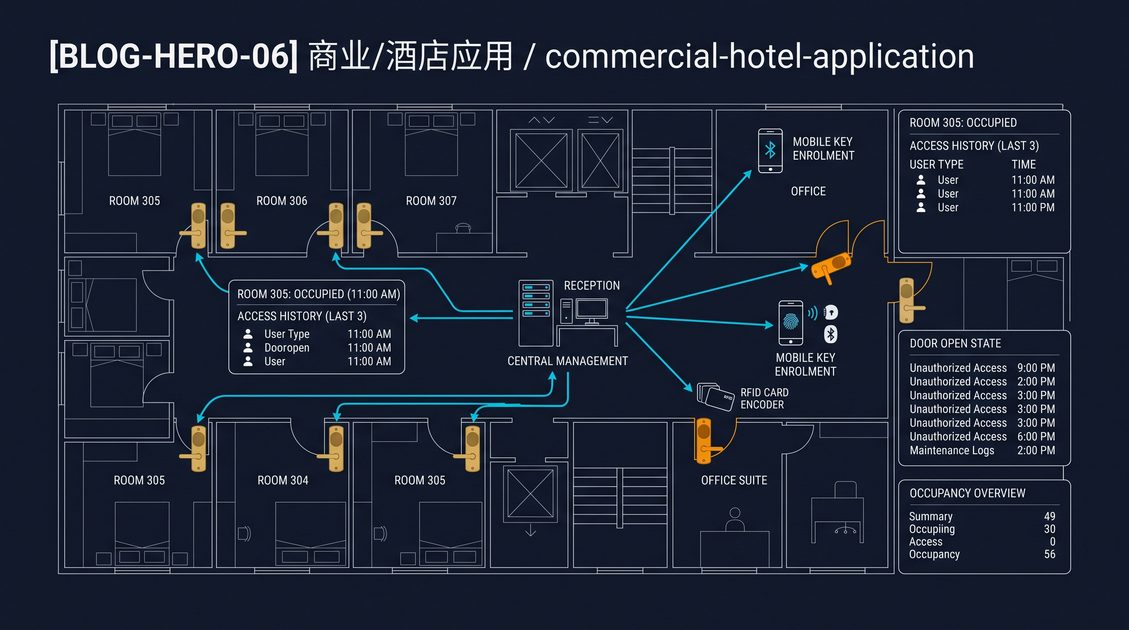
酒店门禁系统是一个完整的网络,用于控制人员在什么时间进入哪些客房、走廊和服务区域,并将电子插芯锁、凭证与管理软件结合起来。它保护宾客、员工和酒店资产,影响入住办理速度,并提供可追溯的审计记录,回答“谁在什么时间进入了哪间客房”等问题。本指南将说明酒店门禁系统的工作方式、锁具与凭证层、安全维护方法,以及如何选择可靠、集成度高且安全的系统。
酒店门禁系统的组成层级
酒店门禁系统由三层组成。第一层是硬件,包括客房门和服务门上的电子插芯锁、读卡器及门五金。第二层是凭证,包括宾客或员工使用的 RFID 卡、手机钥匙或 PIN 码,并设有明确的有效期和使用范围。第三层是软件,即管理平台,用于登记锁具、签发和撤销凭证、设置多级权限、记录审计信息,并与物业管理系统集成,实现自动入住和退房。
酒店门禁系统的优势在于这些层级能够协同工作。宾客获得只在入住期间对指定客房有效的卡片或手机钥匙;客房服务人员在工作班次内获得指定客房的权限;管理人员则可通过一个控制面板查看和管理整个物业。系统属于酒店运营基础设施,其质量决定前台能否快速办理入住、遗失卡片能否在几秒内处理,以及酒店能否应对客房访问争议。
安全、审计与可靠性
酒店门禁系统的安全性建立在加密凭证、本地认证和集中审计之上。凭证应采用加密和分散密钥,不能被普通读卡器轻易复制;锁具应在本地完成认证,因此即使网络中断,卡片仍可正常使用。带时间戳并关联用户身份的集中式审计日志,有助于保障宾客安全、处理争议和满足保险要求。可靠性还需要本地认证、集中电池状态报告,以及机械钥匙或备用电源等应急路径。
系统本身的数据也必须受到保护。凭证、审计日志和宾客信息应安全存储并传输,并通过基于角色的权限控制,确保只有授权员工能够查看进出记录,同时遵守数据保护法规。无论锁具质量多高,如果酒店门禁系统通过薄弱接口暴露数据,或以明文存储凭证,都会削弱整个运营体系的安全性。
如何选择酒店门禁系统
选择酒店门禁系统时,应同时评估锁具、凭证、软件、集成能力和供应商。确认插芯锁经过认证和循环测试,并适用于新建项目或改造项目的门体;确认加密 RFID 和手机钥匙等凭证组合符合宾客需求;确认软件支持多级权限和审计,并能与 PMS 双向、实时集成;同时选择能够对硬件、认证、技术支持和售后备件负责的供应商。
对于重视效率、安全和责任追溯的酒店来说,酒店门禁系统是理想的基础设施,并可通过提高前台效率、减少门禁争议实现投资回报。系统应匹配物业规模,并具备加密凭证、本地认证、集中审计、PMS 集成和可靠供应商。按照这些标准选择,酒店门禁系统就能多年稳定、安全地支撑运营。
酒店门禁系统的价值应以多年运营表现衡量,而不仅是安装时的状态,因此上线后仍需持续复核。随着岗位变化重新检查员工权限,确认审计日志确实被查看而非仅被存储,并在每次固件或平台更新后重新测试应急恢复流程。今天配置良好、明天管理失控的系统,最终会同时带来不便和风险。因此,酒店应为凭证、日志和维护指定明确负责人,并按固定周期进行检查。
确认系统为电量耗尽的手机、遗失卡片或语言沟通障碍等情况提供经过测试的处理路径,并确保前台员工能够快速解决问题而不牺牲安全性。酒店门禁系统的能力,不仅体现在处理常规宾客,也体现在应对特殊情况。应检查事件处理、员工培训和凭证补发速度,确保无论宾客使用何种设备、遇到何种情况,都能顺利进入客房。
酒店门禁系统的硬件层
酒店门禁系统的硬件始于安装在每间客房门上的电子插芯锁。该组件将锁体、读卡器、执行器、处理器和门五金集成在一起。插芯锁体是机械核心,承载锁舌和扣板配合结构。选择时应匹配门体现有的锁孔、中心距和厚度,使改造过程整洁而非破坏性施工。读卡器是凭证进入系统的接口,通常为 RFID 读卡器、键盘,或用于手机钥匙的 Bluetooth 和 NFC 天线。其安装位置和读取距离会影响开锁体验。凭证有效时,执行器释放锁舌;处理器则保存授权表,并在本地判断某张卡或手机在特定时间是否有权开启该门。
门五金将电子设备与宾客体验及酒店整体质感连接起来。内侧把手或执手是日常生命安全释放装置,外侧执手则必须在保持自然使用感的同时不削弱安全性。表面处理、装饰和把手设计在每间客房中都清晰可见,既要符合品牌风格,也要承受多年的高频使用。在机械结构方面,坚固的锁舌、扣板和安装方式能够抵抗强行进入,整个组件还必须保持所安装门体的防火等级。酒店门禁系统的可信度取决于其所依托的实体锁具,因此硬件层同时决定了安全性、寿命和外观。
| 硬件组件 | 作用 | 关键选择因素 |
|---|---|---|
| 插芯锁体 | 机械安全与锁舌控制 | 匹配锁孔、中心距和厚度 |
| 读卡器 | 接收凭证 | RFID、键盘、Bluetooth、NFC |
| 处理器 | 本地验证凭证 | 离线运行、授权表 |
| 执行器 | 释放锁舌 | 可靠性、循环寿命、电池消耗 |
| 门五金 | 面向宾客的把手和装饰 | 表面处理、耐久性、疏散 |
凭证层:卡片、手机钥匙与 PIN 码
凭证是宾客或员工出示的身份令牌。在 RFID 卡、手机钥匙和 PIN 码之间进行选择,会同时影响宾客体验和运营成本。RFID 卡通常工作在 13.56 MHz,靠近读卡器即可使用,速度快、耐用、成本低,而且任何拥有手机的宾客都能使用,因此是大多数酒店的默认选择。手机钥匙是发送到智能手机上的数字凭证,通常通过 Bluetooth Low Energy 工作,可在应用中通过接近或点击开锁,并支持自助、无接触到店,无需前往前台。PIN 码是在键盘上输入的数字代码,适合低流量区域或员工通道,但身份追溯能力较弱,也容易被他人看到或共享。
大多数现代系统会组合使用这些凭证,而不是强制只选一种。酒店可在前台为多数宾客发放 RFID 卡,为选择无接触入住的宾客提供手机钥匙,并将 PIN 码保留给部分服务门和紧急情况。凭证组合应依据宾客画像,而不是追逐潮流:科技型商务酒店可以重点推广手机钥匙,国际休闲酒店则应以卡片为主,同时提供手机选项。生命周期规则与技术本身同样重要:宾客卡只在指定客房和入住期间有效,客房服务人员的凭证只在班次内对指定房间有效,并且所有凭证都应能在几秒内撤销。酒店门禁系统不仅取决于凭证如何开锁,也取决于凭证如何签发和撤销。
软件层与多级权限
软件将一组门锁转变为真正的酒店系统,其质量决定运营能够获得多少收益。酒店门禁平台应允许管理员登记锁具、定义用户和用户组、设置有效期、管理多级权限,并从一个控制面板读取审计日志。多级权限在酒店中非常重要,因为不同员工拥有不同权限:客房服务人员可在班次内进入指定房间,主管可进入某一楼层的全部房间,管理人员则可访问所有区域。软件应清晰建模这些角色,使凭证拥有正确范围,并在岗位或班次结束时撤销,同时集中、可搜索地记录谁在何时进入了哪扇门。
宾客凭证生命周期是软件处理最频繁的工作。入住时,前台发卡设备在几秒内签发宾客卡或手机钥匙;卡片遗失时,撤销旧凭证并编码新凭证;退房时撤销权限;更换客房时即时更新凭证。生命周期越顺畅,前台运行越快,门锁失效事件越少。对于重视自动化的物业,软件应与 PMS 集成,使入住自动签发凭证、退房自动撤销权限,并与客房服务和能源管理系统联动,使房态保持同步。软件层将硬件转化为运营基础设施,而其工作流质量正是员工和宾客真正感受到的部分。
酒店门禁系统中的安全机制
酒店场景下的安全,意味着防止未经授权进入客房、保护宾客隐私,并抵抗凭证复制和绕过锁具。系统应使用加密、分散的卡片密钥抵抗复制,每张卡都使用针对特定锁具和物业生成的密钥进行编码,因此普通 RFID 读卡器无法复制卡片;未加密的低频卡存在风险,应避免使用。锁具与发卡设备之间、手机钥匙通过 Bluetooth 传输时,以及无线管理链路上的通信,都必须加密。手机钥匙还应采用安全传输以及限时或一次性凭证。锁具应本地完成认证,使卡片在网络中断时仍能使用,并保留可靠的机械钥匙应急开启功能。
保护宾客隐私和酒店数据,需要从安全设计出发。凭证、审计日志和宾客信息应安全存储与传输,管理平台应执行基于角色的权限控制,确保只有授权员工能够查看进出记录。对于处理个人数据的酒店,遵守数据保护法规十分重要。相比通过薄弱接口暴露数据的系统,将数据存储在本地服务器或具备适当访问控制的合规云平台通常更合适。机械与硬件安全同样不可缺少:坚固的锁舌、扣板和安装结构能够抵抗强行进入,电子部件应具备防拆能力,并通过 CE、FCC、RoHS 以及 UL 或 ANSI/BHMA 等更高等级认证获得独立验证。只有从宾客手中的卡片到平台中的数据,每个环节都可靠时,酒店门禁系统才真正安全。
审计记录与宾客安全
审计记录是安装酒店门禁系统的重要原因之一,因为它能够回答谁在何时进入了哪间客房。带时间戳并关联用户身份的每次进出记录,可支持宾客安全调查、争议处理、保险理赔和运营复盘,也能帮助酒店应对关于客房访问的错误指控。要真正发挥作用,审计记录必须集中且可搜索,而不能分散在各把锁中;还应按照明确政策保存,并仅允许授权员工读取。没有被查看的日志,只能提供理论上的责任追溯,因此酒店应定期检查审计记录,而不能只是存储它们。
审计记录还能发现运营问题。反复失败的开锁尝试,可能说明卡片失效或有人尝试猜测代码;持续出现的低电量警告,说明某扇门需要在宾客受影响前维护;按时间和楼层检查访问记录,则可发现权限和排班是否符合实际运营。记录成为访问政策得到执行的证据,也使酒店门禁系统从便利工具变成管理控制工具。无论问题涉及物品遗失、异常进入、保险调查还是监管检查,审计日志都是持久的答案。缺少完善审计层的系统,不能算是真正的门禁系统。
走廊中的可靠性与供电
酒店门禁系统必须在其他设备都无法工作时继续运行,因为带着行李站在锁闭客房门前的宾客不会耐心等待网络恢复。因此,酒店插芯锁通常采用本地认证:锁具通过自身授权表验证凭证,无需实时网络连接;读卡器、处理器和执行器则由门内电池供电。这种离线优先设计使前台刚签发的卡片能够立即使用,即使 WiFi、服务器或云平台故障,系统也能继续工作。代价是离线锁需要通过发卡设备、前台主卡或定期同步进行更新,审计数据则会暂存在设备中,直到被收集。
电池管理是酒店锁具群的重要运营问题。酒店插芯锁通常使用电池,常见为 AA 电池,实际续航取决于开锁频率、读卡器类型和无线电使用情况。高流量酒店的客房门可能在几个月至约一年内耗尽电池,而低流量房门的续航更长。系统必须集中报告低电量状态,以便维护人员按计划更换电池;许多锁具还会在门锁上向宾客提示低电量,并通过软件通知员工。一些设计支持备用电源接口,避免电池耗尽导致宾客无法进入,机械钥匙应急开启则仍是通用的最终后备方案。走廊中的可靠性,是离线认证、电池规划和机械质量共同作用的结果;前台运行迅速、走廊却不可靠的系统,就是失败的系统。
酒店门禁系统与 PMS 及其他系统的集成
物业管理系统,即 PMS,是酒店运营的核心。酒店门禁系统只有与 PMS 集成后,才能充分发挥作用。集成意味着门锁软件与 PMS 交换数据,使入住时自动签发客房凭证、退房时撤销凭证,并保持每间客房的状态同步。没有集成,前台必须手动编码卡片,还要将门锁软件作为独立系统管理,这会增加工作量并带来错误,尤其是在决定酒店日常运营节奏的入住和退房环节。集成深度各不相同:基础集成只传递关键事件,深度集成还可传递客房服务状态、启用远程审计,并与能源管理系统同步,在宾客离开后将房间设为空置状态并减少 HVAC 使用。
集成能力必须经过验证,而不能想当然,并且应作为首要选择标准。应询问系统支持哪些 PMS 平台、集成如何交付、是否双向实时,以及供应商是否提供接口和技术支持。某些系统虽然声称支持“PMS 集成”,却需要定制开发、收取持续费用的专有中间件,或依靠手动导入导出;这类系统不如已与物业所使用的 PMS 品牌实现成熟插件式集成的系统。除 PMS 外,酒店还可能希望门锁与楼宇门禁协同,使员工凭证能够跨客房、楼层和入口使用,并与能源和客房服务系统联动。由于 PMS 是业务记录系统,酒店门禁系统必须干净地融入其中,否则酒店每天都要承担不兼容带来的成本。
选择酒店门禁系统与供应商
选择酒店门禁系统时,应同时评估锁具、凭证、软件、集成和供应商。确认插芯锁经过认证、循环测试,并适用于新建或改造门体;确认加密 RFID 和手机钥匙等凭证组合符合宾客画像;确认软件支持多级权限和审计,并与 PMS 双向、实时集成;同时选择能够对硬件、认证、技术支持和售后备件负责的供应商。供应商关系与硬件同样重要,因为酒店系统通常安装一次、运行多年,所以可靠性、支持能力、备件供应和售后响应,比小幅价格差异更重要。
选择供应商时,也应像验证硬件一样进行核查。确认制造商资质,要求提供相近规模酒店的参考项目,询问质保、备件、技术文档和培训,并确认供应商能够支持系统完整生命周期。酒店门禁项目的成本包括每扇门硬件、安装、持续凭证成本和软件订阅费等多个层面。本指南建议基于合理使用周期,计算每扇门的总拥有成本,而不是只比较单价。对于重视效率、安全和责任追溯的酒店,酒店门禁系统是理想的基础设施;直接向智能插芯锁制造商采购,还能让物业在整个项目中拥有一个明确负责的合作伙伴。
新建项目、改造项目与门体兼容性
实体安装环境会影响酒店门禁选择,新建项目和改造项目通常需要不同方案。在新建项目中,门体和锁具可以一起设计,因此酒店拥有更大的自由度,可选择插芯锁外形、表面处理、把手套件和电子配置,并提前规划电源和网络基础设施。改造项目更常见,也更受限制,因为大多数酒店需要升级现有门体。关键问题是现有门体是否具有可供新电子锁复用的插芯锁孔,从而保留原把手套件和外观;如果外形规格改变,则可能需要重新开孔,这对实芯门或防火门而言属于专业施工。
酒店物业还包含多种门型,酒店门禁系统必须全部适配。除标准客房插芯锁外,酒店通常还需要走廊门、楼梯间门、防火门、服务门、客房服务间和主入口设备,并为每类门配置适当权限;对于防火门,硬件还必须保持原有防火等级。兼容性也包括表面处理和门五金:锁具表面、把手套件和装饰必须符合品牌风格,并能承受高频宾客使用。选择系统前应进行门体审计,确认锁体系列、中心距、厚度、开门方向和防火等级,并据此判断项目属于直接替换还是改造项目。本指南建议提前明确门型、表面处理和系统集成要求,避免日后形成高成本的拼凑方案。
结论:支撑酒店运营的门禁系统
本指南介绍了酒店门禁系统的工作方式,涵盖插芯锁与凭证层、软件、安全、审计、可靠性、集成和供应商选择。核心建议是选择一套能够在门端稳定认证、保存加密凭证和安全审计记录、应对网络与电池故障、与 PMS 及更广泛楼宇系统顺畅集成,并由能够对完整生命周期负责的供应商提供的系统。酒店门禁系统可以通过提高前台效率和减少门禁争议实现投资回报,而正确选择的系统还能多年保护宾客体验和酒店运营安全。
应将本指南作为技术规格使用。确认插芯锁采用离线优先设计,并检查其电池与应急进入方案;选择适合宾客的凭证组合;验证真实 PMS 集成;要求集中审计和多级权限;选择能够多年承担责任的制造商。预算应覆盖完整生命周期,包括凭证、电池更换和管理平台订阅费,并在上线后按计划复核系统,使权限、日志和维护持续保持最新。按照这种方式选择的酒店门禁系统,会成为融入顺畅、快速、安全宾客体验中的运营基础设施,这正是投资的全部意义。
从入住到退房的宾客旅程
宾客对酒店门禁系统的感受,最直接地体现在整个入住旅程中,而良好集成的系统会让每一步都自然无感。入住时,前台或自助终端发放卡片或手机钥匙,凭证仅在指定客房和入住期间有效;如果系统已与 PMS 集成,发放过程还可自动完成,无需单独编码。宾客走到客房后使用卡片或手机开锁,锁具在本地完成认证并快速开启。入住期间,如果需要换房、延住或补发遗失卡片,系统可在几秒内撤销旧凭证并签发新凭证。退房时,访问权限在正确时间结束,凭证被撤销,宾客无法再次进入客房。
特殊情况最能体现系统质量。提前到店、遗失卡片、手机没电或不会使用当地语言的宾客,都会考验前台工作流和备用路径。能够为提前到店宾客签发临时凭证、在几秒内补发遗失卡片、在电子方式失效时通过机械应急方式开门,并以最少阻碍引导困惑宾客的系统,才能在最脆弱的时刻保护宾客体验。酒店门禁系统的真正标准,是它如何处理遇到问题的宾客,而不是如何服务一切顺利的宾客。
客房服务与员工凭证管理
除宾客外,酒店门禁系统还管理着全天在建筑内移动的员工队伍,员工凭证管理是系统价值的重要组成部分。客房服务人员需要在班次内进入指定房间,主管需要进入某楼层全部房间,维修人员需要进入服务区域,管理人员需要最广泛的权限。多级权限模型应为每类人员分配正确范围,并在班次或岗位结束时撤销权限。只允许客房服务人员在指定班次进入指定房间的凭证,能够避免使用不便,也能降低超范围访问风险。系统应让管理员可以轻松调整班次和房间组,并在员工离职时立即撤销凭证。
同样的管理方式也适用于承包商、临时员工和应急响应人员。承包商可获得仅在工单规定时间内有效的凭证,急救人员则可通过记录完整的应急路径获得权限,而不破坏审计记录。每张员工凭证都应关联具体身份,使审计日志能够说明谁在何时进入了哪扇门;平台还应支持基于角色的权限控制,确保只有授权管理员能够签发或撤销凭证。良好管理员工凭证的酒店门禁系统,既能降低过度授权风险,也能减少权限不足造成的运营阻碍,这正是系统实现投资回报的重要原因。
能源、客房服务与楼宇集成
酒店门禁系统的完整价值不止于门锁,还延伸至维持楼宇高效运行的其他系统。当门锁报告客房无人占用时,能源管理系统可将房间设为空置状态,减少 HVAC 和照明使用,在没有宾客时降低能源账单。宾客到达并开门后,房间恢复为有人状态,空调控制重新运行,使房间在使用时舒适、空置时节能。客房服务集成也以类似方式工作:门状态显示房间何时空置并可以清洁,从而协调员工路线和房间准备完成信号。
这种集成依赖门禁平台与其他系统清晰交换数据,因此接口和供应商支持与硬件同样重要。与物业实际使用的能源、客房服务和楼宇管理平台实现成熟集成的系统,能够每天节省员工时间和能源;需要定制开发或人工操作的系统,则会持续产生额外成本。当门锁、能源系统、客房服务系统和 PMS 共享统一房态信息时,物业就能像一台协调一致的机器运行。酒店门禁系统的最佳状态,是成为连接客房、宾客和楼宇的神经系统。
应急进入、反锁与旁路流程
酒店门禁系统必须为紧急情况、反锁以及各种故障模式提供经过测试的处理方案,因为这些时刻会同时考验安全与生命保障。机械钥匙应急开启仍是通用的最终后备方案:电池耗尽、卡片失效、手机没电或电子部件故障时,持有主钥匙或应急权限的员工仍可开启房门。一些锁具还配备备用电源接口,避免电池耗尽导致宾客被困在门外;系统也应集中报告低电量,以便维护人员在故障前到达。应急路径必须形成文档、完成培训并定期测试,因为无人掌握使用方法的备用方案并不是真正的备用方案。
反锁是酒店每天都会遇到的情况,系统必须快速解决。遗失卡片或手机没电而被锁在门外的宾客,需要在几秒内获得新凭证,而不是等待漫长的维修电话。忘记班次变化或凭证过期的员工,也需要简单且经过授权的重新签发流程。前台工作流应在不绕过安全措施的情况下处理常规反锁,审计日志还应记录每次补发和应急开启,使任何旁路操作都可追溯。应急和反锁流程体现了酒店门禁系统能否赢得宾客与员工信任,酒店应在系统健康时定期复核和演练,而不是等危机发生后才临时设计。
培训、治理与持续运营
酒店门禁系统的价值应以多年运行表现衡量,而不只是安装时的状态,因此上线后仍需持续复核。随着岗位变化重新检查员工权限,确认审计日志确实被阅读而不只是存储,并在每次固件或平台更新后重新测试应急恢复。今天配置良好、明天治理不善的系统,最终会同时带来不便和风险。因此,物业应为凭证、日志和维护指定明确负责人,并按固定周期进行检查。培训与技术同样重要:前台员工必须能够顺畅签发、补发和撤销凭证;客房服务人员必须正确使用凭证流程;管理人员必须阅读审计信息并处理其中反映的规律。
同样的纪律也适用于供应商关系。通过受控流程保持固件更新,保存文档和备件库存,并将供应商支持能力及更新节奏纳入运营检查。随着物业扩建、增加楼栋或改变宾客结构,酒店门禁系统也应重新评估,以确认其仍能适应新楼层、新凭证要求和新集成需求。最强的酒店门禁系统并不是安装时功能最多的系统,而是能够在完整服务周期内被负责任地运营的系统;这一结果既取决于硬件,也取决于围绕硬件建立的人员和流程。
酒店门禁系统采购清单
对于采购方或进口商,选择酒店门禁系统应依据书面清单,而不是销售演示。首先进行门体审计,确认每扇客房门和服务门的插芯锁系列、中心距、厚度、开门方向和防火等级,并判断项目属于直接替换还是改造项目。确认加密 RFID 和手机钥匙等凭证组合符合宾客画像及物业需要支持的员工角色。确认软件支持多级权限和审计,并与 PMS 双向、实时集成;还要根据物业实际使用的 PMS 品牌验证集成效果。确认锁具采用离线优先设计,具备电池状态报告和应急路径;同时根据具体型号核实 CE、FCC、RoHS 以及 UL 或 ANSI/BHMA 等认证。
完成清单时,应按生命周期而不是单价进行核算。估算每扇门硬件、安装、持续凭证成本、电池更换和管理平台订阅费,并比较不同供应商五年期每扇门总拥有成本。核实供应商资质,要求提供相近规模酒店的参考项目,确认质保、备件、技术文档和培训,并独立验证参考案例,而不是只接受宣传评价。对于批量采购方或进口商,还应确认标准锁和定制锁的 MOQ,以书面形式确定交期,并明确付款条件和售后备件供应。按照这份清单选择的酒店门禁系统,能够适配门体、服务宾客,并支持多年运营维护;这种严谨流程正是一次普通采购与长期资产之间的区别。
由于系统会影响每一次宾客入住,并持续运行多年,决策速度应与其重要性相匹配。不要只依据价格或功能列表采购,而应在确定大批量订单前,先在具有代表性的门体上试用候选系统,测试实际开锁速度、低电量处理流程和 PMS 事件。通过试点确认规格书中的承诺能否在物业真实门体和实际运营中成立,并据此最终确定规格和总拥有成本。本指南旨在将这一过程明确化,而不是任其依赖直觉,从而确保最终选择的酒店门禁系统能够在建筑完整生命周期内,干净、安全且经济地支撑运营。
本文部分内容由 AI 生成,并针对专业准确性和可读性进行了优化。 A hotel access control system is the complete network that controls who can enter which guest room, corridor, and service area at which time, combining electronic mortise locks, credentials, and management software. It protects guests, staff, and property, determines the speed of check-in, and provides the audit trail that answers who-entered-which-room questions. This guide explains how a hotel access control system works, the lock and credential layers, how security is maintained, and how to choose a system that is reliable, integrated, and secure.
The Layers of a Hotel Access Control System
A hotel access control system operates across three layers. The first is the hardware: the electronic mortise locks on guest-room and service doors, the readers, and the door furniture. The second is the credential: the RFID card, mobile key, or PIN that a guest or staff member uses, issued with a defined validity and scope. The third is the software: the management platform that enrolls locks, issues and revokes credentials, sets multi-level access, and records an audit, and that integrates with the property-management system for automated check-in and check-out.
The strength of a hotel access control system is that these layers work as one. A guest receives a card or mobile key valid only for the room and the stay; a housekeeper receives access to defined rooms during a shift; management can view and control the whole property from one dashboard. The system is operational infrastructure, and its quality determines whether the front desk moves fast, whether a lost card is resolved in seconds, and whether the hotel can defend a question about room access.
Security, Audit, and Reliability
Security in a hotel access control system rests on encrypted credentials, local authentication, and centralized audit. Credentials should be encrypted, diversified keys that cannot be cloned by a simple reader, and the lock should authenticate locally so a card works even through a network outage. A centralized, timestamped audit log with user attribution supports guest safety, dispute resolution, and insurance. Reliability requires local authentication, central battery reporting, and a mechanical key or backup power as an emergency path.
The system should also protect its own data. Credentials, audit logs, and guest information should be stored and transmitted securely, with role-based access so only authorized staff see entry records, and compliance with data-protection regulations. A hotel access control system that exposes data through weak interfaces, or that stores plaintext credentials, undermines the security of the whole operation regardless of the lock quality.
Choosing a Hotel Access Control System
When choosing a hotel access control system, evaluate the locks, the credentials, the software, the integration, and the supplier together. Confirm the mortise locks are certified, cycle-tested, and fit your door for new build or retrofit; confirm the credential mix, encrypted RFID and mobile key, matches your guests; confirm the software manages multi-level access and audit and integrates with your PMS bidirectionally and in real time; and select a supplier accountable for hardware, certification, support, and after-sales parts.
A hotel access control system is the right backbone for any hotel that values speed, security, and accountability, and it pays for itself in front-desk efficiency and the prevention of access disputes. Match the system to the property size, require encrypted credentials, local authentication, centralized audit, PMS integration, and a reliable supplier. Apply these criteria, and a hotel access control system will run your operation cleanly and securely for years.
A hotel access control system is judged over years, not at installation, so the review should continue after go-live. Recheck staff permissions as roles change, verify that audit logs are being read rather than merely stored, and re-test emergency recovery after every firmware or platform update. A system that is well configured today and poorly governed tomorrow drifts into both inconvenience and risk, so assign clear owners for credentials, logs, and maintenance and review them on a fixed schedule.
Confirm the system includes a tested path for a guest who arrives with a dead phone, a lost card, or a language barrier, and that front-desk staff can resolve these quickly without compromising security. A hotel access control system is measured by how it handles the exceptional guest, not only the routine one. Review incident handling, staff training, and the speed of reissuing credentials so every guest, whatever their device or situation, reaches the room without friction.
The Hardware Layer of a Hotel Access Control System
The hardware of a hotel access control system begins with the electronic mortise lock fitted to each guest-room door, an assembly that combines a lock body, a reader, an actuator, a processor, and door furniture in one unit. The mortise lock body is the mechanical heart, a strong case that carries the bolt and the strike engagement, and it is chosen to fit the door's existing mortise pocket, backset, and thickness so that retrofit is clean rather than destructive. The reader is the point of entry for the credential, most commonly an RFID reader, a keypad, or a Bluetooth and NFC antenna for mobile keys, and its placement and range shape the unlock experience. The actuator releases the bolt when the credential is valid, and the processor holds the authorization table that decides, locally, whether a card or phone is authorized for that door at that time.
The door furniture links the electronics to the guest-facing experience and the feel of the property. The inside handle or lever is the everyday life-safety release, and the outside lever must not compromise security while remaining natural to use. The finish, trim, and handle design are visible in every room and must match the brand aesthetic while surviving years of heavy guest use. On the mechanical side, a robust bolt, strike, and mounting resist forced entry, and the entire assembly must preserve the fire rating of the door it is mounted to. A hotel access control system is only as trustworthy as the physical lock it sits on, so the hardware layer is where security, longevity, and appearance are decided together.
| Hardware element | Role | Key selection factor |
|---|---|---|
| Mortise lock body | Mechanical security and bolt | Fit to pocket, backset, thickness |
| Reader | Accepts the credential | RFID, keypad, Bluetooth, NFC |
| Processor | Validates credential locally | Offline operation, authorization table |
| Actuator | Releases the bolt | Reliability, cycle life, battery draw |
| Door furniture | Guest-facing handles and trim | Finish, durability, egress |
The Credential Layer: Cards, Mobile Keys, and PINs
The credential is the token a guest or staff member presents, and the choice among RFID cards, mobile keys, and PINs shapes both the guest experience and the operating cost. An RFID card, most commonly operating at 13.56 MHz, is presented to the reader, is fast, durable, inexpensive, and works for any guest with any phone, which makes it the default for most hotels. A mobile key is a digital credential delivered to the smartphone, usually over Bluetooth Low Energy, that unlocks by proximity or a tap in the app and enables self-service, contactless arrival without a stop at the front desk. A PIN is a numeric code entered on a keypad, useful for low-traffic or staff openings but weak on attribution and vulnerable to being observed or shared.
Most modern systems use the credentials together rather than forcing one. A hotel leads with an RFID card at the desk for the majority of guests, offers a mobile key to guests who opt into contactless arrival, and reserves PINs for selected service doors and emergencies. The credential mix should follow the guest profile, not fashion: a tech-forward business hotel may push mobile keys, while an international leisure hotel should lead with the card and offer mobile as an option. The lifecycle rules matter as much as the technology, a guest card is valid only for the room and the stay, a housekeeper's credential is valid only for a defined room set during a shift, and every credential is revocable in seconds. A hotel access control system is defined as much by how credentials are issued and revoked as by how they unlock.
The Software Layer and Multi-Level Access
The software is the layer that turns a set of door locks into a hotel system, and its quality determines how much the operation benefits. A hotel access control platform lets an administrator enroll locks, define users and groups, set validity periods, manage multi-level access, and read audit logs from one dashboard. Multi-level access matters in a hotel because different staff have different rights: a housekeeper accesses a defined set of rooms during a shift, a supervisor accesses all rooms on a floor, and management accesses everything. The software should model these roles cleanly so that credentials are issued with the correct scope and revoked when a role or shift ends, and it should keep a centralized, searchable audit record of who entered which door and when.
The guest credential lifecycle is the busiest workload the software handles. A front-desk encoder issues a guest card or mobile key in seconds at check-in, a lost card is reissued by revoking the old credential and encoding a new one, a check-out revokes access, and a room change updates the credential instantly. The smoother this lifecycle, the faster the desk operates and the fewer lockouts occur. For a property that values automation, the software integrates with the property-management system so that check-in issues the credential and check-out revokes it automatically, and with housekeeping and energy management so that a room status stays in sync. The software layer converts hardware into an operating infrastructure, and its workflow quality is what staff and guests actually experience.
Security in a Hotel Access Control System
Security in a hotel context means preventing unauthorized room entry, protecting guest privacy, and resisting credential cloning and lock bypass. A system resists cloning through encrypted, diversified card keys, each encoded with a key derived for the specific lock and property, so a simple RFID reader cannot clone a card; unencrypted low-frequency cards are vulnerable and should be avoided. The radio communication, between the lock and the encoder, the mobile key over Bluetooth, and the wireless management link, must be encrypted, and a mobile key should use secure transport and a time-limited or one-time credential. The lock should authenticate locally so that a card works even through a network outage, and it should retain a robust mechanical key override for emergencies.
Protecting guest privacy and the hotel's data exposure follows from secure design. Credentials, audit logs, and guest information should be stored and transmitted securely, and the management platform should enforce role-based access so that only authorized staff see entry records. For hotels handling personal data, compliance with data-protection regulations matters, and a system that stores data on a local server or in a compliant cloud with proper access controls is preferable to one that exposes data through weak interfaces. Mechanical and hardware security complete the picture: a robust bolt, strike, and mounting resist forced entry, and the electronics resist tampering, with certification, CE, FCC, RoHS, and higher grades such as UL or ANSI/BHMA, giving independent verification. A hotel access control system is secure when every link, from the card in the guest's hand to the data in the platform, holds.
Audit Trails and the Guest-Safety Case
The audit trail is one of the strongest reasons to install a hotel access control system, because it answers the question of who entered which room and when. A timestamped, user-attributed record of every entry supports guest-safety investigations, dispute resolution, insurance claims, and operational reviews, and it protects the property against a false accusation about room access. To be useful, the audit must be centralized and searchable rather than scattered on individual locks, retained under a clear policy, and readable only by authorized staff. A system whose logs are never read is a system whose accountability is theoretical, so the hotel should regularly review the audit, not merely store it.
The audit trail also surfaces operational issues. A pattern of failed attempts flags a card that is failing or a code being guessed, a recurring low-battery alert flags a door that needs service before a guest is stranded, and a review of access by time and floor reveals whether permissions and schedules match the actual operation. The record becomes the evidence that the access policy is enforced, and it turns a hotel access control system from a convenience into a control. Whether the question is a missing item, an unexpected entry, an insurance inquiry, or a regulatory inspection, the audit log is the durable answer, and a system that omits a proper audit layer is not really an access control system at all.
Reliability and Power in the Corridor
A hotel access control system must work when nothing else does, because a guest standing at a locked room door with luggage has no patience for a network outage. Hotel mortise locks are therefore designed to authenticate locally: the lock validates the credential against its own authorization table without needing a live network connection, and the reader, processor, and actuator run on batteries inside the door. This offline-first design is what makes a card issued at the desk work immediately and keeps the system functional even if the WiFi, the server, or the cloud platform fails. The trade-off is that offline locks must be updated, typically by an encoder or a master card at the front desk or by a periodic sync, and audit data accumulates on the device until it is collected.
Battery management is a defining operational concern for a hotel lock fleet. A hotel mortise lock typically runs on batteries, commonly AA cells, for a period that depends on unlock frequency, reader type, and radio use; a high-traffic hotel door can drain batteries in several months to about a year, while a low-traffic door lasts longer. A system must report low-battery status centrally so that maintenance replaces cells on schedule, and many locks provide a low-battery warning to the guest on the lock itself and to staff via the software. Some designs support a backup power terminal so a dead battery does not strand a guest, and the mechanical key override remains the universal final fallback. Reliability in the corridor is the sum of offline authentication, battery planning, and mechanical quality, and a system fast at the desk but unreliable in the corridor is a failure.
Integrating the Hotel Access Control System with the PMS and Beyond
The property-management system, or PMS, is the operational heart of a hotel, and a hotel access control system is only fully useful when it integrates with it. Integration means the door-lock software exchanges data with the PMS so that check-in issues the room credential automatically, check-out revokes it, and the status of each room stays in sync. Without integration, the front desk must encode cards manually and manage the door-lock software as a separate silo, which doubles the work and invites errors, especially for the check-in and check-out events that define a hotel's day. The depth of integration varies, from a shared interface that passes the essential events to a deeper integration that also passes housekeeping status, enables remote audit, and synchronizes with energy management to set a room unoccupied and cut HVAC use when a guest leaves.
Integration capability should be verified, not assumed, and it is a top selection criterion. Ask which PMS platforms the system integrates with, how the integration is delivered, whether it is bidirectional and real-time, and whether the vendor provides the interface and support. A system that claims "PMS integration" but requires custom development, a proprietary middleware with recurring fees, or manual export-import is weaker than one with a proven, plug-in integration to the PMS brands the property runs. Beyond the PMS, a hotel may want the door lock to work with building access, so staff credentials work across rooms, floors, and entrances, and with energy and housekeeping systems. Because the PMS is the system of record, the hotel access control system must fit into it cleanly or the operation will carry the cost of the mismatch every day.
Choosing a Hotel Access Control System and Supplier
When choosing a hotel access control system, evaluate the locks, the credentials, the software, the integration, and the supplier together. Confirm the mortise locks are certified, cycle-tested, and fit the doors for new build or retrofit; confirm the credential mix, encrypted RFID and mobile key, matches the guest profile; confirm the software manages multi-level access and audit and integrates with the PMS bidirectionally and in real time; and select a supplier accountable for hardware, certification, support, and after-sales parts. The supplier relationship is as important as the hardware, because a hotel system is deployed once and operated for years, so reliability, support, spare-parts availability, and after-sales responsiveness matter more than a small price difference.
The choice of supplier should follow the same verification as the hardware. Verify the manufacturer's credentials, request reference installations at hotels of comparable size, ask about warranty, spare parts, technical documentation, and training, and confirm that the supplier can support the full lifecycle of the system. Cost in a hotel access control project has several layers, the hardware per door, installation, recurring credential costs, and the recurring software fee, and this guide recommends calculating a total cost of ownership per door over a realistic horizon rather than comparing only the unit price. A hotel access control system is the right backbone for any hotel that values speed, security, and accountability, and buying directly from a manufacturer of smart mortise locks gives the property a single accountable partner across the project.
New Build vs Retrofit and Door Compatibility
The physical installation context shapes the hotel access control decision, and new build and retrofit lead to different choices. In a new build, the door and the lock are specified together, so the hotel has the widest freedom to choose the mortise lock form factor, finish, handle set, and electronic configuration, with power and network infrastructure planned in advance. Retrofit is the more common and more constrained case, because most hotels upgrade an existing door, and the key question is whether the existing door has a mortise pocket that a new electronic lock reuses, preserving the handle set and appearance, or whether the form factor change requires cutting a new pocket, a professional job on solid-core or fire-rated doors.
A hotel property also spans multiple door types, and a hotel access control system must fit them all. Beyond standard guest-room mortise locks, a hotel typically needs devices for corridor doors, stairwell doors, fire doors, service and housekeeping rooms, and the main entrance, each with the appropriate access rights and, on fire doors, hardware that preserves the fire rating. Compatibility also spans finish and furniture: the lock finish, handle set, and trim must match the brand aesthetic and survive heavy guest use. Conduct a door audit before selecting any system, confirming lock body family, backset, thickness, handedness, and fire rating, and use it to decide whether the project is a clean drop-in or a modification project. This guide recommends specifying for door types, finishes, and system integration up front to avoid a costly patchwork later.
Conclusion: A Hotel Access Control System That Runs the Operation
This guide has explained how a hotel access control system works, from the mortise lock and credential layers through the software, security, audit, reliability, integration, and supplier selection. The unifying recommendation is to choose a system that authenticates reliably at the door, keeps encrypted credentials and a secure audit trail, works through network and battery failures, integrates cleanly with the PMS and the broader building, and comes from a supplier accountable for the whole lifecycle. A hotel access control system pays for itself in front-desk efficiency and the prevention of access disputes, and a well-chosen system protects both the guest experience and the operation's security posture over years of service.
Apply this guide as a specification. Confirm the offline-first mortise lock and its battery and emergency-access design, choose a credential mix matched to your guests, verify real PMS integration, require centralized audit and multi-level access, and select a manufacturer you can hold accountable for years. Budget for the full lifecycle, including credentials, battery replacement, and the management-platform subscription, and review the system on a schedule after go-live so that permissions, logs, and maintenance stay current. A hotel access control system chosen this way is operational infrastructure that disappears into smooth, fast, secure guest stays, and that is the entire point of the investment.
The Guest Journey from Check-In to Check-Out
A hotel access control system is experienced most vividly through the guest journey, and a well-integrated system makes every step invisible. At check-in, the front desk or a kiosk issues a credential, a card or a mobile key, valid only for the assigned room and the duration of the stay, and in a system with PMS integration this happens automatically without a separate encoding step. The guest walks to the room and unlocks with a card or phone, and the lock, having authenticated locally, opens without delay. Mid-stay, a room change, an extension, or a replacement for a lost card is handled in seconds, with the old credential revoked and the new one issued. At check-out, access ends exactly when it should, revoking the credential so the room cannot be re-entered.
The exceptional cases define the quality of the system. A guest who arrives before check-in, a guest who loses the card, a guest whose phone is dead, a guest who does not speak the local language, each is a test of the front-desk workflow and the fallback paths. A system that issues a temporary credential for an early arrival, reissues a lost card in seconds, opens a door on mechanical override when no electronic method works, and guides a confused guest with minimal friction is a system that protects the guest experience at its weakest moments. The measure of a hotel access control system is how it handles the guest for whom something goes wrong, not the guest for whom everything goes right.
Housekeeping and Staff Credential Management
Beyond guests, a hotel access control system manages a workforce that moves through the building all day, and staff credential management is a large part of its value. Housekeepers need access to a defined set of rooms during a shift, supervisors need access to all rooms on a floor, maintenance needs access to service areas, and management needs the broadest authority, and the multi-level access model issues each of these with the correct scope and revokes them when the shift or role ends. A housekeeper's credential that works only for the assigned rooms, during the assigned shift, prevents both inconvenience and the risk of access beyond an authorization. The system should make it trivial to change a shift assignment or a room set and to revoke a credential the moment an employee leaves.
The same management applies to contractors, temporary staff, and emergency responders. A contractor can be given a credential valid for the hours of a work order and no more, and a first responder can be granted access through a documented emergency path without compromising the audit record. Every staff credential should be attributable, so that the audit log can say who entered which door and when, and the platform should support role-based access so that only authorized administrators can issue or revoke. A hotel access control system that manages staff credentials well protects the operation from both the risk of over-authorization and the friction of under-authorization, and it is a large part of why the system pays for itself.
Energy, Housekeeping, and Building Integration
The full value of a hotel access control system extends beyond the door to the systems that keep the building running efficiently. When the door lock reports that a room is unoccupied, the energy management system can set the room to an unoccupied state, cutting HVAC use and lighting and reducing the property's energy bill while no guest is present. When a guest arrives and unlocks the door, the room returns to an occupied state and the climate control resumes, so that the room is comfortable exactly when it is used and economical exactly when it is not. Housekeeping integration works the same way, with the door status indicating when a room is vacant and ready to be serviced, coordinating the housekeeper's route and the room-ready signal.
This integration depends on the access control platform exchanging data cleanly with the other systems, which is why the interface and the vendor support matter as much as the hardware. A system with proven integration to the energy, housekeeping, and building-management platforms the property runs saves staff time and energy every single day; a system that requires custom development or manual steps carries that cost indefinitely. When the door lock, the energy system, the housekeeping system, and the PMS all share a single view of room status, the property operates as one coherent machine. A hotel access control system is at its best when it is the nervous system that connects the room, the guest, and the building.
Emergency Access, Lockout, and Override Procedures
A hotel access control system must have a tested answer for emergencies, lockouts, and every failure mode, because these are the moments when security and safety are tested together. The mechanical key override remains the universal final fallback: when a battery dies, a card fails, a phone is dead, or the electronics malfunction, a staff member with the master key or an override can open the door. Some locks add a backup power terminal, so a dead battery does not strand a guest at the door, and the system should report low battery centrally so that maintenance reaches the door before it fails. The emergency path should be documented, trained, and tested, because a fallback that no one knows how to use is not a fallback at all.
Lockouts are a daily reality that the system must resolve quickly. A guest locked out with a lost card or a dead phone needs a new credential in seconds, not a maintenance call that drags on. A staff member who forgets a shift change or whose credential expired needs a simple, authorized reissue. The front-desk workflow should handle the routine lockout without security shortcuts, and the audit log should record every reissue and override so that no bypass goes unobserved. The emergency and lockout procedures are where a hotel access control system earns the trust of both guests and staff, and they should be reviewed and drilled on a schedule while the system is healthy, not invented at the moment of crisis.
Training, Governance, and Ongoing Operation
A hotel access control system is judged over years, not at installation, so the review should continue after go-live. Recheck staff permissions as roles change, verify that audit logs are being read rather than merely stored, and re-test emergency recovery after every firmware or platform update. A system that is well configured today and poorly governed tomorrow drifts into both inconvenience and risk, so the property should assign clear owners for credentials, logs, and maintenance and review them on a fixed schedule. Training matters as much as technology: front-desk staff must issue, reissue, and revoke credentials without friction, housekeeping must use the credential workflow correctly, and management must read the audit and act on its patterns.
The same discipline applies to the vendor relationship. Keep firmware current through a controlled process, preserve documentation and spare-parts stock, and review the supplier's support and update cadence as part of the operation. As the property grows, adds buildings, or changes its guest mix, the access control system should be re-evaluated so that it continues to fit, a new floor, a new credential requirement, a new integration. The strongest hotel access control system is not the one with the most features at installation; it is the one that is operated responsibly for its full service life, and that outcome depends on the people and the processes around the hardware as much as on the hardware itself.
A Purchasing Checklist for a Hotel Access Control System
For a buyer or an importer, the selection of a hotel access control system should follow a documented checklist rather than a sales presentation. Begin with the door audit, confirming the mortise lock family, backset, thickness, handedness, and fire rating of every room and service door, and decide whether the project is a clean drop-in or a modification project. Confirm the credential mix, encrypted RFID and mobile key, matches the guest profile and the staff roles the property must support. Confirm the software manages multi-level access and audit and integrates with the PMS bidirectionally and in real time, and verify the integration against the actual PMS brands the property runs. Confirm the offline-first lock, its battery reporting, and its emergency path, and confirm the certifications, CE, FCC, RoHS, and higher grades such as UL or ANSI/BHMA, against the exact model.
Complete the checklist by pricing the lifecycle rather than the unit. Estimate the hardware cost per door, installation, recurring credential costs, battery replacement, and the management-platform subscription, and compare a five-year total cost of ownership per door across suppliers. Verify the supplier's credentials, request reference installations at hotels of comparable size, confirm warranty, spare parts, technical documentation, and training, and validate the references rather than accepting a testimonial. For a volume buyer or importer, confirm the MOQ for the standard and customized lock, commit the lead time in writing, and clarify payment terms and after-sales parts supply. A hotel access control system chosen against this checklist fits its doors, serves its guests, and can be operated and maintained for years, and that disciplined process is the difference between a purchase and a durable asset.
Because the system touches every guest stay and stays in place for years, the pace of the decision should match its importance. Resist buying on price or feature lists alone, and instead pilot the shortlisted systems on a representative set of doors before committing the full order, testing the real unlock speed, the low-battery workflow, and the PMS events. Use the pilot to confirm that the claims on the spec sheet hold on the property's actual doors and in its actual operation, and use the results to finalize the specification and the total cost of ownership. This guide is intended to make that process explicit rather than leaving it to instinct, so that the hotel access control system chosen is the one that runs the operation cleanly, securely, and economically for the full life of the building.
Part of this article content is generated by AI and optimized for professional accuracy and readability.
不确定哪款传感器适合您的项目?
与我们的毫米波应用工程师免费咨询。