门把手与死锁套装选购指南:打造安全门锁方案
本门把手与死锁套装指南帮助您匹配门锁五金、门体预留、访问需求、疏散规范、安装细节与维护计划,确保安全、易用并适配实际门体。
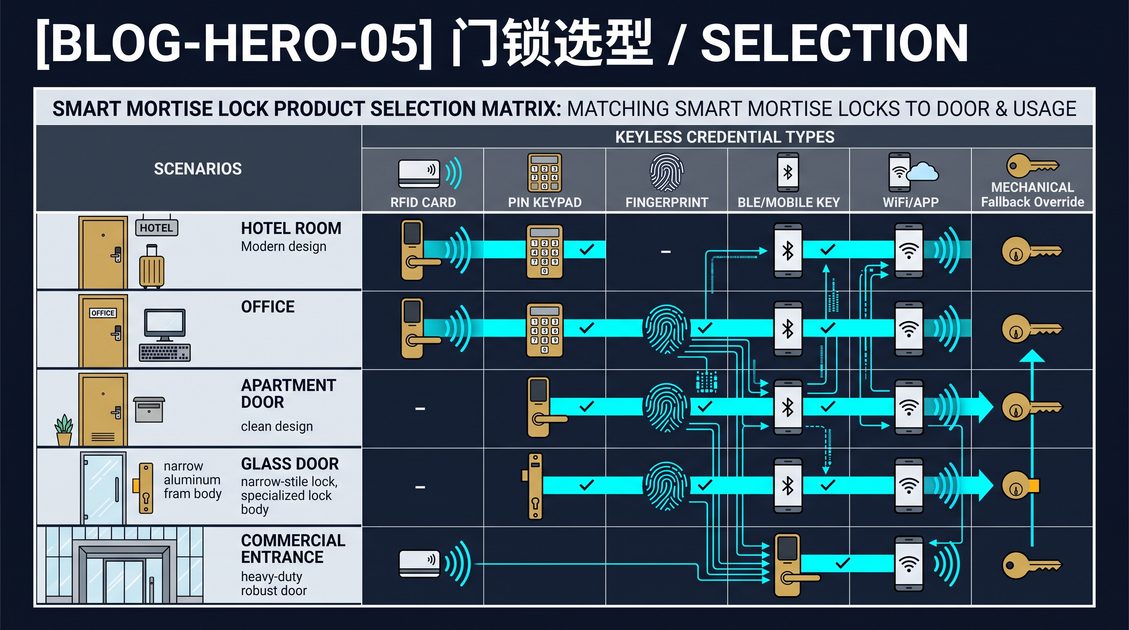
门把手与死锁套装选购指南帮助业主选择功能协调的门锁,而不是仅凭外观判断五金件。门把手或执手通常通过弹簧锁舌控制通行;门扇关闭后,死锁则增加更长的锁栓,可抵御常见的撑门和撬动力量。合适的组合仍取决于门体、门框、铰链、锁扣板、使用者以及当地安全规范。下单前,应确认门体材质、厚度、中心距、锁孔尺寸、开门方向和现有预留孔。随后确定入口是否需要钥匙访问、旋钮、密码输入或受管理的凭证。再坚固的套装也无法弥补薄弱的门框或松动的铰链。本指南提供一套实用流程,帮助您比较适配性、安全性、易用性、安装和持续服务能力,避免将住宅外观产品默认视为适合所有门体的方案。
门把手与死锁套装的功能
门把手与死锁套装将日常闭合与主动上锁分开。门扇关闭时,弹簧锁舌会进入锁扣,用户可从内侧转动门把手或执手将其收回。它使用方便,但并不是主要的安全屏障。死锁需要手动或电子方式伸出,并应进入门框中经过适当加固的锁扣板。对于卧室、办公室、出租单元和员工区域而言,这一区别很重要,因为使用者可能只关门而不上锁。
应根据握持感、活动空间和通行频率选择门把手或执手。执手通常需要较小的手腕旋转角度,更适合手部灵活性有限的人群;门把手则可能更适合现有建筑五金风格。单锁芯死锁通常外侧使用钥匙,内侧使用旋钮。双锁芯设计两侧都需要钥匙,在无法立即取得钥匙的场所可能带来疏散风险。电子死锁可提供时段管理和审计选项,但必须明确记录机械应急开启方式和断电处理流程。
门把手与死锁套装的尺寸测量
只有当门把手与死锁套装的尺寸匹配门体预留孔,并且装饰面板能够覆盖现有孔位时,套装才具备兼容性。应测量中心距,通常指门边缘到锁孔中心的距离,而不能想当然地采用标准尺寸。同时记录门体厚度、锁孔直径、横向锁孔间距、边孔形状,以及门把手与死锁之间的距离。确认门体是左开还是右开,并检查现有锁舌能否反向安装。
选择替换产品前,应检查门框。死锁应伸入深度足够的锁扣槽,并且螺钉后方应有坚固材料支撑。只安装在薄装饰条上的短螺钉几乎无法提供有效加固。检查门框开裂、铰链侧晃动、门体变形以及天气导致的膨胀。在金属门、复合门、防火门或玻璃门上,未经门体制造商或合格安装人员批准,不得钻孔或改动原有预留结构。
| 测量项目或状况 | 重要原因 | 验证方法 |
|---|---|---|
| 中心距 | 使锁舌和死锁与现有锁孔对齐 | 测量门边缘到锁孔中心的距离 |
| 门体厚度 | 决定方轴、锁芯和装饰面板是否匹配 | 测量门扇本体,不包含装饰件 |
| 门框深度 | 确保锁栓伸出时不会卡住 | 关闭门体并测试锁扣槽 |
| 锁扣加固 | 将受力传递到门框 | 检查材料和螺钉咬合长度 |
| 开门方向与活动空间 | 防止把手相互干涉 | 让门体完整摆动一周 |
门把手与死锁套装的安全选择
只有当锁芯、锁扣板、门框和凭证管理策略作为一个整体协同工作时,门把手与死锁套装才能提供有效安全性。机械钥匙套装维护简单,不依赖电池或网络。其风险包括钥匙被复制、总钥匙失去控制,以及钥匙丢失后无法快速撤销权限。可换芯锁芯能够在使用者变更时减少更换时间。若需要更高的管理能力,密码或智能版本可能支持个人密码、临时访问、事件记录和远程管理,但这些功能也会带来电池、固件、网络、隐私和恢复流程方面的要求。
比较实际的锁芯和锁栓结构,而不应只关注宣传等级或表面处理。应询问锁具拥有多少种锁定组合、是否提供受限钥匙槽、内侧释放方式如何,以及能否在本地采购替换锁芯。电子产品应明确低电量提醒、离线运行状态、应急供电方式和无网络备用方案。在可行的情况下,为不同人员或角色设置独立凭证;人员离开后应及时删除权限,并使用强身份验证保护管理账户。
安全性还包括周边门体结构。使用长度合适的紧固件;对于向外开启的门,应采取措施保护铰链;同时修复可能被利用进行操作的缝隙。协调的套装能够提升便利性,但仍应将其作为完整门体组件的一部分进行评估。
门把手与死锁套装的易用性与疏散
门把手与死锁套装必须在紧张、黑暗和断电情况下仍然易于理解和操作。门内人员应清楚哪一个动作释放锁舌,哪一个动作收回死锁。正常离开时,旋钮和电子内侧控制装置不应要求使用手机、网络连接或陌生的操作步骤。检查操作力度、可触及范围、与相邻墙面的距离,以及标签是否清晰可见。应让实际使用者测试门体,包括握力或行动能力有限的人员。
紧急疏散要求会因建筑用途、门的位置、人员数量和管辖区域而异。适用于私人储藏室的锁定方式,可能不适用于卧室、集会空间、工作场所或公共设施。未经确认人员能够合法且快速离开,绝不能仅为提高防护能力而增加第二个锁芯或门禁控制功能。防火门组件可能要求使用列名五金,并且现场改动必须获得批准。
对于受管理的物业,应记录谁可以解锁门体、凭证失效时如何处理,以及应急钥匙存放在哪里。负责任的流程应在安全、隐私和生命安全之间取得平衡:授权工作人员应能够恢复访问权限,而日常使用者不应因电池耗尽或时段设置错误而被困在室内。
门把手与死锁套装的安装检查
安装门把手与死锁套装是一项适配与对齐工作,并不只是拧紧可见螺钉。安装人员应确认门体保持方正,铰链能够支撑门扇且没有下垂,并确保锁舌和锁栓无需抬门、推门或用力关门即可进入锁扣板。确认尺寸后再使用随附模板,并标记最终位置;同时避免碎屑进入锁舌机构。锁扣板应使用适合门框的紧固件,固定在坚固材料上。
安装完成后,至少从门内外两侧反复测试门体。确认门把手或执手能够完全收回锁舌,门体关闭时死锁能够顺畅伸缩,并在需要时确认内侧释放不需要钥匙。安装门封条并施加正常关门压力后再次测试;如果只有在门体打开时系统才能正常工作,说明对齐不正确。
对于电子五金,应测试密码创建、删除、低电量提醒、手动应急开启、断电行为以及任何联网功能。记录已安装的型号、锁芯类型、钥匙配置方案、电池日期和负责变更的管理员。可以拍摄安装完成后的锁扣板和门框照片,以便未来维修,但不得暴露凭证信息。
门把手与死锁套装的维护计划
门把手与死锁套装需要定期检查,因为铰链磨损、门框沉降和季节性湿度变化会逐渐影响对齐状态。每次维护时,应在门体打开和关闭两种状态下操作锁舌与死锁,检查安装螺钉和锁扣板是否牢固,并留意摩擦痕迹或锁栓无法完全伸出的情况。不要强行操作卡滞的锁具;应判断问题究竟源于铰链下垂、锁扣板移位、材料膨胀、机构磨损还是安装错误。
仅按照五金制造商的说明进行润滑。不合适的油剂可能积聚灰尘,或损坏敏感的锁芯部件。对于疲软的弹簧、损坏的装饰件、弯曲的锁扣板和受损的紧固件,应直接更换,而不是用过大的操作力度掩盖问题。对于电子套装,应跟踪电池使用时间、固件状态、连接情况和最近一次成功的应急访问测试。
建立简单的服务记录,包含门体编号、日期、缺陷、处理措施、技术人员和后续日期。当居住者、员工、承包商或供应商发生变化时,应审核钥匙和密码。对于使用频率较低的门体,每年检查一次是合理的基础周期;高频使用的门体可能需要每季度检查。应与制造商、设施管理人员和适用规范专业人员共同确认维护计划。
门把手与死锁套装采购检查清单
在批准采购前,请使用以下门把手与死锁套装指南检查清单:
- 确认中心距、门体厚度、锁孔尺寸、开门方向和锁扣兼容性。
- 检查门体、铰链、门框和加固结构,而不是只评估锁具本身。
- 根据实际使用者选择门把手、执手、锁芯、密码或智能功能。
- 确认内侧疏散、防火等级兼容性、无障碍要求和当地建筑规范。
- 明确钥匙管理、凭证撤销、应急覆盖和隐私处理流程。
- 索取安装说明、替换部件、质保条款和服务支持信息。
- 在扩大部署前,先在具有代表性的门体上试装完整配置。
- 记录最终型号、钥匙或密码管理策略、维护负责人和检查周期。
对于不常见、高风险、防火、商业或公共门体,应由合格专业人员进行审核。优质五金能够支持可靠的门体运行,但无法替代坚固的结构和规范的操作。
A door knob and deadbolt set guide helps owners choose coordinated locking functions rather than judging hardware by appearance alone. The knob or lever normally controls passage through a spring latch, while the deadbolt adds a longer locking bolt that resists common spreading and prying forces when the door is closed. A suitable combination still depends on the door, frame, hinges, strike, users, and local safety rules. Before ordering, identify the door material, thickness, backset, bore size, handing, and existing preparation. Then decide whether the opening needs keyed access, a thumb-turn, keypad entry, or managed credentials. The strongest set cannot compensate for a weak frame or loose hinges. This guide provides a practical sequence for comparing fit, security, usability, installation, and ongoing service without treating a residential-looking product as automatically suitable for every opening.
Door knob and deadbolt set functions
A door knob and deadbolt set separates daily latching from deliberate locking. The spring latch engages when the door closes and can be retracted from the inside by turning the knob or lever. It is convenient, but it is not the primary security barrier. The deadbolt is extended manually or electronically and should enter a properly reinforced strike in the frame. That distinction matters in bedrooms, offices, rental units, and staff areas where users may close a door without locking it.
Choose a knob or lever based on grip, clearance, and traffic. Levers generally require less wrist rotation and can be easier for people with limited dexterity, while knobs may suit existing architectural hardware. A single-cylinder deadbolt typically uses a key outside and a thumb-turn inside. Double-cylinder designs require a key on both sides and may create an egress concern, especially where a key is not immediately available. Electronic deadbolts add scheduling and audit options, but they need a clearly documented mechanical override and power-loss procedure.
Door knob and deadbolt set measurements
A door knob and deadbolt set is compatible only when its dimensions match the opening and its trim covers the prepared holes. Measure the backset, usually the distance from the door edge to the center of the bore, rather than assuming a standard size. Record door thickness, bore diameter, cross-bore spacing, edge-bore shape, and the distance between the knob and deadbolt. Check whether the door is left- or right-handed and whether the existing latch can be reversed.
Inspect the frame before selecting a replacement. The deadbolt should project into a strike pocket with adequate depth and solid material behind the screws. Short screws installed only into thin trim provide little reinforcement. Look for frame splitting, hinge-side movement, warped doors, and weather-related swelling. On metal, composite, fire-rated, or glazed doors, do not drill or alter the preparation without approval from the door manufacturer or a qualified installer.
| Measurement or condition | Why it matters | Verification method |
|---|---|---|
| Backset | Aligns latch and deadbolt with the existing bore | Measure edge to bore center |
| Door thickness | Determines spindle, cylinder, and trim fit | Measure the slab, excluding trim |
| Frame depth | Allows the bolt to extend without binding | Test the closed door and strike pocket |
| Strike reinforcement | Transfers force into the frame | Check material and screw engagement |
| Handing and clearance | Prevents handle interference | Swing the door through its full arc |
Door knob and deadbolt set security choices
A door knob and deadbolt set provides useful security only when the cylinder, strike, frame, and credential policy work as one system. Mechanical keyed sets can be simple to service and do not depend on batteries or networks. Their risks include copied keys, uncontrolled master keys, and slow revocation after loss. Rekeyable cylinders can reduce replacement time when occupancy changes. For higher control, keypad or smart versions may support individual codes, temporary access, event logs, and remote administration, but those capabilities introduce battery, firmware, network, privacy, and recovery requirements.
Compare the actual cylinder and bolt construction, not just a marketing grade or finish. Ask how many locking combinations exist, whether restricted keyways are available, how the interior release works, and whether replacement cylinders can be sourced locally. Electronic products should specify low-battery warnings, offline behavior, emergency power access, and a non-network fallback. Keep credentials unique to people or roles where practical, remove departed users promptly, and protect administrative accounts with strong authentication.
Security also includes the surrounding opening. Use long, suitable fasteners, keep hinges protected where the door swings outward, and repair gaps that allow manipulation. A coordinated set improves convenience, but it should be evaluated as part of a complete door assembly.
Door knob and deadbolt set usability and egress
A door knob and deadbolt set must remain understandable and operable during stress, darkness, and power loss. The person inside should know which motion releases the latch and which motion retracts the deadbolt. Thumb-turns and interior electronic controls should not require a phone, network connection, or unfamiliar sequence for normal exit. Check turning force, reach range, clearance from adjacent walls, and visibility of labels. Test the opening with the intended users, including people with limited grip strength or mobility.
Emergency egress requirements vary by occupancy, door location, occupant load, and jurisdiction. A locking arrangement that is acceptable on a private storage room may be inappropriate on a sleeping room, assembly space, workplace, or public facility. Never add a second cylinder or access-control feature merely to increase resistance without confirming that occupants can exit legally and quickly. Fire-rated assemblies may require listed hardware and approved field modifications.
For managed properties, document who can unlock the door, what happens when a credential fails, and where emergency keys are secured. A responsible procedure balances security with privacy and life safety: authorized staff should be able to recover access, while routine users should not be trapped by a depleted battery or misconfigured schedule.
Door knob and deadbolt set installation checks
Installation of a door knob and deadbolt set is a fit-and-alignment task, not simply a matter of tightening visible screws. The installer should verify that the door sits squarely, the hinges hold the slab without sag, and both latch and bolt enter their strikes without lifting, pushing, or slamming. Mark the final positions, use the supplied template only after confirming measurements, and keep chips or debris out of the latch mechanism. The strike should be secured into sound material with fasteners appropriate to the frame.
After installation, test the door from both sides at least several times. Confirm that the knob or lever retracts fully, the deadbolt throws smoothly with the door closed, and the inside release works without a key when required. Test with weather seals engaged and with normal door pressure; a system that works only while the door is held open is not aligned correctly.
For electronic hardware, test code creation, deletion, low-battery alerts, manual override, outage behavior, and any connected integration. Record the installed model, cylinder type, keying plan, battery date, and administrator responsible for changes. Photographing the completed strike and frame can support future service without exposing credential information.
Door knob and deadbolt set maintenance plan
A door knob and deadbolt set needs scheduled inspection because alignment changes gradually as hinges wear, frames settle, and seasonal humidity moves wood. At each service interval, operate the latch and deadbolt with the door open and closed, inspect mounting screws, check strike tightness, and look for rubbing marks or a bolt that stops short. Do not force a sticking lock; determine whether the cause is hinge sag, strike displacement, swollen material, a worn mechanism, or an incorrect installation.
Lubricate only according to the hardware manufacturer’s instructions. Improper oils can collect dust or damage sensitive cylinder components. Replace weak springs, damaged trim, bent strikes, and compromised fasteners rather than masking the problem with excessive force. For electronic sets, track battery age, firmware status, connectivity, and the last successful emergency-access test.
Maintain a simple service record containing the opening identifier, date, defect, action, technician, and follow-up date. Audit keys and codes when occupants, employees, contractors, or vendors change. A yearly review is a reasonable baseline for lightly used doors, while high-traffic openings may need quarterly checks. Confirm the schedule with the manufacturer, facility manager, and applicable code professional.
Door knob and deadbolt set purchasing checklist
Use this final door knob and deadbolt set guide checklist before approving a purchase:
- Confirm backset, door thickness, bore dimensions, handing, and strike compatibility.
- Inspect the door, hinges, frame, and reinforcement instead of evaluating the lock alone.
- Select knob, lever, cylinder, keypad, or smart features for the actual user group.
- Verify inside egress, fire-rating compatibility, accessibility, and local building requirements.
- Define key control, credential revocation, emergency override, and privacy procedures.
- Request installation instructions, replacement parts, warranty terms, and service support.
- Pilot the exact configuration on a representative opening before a larger rollout.
- Record the final model, keying or code policy, maintenance owner, and inspection interval.
A qualified professional should review unusual, high-risk, fire-rated, commercial, or public openings. Good hardware supports a reliable opening; it cannot replace sound construction and disciplined operation.
不确定哪款传感器适合您的项目?
与我们的毫米波应用工程师免费咨询。