数字门锁与电子门锁详解:选购适合您门型的智能门锁
全面了解数字门锁和电子门锁包含哪些功能、不同结构如何比较,以及如何根据门体、使用场景、安全需求与管理方式,选择真正匹配的数字门锁。
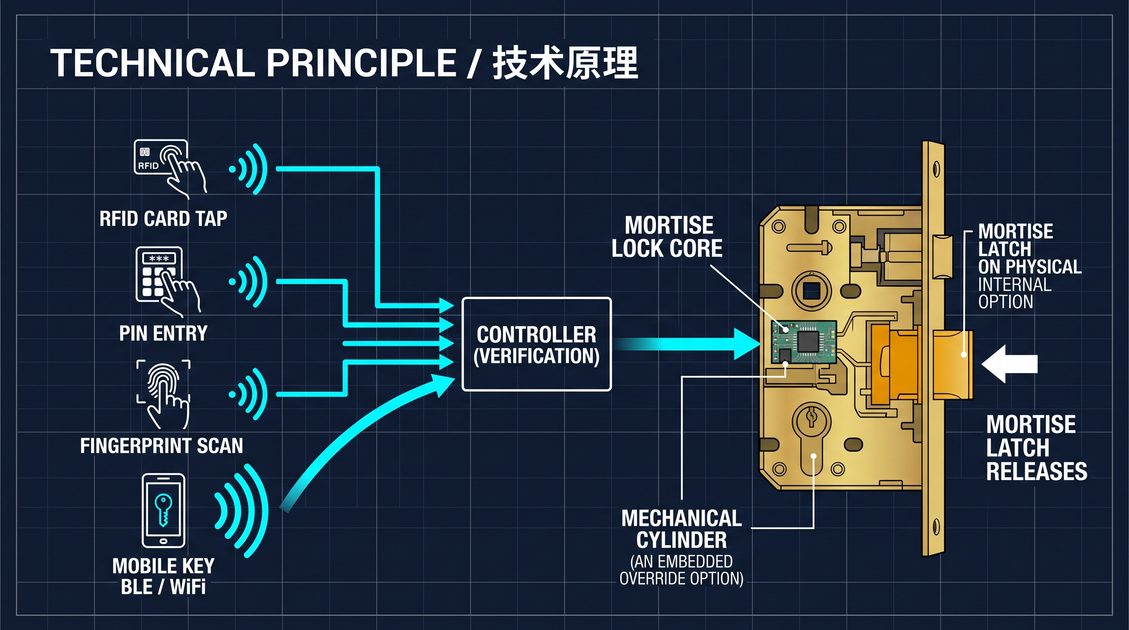
数字门锁是一种用于门体的电子门锁,以密码、卡片、指纹或手机等数字凭证取代机械钥匙。它是一个涵盖键盘锁、智能锁和生物识别锁的广义类别,适用于从圆柱形锁舌到电子插芯锁的各种结构。本指南将介绍数字门锁和电子门锁实际包含哪些部分、二者有何区别,以及如何选择真正适合门体和使用者的数字门锁。
数字门锁包含哪些部分
数字门锁通常将电子凭证读取器、控制器、执行器和电源集成在锁体中。读取器接收凭证,控制器验证凭证,执行器则驱动锁舌完成解锁。许多数字门锁会组合多种读取方式,例如键盘加读卡器,让用户可以选择最方便的凭证。锁体结构可以是插芯锁,将锁舌和主锁舌集成在同一锁体中,常见于商业建筑和欧洲门体;也可以是圆柱形锁舌,在北美更为普遍。
电子门锁通常是一个广义说法,指通过电子机构控制进门、无需使用钥匙的门锁。数字门锁之间的区别主要体现在凭证、锁体结构和连接方式上。键盘式数字门锁验证密码;智能锁增加应用程序以及可能的远程或联网控制;生物识别锁则增加指纹或面部识别功能。选择其中一种,本质上是在选择用户所需的凭证方式和管理模式。
如何选择数字门锁
选择数字门锁时,可以采用与选择其他电子门锁相同的判断框架:门体结构、开门方式、连接能力、电池与应急进入、安全性、锁体结构和管理方式。门体结构决定您需要插芯锁还是圆柱形锁。开门方式决定用户需要携带或记忆哪类凭证。连接能力决定您是否需要远程或联网控制。电池和应急进入方式决定可靠性,因此备用凭证、机械钥匙或备用电源都不可或缺。安全性和认证决定产品是否值得信赖,而管理方式则决定您能否管理一扇门或多扇门。
合适的数字门锁,应该与您的实际情况相匹配。对于单扇入户门,带备用开门方式和应用程序控制的键盘锁或智能锁通常是不错的选择。对于出租房或企业,支持凭证管理并可即时撤销权限的门锁更为合适。对于商业建筑或多户住宅,支持联网和集中管理的电子插芯锁可以作为可靠的基础设施。本指南建议选择具备备用进入方式、经过认证的安全性能、电池状态报告,并且锁体结构适配门体的数字门锁;只有当数字门锁能够像被替代的机械锁一样可靠地运行时,才应将其视为真正的升级。
优质数字门锁与普通数字门锁之间的实际差异,往往体现在低电量、停电或用户忘记凭证等边界情况下的表现。请选择能够报告自身状态、保留机械钥匙或备用电源恢复路径,并以便于门主查看的方式保存权限的门锁。易于管理且能够如实反映自身状态的数字门锁,通常比仅凭广告功能数量选出的产品使用寿命更长。
请确认数字门锁能够满足实际使用者的无障碍需求,例如提供清晰反馈、易于触及的控制部件,以及为视力或灵活性受限用户提供屏幕之外的替代操作方式。技术功能完善但目标用户难以使用的数字门锁,反而违背了产品初衷。请根据实际家庭成员或工作人员的情况,匹配读取器高度、反馈类型和凭证选项,而不是盲目依据通用规格。
无论采用何种锁体结构,目标始终相同:在需要安全时保持可靠,在能够便捷时提供便利。
A digital lock is an electronic lock for a door that replaces a mechanical key with a digital credential, such as a code, a card, a fingerprint, or a phone. It is the broad category that includes the keypad lock, the smart lock, and the biometric lock, and it covers every form factor from a cylindrical deadbolt to an electronic mortise lock. This guide explains what a digital lock and an electronic lock for a door actually include, how they compare, and how to choose a digital door lock that genuinely fits your door and your users.
What a Digital Lock Includes
A digital lock contains an electronic credential reader, a controller, an actuator, and a power source, packaged in a lock body. The reader accepts the credential, the controller validates it, and the actuator moves the bolt to unlock. Many digital locks combine several readers, such as a keypad plus a card reader, so a user can choose the most convenient credential. The mechanism can be a mortise lock, which carries a latch and deadbolt in one body and dominates commercial and European doors, or a cylindrical deadbolt, which is common in North America.
The term electronic lock for a door is used broadly to mean the same thing, an electronic mechanism that controls entry without a key. The distinction among digital locks is the credential, the form factor, and the connectivity. A keypad digital lock verifies a code; a smart lock adds an app and possibly remote or networked control; a biometric lock adds a fingerprint or face. Choosing among them is choosing the credential and the management model your users need.
Choosing a Digital Door Lock
When choosing a digital door lock, apply the same framework as any electronic lock: door structure, opening method, connectivity, battery and emergency access, security, form factor, and management. The door structure decides whether you need a mortise or a cylindrical lock. The opening method decides which credentials your users will carry or remember. The connectivity decides whether you need remote or networked control. Battery and emergency access decide reliability, with a fallback credential and a mechanical key or backup power essential. Security and certification decide trust, and management decides whether you can administer one door or many.
The right digital lock is the one matched to your situation. For a single front door, a keypad or smart lock with a fallback and app control is a strong pick. For a rental or a business, a lock with managed credentials and instant revocation is better. For a commercial or multifamily building, a networked electronic mortise lock with central management is the reliable backbone. This guide recommends choosing a digital door lock with a fallback, certified security, battery reporting, and a form factor that fits the door, and treating a digital lock as an upgrade only when it is implemented as reliably as the mechanical lock it replaces.
The practical difference between a good and a poor digital door lock is how it behaves at the edges, at low battery, during an outage, and with a forgotten credential. Choose a lock that reports its own health, keeps a mechanical or backup-power recovery path, and stores permissions in a way the owner can inspect. A digital door lock that is easy to administer and honest about its condition will outlast one chosen purely for the number of advertised features.
Confirm the digital door lock meets the accessibility needs of the people who use the door, such as clear feedback, reachable controls, and an alternative to a screen for users with limited vision or dexterity. A digital lock that is technically capable but hard for the intended users defeats its purpose. Match the reader height, the type of feedback, and the credential options to the actual household or workforce, not to a generic specification.
Whatever the form factor, the goal is the same: a lock that is secure when it should be and convenient when it can be.
不确定哪款传感器适合您的项目?
与我们的毫米波应用工程师免费咨询。