商业电子门锁系统指南:选型、部署与管理实践全解析
面向工程与采购人员的商业电子门锁系统选型部署指南,覆盖门体适配、凭证体系、供电策略、系统集成、生命安全、施工验收与全生命周期成本管理等关键环节。
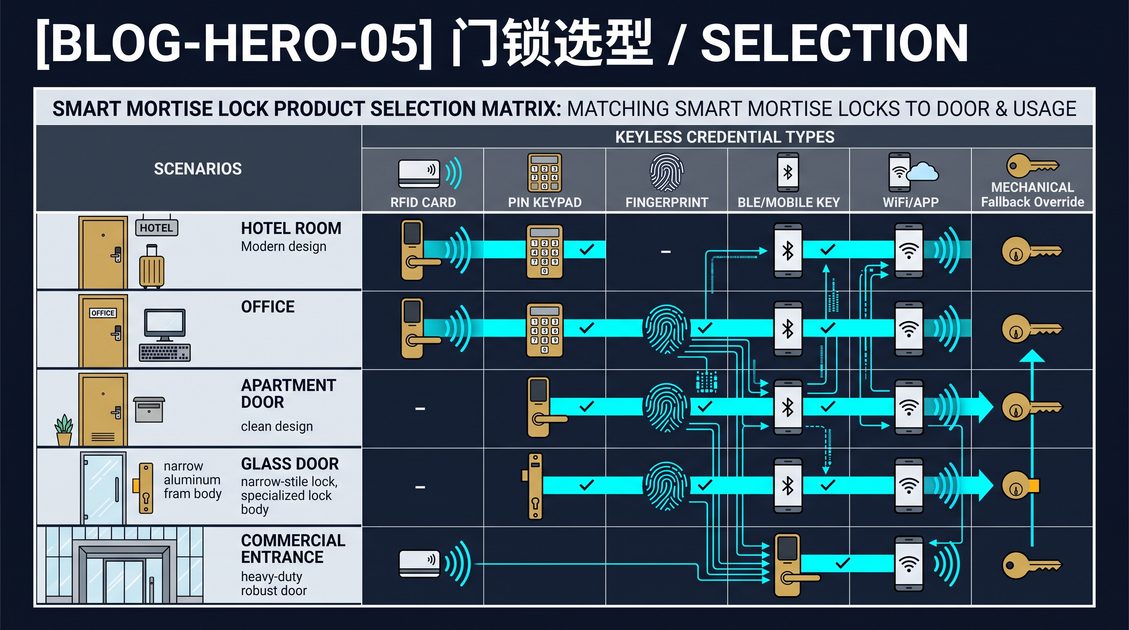
商业电子门锁系统指南——范围与定义
商业电子门锁系统是一种电气化门禁解决方案,用于管控非住宅出入口——包括办公室、多租户建筑、酒店、医疗、教育、仓储及物流场所。其工作原理是:仅在读取到经过授权的电子凭证时,才释放机械锁闭机构。该系统通常由以下部分构成:带电子释放功能的锁体或插芯锁壳、凭证读头、在锁端本地或通过网络由中央端做出放行/拒绝决策的控制器、按电池供电或故障安全模式配置的电源方案,以及用于管理用户、时段与审计事件的管理平台。凭证形式通常包括 PIN 码、感应式或非接触式卡、基于蓝牙或 NFC 的手机应用、指纹等生物识别信息,同时保留机械钥匙作为故障状态下的最后应急手段。选型应依据门体与门框几何尺寸、门禁策略、威胁模型、疏散与消防要求以及维护与生命周期计划来综合判断,而非仅凭数据表上的某一项功能亮点做决定。
应将门锁视为整个门体组件中的一个部件:坚固的锁舌无法弥补空心门扇或安装不当的锁扣片带来的缺陷;同样,一项忽视日常开门人员实际需求的决策,最终只会成为负担。在比较供应商之前,应邀请设施管理、安保、IT、法务及日常使用者共同参与评估。建议建立一份决策记录,明确每项需求的负责人,确保后续选择可追溯至现场的真实约束条件,而非供应商的销售话术。
机械与电子的界限
理解商业电子门锁系统的有效方式,是将机械核心——即实际物理固定门体的锁舌、斜舌、锁扣片、锁芯和执手——与决定机械核心何时允许动作的电子层分开来看。机械核心才是真正保障出入口安全的部件;电子部分仅负责监督其释放。这一区分至关重要,因为若机械层失效,则系统对所有使用者都会失效,即便电子部分完美无缺也无济于事。斜舌卡入松动的锁扣片,任何读头、凭证或管理平台都无法修复。决策时应同时关注这两个层面,并以与电子部分同等的严谨度去验证机械部分,因为在日常运行中,物理硬件承担了绝大部分真实安全载荷。
本指南的适用读者
本指南面向设施经理、安保主管、IT 管理员、建筑师、承包商及采购专业人员,他们需要为商业出入口完成门禁的规格制定、采购、安装或维护工作。本指南不涉及特定品牌的承诺或厂商测试声明,也不替代合格的法律、消防、无障碍、网络安全或工程审查。文中所引用的标准与规范,其描述深度以辅助规划和提出更精准的问题为限;具体司法管辖区及使用场景的实际要求,必须由具备资质的专业人员确认。阅读顺序并非强制,但各章节环环相扣:物理勘测决定形态选型,形态选型又制约供电与生命安全行为,而所有这些最终汇入成本与尽职调查决策。时间紧张的读者可从文末的实施检查清单入手,再回溯至驱动各项清单条目的对应章节。
商业电子门锁系统指南——门体与门框勘测
物理门体决定了电子系统能否正常运作。在评估商业电子门锁系统之前,需要测量门厚、锁舌偏距、门扇方向、开启方向、插芯锁壳尺寸、转轴与锁芯位置以及锁扣片几何尺寸,同时记录门框类型、门扇等级与材质、地面状况及预期使用频次。防火门对切割、修整和标识有严格限制;玻璃门或隔音门会限制钻孔位置;而磨损的闭门器或损坏的门框,无论锁具规格多高都会被拖垮。现场勘测应以具有代表性的门体为对象,兼顾使用频率最高及环境暴露最严重的门体,所有假设均需记录在案而非凭空猜测,确保锁具适配门体,而非让门体迁就锁具。勘测若跳过条件最恶劣的门体,最终会在实际应用中悄然否定所有基于理想样本做出的选型。
在勘测表上记录每个代表性门体的开门方向与开启方式,并拍照存档。收集真实使用数据——每日开关次数、换班或就餐时段的峰值聚集情况——因为 duty 周期额定值和电池消耗假设取决于实际使用情况,而非包装盒上的标签。一小串经过仔细测量的数据,远胜一份充斥着未经核实猜测的长篇勘测报告。
关键测量项
决定锁具兼容性的测量项数量不多但不可妥协:门厚(商用钢质或木质门通常为 1.75 英寸(44 mm)至 2.75 英寸(70 mm)之间)、锁舌偏距(从门边到斜舌或锁体中心的距离,北美常见为 2.75 英寸(70 mm),公制地区多为 55 mm 起)以及开门方向(铰链所在侧,以及是左开门还是右开门、内开还是外开)。插芯锁壳必须能适配已开好的孔槽和预加工;筒式锁需要匹配的孔径和锁舌偏距;电锁扣必须固定在特定门框上,并与斜舌伸出长度和唇片相匹配。还需记录锁扣片开口尺寸、门扇与门框之间的缝隙(间隙超过约 4.8 mm(3/16 英寸)时通常需要先做校准),以及是否装有闭门器——因为闭门器的关门速度直接影响电锁扣能否可靠扣合。
防火等级与施工限制
防火门上的一切加工均受规范约束:开挖新孔、更换锁具或增加贯通门体的饰板,除非获得制造商许可或由合格的门体五金专业人员施工,否则可能导致防火标签失效;部分司法管辖区还要求持证安装人员操作已贴标门体。钻孔布局、开孔尺寸及防火级饰板替代件的使用均受严格管控。对于空心金属门框,电锁扣必须匹配框体截面,并使用合适的垫片与五金件安装;铝合金或玻璃幕墙入口门的选择范围较窄,因为薄型竖梃往往难以钻孔,需要采用表面安装或隐藏式方案。隔音门对开孔施工有隔音等级限制,洁净室或腐蚀性/双峰环境则对材料有特殊要求。所有此类限制都应写入勘测记录,以便在硬件入围筛选之前将其转化为排除条件。
使用频次与环境暴露
使用频次指硬件每小时必须承受的开关循环次数,这是区分劣质家用产品与真正商用级电子门锁硬件的关键指标。紧邻交通枢纽的办公楼公共入口可能每天经历数千次开关;少有人走的楼梯间可能一天只有几十次。供应商会按循环次数标注硬件的设计使用寿命,超出额定值会加速斜舌磨损、电机故障和弹簧疲劳,这些问题会在电子部件老化之前就暴露出来。环境暴露是第二个维度:室外门体面临雨水、温差、沿海地区的盐雾以及紫外线老化,这些都会影响密封件、电子部件和电池。在同一个勘测批次中采集流量密度和暴露程度数据,确保这两项约束同时进入规格书。
商业电子门锁系统指南——锁体形态选型
商业电子门锁系统并非单一产品,而是一个机构家族。选择何种形态取决于物理门体、使用流量、能耗预算以及失效时的预期行为。主要家族——插芯锁、筒式锁、电锁扣、磁力锁以及挂锁/柜锁——在成本、使用频次、改造便捷性和生命安全行为方面各有取舍,安装位置也各不相同:有些在门扇上自备锁舌,有些安装在门框上释放斜舌,还有些依靠吸力而非机械凸起来固定门体。选错形态是规格制定中最昂贵的单一错误,因为这种错误通常要到安装完成后才会被发现,而此时门体、门框和供电方案都已无法更改。形态选择应与现有门体加工条件、门体承受的使用频次以及使用场景所要求的失效姿态相匹配,并将选择结果对照勘测记录存档,而非仅凭个人偏好。
插芯锁
插芯锁嵌入在门边开凿的矩形槽口内,自带一个包含饰板、锁芯、斜舌和锁舌的一体化壳体。它是高端商业入口的主力产品,因为壳体空间足够容纳电机、微动开关组以及驱动更长行程的齿轮机构。与筒式锁相比,插芯锁在高频使用下通常更厚重、更顺滑、寿命更长,常见于希望采用大型饰板的古建筑或高端建筑中。改造时需要铣出尺寸精确的槽口,因此侵入性更强;在既有门体上要么新开槽口,要么匹配原有插芯壳。当门体较厚、流量较大或需要单一机构同时提供斜舌和锁舌时,插芯锁通常是承受机械负荷的最优技术方案。
筒式锁与钻孔锁
筒式锁通过门体上的钻孔安装,依靠执手旋转驱动斜舌缩回;这一类别涵盖了成千上万办公室和设施门上的经典钻孔 knob 和执手锁。由于壳体小巧,预加工只需一个圆孔和对应偏距的斜舌槽口,筒式锁成本低廉、改造迅速,因此在预算或工期优先的场景下成为默认选择。其代价在于使用频次和结构强度:筒式机构通常循环寿命等级较低、结构较轻,最适合中等人流的室内门,而非主入口或高流量公共门。对许多设施经理而言,筒式电子锁是在已具备钻孔预加工的办公走廊上加装凭证验证门禁的最经济方案之一。
电锁扣
电锁扣安装在门框上,替代被动式锁扣片,其锁环释放后允许门体斜舌通过,而无需斜舌本身缩回。由于电锁扣位于门框,锁体保留在门扇上,电锁扣能从门框侧提供比单独门锁高得多的安全等级,并能与纯机械锁作为主锁机构共存。电锁扣非常适合必须保留现有机械锁的改造项目,以及需要强力停门和保持功能的门体;但其前提是门框能够承载、斜舌伸出长度足够可靠扣合、以及正确选择故障安全型或故障保持锁闭型。斜舌伸出过短与锁扣片错位的组合,是导致门在受力下摇晃打开的常见原因。
磁力锁
磁力锁依靠门扇上的衔铁与门框上的电磁体之间的吸力固定门体,完全没有物理锁舌。由于没有斜舌,磁力锁天然具有故障安全特性——断电瞬间释放,因此非常适合疏散关键型和公共出入口——且安装快捷,采用表面安装方式。其代价在于:保持力完全取决于拉力额定值和门体顶部的安装质量;如不增加配件防护,可能被撬棍或垫片攻破;部分司法管辖区限制在已贴标的疏散门或防火门上仅使用磁力锁,因为它不提供锁舌。磁力锁最适合内部防损、常开保持或故障安全应用,且应搭配与被保护门体价值相匹配的防残磁和防垫片设计。
挂锁、柜锁与特种锁
挂锁和柜锁覆盖储物间、服务器机柜、柜体、大门和集装箱等场景,在这些地方安装完整门锁属于过度配置。它们通常支持相同的凭证体系,并可在同一平台上管理——当站点希望入口门和内部保管点统一身份时,这一点非常有价值。由于挂锁挂在锁扣上,其安全性不仅取决于锁体本身,还取决于锁扣和安装表面的材质;加固挂锁配薄锁扣,很快就能被攻破。柜锁对于可追溯性(谁在何时打开了哪个柜子)以及化学品、药品或工具的合规保管至关重要。这类小规格锁具是更大规模商业电子门锁系统部署的天然补充,而非替代品。
商业电子门锁系统指南——机械等级与额定值
机械分级制度旨在让"坚固五金"这一抽象承诺在不同产品之间可比较。采购应始终锚定具体的分级和认证标识,而非营销文案中的形容词。主流体系是美国国家标准协会的门锁分级:根据对循环寿命、强度、表面耐腐蚀性以及锁具抵抗暴力破坏能力的实验室测试,授予 1 级、2 级或 3 级。1 级锁专为高频、高滥用商业场景设计;2 级适用于中等商业流量;3 级适用于轻负载住宅使用。正确的商业电子门锁系统应针对每个门体的实际使用频次和滥用程度选择匹配的等级,而非整栋楼一刀切使用同一等级,并将等级与勘测记录一并存档,确保选择可追溯至支撑其决策的流量和暴露数据。
解读 1 级、2 级或 3 级评级
分级同时评估多项机械品质。循环寿命通过斜舌的反复操作进行测量,以数十万次计;1 级硬件必须比低等级承受多得多的循环次数后才能出现疲劳损坏。强度测试通过施加试图打开已上锁或闭锁门体的力——例如数百磅的垂直和侧向载荷——并测试执手在承受重压后不塌陷、不断裂的能力。这就是公共门上的执手经常指定 1 级的原因,即便流量看着只是中等:执手的强度几乎完全取决于承载它的机构,而塌陷的执手一定会招来投诉。表面腐蚀测试将硬件置于盐雾和潮湿环境中,以预测表面处理在沿海或高湿室内环境中的表现。
分级适用于整个锁体组件,因此应仔细阅读测试对象的具体说明。有些产品的斜舌和锁体机构通过了某等级认证,但饰板、锁扣片或连接部件并不在同一认证范围内。应索取覆盖拟购具体型号及门体实际安装组件的认证报告,若证书上的型号与计划购买的型号不一致,则不予采信。选择错误等级的实际后果通常不是灾难性的安全失效,而是可预见的过程性磨损——办公走廊每天数百次开关的 3 级筒式执手锁,会比成本测算假设的时间提前很多就需要更换。
商业电子门锁系统指南——凭证与身份架构
凭证架构决定了人员如何获得授权访问,以及在建筑全生命周期内身份如何登记、变更和吊销。商业电子门锁系统必须明确支持哪些凭证类型(PIN、卡、手机、生物识别、钥匙)、决策是在锁端本地做出还是在服务器端集中做出、网络中断时的离线持续工作时间、记录的审计轨迹,以及丢失凭证的多快吊销速度。支持远程吊销时,丢失或被盗的卡风险要低得多;而纯机械钥匙系统完全没有此类控制能力。架构必须能从容应对从少数用户到每月数百次登记和吊销的员工流动规模,且不淹没管理员。凭证并非可互换的便利功能:每种类型都有不同的成本、故障模式和身份管理负担。
对于共享或临时访问——分租户、临时工、快递员——应使用限时或一次性凭证,以缩短身份过期残留。明确谁可以在什么审批流程下签发凭证;不受控制的登记是安全状态悄然漂移的最常见源头。一个从未被吊销的身份就是一道永久后门,随着每一位离职员工不断累积风险,因此吊销流程值得与登记流程同等水平的设计投入。
本地决策与中央决策
第一个架构选择是决策发生在何处。在老式独立锁中,决策是本地化的:锁内保存一份授权凭证及其时段的列表,对比出示的凭证后决定是否释放,无需与任何系统通信。本地决策能确保锁在网络中断时继续工作,且成本低、简单,但无法从中央办公室进行控制、审计或吊销,修改一把锁需要亲临现场。在网络连接系统中,锁具仍可缓存列表以支持离线运行,但同时也会与中央控制器通信,后者可以推送更新、吊销凭证并收集审计事件。实际上界限已经模糊——许多现代锁具缓存凭证并定期同步,以有限的陈旧窗口为代价换取弹性,这个窗口成为设计参数,必须被你有意识地接受并设定大小。
电池供电锁尤其倾向于本地决策加偶尔同步,因为每秒轮询服务器的锁具电池会迅速耗尽;下文离线保持和电池章节将进一步说明这一权衡。无论采用何种模式,都应记录吊销的最坏情况延迟:如果一把锁每小时只同步一次,那么被吊销的徽章在该门体上最多还能使用一小时。对大多数设施而言,一小时的残余访问可接受,前提是被保护区域能容忍这一风险。若不能容忍,应选择能缩短同步间隔的硬件和策略,或通过实时连接立即使关键门体失效。
凭证家族及其权衡
基于 PIN 的访问是最便宜、最简单的凭证方式,只需键盘,无需携带实体令牌;但 PIN 容易被共享、被肩窥、被重复使用,因此作为已知秘密其固有风险最高;仅使用 PIN 的商业电子门锁系统应强制执行最小长度和更换策略。采用 13.56 MHz 近场通信的卡和钥匙扣是机构主流凭证,安全性合理、登记方便、吊销即时;但卡可能丢失,扇区管理不善时可能被克隆,或被中继攻击。通过蓝牙低功耗或 NFC 分发的移动凭证将凭证放在用户随身携带的手机上,降低了制卡成本并支持远程签发;但要求手机有电,且平台能安全地配置设备。指纹、虹膜或人脸等生物识别提供了不可转移的因素,但增加了登记摩擦、隐私和可靠性问题——手指受伤或严寒室外门口戴着口罩,都会变成支持工单。机械钥匙仍然是所有电子系统诚实的最后防线。
登记、流动与吊销
身份生命周期管理——一个人如何从"抵达总部需要门禁权限"到"离职两年后仍持有权限"——是大多数门禁项目悄然腐烂的地方。定义谁是授权人员的唯一事实来源:管理良好的组织将门禁权限绑定到 HR 身份系统或其访客管理对等系统,这样雇佣关系结束时门禁权限也随之终止。为人员流动而设计:如果站点每月招聘和解雇数十名员工,登记和吊销路径必须设计为可重复的自助或 HR 触发流程,而非少数管理员之间的临时技能。每次授予、变更和吊销都记录审批人标识。无法在不亲临门体的情况下吊销的凭证是长期负债,吊销路径应在调试时端到端测试,而非想当然认为它能工作。
商业电子门锁系统指南——电源、疏散与生命安全
电源和生命安全行为决定了断电时锁具是开锁还是保持锁闭,分别称为故障安全(断电开锁,适合疏散需求高的公共门)和故障保持锁闭(保持锁闭,适合周界安全)。商业电子门锁系统在电池供电产品上还必须具备低电量检测和机械钥匙应急开启功能,并在网络型产品上定义部分断电或网络中断时的行为。地方建筑、消防和无障碍规范对自由疏散、紧急逃生装置、门内信号和延迟疏散功能有硬性规定,须由合格专业人员针对具体司法管辖区和使用场景做出判定。绝不允许方便的正常时段开锁方式,在网络或电源不可用时凌驾于法定的安全疏散路径之上。疏散是系统中优先级高于一切便利功能的需求,一把在紧急情况下困住使用者的锁,无论写入多少审计日志都是负担。
任何无法容忍紧急情况下困住人员的出入口,都应选择故障安全硬件,并依据设施实际的应急预案和人员构成来验证疏散,而非套用一般性假设。
故障安全与故障保持锁闭
故障安全和故障保持锁闭描述的是锁具在断电时的静止位置。故障安全硬件仅在有电时保持锁闭,断电后释放,门体可自由开启;这是永不允许困住人员的门——主出口、楼梯间门和紧急情况下的公共走廊——的正确姿态。故障保持锁闭硬件在断电时保持锁闭,使周界门在停电期间保持关闭,但要求使用者在内部有替代出路或入口(机械钥匙、备用电池或紧急释放装置)。这些术语有时会与锁定方向以及锁舌是否伸出的机械含义混淆;设计真正关心的是断电时的精确行为,应以数据表为准,并在调试时通过断电测试验证。不要因为安装人员口头保证就认定产品具备"断电释放"功能;要用实际模拟断电来证明。
自由疏散与紧急逃生装置
自由疏散意味着门体必须允许居住者在无需专门知识、无阻碍的情况下逃生,且通常只需一个动作——推压执手、触碰横杆——慌乱中的身体也能完成。不同法规体系有不同要求:受保护侧离开时不得要求钥匙、PIN 或卡;超过一定人数的场所(通常为 50 人或 100 人)必须安装触碰横杆或逃生装置;不得利用电子手段破坏紧急释放。逃生装置是独立的设备:推板或触碰横杆在推压时机械释放斜舌,通常与电控斜舌或电锁扣配合,同时满足生命安全释放和远程门禁两项要求。延迟疏散是另一项单独功能:在报警响起的同时将释放延迟一段受规范约束的短时间(通常为 15 至 30 秒),受严格的使用场景和标识规则约束;其存在是为了调和防盗需求与消防安全,绝非默认选项。任何此类判定都必须由合格专业人员按照具体使用场景签字确认。
锁闭、钥匙应急与无障碍
在电池供电或联网锁上,保留一条独立于电子系统的机械路径:通常是锁芯和钥匙直接开启斜舌,或手动释放装置,确保电池耗尽或控制器故障时不会让使用者或员工被困。这个钥匙应急功能是仅次于自由疏散的第二重要安全特性。无障碍规范通常要求门体无需捏握、紧握或扭转即可操作——使用执手而非球形把手、合理的触及范围、力量限制在特定阈值内——这既影响锁体硬件,也要求凭证读头放置在规定触及范围内。读头应安装在可达高度,防眩光、防霜冻,提供可见反馈(LED 和蜂鸣声),并在采购前确认释放力和开启硬件符合适用的无障碍标准。
紧急状态下的行为验证
疏散是一种系统行为,而非单一部件。在调试和定期演练中,应验证三种状态下的门体开启情况:锁定且有电、锁定且断电、网络切断,并确认逃生装置和凭证读头在每种场景下都表现正确。记录每扇门的验证结果,因为图纸上合规的防火走廊门,在安装到位后可能因锁扣片错位而失效。使用者的真实情况同样重要:儿童教室、医院走廊和员工专用卸货码头有着截然不同的逃生需求。先以平实的语言描述设施的应急预案,再据此选择故障安全姿态、逃生装置和延迟疏散功能,而不是把这件事当作布线完成后的补充。
商业电子门锁系统指南——电池化学与低功耗阈值
电池供电锁节省了向门体布线的成本和麻烦,但将生存能力押在电池预算上,所选的化学体系和电源架构决定了工作人员需要多久接触一次锁具,以及锁具如何优雅地失效。使用电池的商业电子门锁系统必须定义其化学体系、低电量阈值、低功耗行为以及更换节奏,因为锁具的可用性与锁舌机构一样依赖于能源预算。最常见的化学体系是锂、碱性和可充电电池,每种都有不同的能量密度、低温表现、存储寿命和单次更换成本。规格书还应明确电池数量和排列方式、在站点实际流量下的更换间隔、允许的更换类型以及告警接收人。缺少这些细节,标称电池寿命只是实验室里的数字,设施团队无法可靠地规划维护。
常见电池化学体系及差异
锂电池(二硫化铁锂或亚硫酰氯锂)能量密度高、温度耐受范围宽、电压平台长而稳定,非常适合碱性电池在低温下电压跌落和漏液的室外和寒冷环境门体。碱性电池便宜、随处可得,是大宗消费级硬件的默认选择,但消耗更快、低温大电流下电压跌落明显,深度放电或放置过久可能泄漏腐蚀性电解液。可充电电池降低了反复更换的成本,对于已在管理电池的作业现场有吸引力,但需要充电站(因而需要门边维护)或在锁舌操作上仍属小众的能量采集方案,且由于自放电和老化特性不同于一次性电池,会复杂化低电量模型。这个选择本质上更多是总拥有成本与环境适配性的权衡,而非安全问题。
自放电与低温表现
静态自放电会让即使闲置不用的电池也缓慢耗损,因此一扇长期闲置的锁仍需要定期关注;实际结果就是厂商会印上一个推荐的最大电池驻留时间,超过之后不论报告电量如何都应更换。温度加剧了问题:低温升高内阻,锁舌操作的电机负荷下电压可能跌落,在电池真正耗尽前就触发低电量报警或电机动作迟缓。对于室外及无采暖出入口,应优先采用低温电压稳定的化学体系(锂盐),在严寒气候下预留更早的更换周期,并以锁具自身的电压截止值进行验证,而非只信电池数据表。一把只在天气转冷时开始无法可靠重新上锁的锁,是一个可以预测的季节性问题——通过合理匹配化学体系和更换日历即可预防。
低功耗阈值与低电量报警
低电量阈值是锁具停止保证锁舌动作并开始求助的信号点。设计良好的锁具会在真正失效前很久报告电池状态——通常是百分比或预估剩余天数——阈值应留有足够余量,确保在实际功耗模式下有合理的更换窗口(通常是数周而非数天)。许多锁具通过可见信号(红色 LED、蜂鸣模式、平台告警)提醒电量即将耗尽,但仍允许用户完成一次开关门循环;危险在于长期告警却无人响应,因此每个低电量告警都应绑定指定的负责人和更换流程。部分系统会升级为"电量严重不足"并拒绝驱动电机,以避免锁舌半伸,此时机械钥匙是唯一入口——这正是电池硬件上钥匙应急功能不可妥协的原因。应在维护计划中定义告警阈值、告警通道、责任人和升级流程,并在调试时使用老化或减容电池验证行为。
商业电子门锁系统指南——离线保持与降级模式
联网商业电子门锁系统几乎不可能始终与服务器保持完美连接;它会不时失去分支电路、网络链路甚至管理平台本身,设计必须定义连接中断时哪些功能仍然可用。离线保持是锁具在无法联系控制器时保留的一组行为——授权人员缓存列表、适用的时段表,以及排队待上传的审计事件——它决定了停电期间门体的可用性和安全性。设计良好的离线行为,就是"默默继续工作数小时的门"与"交换机一坏就把所有人锁在门外(或门内)的门"之间的区别。计划还应明确最大可接受离线窗口、窗口即将关闭前的紧急信号方式,以及设施团队中谁知道门体停止同步时该做什么,让降级状态成为一种操作性场景,而非事后发现。
缓存凭证与时段行为
在常见模型中,锁具缓存凭证数据库和相关时段表,以便在中断期间本地评估出示的凭证。关键设计决策是缓存的陈旧程度以及吊销事件发生时缓存持有什么。如果缓存按计划刷新,那么在线的吊销凭证直到下次同步才会在锁具中生效;离线窗口是对电池和带宽刻意做出的让步。有些产品会优先推送紧急吊销或访问列表压缩,即使链路降级也能传输紧急拦截指令。应以平实的语言确认锁具的离线语义:检查什么、缓存陈旧度多小、审计轨迹是否在本地累积并在连接恢复后以可靠时间戳上传。缓冲的事件队列不能静默溢出并丢弃最旧记录,因为这些正是事件之后你最想追溯的痕迹。
降级电源与网络语义
降级模式涵盖部分故障:电量低但未耗尽、网络链路抖动、服务器在线但响应缓慢。定义锁具在每种状态下的行为,避免意外:是告警、延长本地缓存、扩大离线窗口还是限制操作?对于故障保持锁闭硬件,意外的离线状态导致门上锁至多是不便;但在疏散关键出入口上,这是安全问题。将降级曲线——低电量、链路丢失、链路缓慢——纳入调试测试,因为每种情况在实际中表现各异,并提前决定哪些降级对哪些门体是可以接受的。一个有用的原则:将"烦人但可容忍"的降级与"绝不允许发生"的降级分开,通过硬件、备用电源和流程设计确保第二类永远不会被突破。
同步、对账与时钟
连接恢复后,锁具必须上传排队事件并拉取最新授权数据,两端必须干净地对账:服务器的授权副本比锁具缓存更新,错失的事件必须以能映射到服务器时间线的时间戳抵达。时钟至关重要,因为审计有效性依赖时间戳;如果锁具离线时时钟漂移,事件会落在看似合理但错误的时间点上,破坏与视频或门禁平台日志的关联性。应选择每次成功连接都同步时钟、并以此同步时钟为缓存和审计记录打时间戳的硬件,并测试长时间中断与恢复之间的时间偏差,确保对账不会导致审计轨迹悄然重排。离线方案应像正常路径方案一样明确写入验收记录。
商业电子门锁系统指南——连接与系统集成
商业电子门锁系统的大部分价值来自与门禁软件、访客管理、电梯或闸机控制、楼宇自控、消防面板、视频与报警监控以及中央身份平台的集成。集成深度必须在采购前决定:哪个边缘设备上报哪个事件、真正需要多少集成、协议是开放的还是厂商锁定的,以及凭证或固件变更时由谁维护连接。常见边缘协议包括 Wiegand、OSDP 和 RS-485,向上发展为 IP 和 API 集成,电池锁则采用 Zigbee 或蓝牙低功耗。集成范围不足会导致新员工和丢失卡片的同步依赖人工、易出错;而平台许可过度则留下大量未使用功能。将集成足迹映射到当前运营和未来三年,并确认门禁平台、电梯控制器或楼宇自控系统升级时每条连接的归属方——因为这通常是第一个消失的东西。
边缘端的 Wiegand、OSDP 与 RS-485
Wiegand 是历史悠久的读头到控制器布线标准:几根线携带并行数据线和公共时钟,支持广泛、布线简单,但不加密,容易在读头处被简单搭线窃听或重放。OSDP(开放监督设备协议)是现代的、受监督的、加密的替代方案,在一个协议中集成了安全信道建立、读头/控制器监督和固件能力,越来越多地成为新商业安装的推荐选择。RS-485 是多种多分支串行骨干,OSDP 和许多遗留专有协议运行其上,允许单一控制器总线服务长距离菊花链设备。选择通常归结为你是在扩展现有受监督总线还是新建系统:全新部署倾向于选择 OSDP 对齐的硬件,而现有 Wiegand 安装可能以安全性换取连续性。无论采用何种协议,都应记录布线、总线终端和最大距离,因为布线质量决定数字总线是否表现如其数据表所述。
向上一层的 IP、API 与平台集成
在边缘之上,集成将锁具连接到承载人员、时段、报警和视频的系统:存储身份数据库的门禁软件、发放临时通行证的访客管理系统、驱动入职和离职的 HR 系统、执行垂直或区域移动限制的电梯或闸机控制器、需要门状态和有时远程释放的楼宇管理系统、报警时必须驱动开锁的消防报警面板,以及希望门事件与录像关联的视频系统。每次集成都有归属方、协议和故障模式;它不是单个勾选框。开放、有文档的 API 很重要,因为它允许集成商在无需厂商做中间人的情况下将平台连接到未来工具,并防止锁具成为只有一家厂商软件能对话的封闭孤岛。应将范围纳入书面集成登记册,并注明归属方和审查节奏。
你实际需要的集成
最便宜的集成是你没有构建的那个。每次集成都增加一个许可证、一个参与方、一个故障面和一份维护合同,因此每个都应有存在的理由。从你要解决的实际痛点出发:如果反复出现的人工成本是手动发卡和吊销,那么与 HR 的身份同步集成会自我证明价值;如果反复出现的投诉是"丢失的徽章仍能开门",那么交付物是吊销流程,而厂商视频集成可能可有可无。尽早让网络和安全团队参与,避免集成商在硬件到货后才发现防火墙或分段策略阻挡了平台流量。获取每个计划集成的接口规范,并取得书面声明明确每条链路由哪个厂商负责,同时为集成调试预留一小块项目预算,因为链路故障是报价漂亮的锁具项目上线时感觉崩溃的最常见原因。
商业电子门锁系统指南——安全工程与威胁模型
安全工程始于威胁模型:攻击者想要什么,谁有动机尝试,他们会怎么做。商业电子门锁系统面临的威胁包括凭证丢失或被盗、针对 PIN 或徽章的社会工程、薄弱门体或锁扣片处的强行闯入、非接触式卡的中继攻击、针对管理平台的网络入侵以及对锁体外壳的物理篡改。控制措施包括凭证和通信加密、防尾随逻辑、带告警的审计日志、防篡改检测、抗强行闯入能力,以及可即时吊销的凭证。控制深度应与被保护门体背后资产的价值成比例;按每扇门后面的核心资产对出入口分级,可以将预算集中到真正降低残余风险的地方。用平实的语言陈述每种威胁,并按后果对出入口排序。并非每扇门都需要高安全锁具加监控,明确说出这一点是合理的采购决策,而非妥协。
构建威胁模型
首先明确每扇门后面是什么,以及如果该区域被进入会造成什么伤害:服务器机房存放凭证和私密数据,药房存放管制物质,锅炉房存在责任风险,而储物间则没什么价值。为每个出入口指定后果等级(低、中、高),不仅反映盗窃价值,还反映安全、隐私、合规和连续性影响,并注意是否存在后续控制层(摄像头、保安、内部门)。然后列出现实的攻击者画像:试门把手的顺手牵羊者、仍知道密码的前雇员、收集 PIN 的肩窥者、带中继套件的卡克隆者、在薄弱锁扣片处用撬棍的窃贼,以及在网络上耐心攻击管理平台的攻击者。每个画像指向不同的控制措施,威胁模型告诉你在哪些门上买哪些控制措施,而不是到处买齐一切。
凭证与通信威胁
在凭证侧,将共享知识视为低保证级别:PIN 最容易悄然流失,因此应仅用于低后果门体,并配合强力锁定和更换策略。非接触式卡可能被中继:两个协作的无线电设备将门读头桥接到远处受害者的卡上,缓解措施是采用能检测或阻止中继的访问协议,或将卡与另一因素结合的凭证。克隆很大程度上取决于卡技术和卡扇区的配置方式,因此必须确保扇区管理密钥实际轮换过,而非停留在出厂默认值。在通信侧,每一跳都加密:读头到控制器(通过 OSDP 安全信道)、控制器到平台(带验证证书的 TLS)、电池锁空中接口(具有正确配对和密钥处理的 BLE 或 Zigbee 安全)。任何一个遗留的未加密跳都是坚定攻击者的拦截或重放点,而包含客户端设备的加密端到端路径是移动凭证的前提条件。
物理与网络攻击面
物理攻击针对机构和安装质量:从软门框撬开锁扣片、垫开锁舌或防撬斜舌、钻锁芯、或在可进入的走廊里破坏锁体外壳。硬件等级和锁扣片安装质量是主要防线,一扇门只能抵抗到它最薄弱组件的强度——装在可垫开门框上的 1 级锁仍然是一扇弱门。锁具上的防篡改开关在外壳或读头被打开时上报,对该报告的报警能把一次未被注意的攻击变成一次有记录、有处理的事件。在网络侧,管理平台是皇冠上的明珠:平台被攻破就是所有凭证和所有门被攻破,因此平台需要强认证、告警、基于角色的管理、打了补丁的软件以及与不可信网络的隔离。威胁模型通过给每扇门分级并规定该门真正需要的等级、凭证、加密和监控的组合来闭环,把预算和注意力留在残余风险实际所在之处。
商业电子门锁系统指南——管理平台与网络安全
管理平台是保存身份数据库、推送时段表、收集审计事件并让管理员日常运行商业电子门锁系统的软件,其安全性就是附着于它的每一扇门的安全性。一个易于管理但易于攻击的平台是虚假的经济性,因为一个薄弱的门户账号可以凌驾于任何门锁等级之上。将平台视为系统中价值最高的目标,并以与保护读头相同的严谨度保护控制台,包括强认证、访问审查、补丁、日志和与不可信网络的隔离。由于平台是决定谁能通过每扇门的记录系统,其设计决策——角色模型、身份来源、更新渠道和审计保留——就是整个部署的安全架构,应在项目开始时做出书面、经过审查的决策。
认证、角色与访问审查
管理控制台最低限度要求每人员一个账号,而非共享登录,并应对所有能修改权限或签发凭证的人员支持第二因素——一次性代码、认证器应用或硬件令牌。严格控制角色:谁能读审计日志、谁能签发凭证、谁能修改时段、谁能在胁迫下开门,每个都是独立权限,使低信任的工单工单永远无法升级为全局解锁。按固定节奏(通常每季度)并在每次重大人员变动后审查这些角色和成员列表,因为角色蔓延是门禁管理的静默失败。启用自动登出、最小密码长度和轮换、重复登录失败锁定,并确认平台自身记录管理员操作的审计轨迹,让错误配置留下取证记录。
补丁、设备固件与资产全生命周期管理
软件和固件漂移是平台和锁具漏洞中最可预测的来源,未打补丁的机群比任何单个漏洞都更宽的缺口。确认厂商发布安全公告和可靠的更新渠道,并确认平台和锁具固件的更新包含在许可证内或有预算支持,因为按每扇门收费的安全补丁是运营方会跳过的补丁。规划更新节奏和回滚路径,并在全站推送前先在代表性硬件上分阶段验证更新,因为改变锁具行为的固件更新就是对安全关键系统的变更。维护每台设备的型号、固件版本和 IP 地址的准确清单,因为你无法修补你不知道存在的东西;无法再接收安全补丁的过期设备应替换而非保留。
网络分段与事件响应
将锁具系统的流量放在独立网段上,使网络其他部分的失陷无法直通控制台,并严格控制对该网段和凭证签发的访问。定义事件是什么——导入的疑似管理员操作、关键门体上反复失败的凭证、防篡改报警或申报的设备丢失——以及谁在什么证据下被通知。演练最简单的有意义的演练:丢失的徽章应被端到端吊销,审计轨迹应在每个关键位置显示那次吊销。平台是记录系统,因此将其日志视为证据:保存它们、用共享时钟打时间戳、并按设施的法律和合规义务定义保留期。平台的网络安全不是一次性的加固任务,而是一组运营习惯,在验收时签字确认,并在部署的整个生命周期内持续维护。
商业电子门锁系统指南——安装、调试与验收
安装质量决定了好系统是否表现得好。商业电子门锁系统的调试涵盖:锁体、锁扣片和闭门器的机械对位;确认锁体在正常和紧急条件下的上锁与释放;凭证登记和每个用户旅程的端到端测试;在模拟断电和断网下验证故障安全或故障保持锁闭行为;以及由运营方签署的书面验收。测试在代表性门体上执行,并在安装后重复进行,每个假设都记录在案。交接内容包括布线图、凭证管理指南、联系人列表和经过测试的恢复流程,使设施能够脱离厂商独立运行。委托调试的负责人应有权在测试失败时叫停。卡住的门、错位的锁扣片或建筑某个角落凭证失效的问题,应在调试时暴露,而不是让员工在周一早上撞上。此时浮出的问题代价很低;等到使用者每天依赖门体后同样的问代价完全不同。
先做机械对位
没有电子设备能修复机械上错误的门。在布线和登记之前,确认锁体或锁扣片位于正确预加工的开口中,斜舌和锁舌与锁扣片干净咬合,闭门器关闭门扇不卡滞,门扇与门框间间隙在厂商规格内。斜舌拖滞、锁扣片突出、门体砰地关上震得铰链作响——这些都会消耗电池、产生误报、惹恼每个用户。先修正机械故障,再配置电子设备,并记录每扇验收门的对位测量值,以便将来重新对位时能恢复到已知良好状态。这一步在赶上线日期时最容易跳过,也是"系统不可靠"报告最常见的根本原因——最终证明纯粹是物理问题。
调试测试
调试在代表性门体上执行一套脚本化测试:正常凭证出入、机械钥匙应急、部署的每种凭证类型、使用老化电池验证低电量行为、模拟断电下的故障安全或故障保持锁闭行为、断网下的离线行为、如使用的防尾随、防篡改和报警事件,以及每个事件必须触发的平台集成。每个测试都给出预期结果和通过标准,失败的测试暂停工期,直至找到原因并解决。在整改清单完成后重复关键测试,因为重新对位锁扣片可能以安装人员未预想的方式改变门体行为。验收签字是运营方正式确认系统符合规格并安全移交给使用者的文件,签字人绝不应是对因进度而吞下已知缺陷有利益关系的人。
交接与操作员培训
交接是设施从租用系统变为拥有系统的时刻。向运营方提供布线图和网络拓扑、凭证管理指南和角色矩阵、厂商/集成商/网络归属方的联系人名单,以及针对现实坏日子的书面且经过测试的恢复流程:持钥匙者被锁在门外、平台凭证故障、低电量潮。让至少两名设施团队成员在真实管理任务上接受培训,而非演示,并留下一份新管理员一年后无需原始安装人员即可遵循的运行手册。交接结束时厂商离场而设施自给自足,是项目成熟的标志,它决定了系统是建筑能真正维系的资产,还是变成需要打给暗处的支持工单。
商业电子门锁系统指南——多租户与酒店应用
多租户建筑和酒店将商业电子门锁系统推向最严苛的边缘:高流动性、许多独立方、临时用户,以及既需要严格隔离又需要快速、授权的凭证签发。服务单一办公楼层的设计在面对一扇门一扇门单独出租的建筑时可能不堪重负。规划按租户管理、短期和一次性凭证,以及将租户数据分隔的审计轨迹。这里的凭证生命周期以小时和天计,而非雇佣合同,因此平台的吊销和重编码流程才是真正的产品,而非锁具硬件。操作员应能在几秒内重编码一间酒店客房、即时吊销退租租户的套房权限,并仅凭审计轨迹证明每个过期凭证按时失效,全程无需全局管理员触碰每项变更。
租户隔离与授权管理
在多租户建筑中,每个租户应能自行管理其套房的门,而看不到其他租户的凭证或日志,也无需全局管理员处理每次新员工登记。这需要平台支持基于角色的委托:租户管理员账户可在租户门上签发和吊销凭证,但不能触碰公共区域或其他租户的空间;同时需要一个范围模型,将每个凭证和每条审计记录绑定到租户。全局所有者保留对公共区域、主入口和平台的控制权,但将日常门体管理下放给每个租户,使其无需增加人员即可扩展。在合同中明确谁拥有主管理钥匙、租约到期时如何吊销租户访问权,以及审计轨迹如何证明退租租户在最后一天之后不再持有任何凭证。
酒店:高频周转与按设计重编码
酒店客房门是教科书式的案例:每周数百名临时人员、需要快速重编码的房间、以及需要精确管理的员工卡、锁具和分区区域(客房服务楼层、布草间、服务电梯)。运营节奏要求每次退房后重编码客房门、精确的入住/退房时段、前台方便的重发流程,以及在停业期间锁定或中止楼层访问的能力。移动凭证在这里有很强的吸引力,因为客人的手机可以充当钥匙,退房时无需物理重编码即可吊销。同样的原则延伸至青旅、服务式公寓、联合办公、医疗配楼和学生宿舍,每种都有自己的周转和权限模型,也都有同样不可妥协的要求:凭证按时失效,审计轨迹能证明它确实失效了。
公共区域与员工分区
除客人或租户门外,平台还必须管理区域和角色的层级结构:员工专用走廊、机电和服务器机房、卸货码头和紧急出口,各自需要独立的访问策略和独立的在场记录。酒店的客房清洁排班、建筑运营商的维护窗口和租户的夜间服务器访问都是时段表,平台需要表达时间窗口、周期性访问和例外访问,无需逐一班次手动授权。在铺开之前设计好区域和角色层级,因为事后在扁平的门体集合上改造分区非常痛苦,而且同一层级在事件中限制爆炸半径的同时,也限制了单一凭证失陷的损害。在可容忍的出入口使用防尾随,并对最敏感房间的非工作时段访问设置报警,同时将门事件与视频联动,让触发的报警有画面可确认。
商业电子门锁系统指南——维护与恢复
即使安装得最好的系统也需要维护和恢复节奏,这种节奏的质量决定了部署是悄然退化还是十年保持锐利。商业电子门锁系统有一套有限的日常部件——电池更换、凭证卫生、固件更新、锁扣片和闭门器调校、定期复测——同样还有一份简短的要求恢复的坏日子清单:锁门外、死锁、主卡丢失或平台凭证故障。预算、计划和测试每项,因为设计良好但从不维护的系统会退化为恰恰是任何设计都无法预防的不可预测行为。维护计划应为每项重复性任务指定负责人、说明节奏,并将每个任务挂在成本线上,让保持系统健康成为设施预算的常事,而非偶发的救火。
日常维护节奏
电池更换是最显眼的日常任务,直接影响电池供电门的可用性。应根据低电量报告和化学体系存储寿命来安排更换,而非通用日历,并按区域分批,保持团队路径合理。凭证卫生基于流动性模型运行:将身份数据库与 HR 和访客系统对账、清除陈旧和未使用的凭证、重发丢失或申报重复的卡,以及轮换保护卡扇区和平台管理员的秘密。将固件和平台更新与代表性门体上的简短回归测试结合执行,因为固件变更就是对安全设备的变更。最后,按计划进行机械侧调校——锁扣片对位、闭门器速度、斜舌伸出——并在每年或任何硬件变更后重新执行调试疏散测试,因为漂移出对位的门就是电子部件开始悄然失效的门。
凌晨两点的锁门外与恢复流程
最糟的日子通常发生在工作时间之外:员工拿着没电的钥匙卡被困在锁着的门外、物理钥匙不在对讲机预期的地方、或者凌晨两点平台账号无法认证。恢复的成败取决于是否有经过测试的书面流程和在那个时刻能联系到的指定值班人员。定义并演练现实的开锁路径:机械钥匙应急、绕过常规时段的紧急主凭证、远程开锁能力及谁可以调用、以及区域备件包,让寒冷的夜晚永远不必依赖临时决策。将流程与访问日志要求配对,因为在胁迫下或由低信任账户执行的夜间开锁,恰恰是之后需要审计轨迹的事件。至少以桌面推演的方式演练恢复流程,并将备件和运行手册放在值班人员无需专家即可拿到的地方。
备件、生命周期终止与退役
在故障发生前规划备件,而非故障期间:少量备用电池、一把或两把主要形态的备用锁、备用锁扣片和备用凭证。审查厂商的生命周期终止声明,让停产的型号成为计划中的迁移,而非紧急事件;确认退役路径——如何清除凭证、如何关闭平台账户、如何拆除硬件且不留下功能性电子开锁的门。当硬件达到支持寿命终点时,优先更换后果最严重的门体,并在备件和文档仍可用时安排更换。好的维护计划让 10 年成本由小型的、可预测的条项构成,而非一连串昂贵的意外,并让设施运营系统,而非系统运营设施。
商业电子门锁系统指南——生命周期成本与供应商尽调
生命周期成本是采购、安装、凭证管理、维护、能源、软件许可、培训和最终退役的总和,而非锁具的标价。电池供电锁增加了反复更换和监控负担;联网锁增加了基础设施、服务器和许可成本;复杂系统增加了培训和集成维护开销。商业电子门锁系统需要在采购前明确维护归属:谁更换电池、重发凭证、更新固件、响应凌晨两点的锁门外,以及备有哪些备件。尽职调查核实供应商的认证、当前型号专属文档、测试证据、支持渠道和保修条款,而非轻信营销说辞。确认具名的支持路径和明确响应时间,索取按型号区分的认证记录,确认固件和软件更新是免费还是按许可收费,并获得书面的备件和生命周期终止计划,因为合同中期失去支持的锁具会成为买方继承的安全和维护问题。
构建生命周期成本模型
基于真实驱动因素建模:每扇门的硬件价格、安装和预加工成本(插芯锁或防火改造中可能达到与硬件相当的水平)、设计寿命内的电池和备件成本、按门和按管理员持续收取的平台许可费、集成许可,以及需求中承诺的人员凭证管理时间和维护时间。时间跨度应与建筑实际持有硬件的期限匹配,通常为 5 至 10 年,并在厂商收费更新固件和平台时纳入递增系数。模型跑两次——一次针对整个资产组合,一次针对试点门体——因为每门平均值掩盖了尾部风险:几扇难重编码的防火门或长距离布线可能主导真实数字。诚实的生命周期模型是比较标价相差两倍但表面相似的报价时最有效的工具。
认证与尽职调查清单
尽职调查通过供应商应要求即可提供的文件来核实说法:适用机械等级的按型号认证(证书标明具体型号)、区域合规标志(通常为 CE、FCC、RoHS 类别,必要时为 UL)、防火硬件的防火等级证明,以及安装配置的无障碍或疏散合规声明。询问这些文件如何保持更新,由第三方实验室测试还是自我声明支持,固件和软件更新是捆绑还是按许可。具体考察支持渠道:具名联系人、明确响应时间、可用的语言,以及合理时限内的升级路径。阅读保修条款中涵盖和不涵盖的内容(电池、易损件、滥用),确认已发布的备件和生命周期终止声明。在文件上犹豫的供应商,已经告诉你一件重要的事。
供应商作为系统整个生命周期的合作伙伴
最重要的关系跨越采购,延伸到第三年——此时原安装者已渐渐被遗忘,建筑依赖供应商的支持、更新节奏和维持旧型号生存的意愿。应优先选择能够阐明支持路径、固件路线图、备件政策和停产型号迁移路径的供应商,并将中等规模商业部署的获取视为合作的开始,而非销售的结束。同行业现有安装的参考核实胜过任何精美宣传册;询问其他业主供应商在他们自己的坏日子里表现如何。只按标价采购的买家通过支持工单、无支持硬件和过期固件支付生命周期成本;而按生命周期成本采购并核实声明的买家,在五年节点到来时仍能拥有健康的系统。
商业电子门锁系统指南——方案对比
决策矩阵是将商业电子门锁系统的各种权衡放在一张表中的实用方式,依据站点实际设定的需求——门体与门框、使用频次、凭证类型、电源、生命安全姿态、集成深度、安全等级和生命周期成本——对每个候选方案打分。下表仅作说明,并非产品推荐;其行是决策维度,条目是每个锁具家族的典型优势和注意事项。用它为一类门体筛选形态,然后在任何采购前依据勘测结果和已验证文档确认入围名单。依据经核实的事实和站点优先级打分,而非营销权重,并按后果加权各维度,确保疏散和生命安全决策永远不会为了省一点钱而被牺牲。
| 维度 | 插芯锁 | 筒式锁 | 电锁扣 | 磁力锁 | 挂锁/柜锁 |
|---|---|---|---|---|---|
| 最佳原生适配 | 高频、厚门、高端门 | 中等流量室内门 | 将现有门锁升级为电控保持 | 故障安全室内或公共入口 | 储物、机架、大门、柜体 |
| 改造侵入性 | 高(铣槽口) | 低(钻孔) | 中(门框安装) | 低(表面安装) | 极低(锁扣或搭扣) |
| 典型额定使用频次 | 最高 | 中等 | 取决于锁和电锁扣 | 中等(吸力点) | 低至中等 |
| 是否以锁舌固定门体 | 是(锁舌加斜舌) | 是(斜舌、锁舌) | 是(现有锁的锁舌) | 否(仅磁力) | 是 |
| 断电时故障安全 | 视型号而定 | 视型号而定 | 视型号而定 | 固有故障安全 | 视型号而定 |
| 凭证读头集成 | 一体或外接读头 | 一体或外接读头 | 读头在锁上,锁扣在门框 | 读头加独立磁力控制器 | 一体式小规格读头 |
| 典型能耗 | 低(偶尔电机动作) | 低 | 通电后极低;保持吸合电流 | 持续耗电保持闭锁 | 低 |
| 主要生命安全注意点 | 防火标签门上的预加工问题 | 滥用下的使用频次极限 | 斜舌伸出与锁扣片的匹配 | 无锁舌;疏散门受限 | 锁扣强度决定整体安全性 |
一个实际案例
考虑一栋四层办公楼改造,分三个区域:临街主大堂入口(高流量、公共属性、断电必须解锁并与大堂和门禁平台集成)、两百扇内部办公室门(中等流量、已有钻孔预加工、预算敏感),以及一个小型服务器和机电层(高安全、低流量、需要锁舌和防篡改报警)。大堂是疏散关键、故障安全、重集成的门:建议采用加固门体配磁力或电控释放、外置读头和对讲、IP 连接到门禁平台和消防面板,并为故障安全姿态配置机械应急。办公室门沿用现有钻孔预加工:中等使用等级的双子筒式电子执手锁,每个都支持卡、PIN 和移动凭证,电池预算由低电量节奏管理,设施管理员直接使用平台管理。服务器和机电层获得最高等级:带锁舌的插芯锁、防篡改检测、经规范专业人士核验的延迟疏散原则、入口防尾随区域以及下游视频联动。整个部署先在一扇办公室门和大堂试点,再进行全站铺开;每扇代表性门都完成调试、验收签字,并附带经过测试的恢复运行手册移交给运营方。决策矩阵、生命周期模型和威胁模型都指向同一模式:每扇门花费不同,因为它们本就不是同一种东西。
商业电子门锁系统实施检查清单
一个可靠的商业电子门锁系统项目遵循可重复的序列:勘测门体和门框几何;定义威胁模型和访问策略;记录凭证和身份生命周期;决定电源、故障安全或故障保持锁闭行为以及生命安全合规性;明确连接和集成;以已验证文件保障供应;在代表性门体上调试和验收;并以培训、维护归属、备件和恢复流程完成交接。每个步骤以决策记录收尾,开放项在下一阶段开始前解决。在全站铺开之前,先在一扇代表性门体上试点所选系统,对照决策记录衡量,然后才扩大规模。本指南具有教育性质,不替代对具体项目的合格法律、消防、无障碍、网络安全或工程审查,因此每一项要求都应咨询针对具体地点和使用场景的合格专业人员。
| 阶段 | 关键活动 | 收尾的决策记录 |
|---|---|---|
| 勘测 | 测量门体、门框、方向、偏距、使用频次、环境;拍照记录门体 | 每扇代表性门的勘测表 |
| 需求 | 威胁模型;访问策略;区域和角色层级;疏散姿态 | 书面威胁模型和策略 |
| 形态选型 | 为每个出入口选择插芯、筒式、电锁扣、磁力或特种锁 | 与勘测关联的形态映射表 |
| 凭证架构 | 本地 vs 中央;凭证家族;登记和吊销流程 | 身份生命周期文档 |
| 电源与安全 | 故障安全/故障保持锁闭;备用电源;低电量阈值;钥匙应急;规范签字 | 合格专业人员的安检签字 |
| 连接性 | 边缘协议;集成登记册;API 和每条链路的归属方 | 集成登记册 |
| 安全与平台 | 平台角色、MFA、补丁、分段;按等级划分的威胁控制 | 平台安全运营计划 |
| 供应 | 每型号验证认证;支持路径;备件和生命周期终止声明 | 尽职调查文件 |
| 试点 | 调试一扇代表性门;运行关键测试 | 试点验收记录 |
| 铺开与验收 | 调试所有门;测试降级模式;交接运行手册和培训 | 签署的验收文件 |
| 维护与恢复 | 电池节奏、卫生、固件、演练、备件;经测试的恢复流程 | 维护日历和运行手册 |
商业锁具项目中的常见错误
门禁项目反复出现的失败是可预测的,指出它们可以保护下一次铺开。最常见的是跳过门体和门框勘测,让一个吸引人的产品把站点拖入无法支持的改造。其次是将疏散视为事后想法:公共路径上的故障保持锁闭门没有钥匙应急,只有在真实紧急事件或真实演练中才会被发现是安全隐患。低估离线窗口和低电量阈值是另一个静默数据库:每小时只同步一次的锁具可能让已吊销的卡在长达一小时内继续有效。计算单一生命周期成本很罕见;仅比较标价的买家会自我选择标价最便宜、长期最昂贵的报价。最后,承诺自给自足客户却未交付任何培训、运行手册或备件的交接,会让系统变成持续的支持负担。只要各阶段决策记录真正写下来并实际使用,上述每一项都可以被检查清单拦截。
常见问题
电池供电锁和有线供电锁一样安全吗?在锁舌和凭证层面是的,差别在于电源可靠性和持续监控;合理设定电池更换节奏并保留钥匙应急。故障安全和故障保持锁闭有什么区别?故障安全断电开锁;故障保持锁闭断电保持锁定,选择由疏散安全与周界策略驱动。电子锁还需要机械钥匙吗?钥匙应急是应对电池耗尽或控制器故障的核心弹性路径,每扇电池供电门都应保留。我可以在一个平台上管理所有门吗?大多数中型商业系统可以,但确认平台支持确切的形态、边缘协议、离线模型和集成后再做承诺。电池供电商用锁多长时间换一次电池?按厂商的低电量报告和化学体系存储寿命计划更换;按区域批量更换,并在每批更换后测试重新上锁。
Commercial Electronic Door Lock System Guide — Scope and Definition
A commercial electronic door lock system is an electrified access solution that controls non-residential entrances — offices, multi-tenant buildings, hotels, healthcare, education, warehouse, and logistics sites — by releasing a mechanical lock mechanism only when an authorized electronic credential is presented. It typically comprises a lockset or mortise case with an electronic release, a credential reader, a controller that makes the grant or deny decision locally on the lock or centrally over a network, a power source provisioned for battery or fail-safe operation, and a management platform that holds users, schedules, and audit events. Credentials usually include PINs, proximity or contactless cards, mobile apps using Bluetooth or NFC, biometrics such as fingerprints, and a mechanical key retained as a fail-safe fallback. A system is chosen against the door and frame geometry, the access policy, the threat model, the egress and fire requirements, and the maintenance and lifecycle plan, not against any single feature from the datasheet.
Treat the lock as one component of a complete door assembly: a strong bolt cannot compensate for a hollow-core leaf or a misaligned strike, and a decision that ignores the people who open the door daily becomes a liability. Involve facilities, security, IT, legal, and regular users in the evaluation before comparing suppliers. Establish a decision record that names the person accountable for each requirement so that later choices are traceable to the site's actual constraints rather than to a vendor's best sales pitch.
The boundary between mechanical and electronic
A useful way to frame any commercial electronic door lock system is to separate the mechanical core — the bolt, latch, strike, cylinder, and levers that physically hold the door — from the electronic layer that decides when that mechanical core is permitted to move. The mechanical core is what actually secures the opening; the electronics merely supervise its release. This distinction matters because a system that fails at the mechanical layer fails for everyone, even when the electronics are flawless. A door whose latch engages a loose strike is an open invitation no reader, credential, or management platform can repair. Keep both layers in the decision, and verify the mechanical side with the same rigor as the electronics, because the physical hardware carries nearly all of the real security load under normal operation.
Who this guide is for
The guide serves facility managers, security directors, IT administrators, architects, contractors, and procurement professionals who must specify, buy, install, or maintain access control for commercial openings. It avoids brand-specific promises and manufacturer test claims, and it does not substitute for qualified legal, fire, accessibility, cybersecurity, or engineering review. Standards and code references are described at a level suitable for planning and for asking better questions; the actual requirements for a given jurisdiction and occupancy must be confirmed by a qualified professional. Reading order is not mandatory, but the sections build on one another: physical survey informs form-factor choice, form factor constrains power and life-safety behavior, and all of it feeds cost and due-diligence decisions. A reader short on time can start at the implementation checklist at the end and work backward to the sections that drive each checklist item.
Commercial Electronic Door Lock System Guide — Door and Frame Survey
The physical door decides whether the electronics can work at all. Before evaluating a commercial electronic door lock system, measure the door thickness, backset, handing, swing direction, mortise case dimensions, spindle and cylinder positions, and strike geometry, and record the frame type, leaf grade and material, floor condition, and expected duty cycle. Fire-rated doors impose strict limits on cutting, trimming, and labeling; glazed or acoustical doors restrict drill locations; and a worn closer or damaged frame defeats any lock regardless of specification. Field surveys are done on representative openings, including the heaviest-traffic and the most environmentally exposed, and assumptions are documented rather than guessed, so the lock is sized to the door and never the reverse. A survey that skips the worst-corner opening will silently reject every lock chosen from the docent of a clean one.
Record the door handing and swing on a survey sheet and photograph each representative opening. Capture real traffic data — cycles per day and clustering at shift changes or meal times — because duty-cycle rating and battery-drain assumptions depend on actual use, not on the label printed on the box. A small list of measurements, taken carefully, is worth more than a long survey filled with unverified guesses.
The essential measurements
The single set of numbers that decides lock compatibility is small but non-negotiable: door thickness (typically 1.75 inches (44 mm) to 2.75 inches (70 mm) on commercial steel or wood doors), backset (the distance from the door edge to the center of the latch or lock, most commonly 2.75 inches (70 mm) in North America and 55 mm upwards in metric regions), and handing (the side of the door on which the hinges sit, plus whether it is left- or right-handed and inswinging or outswinging). A mortise case must physically fit the routed pocket and prep; a cylindrical lock needs a matching hole diameter and backset; an electric strike must bolt to a specific frame and pair with the latch throw and lip. Record the strike opening, the gap between leaf and frame (a binding gap above about 4.8 mm (3/16 in) often needs alignment work first), and the presence of a closer, because a closer's closing speed directly affects whether a strike will catch reliably.
Fire rating and preparation constraints
On fire-rated doors the preparation is regulated: cutting a new hole, changing the lock, or adding Trim through the door can void a fire label unless the change is permitted by the manufacturer or performed by a qualified door-and-hardware professional, and some jurisdictions require a licensed installer for labeled doors. Drilling patterns, the size of openings, and the use of fire-labeled trim substitutes are all controlled. On hollow-metal frames an electric strike must match the frame profile and be installed with the appropriate shims and hardware; on aluminum or glass storefront doors, the choice narrows because drilling into thin stiles is often impractical and surface-mounted or concealed solutions differ. Acoustical doors carry sound-rating limits on prep work, and clean-room or corros/bimodal environments place limits on materials. Every one of these constraints should be written into the survey so it can be turned into an exclusion criterion before you shortlist hardware.
Duty cycle and environmental exposure
Duty cycle is the number of open and close cycles per hour the hardware must survive, and it separates flimsy domestic products from genuine commercial electronic door lock system hardware. A public-facing entrance at a transit-adjacent office can see thousands of cycles daily; a seldom-used stairwell may see a few dozen. Vendors rate hardware for a service life in cycles, and exceeding the rating accelerates latch wear, motor failure, and spring fatigue long before the electronics age out. Environmental exposure is the second dimension: exterior openings face rain, temperature swing, salt air in coastal sites, and UV breakdown, all of which affect the seal, the electronics, and the battery. Capture density of traffic and exposure in the same survey pass so both constraints reach the specification together.
Commercial Electronic Door Lock System Guide — Lock Form Factors
A commercial electronic door lock system is not a single product but a family of mechanisms, and the form factor you choose is dictated by the physical opening, the traffic, the energy budget, and the behavior required in a failure. The main families — mortise, cylindrical, electric strike, magnetic, and padlock or cabinet — each trade cost, duty cycle, retrofit ease, and life-safety behavior differently, and each mounts on a different part of the door assembly: some carry their own bolt on the leaf, some sit on the frame and release the latch, and some hold the door with attraction rather than a mechanical projection. Choosing the wrong family is the most expensive single mistake in the specification, because it is usually discovered only after installation when the door, frame, or power arrangement already commits to it. Match the family to the prep that exists, the duty the opening will impose, and the failure posture the occupancy requires, and record the choice against the survey rather than against preference.
Mortise locks
A mortise lock is machined into a rectangular pocket or mortise cut into the door edge and carries its own escutcheon, cylinder, latch, and deadbolt within a self-contained case. It is the workhorse of premium commercial openings because the case is large enough to hold a motor, a microswitch set, and the gearing that drives a longer throw. Mortise hardware tends to be heavier, smoother, and longer-lived at high duty cycles than cylindrical alternative hardware, and it frequently appears in historic or high-end buildings where a substantial escutcheon is desired. Retrofit requires routing a precisely sized pocket and is therefore more invasive; on existing doors the opening has to be created or the existing mortise case matched. When the door is thick, high-traffic, or needs a latch and deadbolt from one mechanism, mortise locks are usually the strongest technical fit for the mechanical burden.
Cylindrical and bored locks
A cylindrical lock fits through a drilled hole in the door with a latch bolt that retracts by a lever rotation; the name covers the classic bored knob and lever sets found on thousands of office and facility doors. Because the case is small and the prep is a simple hole plus a latch slot at the required backset, cylindrical hardware is inexpensive and fast to retrofit, which makes it the default when budget or schedule dominates. The trade is duty cycle and mass: cylindrical mechanisms generally carry lower cycle ratings and lighter construction than mortise hardware, so they are best matched to interior doors with moderate traffic rather than to main entrances or heavy public doors. For many facility managers, cylindrical electronic locks are one of the cheapest ways to add credential-verified entry to a corridor of offices that already has bored prep.
Electric strikes
An electric strike is mounted on the frame, replacing the passive striking plate, and its keeper releases to let the door latch pass without retracting the latch itself. Because the strike sits on the frame and the lock body stays on the door, an electric strike can hold from the frame a far higher security (grade) than the door lock alone, and it coexists with a purely mechanical lock as the primary mechanism. Strikes are ideal for retrofit where the existing mechanical lock must remain and for doors that need strong stop-and-hold, but they depend on a frame that can accept them, on a latch throw long enough to engage reliably, and on correct fail-secure or fail-safe selection. A weak pairing of a short latch throw with a misaligned strike is a common source of a lock that rattles open under force.
Magnetic locks
A magnetic lock holds the door by electromagnet attraction between an armature on the leaf and a magnet on the frame, with no physical bolt at all. Because it has no latch, a magnetic lock is inherently fail-safe — it releases the instant power drops, which makes it attractive for egress-critical and public openings — and it is quick to surface-mount. The trade is that holding power is only as good as the pull rating and the (over-door) mounting, that it can be defeated by prying or shimming unless accessory protection is added, and that some jurisdictions restrict magnetic-only holding on labeled egress or fire doors because it offers no deadbolt. Magnetic locks are best for interior damage, held-open, or fail-safe applications and should be specified with the diehold and shim resistance matched to the door value.
Padlocks, cabinet, and specialty locks
Padlocks and cabinet locks cover storage, server-rack, cabinet, gate, and container openings where a full door lockset is overkill. They typically take the same credential families and can be managed on the same platform, which is valuable when a site wants a single identity across both entry doors and internal custody points. Because a padlock hangs on a hasp, its security depends on the hasp and the material of the mounting surface as much as on the lock body; a hardened padlock on a thin hasp is quickly defeated. Cabinet locks matter for traceability (who opened which cabinet, when) and for compliance in settings where custody of chemicals, medication, or tools is regulated. These small-format locks are a natural complement to a larger commercial electronic door lock system roll-out rather than a replacement for it.
Commercial Electronic Door Lock System Guide — Mechanical Grades and Ratings
Mechanical grading exists to make the abstract promise of "solid hardware" comparable between products, and every procurement should anchor on the concrete grading and certification marks rather than on adjectives in marketing copy. The dominant scheme is the American National Standards Institute grading of locksets, which awards Grade 1, 2, or 3 based on laboratory testing of cycle life, strength, finish corrosion resistance, and in the case of locks, the ability of the hardware to resist attack. A Grade 1 lock is engineered for high-traffic, high-abuse commercial use; Grade 2 suits moderate commercial traffic; Grade 3 suits light residential use. The right commercial electronic door lock system selects a grade matched to the actual duty and abuse of each opening rather than one blanket grade for the whole building, and it records the grade alongside the survey so the choice is traceable back to the traffic and exposure data that justified it.
Decoding a Grade 1, 2, or 3 rating
Grading classifies several mechanical qualities at once. Cycle life is measured by repeated latch operation into the hundreds of thousands of cycles; Grade 1 hardware must endure materially more cycles before (fatigue) than lower grades. Strength is tested by applying forces that would try to open a latched or locked door — the latch and bolt must hold against an operating force, for example hundreds of pounds of vertical and lateral load — and by testing the ability of levers to survive heavy downward force without sagging or breaking. That abuse resistance is why lever handling on public doors is frequently specified at Grade 1 even when the traffic seems only moderate: a lever is almost exactly as strong as the mechanism that carries it, and a sagging lever is a guaranteed complaint call. Finish corrosion testing pushes the hardware through salt and humidity exposure to predict how the finish will survive coastal or humid interiors.
The grade applies to the whole lock as an assembly, so you should read the fine print on what was actually tested. Some products are certified to a grade for the latch and lock mechanism but the trim, strike, or interconnective parts are not part of the same mark. Ask for the specific certification report covering the exact model and the components that live on the door, and disregard a certificate that names a different model from the one you intend to buy. The practical consequence of choosing the wrong grade is usually not catastrophic security failure but predictable premature wear — a Grade 3 cylinder lever on an office corridor that sees hundreds of cycles a day will need replacement far sooner than the cost math assumed.
Commercial Electronic Door Lock System Guide — Credential and Identity Architecture
The credential architecture defines how people gain authorized access and how identities are enrolled, changed, and revoked for the life of the building. A commercial electronic door lock system must decide which credential types it supports (PIN, card, mobile, biometric, key), whether decisions are made locally on the lock or centrally on a server, how long it keeps working offline when the network drops, what audit trail it records, and how quickly a lost credential can be revoked. A lost or compromised card is far less risky when remote revocation is possible, while a purely mechanical-key system offers no such control at all. The architecture must scale from a handful of users to employee churn measured in hundreds of enrollments and revocations per month without drowning the administrator. Credentials are not interchangeable convenience features: each type carries a different cost, a different failure mode, and a different identity-management burden.
For shared or transient access — a subtenant, a temp, a delivery person — use time-limited or one-time credentials to shrink the tail of stale identities. Define who may issue credentials and under what approval; uncontrolled enrollment is the most common source of quiet security drift. An identity that is never revoked is a permanent back door that grows with every departing employee, so the revocation workflow deserves as much design attention as the enrollment workflow.
Local versus central decision
The first architectural choice is where the grant-or-deny decision happens. In old-style standalone locks, the decision is local: the lock holds a small list of authorized credentials and their schedules, evaluates the presented credential against the list, and releases without talking to anyone. Local decision keeps a lock working through a network outage and is cheap and simple, but it cannot be controlled, audited, or revoked from a central office, so a change to one lock means visiting that lock. In network-connected systems, the lock may still hold a cached list for offline operation but also consults a central controller that can push updates, revoke credentials, and collect audit events. In practice the line blurs — many modern locks cache credentials and sync periodically, gaining resilience at the cost of a bounded window of staleness, and that window becomes a design parameter you must consciously accept and size.
Battery-powered locks in particular push toward local decisions with occasional sync because a lock that must poll a server every second drains its battery far too fast; the offline retention and battery sections below expand on exactly this trade. Whatever the model, document the worst-case latency of a revocation: if a lock only syncs once an hour, then a revoked badge remains usable on that door for up to an hour. For most facilities an hour of residual access is acceptable only if the confidential area behind the door can tolerate it. Where it cannot, choose hardware and policy that tighten the sync interval or that shut critical doors immediately through a live connection.
Credential families and their trade-offs
PIN-based access is the cheapest and simplest credential, needing only a keypad, and it requires no physical token to carry, but PINs are shared, shoulder-surfed, and re-used and therefore carry the highest intrinsic risk of a known secret; a commercial electronic door lock system using only PINs should enforce minimum lengths and change policies. Cards and fobs using 13.56 MHz near-field communication are the mainstream institutional credential, offering reasonable security, easy enrollment, and instant revocation, but a card can be lost, cloned if the sector is poorly managed, or relayed. Mobile credentials delivered over Bluetooth Low Energy or NFC put the credential on a phone the user already carries, reduce card printing cost, and allow remote issuance, but they require a charged phone and a platform that provisions devices securely. Biometrics such as fingerprint, iris, or face add a non-transferable factor but raise enrollment friction, privacy, and resilience questions (a damaged finger or a masked face on a freezing exterior door is a support ticket). Mechanical keys remain the honest fail-safe for every electronic system.
Enrollment, churn, and revocation
Identity lifecycle management — how a person goes from "arrives at HQ and needs door access" to "still holds access two years after leaving" — is where most access-control programs quietly rot. Define a source of truth for who is authorized: a well-run shop binds door access to the HR identity system or its visitor-management equivalent, so when employment ends the door access ends with it. Design for churn: if the site hires and fires dozens of staff a month, the enrollment and revocation path must be structured as a repeatable self-service or HR-triggered flow, not an ad hoc skill shared among a few administrators. Log every grant, change, and revocation with an identifier for who approved it. A credential that cannot be revoked without physically visiting the door is a standing liability, and the revocation path should be tested end to end at commissioning, not assumed to work.
Commercial Electronic Door Lock System Guide — Power, Egress, and Life Safety
Power and life-safety behavior determine whether the lock unlocks or stays locked when power fails, expressed as fail-safe (unlock on power loss, suited to egress-heavy public doors) or fail-secure (remain locked, suited to perimeter security). A commercial electronic door lock system must also expose low-battery detection and a mechanical-key override on battery-powered units, and define its behavior during a partial-power or network-loss event on networked units. Local building, fire, and accessibility codes govern free egress, panic hardware, signal-in-door, and delayed-egress features, and those determinations belong to a qualified professional for the specific jurisdiction and occupancy. Never let a convenient normal-hours unlock method override the mandatory free path to safety when the network or power is unavailable. Egress is the one requirement that outranks every convenience feature in the system, and a lock that traps occupants during an emergency is a liability regardless of how many audit logs it writes.
Choose fail-safe hardware for any opening that cannot tolerate locking people in during an emergency, and validate egress against the facility's actual emergency plan and occupant profile rather than against a generic assumption.
Fail-safe versus fail-secure
Fail-safe and fail-secure describe the lock's resting position on power loss. Fail-safe hardware relocks only while powered, so on power outage it releases and the door opens freely; this is the right posture for doors that must never trap people — main exits, stairwell doors, and public corridors in an emergency. Fail-secure hardware stays locked when power is lost, which keeps a perimeter door closed through an outage but demands an alternative way out or in (a mechanical key, a battery backup, or a delride override) for occupants. The labels are sometimes confused with locking direction (fail-locked versus fail-unlocked) and with the mechanical term for whether a deadbolt engages; what matters for design is the exact behavior at power loss, which should come from the datasheet and be verified by a power-loss test at commissioning. Do not assume a "release on power failure" product is present because the installer said so; prove it with the actual simulated cut.
Free egress and panic hardware
Free egress means the door must allow occupants to escape without special knowledge, without impediment, and typically with a single action — a lever push, a touch bar, that a panicking body can complete. Regulatory schemes variously require that the secured side never require a key, a PIN, or a card to leave, that a touch bar or panic device be present above a threshold occupancy (often 50 or 100 occupants), and that electronics cannot be used to defeat emergency release. Panic hardware is a distinct device: a push-pad or touch bar that mechanically releases the latch on push, frequently paired with an electrified latch or strike so that it satisfies both life-safety release and remote access control. Delayed-egress is a separate feature that delays the release for a short, code-bounded period (commonly 15 to 30 seconds) while an alarm sounds, and it is governed by strict occupancies and signage rules; it exists to reconcile theft deterrence with fire safety and is never a default choice. Any of these determinations must be signed by a qualified professional for the occupancy.
Lockout, key override, and accessibility
On battery-powered or networked locks, retain a mechanical path that works independently of the electronics: typically a cylinder and key that unlock the latch or a manual release, so a dead battery or a failed controller never leaves occupants or staff stranded. This key override is the second most important safety feature after free egress. Accessibility codes commonly require that doors be operable without pinching, tight grasping, or twisting — lever handles rather than knobs, a reach range, and forces within specified limits — which affects both the latch hardware and the requirement that a credential reader be placed within instructed reach. Position readers at a reachable height, resist glare and frost, provide visible feedback (LED and beep), and confirm that the release force and opening hardware comply with the applicable accessibility standard before buy-in.
Behavioral validation under emergency conditions
Egress is a system behavior, not a single part. At commissioning and at periodic drills, verify that the door opens freely starting from the locked, powered state, from the locked, powered-off state, and with the network severed, and that the panic device and the credential reader both behave correctly in each scenario. Record the results for that specific door, because a fire-rated corridor door that meets code in the diagram can fail in the installed position with a misaligned strike. The occupants' actual profile matters too: a classroom of children, a hospital bed corridor, and a staff-only loading dock have different realistic escape demands. Choose fail-safe posture, panic hardware, and delayed-egress only after the facility's emergency plan is described in plain terms, not as an afterthought to the wiring.
Commercial Electronic Door Lock System Guide — Battery Chemistry and Low-Power Thresholds
Battery-powered locks avoid the cost and disruption of running power to the door, but they trade survivability on a battery budget, and the chemistry and power architecture chosen shape how often staff touch the lock and how gracefully it fails. A commercial electronic door lock system that runs on batteries must define its chemistry, its low-battery threshold, its low-power behavior, and its replacement cadence, because the lock's availability depends on that energy budget just as much as on the latch. The most common chemistries are lithium, alkaline, and rechargeable cells, each with different energy density, cold behavior, shelf life, and cost per replacement. The specification also needs to state the number and arrangement of cells, the expected cycles between changes under the site's traffic, the permitted replacement type, and the alert owner. Without those details, a nominal battery life is only a laboratory number and the facilities team has no reliable way to plan service.
Common cell chemistry and differences
Lithium cells (lithium iron disulfide or lithium thionyl types) deliver high energy density, wide temperature tolerance, and a long, stable voltage plateau, which makes them a strong choice for exterior and cold-environment doors where alkaline cells sag and leak cold weather. Alkaline cells are cheap and widely available and are the default in mass-market hardware, but they deplete faster, sag under heavy current draw in cold, and can leak corrosive electrolyte when deeply discharged or left too long. Rechargeable cells cut the recurring cost of replacement and appeal to work sites that already manage batteries, but they require either a charging station (and therefore door-side service) or energy-harvesting that is still niche on latch operation, and they complicate the low-battery model because self-discharge and age differ from disposables. The choice is one of total cost of ownership and environmental fit more than of security.
Self-discharge and cold behavior
Static self-discharge slowly drains even an unused battery, so a lock that sits largely idle still needs periodic attention; the practical consequence is a maximum recommended battery dwell time printed by the vendor, beyond which you should replace regardless of reported state of charge. Temperature compounds the problem: cold raises internal resistance, which under the motor draw of a latch operation can droop voltage enough to trigger a low-battery alarm or a slow motor long before the cell is truly empty. For exterior and unheated openings, prefer chemistries with a stable low-temperature voltage (lithium salts), budget an earlier replacement interval in winter climates, and verify the lock's own voltage cut-off rather than trusting the cell's datasheet alone. A lock that starts failing to re-latch only as the weather turns is a seasonal support problem you can predict — and therefore prevent — by sizing the chemistry and replacement calendar.
Low-power thresholds and low-battery alarms
The low-battery threshold is where the lock stops guaranteeing latch moves and starts signaling for help. A well-designed lock reports battery state — often a percentage or an estimated remaining-days figure — long before failure, and its threshold should be set so there is enough headroom for a reasonable replacement window (typically weeks, not days) at the real draw pattern. Many locks visibly signal impending exhaustion (a red LED, a beep pattern, a platform alert) but still allow a user to finish a door cycle; the danger is a chronically alarm without action, so tie every low-battery alert to a named owner and a replacement workflow. Some systems escalate to "battery critical" and refuse to operate the motor to avoid a half-extended bolt, at which point the mechanical key is the only entry — which is exactly why the key override is non-negotiable on battery hardware. Define the alarm thresholds, the alert channel, the owner, and the escalation in the maintenance plan, and test the behavior using an aged or reduced cell at commissioning.
Commercial Electronic Door Lock System Guide — Offline Retention and Degraded Modes
A networked commercial electronic door lock system is almost never in perfect contact with its server; it loses branch circuits, network links, or the management platform itself at times, and the design must define what still works when the connection is gone. Offline retention is the set of behaviors the lock keeps when it cannot reach the controller — a cached list of who is authorized, which schedules apply, and which audit events queue for later delivery — and it defines how usable and how safe the door remains during an outage. Well-designed offline behavior is the difference between a door that quietly keeps doing its job for hours and a door that simply locks everyone (or everyone out) the moment a switch fails. The plan should also state the maximum acceptable offline window, how urgency is signaled before that window closes, and who in facilities knows what to do when a door stops syncing, so the degraded state is an operating condition rather than a discovery.
Cached credentials and schedule behavior
In the common model, the lock caches the credential database and relevant schedules so it can evaluate a presented credential locally during an outage. The critical design decisions are the staleness of that cache and what it holds during a revocation incident. If the cache is refreshed on a schedule, a credential revoked online is not yet revoked in the lock until the next sync; the offline window is a deliberate concession to battery and bandwidth. Some products push emergency revocation or access-list compaction with priority, so an urgent block can travel even during a degraded link. Confirm the lock's offline semantics in plain terms: what is checked, how small the cache staleness is, and whether an audit trail accumulates locally with reliable timestamps for upload when connectivity returns. The queue of buffered events must not silently overflow and drop the oldest records, because those are exactly the traces you will want after an incident.
Degraded power and network semantics
Degraded modes cover partial failures: a low but not empty battery, a flapping network link, or a server that is up but slow. Define the lock's behavior at each state so there are no surprises: does it alert, fall back to extended local caching, widen its offline window, or restrict operation? For fail-secure hardware an unexpected offline state that leaves the door locked is at best an inconvenience, but on an egress-critical opening it is a safety problem. Test the degraded curves — low battery, lost link, and slow link — as part of commissioning, because each reads differently in practice, and decide in advance which degradation is acceptable for which opening. A useful rule: separate the "annoying but tolerable" degradations from the "must-not-happen" ones, and engineer hardware, backup power, and procedure so the second category never gets breached.
Sync, reconciliation, and clocking
When connectivity returns, the lock must upload queued events and pull the latest authority data, and the two sides must reconcile cleanly: the server's copy of authority is newer than the lock's cache, and missed events must arrive with timestamps that map onto the server's timeline. Clocking matters because audit validity depends on timestamps; if the lock's clock drifts offline, its events land at plausible but wrong times and ruin correlation with video or access platform logs. Choose hardware whose clock syncs on every successful link and that stamps cache and audit records from that synced clock, and test the skid of time between a prolonged outage and the recovery so the reconciliation doesn't cause the audit trail to reorder silently. The offline story should be written into the acceptance record as explicitly as the happy-path story.
Commercial Electronic Door Lock System Guide — Connectivity and Systems Integration
A commercial electronic door lock system earns most of its value through integration with access-control software, visitor management, elevator or turnstile control, building automation, fire panels, video and alarm monitoring, and the central identity platform. Integration depth must be decided before procurement: which edge device reports which event, how many integrations are genuinely needed, whether the protocol is open or vendor-locked, and who maintains connectivity when credentials or firmware change. Common edge protocols include Wiegand, OSDP, and RS-485, rising to IP and API integration upward, with Zigbee or Bluetooth Low Energy for battery locks. Under-scoping integration forces manual, error-prone sync of new hires and lost cards, while over-licensing a platform leaves features unused. Map the integration footprint to today's operation and to three years out, and confirm who owns each connection when the access platform, the elevator controller, or the building automation system upgrades, because that ownership is usually the first thing to disappear.
Wiegand, OSDP, and RS-485 at the edge
Wiegand is the venerable reader-to-controller wiring standard: a few wires carrying parallel data lines and a common clock, widely supported and simple to wire, but unencrypted and thus vulnerable to simple tapping or replay at the reader. OSDP (Open Supervised Device Protocol) is the modern, supervised, and encrypted replacement that carries secure channel establishment, reader/controller supervision, and firmware capability in one protocol, and increasingly it is the recommended choice for new commercial installations. RS-485 is the multi-drop serial backbone on which OSDP and many legacy proprietary protocols ride, allowing a single controller bus to serve long runs of daisy-chained devices. Choosing between them usually comes down to whether you are extending an existing supervised bus or building fresh: a clean-room decision favors OSDP-aligned hardware, while an existing Wiegand install may trade that security for continuity. Whatever the protocol, document the cabling, the bus terminations, and the maximum run, because wiring quality is what makes a digital bus behave like its datasheet.
IP, APIs, and platform integration upward
Above the edge, integrations connect the lock to the systems that hold people, schedules, alarms, and video: the access-control software that stores the identity database, the visitor-management system that issues temporary passes, the HR system that drives onboarding and offboarding, the elevator or turnstile controller that enforces vertical or zone movement, the building management system that wants door state and sometimes remote release, the fire alarm panel that must drive unlock on alarm, and the video system that wants door events correlated with footage. Each integration is owned by someone and has a protocol and a failure mode; it is not a single checkbox. An open, documented API matters because it lets the integrator connect the platform to future tools without a vendor middleman, and because it prevents the lock from being a closed island that only one vendor's software can talk to. Bump the scope into a written integration register with owners and review cadence.
The integrations you actually need
The cheapest integration is the one you do not build. Every integration adds a license, a party, a failure surface, and a maintenance contract, so each should earn its place. Start from the process pain you are trying to solve: if the recurring human cost is manual card issuance and revocation, the identity-sync integration with HR pays for itself; if the recurring complaint is "lost badges still open doors," the revocation workflow is the deliverable and vendor video integration may be optional. Involve the network and security team early so the integrator does not discover a firewall or a segmentation policy that blocks the platform traffic after the hardware arrives. Get the interface specifications for every intended integration and a written statement of which vendor is responsible for each link, and reserve a small project line for integration commissioning, because link failures are the most common reason a well-priced lock project feels broken at go-live.
Commercial Electronic Door Lock System Guide — Security Engineering and Threat Model
Security engineering starts from a threat model that asks what an attacker wants, who is motivated to try, and how they would attempt it. A commercial electronic door lock system faces credential loss or theft, social engineering for a PIN or badge, forced entry at a weak door or strike, relay attacks on contactless cards, network intrusion against the management platform, and physical tampering with the lock case. Controls include encryption of credentials and communications, anti-passback logic, audit logging with alerting, tamper detection, resistance to forced entry, and credentials that can be revoked instantly. The depth of control is proportionate to the value of what the protected door guards; grading every opening by the crown-jewel assets behind it keeps budget where residual risk is actually reduced. State each threat in plain terms and rank the openings by consequence. Not every door deserves a high-security lock plus monitoring, and saying so explicitly is a sound procurement decision rather than a compromise.
Dressing the threat model
Begin by naming what sits behind each door and what harm follows if that space is entered: a server room holds credentials and private data, a pharmacy holds controlled substances, a boiler room holds liability, and a storage closet holds little. Assign each opening a consequence class (low, medium, high) that reflects not just theft value but safety, privacy, regulatory, and continuity impact, and note whether secondary controls (camera, guard, interior doors) sit behind the single lock. Then list the realistic attacker profiles: the opportunistic thief testing door handles, the disgruntled ex-employee who still knows a code, the shoulder-surfer harvesting PINs, the card cloner with a relay kit, the burglar with a crowbar at a weak strike, and the more patient attacker who works the management platform over the network. Each profile points at a different control, and the threat model tells you which controls to buy at which doors rather than buying everything everywhere.
Credential and communication threats
On the credential side, treat shared knowledge as low-assurance: PINs are the easiest to lose quietly, so reserve them for low-consequence doors with strong lockout and change policies. Contactless cards can be relayed: two collaborating radios bridge the door reader to a distant victim's card, and the mitigation is an access protocol that detects or deters relay, or a credential that combines the card with an additional factor. Cloning depends heavily on the card technology and how the card sectors are provisioned, so it pays to know that sector management keys are actually rotated and not left at factory default. On the communication side, encrypt at every hop: reader to controller (secure channel via OSDP), controller to platform (TLS with verified certificates), and battery-lock air interface (BLE or Zigbee security with proper pairing and key handling). Any legacy unencrypted hop is a place a determined attacker intercepts or replays, and an encrypted end-to-end path that includes the client device is a prerequisite for mobile credentials.
Physical and network attack surfaces
Physical attacks target the mechanism and its installation: prying a strike from soft frame, shimming a deadbolt or dead-latch, drilling a cylinder, or attacking the lock case in an accessible corridor. The hardware grade and the strike installation are the primary defense, and a door only resists to the strength of its weakest component — a Grade 1 lock on a shim-able frame is still a weak door. Tamper switches on the lock report if the case or reader is opened, and an alarm on that report turns an unnoticed attack into a documented, addressed event. On the network, the management platform is the crown-jewel target: a compromise there is a compromise of every credential and every door, so the platform needs strong authentication, advisory alerting, role-based admin, patched software, and separation from untrusted networks. The threat model closes the loop by grading each opening and prescribing which mix of grade, credential, encryption, and monitoring that opening truly needs, leaving budget and attention where the residual risk actually sits.
Commercial Electronic Door Lock System Guide — Management Platform and Cybersecurity
The management platform is the software that holds the identity database, pushes schedules, collects audit events, and lets administrators run the commercial electronic door lock system day to day, and its security is the security of every door attached to it. A platform that is easy to administer but easy to attack is a false economy, because a single weak portal account can outrank any door grade. Treat the platform as the most valuable target in the system and apply the same rigor to protecting the console as you do the reader, including strong authentication, access review, patching, logging, and separation from untrusted networks. Because the platform is the system of record for who can pass every door, its design decisions — the role model, the identity source, the update channel, and the audit retention — are the security architecture of the whole deployment and deserve written, reviewed decisions at the start of the project.
Authentication, roles, and access review
At minimum the management console requires per-person accounts rather than shared logins, and it should support a second factor — one-time code, an authenticator app, or hardware token — for anyone who can change authority or issue credentials. Model roles tightly: who can read audit logs, who can issue credentials, who can change schedules, and who can unlock a door under duress, each as a distinct permission so a low-trust helpdesk ticket never escalates to a global unlock. Review those roles and the membership lists on a fixed cadence (quarterly is common) and after every significant staff change, because role creep is the quiet failure of access-control administration. Enable automatic logout, minimum password length and rotation, and lockout on repeated login failure, and confirm the platform writes its own audit trail of admin actions so a misconfigured platform leaves a forensic record.
Patches, device firmware, and estates management
Software and firmware drift is the single most predictable source of platform and lock vulnerabilities, and an unpatched fleet is a wider hole than any single exploit. Establish that the vendor publishes security advisories and a reliable update channel, and that updates to the platform and to lock firmware are either covered by the license or budgeted, because a security patch that costs per-door to deploy is one that an operator will skip. Plan the update cadence and a rollback path, and stage updates on representative hardware before pushing them site-wide, since a firmware update that changes lock behavior is a change to a security-critical system. Keep an accurate inventory of model, firmware version, and IP address of every device, because you cannot patch what you do not know you have, and expired devices that can no longer receive security patches are candidates for replacement rather than retention.
Network segmentation and incident response
Place the lock system's traffic on a segregated segment so a compromise in the rest of the network cannot walk straight into the console, and strictly control access to that segment and to credential issuance. Define what an incident looks like — an imported suspicious admin action, repeated failed credentials on a critical door, a tamper alarm, or declared device loss — and who is paged with what evidence. Practice the simplest meaningful drill: a lost badge should be revoked end to end, and the audit trail should show that revocation in every place it matters. The platform is the system of record, so treat its logs as evidence: preserve them, time-stamp them with a shared clock, and define retention to match the facility's legal and compliance obligations. Cybersecurity of the platform is not a one-time hardening task but a set of operating habits, signed off at acceptance and maintained through the life of the deployment.
Commercial Electronic Door Lock System Guide — Installation, Commissioning, and Acceptance
Installation quality decides whether a good system behaves like a good system. Commissioning a commercial electronic door lock system covers mechanical alignment of the lock, strike, and closer; confirmation that the lock latches and releases under normal and emergency conditions; credential enrollment and end-to-end testing of every user journey; verification of fail-safe or fail-secure behavior under simulated power and network loss; and a documented acceptance sign-off by the operator. Tests are performed on representative doors and repeated after installation, with every assumption recorded. Handover includes wiring diagrams, a credential-administration guide, contact lists, and a tested recovery procedure so the facility can run the system without the vendor. Assign commissioning to someone with authority to stop the clock on a failed test. A binding door, a misaligned strike, or a credential that fails at one corner of the building should fail commissioning, not fail a staff member on a Monday morning. Problems surfacing here are cheap; the same problems after occupants depend on the door daily are not.
Mechanical alignment first
Nothing electronic fixes a door that is mechanically wrong. Before any wiring or enrollment, verify that the lock case or strike sits in a correctly prepped opening, that the latch and bolt engage cleanly with the strike and the closer closes the leaf without binding, and that the gap between leaf and frame is within the manufacturer's spec. A latch that drags, a strike that sits proud, or a door that self-closes with a slamming knock that rattles every joint will eat batteries, generate false alarms, and annoy every user. Correct the mechanical faults before configuring the electronics, and record the alignment measurements for each accepted door so a future re-alignment can be reset to the known-good state. This step is easy to skip in the rush to a go-live date and is the most common root cause of "the system is unreliable" reports that turn out to be pure physics.
The commissioning tests
Commissioning executes a scripted set of tests on representative doors: normal credential entry and exit, the mechanical-key override, every credential type deployed, low-battery behavior using an aged cell, fail-safe or fail-secure behavior under a simulated power cut, offline behavior under a severed network, anti-passback if used, tamper and alarm events, and the platform integration that must fire on each event. Each test names an expected result and a pass criterion, and a failed test stops the clock until the cause is found and resolved. Repeat the critical tests after punch-list corrections, because re-aligning a strike can change a door's behavior in ways the installer may not have thought through. The acceptance sign-off is the operator's formal agreement that the system behaves as specified and is safe to hand to occupants, and the person signing should never be anyone who has an incentive to swallow a known defect for schedule.
Handover and operator training
The handover is where the facility stops renting the system and starts owning it. Provide the operator with wiring diagrams and network topology, the credential-administration guide and role matrix, a list of named contacts for the vendor, integrator, and network owner, and a written, tested recovery procedure for the realistic bad days: a lockout of a stranded key holder, a platform credential outage, and a low-battery parade. Train at least two members of the facility team on real administrative tasks rather than a demo, and leave a runbook that a new administrator can follow in a year without the original installer. A handover that ends with the vendor gone but the facility self-sufficient is the sign of a mature project, and it is the difference between a system the building can actually sustain and one that becomes a call-into-the-dark support ticket.
Commercial Electronic Door Lock System Guide — Multi-Tenant and Hotel Use Cases
Multi-tenant buildings and hotels push a commercial electronic door lock system to its hardest edge: high churn, many independent parties, transient users, and a demand for both strict compartmentalization and rapid, delegated credential issuance. The design that serves a single office floor may choke on a building that leases one door at a time. Plan for per-tenant administration, short-lived and one-time credentials, and audit trails that separate one tenant's data from another's. The credential lifetime here is measured in hours and days rather than employment contracts, so the platform's revocation and re-encode workflows are the real product, not the lock hardware. An operator should be able to re-encode a hotel room in seconds, revoke a departing tenant's suite instantly, and prove from the audit trail that each stale credential died on schedule, all without a global administrator touching every change.
Tenant isolation and delegated administration
In a multi-tenant building, each tenant should be able to administer its own suite doors without seeing another tenant's credentials or logs, and without a global admin being required for every new hire. This calls for role-based delegation on the platform: a tenant administrator account that can issue and revoke on the tenant's doors but cannot touch shared areas or other tenants' spaces, and a scoping model that binds every credential and every audit record to a tenant. The global owner retains control of common areas, the main entrance, and the platform, but pushes the day-to-day door management down to each tenant to scale without adding staff. Define at contract time who owns the master admin key, how tenant access is revoked at the end of a lease, and how the audit trail proves that a departing tenant no longer holds any credential after their last day.
Hotels: frequent turnover and re-encode by design
A hotel guest door is a textbook case: hundreds of transient people a week, a room that must be re-encoded quickly, and staff whose cards, locks, and compartmentalized areas (housekeeping floors, linen rooms, service elevators) must be managed precisely. The operational rhythm requires encryption of the room door after every departure, short stay windows with a precise check-in and check-out cadence, easy re-issue at the front desk, and the ability to lock or withhold access to a floor during shutdown. Mobile credentialing has strong appeal here because a guest's phone can carry their key and is revoked at checkout without a physical re-encode. The same principles extend to hostels, serviced apartments, coworking, medical pavilions, and student housing, each with its own turnover and authority model, and each with the same non-negotiable: credentials die on schedule, and the audit trail can show it did.
Common-area and staff compartments
Beyond guest or tenant doors, the platform must manage a hierarchy of zones and roles: staff-only corridors, mechanical and server rooms, loading docks, and emergency exits each need their own access policy and their own retention of who was there. A hotel housekeeping schedule, a building-operator's maintenance window, and a tenant's after-hours server access are all schedules, and the platform needs to express time-windowed, recurring, and exception access without a shift-by-shift manual grant. Design the zone and role hierarchy before rolling out, because retrofitting segmentation onto a flat set of doors later is painful, and because the same hierarchy that limits blast radius in an incident limits the damage of a single compromised card. Where an opening can tolerate it, use anti-passback and alarm on off-hours access to the most sensitive rooms, and couple door events to video so a triggered alarm has footage to confirm.
Commercial Electronic Door Lock System Guide — Maintenance and Recovery
Even the best-installed system needs a maintenance and recovery rhythm, and the quality of that rhythm decides whether the deployment quietly decays or stays sharp for a decade. A commercial electronic door lock system has a finite set of routine parts — battery changes, credential hygiene, firmware updates, strike and closer tuning, and periodic re-testing — and an equally short list of the bad days that demand recovery: a lockout, a dead lock, a lost master card, or a platform credential failure. Budget, schedule, and test each, because a system that is well designed but never maintained decays into exactly the unpredictable behavior that no design can prevent. The maintenance plan should name an owner for every recurring task, state the cadence, and attach each task to a cost line so that keeping the system healthy is a normal part of the facility budget rather than an occasional scramble.
Routine maintenance cadence
Battery replacement is the most visible routine task and the one that directly drives availability on battery-powered doors. Schedule replacements against the low-battery reporting and the chemistry shelf-life rather than a generic calendar, and batch them zone by zone to keep the team's route sensible. Credential hygiene runs on the churn model: reconcile the identity database against the HR and visitor systems, purge stale and unused credentials, re-issue cards that have been lost or reported duplicated, and rotate the secrets that protect card sectors and platform admin. Combine firmware and platform updates with a short regression test on a representative door, because a firmware change is a change to a security device. Finally, tune the mechanical side — strike alignment, closer speed, latch throw — on a scheduled laser-check pass, and re-do the commissioning egress tests annually or after any hardware change, because a door that drifts out of alignment is a door whose electronics quietly start failing.
The 2 a.m. lockout and recovery procedures
The worst day is usually the one outside business hours: a stranded staff member outside a locked door with a dead battery, a physical key that is not where the walkie-talkie expected it, or a platform account that will not authenticate at 2 a.m. Recovery lives or dies on having a tested, written procedure and a named on-call reachable at that hour. Define and rehearse the realistic unlock paths: the mechanical key override, the emergency master credential that bypasses normal schedules, the remote-unlock capability and who can invoke it, and the regional spares kit, so a cold night never depends on an improvised decision. Pair the procedure with an access log requirement, because an after-hours unlock performed under duress or by a low-trust account is exactly the event that later needs an audit trail. Practice the recovery at least as a tabletop exercise, and keep the spares and the runbook where the on-call person can reach them without a specialist.
Spares, end-of-life, and decommission
Plan spares before the outage, not during it: a small stock of replacement batteries, a spare lock or two of the dominant form factor, spare strikes, and spare credentials. Review the vendor's end-of-life statement so a discontinued model is a planned migration, not an emergency, and confirm the decommission path — how credentials are purged, how the platform account is closed, and how the hardware is removed without leaving a functional electronically-unlocked door behind. When hardware reaches the end of its supported life, prioritize replacement for the highest-consequence openings first, and schedule it while spares and documentation are still available. A good maintenance plan makes the 10-year cost composed of small, predictable line items instead of a series of expensive surprises, and it keeps the facility running the system rather than the system running them.
Commercial Electronic Door Lock System Guide — Lifecycle Cost and Supplier Due Diligence
Lifecycle cost is the sum of purchase, installation, credential administration, maintenance, energy, software licensing, training, and eventual decommission, not the tag price of the lock. Battery-powered locks add recurring replacement and monitoring burden; networked locks add infrastructure, server, and licensing cost; and complex systems add training and integration-maintenance overhead. A commercial electronic door lock system needs maintenance ownership assigned before purchase: who changes batteries, reissues credentials, updates firmware, responds to a lockout at 2 a.m., and what spares are stocked. Due diligence verifies the supplier's certifications, current model-specific documentation, test evidence, support channel, and warranty terms instead of trusting marketing claims. Confirm a named support path and a defined response time, and ask for per-model certification records and whether firmware and software updates are free or licensed, and get a written spares and end-of-life plan, because a lock that becomes unsupported mid-contract becomes a security and maintenance problem the buyer inherits.
Building a lifecycle cost model
Build the model on the real drivers: the hardware price per door, the installation and prep cost (which can rival the hardware on a mortise or fire-rated retrofit), the battery and spares cost over the design life, the platform license that recurs per door and per admin, the integration licenses, and the staff time for credential administration and for the drains that were promised in the requirements. Use a time horizon that matches how long the building will actually hold the hardware, typically five to ten years, and include an escalation for firmware and platform updates if the vendor charges for them. Run the model twice — on the whole portfolio and on a pilot opening — because per-door averages hide the tail: a few hard-re-encoded fire doors or long cable runs can dominate the real number. The honest lifecycle model is the single most useful tool for comparing apparently similar offers whose tag prices differ by a factor of two.
Certification and due-diligence checklist
Due diligence verifies the claims with documents the vendor can produce on request: per-model certification to the applicable mechanical grade (with the certificate naming the exact model), compliance marks for the region (commonly CE, FCC, RoHS classes, and where required UL), fire-rating evidence for fire-rated hardware, and any accessibility or egress compliance statements for the installed configuration. Ask how those documents are kept current, whether third-party laboratory testing or self-declaration supports them, and whether firmware and software updates are bundled or licensed. Examine the support channel concretely: a named contact, a defined response time, a known language, and an escalation path within a reasonable horizon. Read the warranty terms for what is and is not covered (batteries, wear items, abuse), and confirm a published spares and end-of-life statement. A vendor that hesitates on documentation is a vendor that has already told you something important.
The supplier as a partner across the life of the system
The relationship that matters most runs past the purchase and into year three, when the original installer is a memory and the building depends on the vendor's support, its update cadence, and its willingness to keep an old model alive. Prefer a supplier who can articulate a support path, a firmware roadmap, a spare-parts policy, and a migration path for obsolete models, and who treats the acquisition of a mid-sized commercial deployment as the start of a partnership rather than the close of a sale. Reference checks on existing installs in the same vertical are worth more than any glossy brochure; ask other owners how the vendor behaved during their own bad days. The buyer who shops only on tag price pays the lifecycle cost through support tickets, unsupported hardware, and expired firmware, while the buyer who shops on lifecycle cost and verifies the claims gets a system that is still healthy when the five-year mark arrives.
Commercial Electronic Door Lock System Guide — Comparing the Options
A decision matrix is the practical way to hold the trade-offs of a commercial electronic door lock system in one place, scoring each candidate against the requirements the site actually set — the door and frame, the duty cycle, the credential types, the power, the life-safety posture, the integration depth, the security grade, and the lifecycle cost. The table below is illustrative, not a product recommendation; its rows are the decision dimensions and the entries are the typical strengths and watch-outs of each family. Use it to shortlist the form factor for a class of openings, then confirm the shortlist against the survey and the verified documentation before any purchase. Score against verified facts and the site's priorities, not against marketing weight, and weight the dimensions by consequence so that egress and life-safety decisions are never traded away to save a small amount of money.
| Dimension | Mortise lock | Cylindrical lock | Electric strike | Magnetic lock | Padlock/cabinet |
|---|---|---|---|---|---|
| Best native fit | High-duty, thick, premium doors | Moderate-duty interior doors | Upgrade existing door lock to electrified hold | Fail-safe interior or public openings | Storage, racks, gates, cabinets |
| Retail prep invasiveness | High (routed pocket) | Low (bored hole) | Medium (frame fitting) | Low (surface mount) | Very low (hasp or staple) |
| Typical duty rating | Highest | Moderate | Depends on lock and strike | Moderate, at attraction point | Low to moderate |
| Retains a bolt to hold door | Yes (bolts plus huge) | Yes (latch, deadbolt) | Yes (existing lock bolts) | No (magnets only) | Yes |
| Fail-safe on power loss | Model-dependent | Model-dependent | Model-dependent | Inherently fail-safe | Model-dependent |
| Credential reader integration | Integral or exterior reader | Integral or exterior reader | Reader on lock, strike on frame | Reader + separate magnetic controller | Integral small-format reader |
| Typical energy demand | Low (occasional motor) | Low | Low to none once energized; hold current | Continuous draw to hold closed | Low |
| Primary life-safety watch-out | Fire-label prep on rated doors | Duty limits under abuse | Latch-throw match to strike | No deadbolt; restrict on egress | Hasp strength dominates |
A worked example
Consider a four-story office retrofit with three zones: a main lobby entrance on street level (high traffic, public, must unlock on power loss and integrate with the lobby and the access platform), two hundred interior office doors (moderate traffic, existing bored prep, budget-sensitive), and a small server and mechanical level (high security, low traffic, needs a deadbolt and tamper alarm). The lobby is the egress-critical, fail-safe, integration-heavy door: a class-hardened grab with a magnetic or electric release, an exterior reader and intercom, an IP connection to the access platform and fire panel, and a mechanical override for the fail-safe posture. The office doors ride on the existing bored prep: cylindrical electronic lever sets at a moderate duty grade, each with card, PIN, and mobile credentials, a battery budget managed by the low-battery cadence, and platform management that the facility administrator uses directly. The server and mechanical level gets the highest grade: mortise lock with a deadbolt, tamper detection, delayed-egress principles checked by the code professional, an anti-passback zone at the entry, and video coupling downstream. The whole deployment is piloted on one office door and the lobby before full roll-out, and each representative door is commissioned, acceptance-signed, and handed to the operator with a tested recovery runbook. The matrix, the lifecycle model, and the threat model all agree on the same pattern: spend different per door, because the doors are not one thing.
Commercial Electronic Door Lock System Implementation Checklist
A reliable commercial electronic door lock system project follows a repeatable sequence: survey the doors and frame geometry; define the threat model and access policy; document the credential and identity lifecycle; decide power, fail-safe or fail-secure behavior, and life-safety compliance; specify connectivity and integrations; secure supply with verified documentation; commission and accept on representative doors; and hand over with training, maintenance ownership, spares, and recovery procedures. Each step closes with a decision record, and open items are resolved before the next phase begins. Pilot the chosen system on one representative opening before a site-wide rollout, measure against the decision record, and only then scale. This guide is educational and does not substitute for qualified legal, fire, accessibility, cybersecurity, or engineering review of the specific project, so confirm each requirement with qualified professionals for the exact location and occupancy.
| Phase | Key activities | Decision record that closes it |
|---|---|---|
| Survey | Measure door, frame, handing, backset, duty cycle, environment; photo openings | A survey sheet per representative door |
| Requirements | Threat model; access policy; zone and role hierarchy; egress posture | Written threat model and policy |
| Form factor | Choose mortise, cylindrical, strike, magnetic, or specialty per opening | Form-factor map tied to survey |
| Credential architecture | Local vs central; credential families; enrollment and revocation flow | Identity lifecycle document |
| Power and safety | Fail-safe/fail-secure; backup; low-battery thresholds; key override; code sign-off | Safety sign-off by qualified professional |
| Connectivity | Edge protocol; integrations register; API and owner per link | Integration register |
| Security and platform | Platform roles, MFA, patches, segmentation; threat controls per grade | Platform security operating plan |
| Supply | Verified certifications per model; support path; spares and end-of-life statement | Due-diligence file |
| Pilot | Commission one representative door; run critical tests | Pilot acceptance record |
| Roll-out and accept | Commission all doors; test degraded modes; hand over runbook and training | Signed acceptance |
| Maintain and recover | Battery cadence, hygiene, firmware, drills, spares; tested recovery procedure | Maintenance calendar and runbook |
Common mistakes in commercial lock projects
The recurring failures of access-control projects are predictable, and naming them protects the next roll-out. The most common is skipping the door and frame survey and letting one attractive product drag the site into a retrofit it cannot support. Next is treating egress as an afterthought: a fail-secure door on a public path with no key override is a safety violation discovered only because a real emergency or a real drill found it. Under-building the beat of the offline window and the low-battery threshold is another quiet database: a lock that only syncs hourly can leave a revoked card useful for an hour. Interpreting the single lifecycle cost is rare; buyers who compare tag prices alone will self-select the cheapest-priced, most-expensive-over-time offer. Finally, a handover that promises a self-sufficient client but delivers none of the training, runbook, or spares makes the system a continuous support liability. Each of these can be caught in the checklist if the phase decision records are actually written and used.
Frequently asked questions
Is a battery-powered lock as secure as a hardwired one? At the latch and credential layer yes, with the difference sitting in power reliability and continuous monitoring; size the battery cadence and keep the key override. What is the difference between fail-safe and fail-secure? Fail-safe unlocks on power loss; fail-secure stays locked, and the choice is driven by egress safety versus perimeter policy. Do I still need a mechanical key with an electronic lock? A key override is the core resilience path for a dead battery or a failed controller, and it should be retained on every battery-powered door. Can I manage all my doors from one platform? Most mid-size commercial systems can, but confirm the platform supports the exact form factors, the edge protocol, the offline model, and the integrations before you commit. How often should batteries be changed on a battery-powered commercial lock? Replace on the vendor's low-battery report and chemistry shelf-life schedule; batch the change zone by zone and test the recapture after each replacement batch.
不确定哪款传感器适合您的项目?
与我们的毫米波应用工程师免费咨询。