楼宇门禁解决方案指南:从架构到落地
全面介绍楼宇门禁解决方案的系统架构、凭证选择、平台集成、安全加固、总拥有成本与分阶段部署方法,适用于办公楼和多户住宅项目。
什么是楼宇门禁解决方案
楼宇门禁解决方案指南首先应明确其所阐述的概念:解决方案并不是一把独立的门锁,而是一套协同管理建筑内所有门的方式,从大堂入口到独立办公室、实验室、储藏室和设备间都包括在内。每个门点通常遵循相似的架构:读卡器接收凭证,控制器判断该凭证是否有通行权限,电锁执行结果,同时日志记录事件。这些本地决策会连接到一个集中平台,由平台统一管理角色、时间计划和凭证;平台既可以部署在本地,也可以运行在云端。解决方案的价值不只是硬件的简单叠加,而在于将门锁转化为可管理系统的一整套运行策略。因此,即使两栋建筑使用完全相同的硬件,其门禁控制效果也可能截然不同。
为什么架构优先胜过直接挑选产品
门禁项目中最昂贵的错误,往往来自尚未考虑整体系统就购买孤立设备。楼宇门禁解决方案指南应倡导架构优先的流程:先确定需要控制的门、需要访问的用户群体、各群体遵循的时间计划以及所需的审计程度,再选择匹配的硬件。这样的顺序可以暴露出采购式思路容易忽视的问题,例如两扇上锁的门从未接入网络、大堂读卡器无法联动电梯,或住户凭证与公共设施门不匹配。它还能够提升设计的长期适应性,因为将策略与硬件分离后,建筑在更换或增加读卡器时无需重做整个安装系统。先规划系统形态的团队,通常能降低总体支出,也能减少例外情况。
稳健解决方案的组成模块
了解内部构成有助于明确采购需求,因此楼宇门禁解决方案指南应当梳理部署系统的组成。每个受控门点都包含锁闭机构、读卡器、控制器和供电线路,而管理平台则通过管理软件将各个控制器连接起来。凭证是持有人出示的实体或数字令牌,平台真正管理的是每个凭证背后的身份。动作、门状态、出门请求和锁闭信号让控制器能够理解现场情况,包括门是否被强行打开、是否未关严,或是否有人从内部请求开门。明确这些部件,可以避免供应商介绍读卡器时造成的混淆,因为实际决策往往还涉及控制器以及其背后的凭证生态系统。
控制器、读卡器与策略存储位置
控制器的部署位置决定了建筑在网络中断时的运行方式。在具备本地决策能力的架构中,每个控制器都会存储所需的凭证和时间计划,即使无法连接中央平台,也能继续开门,这种方式适合对可靠性要求较高的入口。在依赖云端的模式中,门点可能需要向远程服务查询权限;如果硬件没有本地缓存,连接失败时系统性能可能下降。楼宇门禁解决方案指南应帮助团队在两种模式之间找到平衡:高流量和高安全要求的门点应配备本地智能,而风险较低的开口则可以接受对云端的依赖。同时,读卡器必须匹配所采用的凭证技术,例如卡片、钥匙扣、密码键盘、手机或生物识别,并应安装在合适的高度和角度,以支持快速、舒适的使用体验。
为建筑选择凭证策略
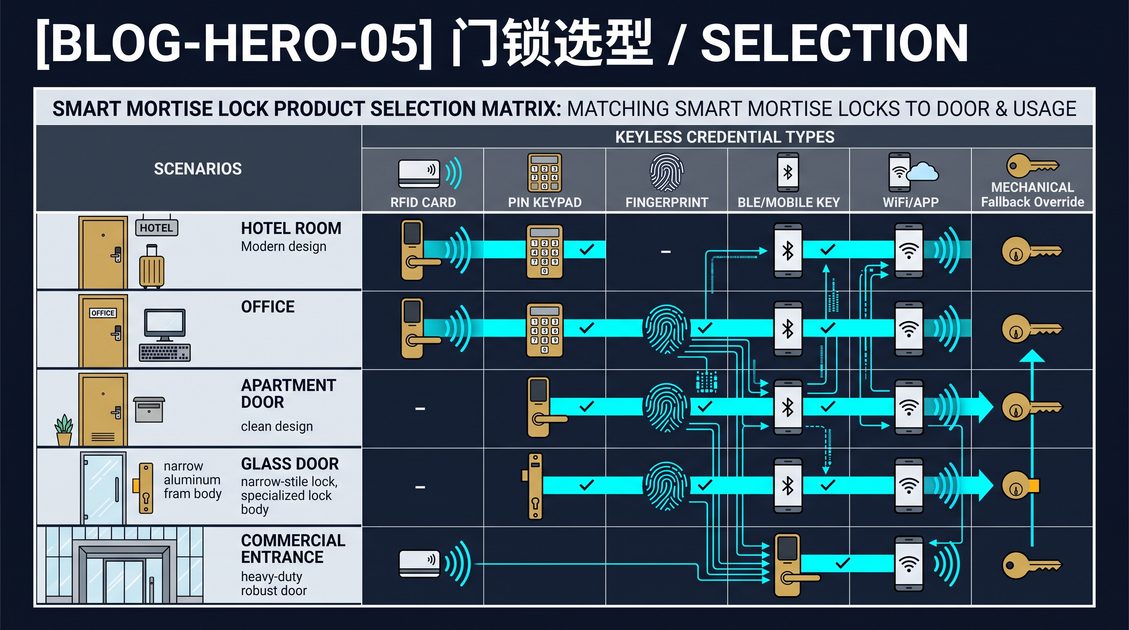
凭证决定了用户在系统各处使用门禁时的日常体验,因此选择凭证是一项战略决策,而不是附带事项。楼宇门禁解决方案指南应公开权衡各种方案的利弊。非接触式卡片和钥匙扣成本低、耐用且几乎不需要培训,但用户必须随身携带,管理方还要进行追踪,并在离职或退租时回收。手机移动凭证无需管理实体库存,并支持即时发放,但依赖应用稳定性以及住户设备的支持。密码键盘不按用户产生凭证成本,却容易出现密码被旁观或多人共用的问题。生物识别使用方便,但会带来隐私和识别一致性方面的疑问。多数实用型建筑会组合采用少量凭证类型,为住户和员工提供默认方式及可靠的备用方式,同时由同一平台统一管理所有凭证、角色和日志。
管理凭证生命周期
凭证只有在有效期间才有用,因此生命周期管理是优秀解决方案中低调却关键的环节。楼宇门禁解决方案指南应覆盖完整流程:在入职或入住时发放,分配角色和时间计划,在职责变化时更新,在离职或退租时撤销,并为审计归档。人员流动会暴露系统的薄弱点:离开者仍保留有效凭证,会形成安全漏洞;新人员无法访问所需区域,则会造成运营问题。应优先选择支持即时远程撤销的管理平台,并使用基于角色的模板,让大多数变更只需两次点击即可完成,同时记录每项管理操作由谁执行。对于存放敏感数据或贵重资产的建筑,应将撤销速度和完整性作为独立且可量化的要求。
与周边建筑系统集成
门禁系统很少独立运行,因此楼宇门禁解决方案指南应将集成视为首要要求。电梯控制可以将入口权限与楼层权限关联起来,使到达特定楼层成为一次单独的授权行为。视频监控能够为每个凭证事件配套影像记录,物业管理和访客管理系统则可以向平台提供所需的身份与时间计划。照明、HVAC 和占用感知系统可以根据进入事件做出响应,紧急系统则能在报警期间覆盖门锁控制。每项集成既能创造价值,也会增加可能发生故障的边界,因此在签约前应绘制数据流、确定通信协议,并确认每条连接由谁负责支持。能够顺畅连接建筑其他系统的解决方案,其价值不仅体现在安全方面,也会通过运营效率逐步体现。
安全加固与抵御入侵
解决方案的安全性取决于攻击者可以利用的路径,因此安全加固应成为任何楼宇门禁解决方案指南中的独立议题。应保护读卡器及其线路,防止被篡改,避免损坏设备轻易暴露通信总线。应采用符合公认标准的凭证技术和加密方案,因为低安全性的无线实现容易受到拦截和复制攻击。应及时更新固件,因为供应商会随着现场漏洞被发现而持续发布修复程序。管理平台应使用强度足够且定期轮换的凭证,并在系统调试完成时删除默认账户。机械部分同样不能忽视:粗心的机械应急开启方式、薄弱的门框或疏于维护的闭门器,都可能抵消电子控制带来的安全效果。安全是一种覆盖所有层面的整体状态,而不是宣传册上的单一功能。
预算完整拥有成本
表面的设备价格往往掩盖了解决方案的大部分真实成本,因此楼宇门禁解决方案指南应推动全面的运营视角。预算中应计入硬件、安装和布线、许可证、员工管理与支持所需的时间、卡片和电池等耗材,以及读卡器和电锁在长期使用中的维护费用。许可证可能是一次性购买,也可能采用订阅模式; recurring fee 应从第一年起纳入运营预算,而不是之后才作为意外支出出现。无线电池锁会将部分资本成本转化为持续的电池更换人工,而有线系统则会前期投入更多成本,以换取较低的持续维护工作量。质量更好的读卡器虽然初始价格略高,但如果能够减少维修次数,整个建筑生命周期内的成本反而可能更低。因此,应根据使用寿命评估总成本,而不能只比较最低的首次报价。
部署、调试与稳定运行
部署楼宇门禁解决方案是一项需要管理的项目,而不是一夜之间完成的设备替换。楼宇门禁解决方案指南应规划分阶段流程:从风险最高的门点开始,使用真实用户开展小范围试点,确认降级模式和各项集成经过验证后再逐步扩大范围。调试阶段应核验每一扇门、每个凭证、离线运行行为以及每项集成,并为任何出现故障的门点准备书面回滚方案。应培训并授权至少两名管理员,提供面向住户和员工的使用指南,同时为读卡器、门锁、闭门器和网络设备建立维护周期。还应定期检查访问策略和审计报告,使系统能够随着人员、租住情况和使用需求变化持续适配建筑,而不是逐渐被弃置不用。
本文部分内容由 AI 生成,并针对专业准确性和可读性进行了优化。
What a building access control solution is
A building access control solution guide should define the term it documents: a solution is not a single lock but a coordinated way to govern every door a building owns, from the lobby entrance to individual offices, labs, storage rooms, and utility closets. The architecture repeats a familiar pattern at each point, a reader accepts a credential, a controller decides whether the credential is entitled to pass, and an electrified lock obeys the result while a log records the event. These local decisions link to a central platform that holds roles, schedules, and credentials, and that platform may run on-site or in the cloud. More than the sum of its hardware, the solution is the set of operating policies that turn door locks into a managed system, which is why two buildings with identical hardware can differ completely in how well they control access.
Why an architectural approach beats picking products
The most expensive mistakes in access control come from buying isolated devices before thinking about the whole. A building access control solution guide should argue for an architecture-first sequence: define the doors that must be controlled, the user groups that need access, the schedules those groups follow, and the level of audit expected, and only then choose hardware that fits. This ordering exposes gaps a shopping approach hides, such as two locked doors that were never networked, a lobby reader that cannot reach the elevator, or a unit credential that does not match the amenity door. It also keeps the design future-proof, because an architecture that separates policy from hardware lets the building replace or add readers without reworking the entire installation. Teams that plan the shape of the system first spend less overall and end up with fewer exceptions.
The building blocks of a robust solution
Understanding the internals makes procurement clearest, so a building access control solution guide should map the anatomy of a deployment. Every treated door holds a locking mechanism, a reader, a controller, and a power feed, and the platform ties the controllers together with administrative software. The credential is the physical or digital token the bearer presents, and the identity behind each credential is what the platform actually manages. Motion, door-status, request-to-exit, and locking signals let the controller understand the physical world, whether a door was forced, left ajar, or asked to open from the inside. Naming these parts prevents the confusion that occurs when a vendor describes a reader when the real decision involves the controller and the credential ecosystem behind it.
Controllers, readers, and where policy lives
Controller placement determines how a building behaves during a network loss. In an architecture with local decision-making, each controller stores the credentials and schedules it needs and can open doors even if the central platform is unreachable, which suits reliability-critical entrances. In a cloud-dependent model, the door may query a remote service and can degrade when connectivity fails unless the hardware holds a local cache. A building access control solution guide should help teams choose the balance these two imply, recognizing that high-traffic and security-critical doors justify local intelligence while lower-stakes openings can tolerate cloud dependency. Readers, meanwhile, must match the credential technology adopted, card, fob, keypad, mobile, or biometric, and should be mounted at a height and angle that supports fast, comfortable use.
Choosing the credential strategy for the building
The credential defines the daily experience everywhere the system is used, making its selection strategic rather than incidental. A building access control solution guide should weigh the trade-offs openly. Contactless cards and fobs are inexpensive, durable, and work with minimal training, but they must be carried, tracked, and recollected at departure. Mobile credentials on phones remove physical inventory and enable instant provisioning, but they depend on app reliability and resident device support. Keypads cost nothing per user but invite observed or shared codes. Biometrics are convenient yet raise privacy and consistency questions. Most practical buildings adopt a small set of credential types together, offering residents and staff a default plus a reliable fallback, and the platform should administer all of them under one set of roles and logs.
Managing the credential lifecycle
A credential is only useful while it is current, so lifecycle management is the quiet hero of a good solution. A building access control solution guide should trace the entire arc: provision at onboarding, assign the role and schedule, allow updates when responsibilities change, revoke at departure, and archive for audit. Turnover exposes the weak point, because a leaver who retains a live credential is a security hole, and a newcomer who cannot access needed areas is an operational one. Favor a platform that makes revocation instant and remote, supports role-based templates so most changes are two clicks, and logs who performed each administrative action. Where the building holds sensitive data or valuable assets, the speed and completeness of revocation should be treated as a measurable requirement in its own right.
Integration with the surrounding building systems
Access control rarely sits alone, and a building access control solution guide should treat integration as a first-class requirement. Elevator control ties entry to floor permissions so that reaching a specific floor becomes a separate authorized act. Video surveillance pairs a visual record with every credential event, while the property management and visitor management systems supply the identities and schedules the platform needs. Lighting, HVAC, and occupancy sensing can respond to entry events, and emergency systems can override locks during an alarm. Each integration adds value and adds a boundary that can fail, so map the data flow, agree on the protocol, and confirm who supports each connection before signing. A solution that connects cleanly to the building's other systems pays for itself in operations, not just in security.
Security hardening and resisting compromise
A solution is only as strong as the paths an adversary can exploit, so hardening deserves its own consideration in any building access control solution guide. Protect readers and their wiring from tampering so that a damaged device cannot trivially expose the bus. Use credential technology and encryption of a recognized standard, because low-security radio implementations are vulnerable to interception and cloning. Keep firmware current, because vendors patch demonstrated field vulnerabilities over time. Guard the administration platform with strong, rotating credentials and remove default accounts at commissioning. Attend to the mechanical side as well, a careless mechanical override, a weak door frame, or a neglected closer can undo every electronic control. Security is a posture across all the layers at once, not a feature in a brochure.
Budgeting the complete cost of ownership
The visible price tag hides most of a solution's true cost, so a building access control solution guide should push toward a full operating view. Account for hardware, installation and cabling, licensing, the administration and support time of staff, consumables such as cards and batteries, and a maintenance allowance for readers and strikes that wear under use. Licensing may be a one-time purchase or a subscription, and a recurring fee belongs in the operating budget from the first year rather than surfacing as a surprise. Wireless battery locks shift capital cost into ongoing battery labor, while wired systems front-load cost for lower recurring effort. A slightly better-built reader that needs fewer service calls can prove cheaper across a building's lifetime, so evaluate on total cost over the service life, not the lowest first quote.
Rollout, commissioning, and the road to steady operation
Rolling out a building access control solution is a managed project, not an overnight swap. A building access control solution guide should plan a phased sequence that begins with the highest-risk doors, runs a small pilot with real users, and widens only after the degraded modes and integrations are proved. Commissioning should verify every door, every credential, the offline behavior, and each integration, with a documented rollback for any door that fails. Train and empower more than one administrator, deliver a resident-and-staff facing guide, and establish a maintenance cadence for readers, locks, closers, and network gear. Review access policy and audit reports regularly so the system keeps fitting the building as people, tenancy, and uses change rather than slowly receding into disuse.
Part of this article content is generated by AI and optimized for professional accuracy and readability.
不确定哪款传感器适合您的项目?
与我们的毫米波应用工程师免费咨询。