生物识别安全解决方案指南:门禁与建筑应用
一份实用的生物识别安全解决方案指南,涵盖指纹、人脸识别、模板保护、访问管理、隐私保护及部署决策。
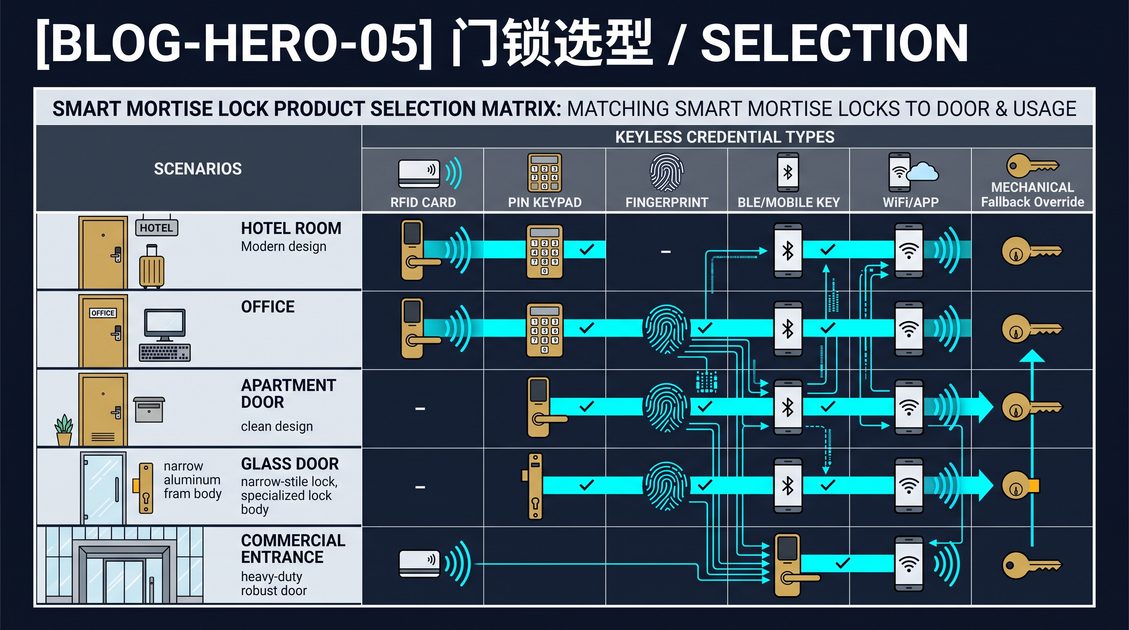
生物识别安全解决方案利用生物特征(通常为指纹或人脸)在允许进入门禁、建筑或受控区域之前对人员进行身份验证。这类方案可以取代共享钥匙和密码,实现个人责任追溯,并可集成电子执手锁与集中式访问管理。本生物识别安全解决方案指南将介绍主要的生物识别类型、准确性与隐私考量、备用方案设计,以及如何为家庭、办公室、酒店或多户住宅选择一款负责任的解决方案。
生物识别安全解决方案:指纹与人脸
指纹读取器通过光学、半导体或其他传感方式采集指纹脊线与谷线特征。指纹方案通常结构紧凑且成本经济,但识别效果取决于手指状态和录入质量。人脸识别则通过摄像头和算法在远距离识别人员身份,实现无感通行,但需要更强的处理能力、更多功耗以及严格的隐私管控。
这两种方式都不会自动具备安全性。一套生物识别解决方案应明确误接受率与误拒绝率表现、在适当场景下的活体检测或演示攻击检测能力,以及备用凭证方案。手指受伤或面部被遮挡的用户需要安全的替代方式,例如卡片、密码、移动凭证或机械钥匙。
生物识别安全解决方案:模板保护
生物识别模板无法像密码那样更换,因此应以加密形式存储在安全元件或其他受保护位置,并尽可能在本地完成处理。应避免将原始指纹图像或人脸图像传输至不受控制的服务。请确认数据的存储位置、可访问人员、删除方式,以及系统如何满足适用的隐私义务。
访问管理应区分录入、管理、审计审查和日常使用等不同角色。当员工离职、租约到期或项目结束时,平台应能够注销相应用户,并记录谁修改了生物识别权限。仅收集实现既定访问目的所必需的生物识别数据即可。
生物识别安全解决方案:部署与测试
选择门体形态和管理架构时应同步考虑生物识别读取器。指纹读取器可集成于智能执手锁,而楼宇系统可使用连接中央控制器的独立读取器。应在预期的光照、温度和通行条件下用真实用户进行测试,并确认断网、断电和传感器拒识时的行为表现。
本生物识别安全解决方案指南仅为一般性信息。请咨询合格的专业人员,确认隐私、无障碍、消防、电气、建筑和紧急疏散等方面的要求。负责任的生物识别部署应兼顾精准感应、模板保护、可靠的备用方案、明确的同意与留存政策,以及训练有素的操作人员。
采购审查还应考虑包容性与备用方案。部分用户可能不同意录入生物识别信息、可能暂时受伤,或工作环境导致传感器不可靠。应提供经批准的卡片、密码或人工恢复通道,并在部署前向用户说明。当人员离开时测试录入信息的删除流程,确认管理员无法查看不必要的原始生物识别数据,并持续更新文档化的留存和删除流程。这些管控措施能使生物识别安全解决方案真正适用于实际团队,而不仅仅是受控演示中的展示品。
部署应包含一套能够生成一致性模板的录入计划。培训用户按规范放置手指或面部位置,在硬件支持的情况下录入多个样本,并在用户外貌发生变化时重新录入。录入完成后,逐一验证每个人员都能可靠开锁,并确认实际场景中的误拒绝率处于可接受范围。在门禁处设置简短的问题排查说明,避免被拒用户陷入困境。最后,将生物识别方案与审计和离职流程打通,确保人员离开时其模板被删除、访问权限被撤销,且变更记录在案。一套易于录入、易于删除的生物识别系统,在运营实用性上远胜于仅在演示中令人印象深刻的方案。
监控计划与录入计划同等重要。明确谁负责审查误拒绝事件、谁可以使用经批准的备用方案临时解除用户锁定、哪些工作人员可以导出或清除审计数据。在启用前公布这些管控措施,有助于向各方表明生物识别安全解决方案以透明方式运行,并可在需要时快速撤回。当与机械或人工恢复通道相结合时,生物识别门将成为一种实用、可问责的通行选项,而非一道僵化的屏障。
本文部分内容由 AI 生成,并经过专业准确性及可读性优化。 Biometric security solutions use a biological trait, usually a fingerprint or face, to identify a person before granting access to a door, building, or controlled area. They can remove shared keys and codes, provide individual accountability, and integrate with electronic mortise locks and centralized access management. This biometric security solutions guide explains the main biometric types, accuracy and privacy considerations, fallback design, and how to choose a responsible solution for a home, office, hotel, or multifamily property.
Biometric Security Solutions: Fingerprint and Face
Fingerprint readers capture ridge-and-valley features through optical, semiconductor, or other sensing methods. They are generally compact and economical, but performance depends on finger condition and enrollment quality. Facial recognition uses a camera and an algorithm to identify a person at a distance, providing hands-free access but requiring more processing, power, and careful privacy controls.
Neither method is automatically secure. A biometric solution should specify false-acceptance and false-rejection behavior, liveness or presentation-attack detection where appropriate, and the fallback credential. A user with an injured finger or a covered face needs a safe alternative such as a card, PIN, mobile credential, or mechanical key.
Biometric Security Solutions: Template Protection
A biometric template cannot be changed like a password, so it should be stored encrypted in a secure element or other protected location and processed locally where possible. Avoid systems that transmit raw fingerprint images or face images to an uncontrolled service. Ask where the data is stored, who can access it, how it is deleted, and how the system supports applicable privacy obligations.
Access management should separate enrollment, administration, audit review, and daily use. The platform should revoke a user when employment, tenancy, or a project ends, and it should record who changed a biometric permission. Collect only the biometric data needed for the stated access purpose.
Biometric Security Solutions: Deployment and Testing
Choose the door form factor and management architecture with the biometric reader. A fingerprint reader may be integrated into a smart mortise lock, while a building system may use a reader connected to a central controller. Test real users in the intended lighting, temperature, and traffic conditions, and confirm behavior during network loss, power failure, and sensor rejection.
This biometric security solutions guide is general information. Confirm privacy, accessibility, fire, electrical, building, and emergency-egress requirements with qualified professionals. A responsible biometric deployment combines accurate sensing, protected templates, a reliable fallback, clear consent and retention policies, and trained operators.
A procurement review should also consider inclusion and fallback. Some users may not consent to biometric enrollment, may have a temporary injury, or may work in conditions that make a sensor unreliable. Provide an approved card, PIN, or staffed recovery route and explain it before deployment. Test enrollment removal when a person leaves, verify that an administrator cannot view unnecessary raw biometric data, and keep the documented retention and deletion process current. These controls make biometric security solutions practical for real teams rather than only for a controlled demonstration.
A deployment should include an enrollment plan that produces consistent templates. Train users to present the approved finger or face position, record multiple samples where the hardware allows, and re-enroll a user whose appearance changes. After enrollment, verify that each person can unlock reliably and that the false-rejection rate is acceptable in practice. Keep a short troubleshooting procedure at the door so a rejected user is not left stuck. Finally, link the biometric solution to the audit and offboarding process, so that when a person leaves, their template is removed, their access is revoked, and the change is recorded. A biometric system that is easy to enroll and easy to remove is far more operationally useful than one that is only impressive during a demonstration.
The monitoring plan matters as much as the enrollment plan. Decide who reviews false-rejection events, who can temporarily override a locked user with an approved fallback, and which staff can export or erase audit data. Publishing these controls before launch helps the property demonstrate that biometric security solutions operate transparently and can be withdrawn quickly. When combined with a mechanical or staffed recovery route, a biometric door becomes a practical, accountable access option rather than a rigid barrier.
Part of this article content is generated by AI and optimized for professional accuracy and readability.
不确定哪款传感器适合您的项目?
与我们的毫米波应用工程师免费咨询。