公寓门禁系统完整规划指南:从设计到落地
实用的公寓门禁系统指南,涵盖核心组件、住户与访客凭证、安全、消防疏散、系统集成及分阶段部署,帮助物业团队高效规划。
什么是公寓门禁系统
公寓门禁系统规划指南应先明确系统本身的定义:门禁系统是由硬件与软件协调组成的方案,用于决定特定人员能否在特定时间打开特定门,并记录相关操作。典型安装范围包括住户门、主大堂入口、配套设施房间、邮件室、停车场闸门及非工作时间员工入口。每个受控点都将实体门与控制器、读卡器、凭证和审计日志连接起来,而整个系统还依赖电源、布线、网络连接及清晰的运行规则。了解这些层次的物业经理能够作出更合理的采购决定,因为他们可以区分必要功能与边际功能。将需求直接对应到硬件的规划方案,可以避免购买外观出色却无法互联、难以高效管理,或因单一依赖失效而导致住户无法进入的设备。
为什么硬件决策应以书面规划为先
大多数在电子门禁方面遇到困难的公寓团队,并不是采购时出了问题,而是在范围界定阶段就出现了偏差。一份真正有效的公寓门禁系统规划指南,应将规划本身视为项目核心。首先巡视每个入口,记录门的类型、开启方向、门扇数量、现有锁具和电锁扣状态、可用电源及网络覆盖情况。与租赁、维修、安保和前台人员沟通,了解每扇门在正常时段、非工作时段、入住办理及紧急情况下的使用方式。将访谈结果转化为明确的需求,例如“快递员在没有住户陪同的情况下必须能够进入大堂”,或“住户手机丢失后仍须在十分钟内进入”。按照优先级及满足成本为需求排序,因为取舍不可避免。在获取任何供应商报价前,物业管理层应确认需求清单,使采购成为填补已验证缺口的过程,而不是凭印象猜测。
构成系统的核心组件
可靠的部署方案应清晰拆分为可识别的功能模块。每扇需要电子门禁控制的门,都需要机电锁闭机构、接受凭证的读卡器、作出允许或拒绝决定的控制器、电源及审计记录。读卡器面向用户,控制器保存策略,因此从一开始就将两者分开规划,便于后续变更。
锁闭硬件与电锁扣
门硬件是实际保护开口的部件。电锁扣、磁力锁和电插芯锁都能将电信号转换为机械释放动作。公寓门禁系统规划指南应强调,锁闭机构必须与实体门匹配:门厚、门框材料、左右手方向、锁舌位置及防火等级连续性,都会限制可安装的设备类型,且不能损害整套门组件。应选择能够承受预期使用次数的硬件,因为每天频繁使用的住户门,与低流量员工储物间的磨损情况不同。涉及防火门时,所选硬件应保持门组件的防火等级,并获得目标用途所需的批准。
接受凭证的读卡器
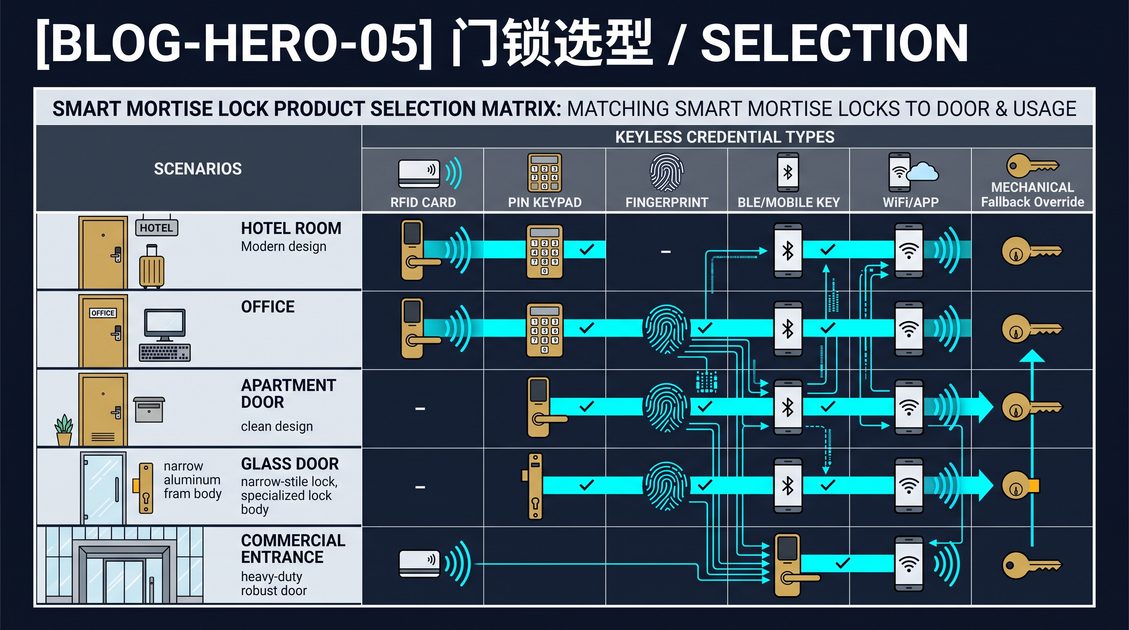
读卡器是用户界面,可采用键盘、卡片、钥匙扣、生物识别以及支持 Bluetooth 或 NFC 的形式。凭证类型会显著影响读卡器选择,反之亦然。卡片和钥匙扣使用快速、耐用,但物业必须向每位住户发放实体物品。键盘无需携带物品,却存在密码被旁观和需要管理 PIN 的风险。移动凭证将管理负担转移到住户手机上,同时增加应用、电量和连接方面的考虑。稳健的系统通常允许同一读卡器支持多种凭证类型,使住户和员工在主要方式不可用时能够切换备用方式。
决策如何从控制器传递到门锁
控制器是整个链路中的决策中心。它保存有效凭证列表,应用时间区域,并在检测到可接受的凭证后发出开门指令。在公寓门禁系统规划中,需要理解不同控制器的主要差异在于智能逻辑所在的位置。有些系统在每扇门本地保存策略,即使网络或中央服务器无法访问,门仍能工作;另一些系统依赖托管服务,服务中断时可能导致门禁功能降级。应选择离线行为符合物业运营承诺的架构。本地保存凭证还可以提高开门速度,因为决策不必等待远程服务器完成往返通信。
有线与无线基础设施
每个读卡器和门锁都必须获得电力与数据。有线安装会向每扇门提供电源线和通信总线,通常最具可预测性。无线门锁可大幅降低布线成本,但其稳定性取决于内部电池和无线链路可靠性。公寓门禁系统规划指南应帮助团队客观比较两种方式:布线成本一次性支付,可带来稳定运行时间;无线方案节省安装人工,适合布线会造成较大干扰或施工困难的改造项目。许多现代系统采用混合方案:为大堂及高流量区域布线,同时在风险较低的室内住户门上安装电池供电的无线锁。
电源、失效安全行为与可靠性
所有电子锁最终都依赖电力,因此可靠性规划应从供电拓扑开始。磁力锁和电锁扣通常可根据物业希望断电时门的行为,设置为断电上锁或断电开锁。在公寓环境中,正常运行时保持锁闭的大多数门,在停电时会默认保持安全锁闭;而消防疏散门和主要行人门通常会释放,以便人员离开。公寓门禁系统规划指南必须说明无线锁的电池预期寿命,因为充电或更换频率会直接影响维修人员配置和住户满意度。应制定清晰的应急措施,包括住户门上的机械钥匙旁路、关键闸门的备用供电路径,以及网络或电源故障时入口门的具体行为。
处理停机与降级模式
停机不是会不会发生的问题,而是什么时候发生的问题。物业应记录每扇门在控制器重启、云服务中断或住户凭证无法验证时的行为。制定前台人员可以独立执行的升级流程,避免每次情况都联系系统集成商。在适当位置保留人工旁路的记录路径,并确保每次旁路事件都被捕获,使审计轨迹保持真实有效。调试验收时,应通过模拟网络中断测试降级模式,而不是等到繁忙的退租日才发现故障。住户始终应至少拥有一种独立的进入方式,通常是机械旁路或备用凭证。
选择凭证技术并管理其生命周期
凭证决定每位住户的日常使用体验,错误选择会造成长期不便,并影响整个建筑的形象。公寓门禁系统规划指南应将凭证选择视为产品决策,而不是硬件采购后的补充事项。采用行业标准无线协议的非接触式卡片和钥匙扣价格低、容错性好;移动凭证则能减少实体库存并简化发放流程。应规划从发放到失效的完整生命周期:新住户入住时如何领取凭证,凭证丢失后如何快速停用,权限如何按角色和时间划分,以及租户离开后如何彻底移除权限。
大规模为住户发放凭证
大型建筑在集中入住季会在短时间内为大量住户发放凭证。应评估系统是否支持批量编程、基于角色的模板,以及管理员之间无需技术人员到场即可完成的凭证转移。每年秋季需要重新发放一百张卡的物业,必须清楚这项工作需要一个下午,还是数天人工录入。确认管理门户会记录每次发放操作的执行人,因为这份审计记录也是安全体系的一部分。住户更替是公寓门禁中工作量最大的管理任务,因此其流程设计应获得与门硬件同等的重视。
处理凭证丢失与撤销访问权限
住户报告钥匙扣或手机丢失后,物业必须立即停用该凭证,最好能够远程完成,并在凭证被用于攻击前完成处理。应建立无需寻找预设令牌或等待技术人员的撤销流程。系统应便于查看所有有效凭证、每个凭证最近一次使用时间及其可到达的门。任何可能已经泄露的凭证都应停用,并通过正常发放流程补发。对于离开租户,应确认所有实体凭证已归还,数字凭证也在同一个管理步骤中停用,因为系统中残留的旧凭证,是退租后争议的常见来源。
从入住到日常使用的住户体验
住户如何开门,比任何后台功能都更影响日常感受。公寓门禁系统规划指南应以住户旅程为中心,因为即使系统是强制使用的,实际采用仍取决于住户体验。应优化第一次使用:新住户入住时应获得凭证和两分钟说明,而不是一份复杂手册。考虑不同年龄和技术熟练程度的用户,因为数百名住户通常不会拥有一致的移动应用使用经验。明确说明主要凭证不可用时的备用进入方式,并让刚搬入、在楼内没有熟人的住户也能轻松找到帮助。正式上线前应邀请具有代表性的住户测试流程,而不是上线后才处理问题,并记录使用阻力,使后续改进有据可依。
管理访客、配送与短期访问
公寓建筑天然具有开放性,住户会接待访客,快递员也会全天到达。优秀的系统应将长期住户权限与临时访客权限分开,使访问范围始终受到控制。公寓门禁系统规划指南应明确前台无人值守时访客如何进入。可选方式包括住户为访客远程开门的视频对讲、一次性或限时密码、住户从个人账户发放的访客通行证,或用于无人包裹接收的自助快递柜。每种方式都在便利性、安全性和管理成本之间进行取舍。无论采用何种设计,都应生成可审计记录,记录谁在何时进入了受保护区域,以便日后还原事件。
配送与包裹流程
包裹数量对门禁策略的影响不亚于安全要求。完全关闭非工作时间配送权限,只会将包裹推入大堂,或让快递员在取件点滞留,结果可能比受控进入更糟。可考虑设置仅凭限时快递员凭证进入的专用包裹室、在规定时段由工作人员接收包裹,或采用快递柜集成,让快递员只能打开指定柜格而无法获得整栋建筑权限。每种方案都应将快递员限制在完成配送所需的最小区域,透明记录进入行为,且绝不暴露住户生活区域。同时应权衡保险、盗窃和住户投诉风险,以及物业能够接受的风险水平。
员工、承包商与服务提供商
内部团队和第三方承包商同样需要进入部分区域,但其权限应比住户更严格、有效期更短。公寓门禁系统规划指南应定义基于角色的权限配置:维修人员可能需要按需通行走廊和设备间,而到访技术人员可能只需在两小时内进入一间机械室。授予完成工作所需的最小权限,设置明确有效期,并在服务结束时立即撤销。记录员工移动轨迹也有助于解决住户不在家时谁进入过房间的争议,因此物业即使对信任的员工也应记录访问,并在问题发生前透明说明该政策。
与对讲机、电梯及智能建筑系统集成
门禁系统很少独立存在。忽略集成规划的公寓门禁系统指南,无法准确反映真实运行环境。常见协作系统包括大堂对讲机、电梯控制、视频摄像头、物业管理系统以及照明或 HVAC 系统。对于高层建筑,电梯集成尤其有价值,因为楼层限制可以将建筑访问风险控制在单个楼层。视频系统能够通过记录进入瞬间,增强每次凭证交易的可追溯性。应明确哪些系统需要交换数据、数据如何流动(本地集成、云 API 或两者兼有),以及每个接口由谁负责。集成故障经常源于协议不匹配,因此在签约前应确认各合作系统的工作模式和集成点。
电梯与配套设施访问
住户进入大堂后,电梯轿厢和配套设施门就成为第二层权限边界。受控电梯可以限制凭证能够到达的楼层,适用于仅限租户使用的高层建筑,也能更好约束承包商权限。健身房、泳池和活动室等配套空间可以使用同一凭证,减少住户需要记忆的物品数量。公寓门禁系统规划指南应提醒团队,每增加一道边界,就会扩大运营范围:需要维护更多读卡器、发放更多凭证,并测试更多故障点。只有在能够明显提升安全性或政策明确要求时才增加边界,不要为了功能堆叠而增加支持负担,却没有降低风险。
消防疏散与生命安全合规
生命安全不可妥协,并决定电子门禁系统在疏散路径上能够执行什么操作。疏散通道上的门,无论门禁状态如何,在火灾或紧急情况下都必须允许人员自由离开。公寓门禁系统规划指南应明确规定:绝不能将锁配置为在警报期间困住人员。疏散路径上的电气硬件通常设置为断电开锁,使断电或消防报警能够释放门锁。在法规允许的情况下,延迟疏散及电磁疏散硬件也必须严格遵循适用的生命安全规范和当地法规,并通过获批准的集成在消防报警信号触发时释放。应与当地主管部门确认哪些门属于疏散门,以及每扇门可接受的硬件配置,因为违反疏散规则的锁具既不安全,也会带来法律风险。
隐私、数据保护与当地合规
电子门禁会产生个人及行为数据,这是公寓门禁系统规划指南不能忽视的责任。访问日志可能揭示住户何时进出,在住宅环境中属于敏感信息。应了解所在司法辖区适用的数据法规、记录可保存多久,以及必须向住户告知哪些数据收集事项。只存储物业确实需要的信息,限制审计报告的读取人员,并规定记录删除期限。满足住户查看其个人数据的要求,并使用强身份验证保护管理凭证,防止攻击者篡改门禁数据。这些责任应写入初始规划,而不是在投诉发生后才补充。
用于责任追踪的审计轨迹与报告
审计日志将门禁安装从单纯的开门设备转变为安全系统。公寓门禁系统规划指南应将日志视为具有明确内容的交付成果:哪个凭证、哪扇门、哪个方向、何时发生以及结果如何。日志的价值取决于能否访问,因此应设计员工真正需要的报告,例如上周谁进入过某个住户单元、哪些钥匙扣仍有效但长期未使用、哪些门保持打开时间过长。日志的保存和备份应不依赖其所在的云服务商或本地服务器。当住户质疑某次事件或调查开始时,能够清晰还原准确的事件顺序,是采用电子门禁系统最有力的理由。
移动凭证与应用架构
移动凭证将住户智能手机变成访问令牌,并改变凭证发放、便利性和故障模式。公寓门禁系统规划指南应像评估读卡器硬件一样认真评估应用体验。确认应用支持住户实际使用的设备类型,在关键门上具备有意义的离线功能,并为手机没电或遗忘手机制定备用方案。移动发放可以取消卡片库存,让租赁团队无需打印任何材料即可即时为新租户开通权限。但必须谨慎评估支持负担,因为并非每位住户都会配置通知,也不是每个人都理解 Bluetooth 握手失败的原因;如果前台变成非正式 IT 服务台,就会产生真实的人员成本。
平衡应用便利性与安全性
用于开门的手机同时保存银行应用和个人账户,因此身份验证非常重要。应考虑应用是否需要独立登录、开门前是否需要生物识别确认,以及频繁通信之间是否需要冷却时间。住户将手机靠近读卡器时自然期待快速响应,因此额外操作必须能够带来相应的安全价值。通信通道应使用认可协议加密,避免在设备上保存长期有效的主密钥。应记录应用重新安装、更换手机或转移账户时的处理方式,因为这些过渡环节正是数字访问最容易中断、并导致住户提交支持请求的时刻。
大规模管理租户更替
租户更替是公寓运营中发生频率最高的事件,门禁系统要么简化流程,要么放大混乱。公寓门禁系统规划指南应对此投入真正的设计精力。退租时,物业必须撤销所有原有权限,收回或使实体凭证失效,并确认单元门不再响应旧租户。入住时,新租户应立即获得可用权限,最好在到达前就完成。这个衔接环节的任何漏洞都会造成安全和声誉风险。在系统允许的情况下应自动化整个流程,保留一名服务台人员即可执行的标准程序,并在每次变更后实际开门验证,而不是只相信管理后台界面。
加固安全并抵御常见攻击
电子门禁的强度取决于攻击者能够找到的最薄弱路径。公寓门禁系统规划指南应如实列出实际攻击面。实施不当的无线凭证可能受到拦截或克隆,因此应优先选择采用成熟加密和双向认证的技术与部署方式。保护读卡器布线,防止被攻陷的读卡器轻易接入通信总线。持续更新固件,因为供应商会随着现场漏洞被发现而发布补丁。使用强密码并定期轮换,保护管理平台,绝不能保留启用状态的默认账户。实体防护同样重要:安装不牢固的读卡器或无人监管的机械旁路,都可能削弱整个电子控制体系。安全是一种覆盖所有层面的状态,而不是某一个设备。
理解尾随进入与搭便车进入
尾随进入是指一人跟随另一人通过未锁闭的门。这属于社会行为而非技术故障,在公寓中极其常见。公寓门禁系统规划指南应坦诚说明:如果没有大多数住宅大堂无法接受的旋转闸机或人员缓冲间,读卡器无法完全阻止这种行为。应采用分层缓解措施,包括高峰时段安排前台人员、在入口位置布置摄像头,以及通过标识或制度提高并肩进入的社会成本。如果风险不可接受,受控入口前室或有人值守的前台通常比更复杂的读卡器更有效。应让住户理解,门禁可以大幅减少非授权进入,但无法消除人为替他人扶门这一行为。
规划真正的拥有成本
设备标价只是门禁预算中最小的一部分。公寓门禁系统规划指南应推动团队计算总拥有成本,其中包括硬件、安装、许可、管理时间、卡片和电池等耗材、维护,以及住户支持和凭证发放所需的人员成本。无线电池锁以持续的电池维护换取较低的初始资本支出;有线系统则以较高的前期布线成本换取较低的持续工作量。许可模式可能是一次性购买,也可能是订阅制;订阅费属于持续运营支出,应从第一年就纳入预算,而不是使用一年后才发现。应为读卡器、电锁扣和闭门器在高频使用下发生故障预留维护费用。适度提高硬件质量,通常可以在建筑整个生命周期内大幅减少服务请求。
选择并采购合适的合作伙伴
供应商选择至少与功能选择同等重要,因为门禁系统需要由人员安装并持续支持多年。公寓门禁系统规划指南应建议团队依据证据,而不是营销宣传,比较系统集成商和制造商。询问每个候选方完成过多少类似住宅项目,晚上及节假日公寓事故集中发生时如何提供支持,以及每个集成边界由谁负责。要求提供可联系的参考项目,并了解供应商如何处理过真实停机。明确许可条款、日后更换供应商时的迁移路径,以及安装人工的实际报价。架构开放、价格透明的系统,比会造成长期绑定的封闭系统更能从容应对未来变化。
编写以需求为驱动的 RFP
清晰的询价文件可以将前期需求目录转化为可比较的报价。公寓门禁系统规划指南应建议围绕可评分、可测试的需求组织 RFP,而不是围绕品牌偏好。要求每个候选方将其方案映射到需求清单,并明确说明哪些项目为标准功能、可选功能或不支持。授予项目前,应索取调试测试计划、面向住户的文档及安装后的支持安排。根据既定排名评分,并通过实际演示住户日常流程,在候选名单中现场验证中选方案。这样的招标方式能够形成经得起实际运行检验的决策。
安装、调试与验收测试
安装质量决定规格完善的系统能否正常运行。公寓门禁系统规划指南应将调试作为独立且有预算的阶段。住户依赖系统前,应验证电缆走向、电源输入、读卡器对准、电锁扣间隙及无线覆盖。制定验收测试,逐扇检查所有门,测试每种凭证,触发各种降级模式,并验证与对讲机和电梯的集成。应准备回退方案,使故障门能够恢复到原有工作状态,避免住户无法进入。只有在测试结果完成记录,且所有例外问题已修复或经批准并附日期说明后,才能将系统移交运营团队。
文档、培训与持续管理
软件只安装一次,但建筑需要依靠文档和能够阅读文档的人员持续运行。公寓门禁系统规划指南应坚持要求交付能够长期使用的资料,包括所有读卡器和控制器的现场地图、凭证与角色矩阵、降级模式说明,以及注明可用时间和升级流程的联系人。至少培训两名员工掌握完整管理流程,避免凭证发放形成单点故障。用通俗语言制作简明的住户指南,并在平台变化时及时更新。未记录的管理流程会逐渐偏离标准,而系统的纪律性取决于日常运行它的制度。
维护、监控与持续改进
门禁不是一次性购买的交钥匙产品,而是一项持续服务。公寓门禁系统规划指南应围绕读卡器、锁具、电池、闭门器和网络设备建立维护周期,因为悄然失效的门比明显报错的门更危险。结合审计数据和故障报告识别模式,例如某个时间经常未关好的门、故障率异常的读卡器,或在不可能的时间使用的凭证。随着员工、供应商和住户构成变化,定期审查访问策略。将门禁事件与摄像头和事故报告关联,使每次事件都能推动配置优化。系统应随着时间推移变得更好,而不是在硬件和流程共同老化的过程中逐渐退化。
系统扩展与面向未来的部署
今年的建筑规模可能与明年不同,但门禁平台应能够扩展,而不必全部重建。公寓门禁系统规划指南应评估系统如何覆盖新增建筑、新住户单元或新的集成合作伙伴。确认增加一扇门或一栋建筑究竟只是配置变更,还是需要重新启动项目。可以考虑云管理平台,在保持各站点策略独立的同时,将多个物业纳入统一管理,并确认集中管理系统能够保留怎样的离线行为。优先选择开放、基于标准的方案,使凭证与硬件能够互操作,避免物业永久受制于单一供应商的产品路线图。
部署过程中应避免的常见问题
大多数公寓门禁问题高度重复,因此也完全可以预防。公寓门禁系统规划指南应列出典型错误:尚未研究住户群体就先决定凭证类型;实际需要稳定供电的门却采购无线设备;电锁扣和磁力锁使用的电源容量不足;忽视决定电气释放门能否重新上锁的闭门器;忘记网络设备和读卡器都需要防浪涌及环境保护。团队还经常跳过验收测试,默认安装商会永久支持系统,并忽略耗材预算。这些问题在规划阶段预防成本很低,却会在住户入住后付出高昂的纠正代价。现在就列出问题并为每项指定负责人,项目便可在大多数故障演变成事故前将其消除。
全面部署前先运行试点
受控试点是降低全楼部署风险最可靠的方法。公寓门禁系统规划指南应建议选择一组规模较小但具有代表性的门,涵盖住户、员工、访客、快递员及电梯通行,然后在真实生产条件下运行一段明确期限。测量实际结果:有多少住户联系支持团队、凭证发放需要多长时间、建筑维修团队如何应对,以及审计轨迹记录了什么。试点能够发现无线盲区、应用操作阻力和人员配置问题,这些都无法通过供应商演示完整体现。应依据试点结果决定是否扩大部署,并将试点数据作为业务论证的真实证据,而不是使用宣传视频。
正式上线后衡量成功程度
没有衡量指标的计划无法改进,因此公寓门禁系统规划指南应以能够判断投资是否成功的指标收尾。持续跟踪每扇门的支持工单数量、平均凭证发放时间、锁定和旁路次数、尾随进入事件,以及撤销离开租户权限所需时间。将丢钥匙和重新配钥匙的成本与新凭证系统进行比较,并调查住户多久遇到无法进入的情况以及解决需要多长时间。如果指标朝错误方向发展,应使用最初设计系统时的同样方法制定行动计划:重新审查需求,重新启用降级模式流程,并加强管理。只有经过衡量和记录的运营,才能让系统真正保护并服务于建筑,而不只是存在于现场。
无障碍与通用设计考虑
一扇供许多住户使用的门,应尽可能服务更多人,包括行动不便、视力较弱或手部灵活性有限的人群。公寓门禁系统规划指南应将通用设计视为核心要求,而不是事后补救。将读卡器安装在轮椅使用者可触及的高度,使用带触觉和声音反馈的键盘,并通过语音提示确认成功开锁,都可以减少对视觉的依赖。如果楼梯或门槛阻挡路线,还必须检查通往入口的完整路径,确保门禁系统不是唯一障碍。大尺寸标识以及无需精细手部操作的备用凭证选项,都应从设计之初纳入布局。设计阶段咨询无障碍专家,远比住户或监管机构发现问题后重新安装硬件更经济。
对声音、视力与灵活性的适配
不同障碍需要不同设计方案,单一凭证很少能很好地服务所有人。视力较弱的住户可使用间距清晰、数字凸起的键盘,以及根据成功或失败发出不同提示音的设备;手部震颤或关节炎住户可能会发现大尺寸钥匙扣比小型 PIN 屏幕更容易使用。物业同时安装钥匙扣读卡器和键盘,就能为不同能力的用户提供合适路径;移动应用还可为不便操作小按键的用户提供大触控界面。任何声音或视觉提示都应有替代通道,避免某个用户能够感知的信号对另一用户完全不可见。应在住户指南中记录适配选项,使支持团队能够根据个人情况推荐合适凭证,而不是强迫所有人接受同一种体验。
分层预算与分阶段实施投资
很少有建筑能够一次性支付所有功能,因此分阶段部署既是财务工作,也是技术工作。公寓门禁系统规划指南应帮助团队将功能映射到不同预算层级,并在分阶段实施时避免早期阶段过于脆弱。第一阶段可以先保护风险最高的点位、大堂入口、邮件室和非工作时间员工门,待基础系统验证后,再在后续阶段加入配套设施和电梯集成。每个阶段都应独立完整运行,避免物业承担未完成工作的成本;同时每个阶段都应交付可衡量的价值,为下一阶段提供依据。由于门禁许可、存储和支持通常是持续费用,运营预算应从第一年开始体现这些支出,而不能将项目视为一次性资本采购。多阶段计划还可以分摊安装人工,并给住户适应时间,避免整栋建筑同时发生剧烈变化。
根据建筑年代与规模合理确定范围
老旧建筑和小型物业组合通常不需要与新建高层建筑相同的系统规模,将同一个模板强行应用于两者,要么浪费资金,要么留下缺口。公寓门禁系统规划指南应在指定硬件前,综合评估建筑布线、门数量、住户规模和安全状况,再与系统容量进行比较。一栋拥有六个单元、WiFi 稳定且预算有限的步梯楼,可能只需每扇住户门安装一把独立无线锁,再配备一个大堂读卡器;而拥有电梯和包裹室的 400 户高层建筑,则需要带控制器、可扩展并具备集成接口的平台。应询问供应商报价是否根据实际建筑规模合理配置,还是直接套用过大的整层企业级系统。最经济的系统,是满足书面需求的最小系统,因为闲置容量仍会带来许可、硬件和管理复杂度成本。
本文部分内容由 AI 生成,并针对专业准确性与可读性进行了优化。
What an apartment access control system is
An apartment access control systems guide should begin by clarifying the subject itself: an access control system is a coordinated set of hardware and software that decides who may open a specific door at a specific time and records that interaction. The installed base typically spans unit doors, the main lobby entrance, amenity rooms, the mailbox room, parking gates, and after-hours staff entry points. Each treated point links a physical door to a controller, a reader, a credential, and an audit log, and the whole arrangement depends on power, cabling, network connectivity, and clear operating rules. Property managers who understand these layers make better buying decisions because they can weigh what is essential against what is marginal. A plan that connects requirements directly to hardware avoids the common failure of purchasing impressive devices that cannot interoperate, cannot be administered efficiently, or leave residents locked out when a single dependency vanishes.
Why a written plan precedes hardware decisions
Most apartment teams that struggle with electronic access did not fail at the point of purchase; they failed at the point of scoping. An apartment access control systems guide that works treats planning as the product. Begin by walking every entrance and noting the door type, swing direction, leaf count, existing lockset and strike condition, available power, and network reachability. Interview leasing, maintenance, security, and front-desk staff about how each door is used during normal hours, after hours, at move-in, and during emergencies. Convert those interviews into explicit requirements statements such as "delivery couriers must enter the lobby without a resident present" or "a resident who loses a phone must still gain entry within ten minutes." Rank statements by priority and by what each costs to satisfy, because trade-offs are inevitable. Property leadership should sign off on the requirement list before any vendor quote, turning procurement into an exercise of filling verified gaps rather than guessing.
Core components that make up the system
A reliable deployment decomposes cleanly into identifiable building blocks. Every door that receives electronic access logic needs an electromechanical locking mechanism, a reader that accepts credentials, a controller that makes the allow-or-deny decision, a power supply, and an audit record. Readers present one face to the user while controllers hold policy, so separating them from the start makes later changes easier.
Locking hardware and the strike
The door hardware is the element that physically secures the opening. Electrified strikes, electromagnetic locks, and electrified mortise locks all translate an electrical command into mechanical release. An apartment access control systems guide should stress that the locking mechanism must match the physical door: door thickness, frame material, handedness, latching points, and fire-rating continuity all constrain what can be installed without compromising the door assembly. Work with hardware rated for the anticipated cycles, because a unit door crossed many times daily will wear differently than a low-traffic staff closet. In situations where fire-rated doors are involved, the chosen hardware should maintain the door assembly's rating and be approved for the intended use.
Readers that accept credentials
Readers are the human interface and come in keypad, card, fob, biometric, and Bluetooth or NFC-capable forms. Credential choice shapes the reader type more than any other factor, and vice versa. Card and fob systems are fast and durable but require that the property distribute physical objects to every resident. Keypads remove the object but carry the risk of observed codes and require PIN management. Mobile credentials shift the burden to the resident's own phone but add app, battery, and connectivity considerations. A robust system normally supports more than one credential type on the same reader so that residents and staff can fall back when their primary method is unavailable.
How decisions flow from controller to lock
The controller is the decision maker in the chain. It holds the list of valid credentials, applies time zones, and issues the open command when presented with an acceptable credential. In an apartment access control systems guide, the reviewer should understand that controllers differ mainly in where their intelligence sits. Some systems store policy locally on each door, which keeps the door functional if the network or central server is unreachable; others rely on a hosted service and may leave doors degraded during an outage. Choose an architecture whose offline behavior matches the operational guarantee the property is willing to stand behind. Local storage of credentials also improves the speed of door opening, because the decision does not have to wait for a round trip to a distant server.
Wired and wireless infrastructure
Power and data must reach every reader and lock. Wired installations deliver a power line and a communication bus to each door and are generally the most predictable. Wireless door locks reduce cabling cost dramatically but place the burden on the lock's internal battery and on the reliability of the radio link. An apartment access control systems guide should help teams compare the two honestly: wiring costs are paid once and produce dependable uptime, while wireless saves installation labor and suits retrofit buildings where running cable is disruptive or physically difficult. Many modern systems use a hybrid approach, wiring the lobby and high-traffic points while fitting battery wireless locks on interior unit doors where the risk is lower.
Power, fail-safe behavior, and reliability
Every electronic lock ultimately depends on electricity, and reliability planning starts with power topology. Electromagnetic locks and electrified strikes are typically fail-secure or fail-safe depending on how the property wants the door to behave during a power loss. In an apartment setting, most doors that are kept locked in normal operation will default to secure during an outage, while fire egress and main pedestrian doors are often set to release so people can exit. An apartment access control systems guide must cover battery expectations for wireless locks, because recharge or replacement frequency affects maintenance staffing and resident satisfaction directly. Provide clear contingencies: a mechanical key override on unit doors, a backup power path for critical gates, and documented behavior for the entrance door when the network or power fails.
Handling outages and degraded modes
Outages are not a question of whether but of when. Properties should document what each door does if the controller reboots, the cloud service goes down, or a resident's credential no longer validates. Draft an escalation sequence that a front-desk agent can follow without calling the integrator on every occasion. Keep a logged path for manual override where appropriate, and make sure every override event is captured so that the audit trail remains useful rather than misleading. Test the degraded modes during commissioning with a simulated network cut rather than discovering the failure on a busy move-out day. Residents should always have at least one independent way to enter, typically a mechanical override or a standby credential.
Choosing credential technology and managing its lifecycle
Credentials determine the daily experience for every resident, and the wrong choice produces annoyance that reflects poorly on the whole building. An apartment access control systems guide should treat credential selection as a product decision, not a hardware afterthought. Contactless cards and fobs using industry-standard radio protocols are inexpensive and forgiving, while mobile credentials reduce physical inventory and streamline provisioning. Plan the full lifecycle from provision to expiry: how a new resident is issued a credential at move-in, how a lost credential is disabled quickly, how privileges are scoped by role and time, and how a departing tenant is fully removed.
Provisioning residents at scale
Large buildings provision many residents in a short window during move-in season. Evaluate whether the chosen system supports batch programming, role-based templates, and transfer of credentials between administrators without a technician on site. A property that reissues a hundred cards each fall must know whether that task takes an afternoon or several days of manual entry. Confirm that the administration portal logs who performed each provisioning action, because that audit is part of the security story. Resident turnover is the highest-volume administrative task in apartment access, so the workflow for it deserves as much design attention as the door hardware itself.
Handling lost credentials and revoked access
When a resident reports a lost fob or phone, the property must disable that credential immediately, ideally remotely and before the loss is used as an attack vector. Define a revocation procedure that does not require locating a preset token or waiting for a technician. The system should make it trivial to see every active credential, when each was last used, and which doors it can reach. Retire any credential that could have been compromised and issue a replacement through the normal provisioning path. For departing tenants, confirm that all physical credentials are returned and that digital ones are deactivated in the same administrative step, since a stale credential lingering in a system is a common origin of after-move-out controversy.
Resident experience from move-in to daily use
The way a resident opens their door matters more to daily perception than any back-office feature. An apartment access control systems guide should center the resident journey because adoption is voluntary in spirit even when mandated. Optimize the first interaction: a resident moving in should receive a credential and a two-minute instruction rather than a manual. Account for users of all ages and technical comfort levels, because a building of hundreds of residents is rarely uniform in familiarity with mobile apps. Provide clear guidance on backup methods for entering when the primary credential is unavailable, and make the help process obvious to someone who has just moved and knows no one. Test the resident flow with a representative sample before go-live, not after, and measure friction so future changes are evidence-based.
Managing visitors, delivery, and short-term access
Apartment buildings are porous by design; residents receive guests, and couriers arrive throughout the day. A good system separates long-standing resident access from temporary visitor access so that permissions remain scoped. An apartment access control systems guide should define how visitors get in when no staff is at the front desk. Options include a video intercom through which a resident buzzes a guest, a one-time or time-limited code, a guest pass provisioned by a resident from their own account, or self-service delivery lockers for unattended packages. Each option trades convenience against security and administrative cost. Whatever the design, it should produce an auditable record of who entered an otherwise-protected space and when, so that any incident can be reconstructed later.
Delivery and package flow
Parcel volume shapes access policy as much as security concerns do. Landlords who disable after-hours delivery access simply push packages into lobbies or entrap them at courier pickup, which can be worse than a controlled entry. Consider dedicated parcel rooms reached with limited-time courier credentials, staffed package acceptance during defined hours, or locker integrations that release a bin to a courier but never yield building-wide access. Each approach should limit couriers to the smallest zone that completes the delivery, transparently log the entry, and never expose resident living areas. Balance these against insurance, theft, and resident-complaint risks that drive the property's tolerance.
Staff, contractors, and service providers
Internal teams and third-party contractors also need doors opened, but their access should be tighter and shorter-lived than a resident's. An apartment access control systems guide should define role-based profiles: maintenance staff may need movement through corridors and utility rooms on demand, while a visiting technician may need exactly one mechanical room for two hours. Grant the least privilege that completes the job, set explicit validity windows, and revoke immediately when the engagement ends. Logging staff movement also settles disputes about who entered a unit during an absence, so properties should record access even for trusted employees and explain that policy to them transparently before incidents arise.
Integrating with intercom, elevator, and smart building systems
Access control rarely lives alone. An apartment access control systems guide that omits integration planning underestimates the real environment. Common partners include the lobby intercom, the elevator control, video cameras, the property management system, and lighting or HVAC systems. Elevator integration is particularly valuable in high-rise towers, because floor restrictions can contain a building-access problem to a single floor. Video systems harden every credential transaction by capturing the moment of entry. Identify which systems must exchange data, how that data flows (local integration, cloud API, or both), and who supports each boundary. Integration failures often trace to mismatched protocols, so confirm the working modes of each partner system and the integration points before contract signing.
Elevator and amenity access
Once a resident is inside the lobby, elevator cabins and amenity doors become secondary permission boundaries. Controlled elevators can restrict which floors a credential reaches, useful for tenant-only towers and for keeping contractor access honest. Amenity spaces such as gyms, pools, and event rooms benefit from the same credential because it reduces the number of objects a resident must remember. An apartment access control systems guide should remind teams that each additional boundary adds operational surface area: more readers to maintain, more credentials to provision, and more failure points to test. Add boundaries only where they measurably improve security or where policy demands them, rather than bolting on features that increase support load without reducing risk.
Fire egress and life-safety compliance
Life safety is non-negotiable and shapes everything an electronic access system may do on exit paths. Doors in a means of egress must permit free exit under fire or emergency regardless of the access-control state. An apartment access control systems guide should be explicit: never configure a lock to trap occupants during an alarm. Electrified hardware on exit paths is commonly arranged as fail-safe so that a power loss or fire alarm releases the door. Delayed-egress and electromagnetic exit hardware, where permitted, should follow the governing life-safety codes and local regulations precisely, and release on the fire alarm signal through an approved integration. Confirm with the local authority having jurisdiction which doors are classified as egress doors and what hardware arrangement is acceptable on each, because a well-intended lock that violates egress rules is both unsafe and legally exposed.
Privacy, data protection, and local compliance
Electronic access generates personal and behavioral data, and that creates obligations an apartment access control systems guide cannot ignore. Access logs can reveal when residents come and go, which is sensitive in a residential context. Know which laws govern the data in your jurisdiction, how long you may store records, and what notice residents must receive about collection. Store only what the property genuinely needs, control who can read audit reports, and define how long records are retained before deletion. Comply with any requirement to show a resident the data held about them, and protect the administration credentials with strong authentication so that access-control data cannot be altered by an attacker. These obligations belong inside the original plan rather than bolted on after a complaint.
Audit trails and reporting for accountability
The audit log is what turns an access-control installation from a door opener into a security system. An apartment access control systems guide should treat the log as a deliverable with defined contents: which credential, which door, which direction, when it happened, and the result. The log is only as useful as its accessibility, so design the reports staff actually use: who entered a specific unit last week, which fobs remain active but unused, which doors stayed open too long. Retention and backup of logs should survive the cloud provider or local server they live on. When a resident disputes an event or an incident investigation begins, the ability to reconstruct a precise sequence cleanly is the strongest argument for adopting an electronic system at all.
Mobile credentials and app architecture
Mobile credentials turn a resident's smartphone into the access token and reshape provisioning, convenience, and failure modes. An apartment access control systems guide should examine the app experience as seriously as the reader hardware. Confirm that the app works on the device families residents actually carry, that it functions meaningfully offline for crucial doors, and that a dead or forgotten phone has a documented fallback. Mobile issuance removes card inventory and lets leasing provision a new tenant instantly without printing anything. Weigh the support burden carefully, since not every resident will configure notifications or understand a failed Bluetooth handshake, and a front desk that becomes an informal IT helpdesk is a real staffing cost.
Balancing convenience and security in apps
The phone that opens a door also holds banking apps and personal accounts, so authentication matters. Consider whether the app requires a separate login, biometric confirmation before opening, or a cooldown between frequent transmissions. A resident who taps the phone to the reader reasonably expects speed, so any extra friction should earn its keep in security value. Keep the communication channel encrypted using accepted protocols, and avoid storing long-lived master secrets on the device. Document what happens if the app is reinstalled, the phone is replaced, or the account is transferred, because those transitions are exactly the moments where digital access breaks and drives residents back to support tickets.
Managing tenant turnover at scale
Turnover is the highest-frequency event in apartment operations, and an access system either smooths it or amplifies its chaos. An apartment access control systems guide should dedicate real design attention here. On move-out, the property must revoke all prior access, collect or invalidate physical credentials, and confirm the unit door no longer responds to the old tenant. On move-in, the new tenant must receive working access immediately, ideally before they arrive. Any lapse in this seam creates both a security gap and a reputational one. Automate the choreography where the system allows it, keep a bounded procedure that a single desk agent can run, and verify by actually opening the door after every change rather than trusting the dashboard screen.
Security hardening and resisting common attacks
Electronic access is only as strong as the weakest path an adversary finds. An apartment access control systems guide should enumerate realistic attack surfaces honestly. Radio-based credentials can be susceptible to interception or cloning on poorly implemented systems, so prefer technologies and deployments that use recognized cryptography and mutual authentication. Protect reader wiring so that a compromised reader cannot trivially illuminate the bus. Keep firmware updated, since vendors patch demonstrated vulnerabilities in the field over time. Guard the administrative platform with strong, rotating credentials and never leave default accounts active. Physical barriers still matter: a reader bolted carelessly or an unmonitored mechanical override can undercut every electronic control. Security is a posture across all layers, not a single box.
Understanding anti-tailgating and piggybacking
Tailgating, in which one person follows another through an unlocked door, is a social rather than technical failure and extremely common in apartments. An apartment access control systems guide should be honest that readers cannot fully prevent it without turnstile or mantrapping hardware that most residential lobbies will not accept. Mitigation is layered: staff at reception during peak hours, cameras positioned at the point of entry, and signage or policy that makes shoulder-to-shoulder entry socially costly. Where the risk is unacceptable, a controlled entry vestibule or an attended desk is more effective than a more complicated reader. Set expectations that access control reduces unwanted entry dramatically but does not eliminate the entirely human act of holding a door for someone.
Budgeting the true cost of ownership
Sticker price is the smallest part of an access-control budget. An apartment access control systems guide should push teams toward total cost of ownership that includes hardware, installation, licensing, administration time, consumables like cards and batteries, maintenance, and the staffing cost of resident support and provisioning. Wireless battery locks trade capital for ongoing battery labor; wired systems trade upfront cabling for lower recurring effort. Licensing models vary between one-time and subscription, and the subscription is a recurring line item that should appear in the operating budget, not be discovered after year one. Build a maintenance allowance for readers, strikes, and door closers that fail under heavy use. A modest increase in hardware quality usually yields a large reduction in service calls across the life of the building.
Selecting and procuring the right partner
Vendor selection matters at least as much as feature selection because an access system is installed and supported by people over years. An apartment access control systems guide should recommend comparing integrators and manufacturers on evidence rather than marketing claims. Ask how many similar residential projects each candidate has delivered, how their support works during evenings and holidays when apartment incidents cluster, and who assumes responsibility at each integration boundary. Request a reference site you can call, and probe how the vendor handled a real outage. Clarify the licensing terms, the migration path if the property switches vendors later, and the tangible estimate for installation labor. A system that is open in architecture and honest in pricing will age far more gracefully than a closed system that becomes a source of recurring lock-in.
Writing a requirement-driven RFP
A clear request for proposal converts the earlier requirement catalog into compare-able offers. An apartment access control systems guide should advise structuring the RFP around scored, testable requirements rather than brand preferences. Ask each candidate to map their offering to the requirement list and to state explicitly which items are standard, optional, or not supported. Request the commissioning and testing plan, the resident-facing documentation, and the post-install support schedule before awarding the project. Score responses against the tied ranking and verify the winner on the shortlist by a hands-on demonstration of the everyday flows residents will experience. Tendering this way produces decisions that survive contact with reality.
Installation, commissioning, and acceptance testing
Installation quality determines whether a well-specified system performs. An apartment access control systems guide should treat commissioning as a distinct, budgeted phase. Cable runs, power feeds, reader alignment, strike tolerances, and wireless coverage all need verification before residents depend on the result. Build an acceptance test that walks every door, exercises every credential type, provokes the degraded modes, and validates the integration with intercom and elevator. Have station a rollback plan so that a failed door can be returned to its prior working condition without stranding residents. Only hand the system to operations after the test results are documented and the exceptions are either fixed or consciously accepted with a dated note.
Documentation, training, and ongoing administration
Software is installed once, but a building runs on its documentation and the people who read it. An apartment access control systems guide should insist on deliverables that outlive the installation crew: a site map of every reader and controller, a credential and role matrix, a rundown of the degraded modes, and a named contact with availability and escalation. Train at least two staff members in the full administration workflow so that provisioning never becomes a single point of failure. Produce a simple resident-facing guide in plain language and update it as the platform changes. Administrative procedures that are undocumented will quietly drift, and a system is only as disciplined as the routine that operates it.
Maintenance, monitoring, and continuous improvement
Access control is not a turnkey purchase but a committed service. An apartment access control systems guide should build a maintenance cadence around readers, locks, batteries, closers, and network gear, because a door that fails quietly is worse than one that fails loudly. Use the audit data plus any fault reporting to spot patterns: a door left ajar at a certain hour, a reader with an unexpected failure rate, a credential used at an impossible hour. Review access policies periodically as staff, vendors, and the resident mix change. Connect access events to camera and incident reports so that each incident sharpens the configuration. The system should get measurably better over time rather than slowly eroding as hardware and procedures decay together.
Scaling and future-proofing the deployment
Today's building and next year's may differ in size, but the access platform should stretch without a rebuild. An apartment access control systems guide should evaluate how a system grows across additional buildings, new units, or new integration partners. Confirm whether adding a door or a building is a configuration change or a new project. Consider cloud-managed platforms that distribute administration across a portfolio while keeping each site's policies distinct, and confirm the offline behavior that a centrally managed system preserves. Prefer open, standards-based approaches where credentials and hardware interoperate, so the property is not permanently bound to a single provider's roadmap.
Common pitfalls to avoid during rollout
Most apartment access-control problems are strikingly repeatable, which makes them avoidable. An apartment access control systems guide should catalog the classics: choosing the credential before examining the resident base, buying wireless for doors that actually need hard power, undersizing power supplies for strikes and maglocks, ignoring the door closer that controls whether an electrically released door relatches, and forgetting that network gear and readers both need surge and environmental protection. Teams also commonly skip acceptance testing, assume the installer supports the system forever, and neglect to budget for consumables. Each of these is cheap to prevent at planning time and expensive to correct after residents have moved in. Name them now, assign an owner to each, and the project avoids the majority of its failure modes before they become incidents.
Running a pilot before full deployment
A controlled pilot is the most reliable way to de-risk a building-wide rollout. An apartment access control systems guide should recommend selecting a small, representative set of doors involving residents, staff, visitors, couriers, and elevator movement, then running the real workflows in production conditions for a defined period. Measure actual outcomes: how many residents call support, how long provisioning takes, how the building maintenance reacted, and what the audit trail captured. A pilot reveals radio dead zones, app frictions, and staffing surprises that no vendor demonstration can represent. Gate the wider rollout on the pilot results, and treat the pilot data as the honest evidence for the business case rather than a promotional video.
Measuring success after go-live
A plan without measures cannot be improved, so an apartment access control systems guide should close with the indicators that tell a property whether the investment worked. Track support tickets per door over time, average credential provisioning time, the count of lockouts and overrides, attempted tailgating incidents, and the time to revoke a departing tenant's access. Compare the lost-key and rekey cost against the new credential system, and survey residents on how often they could not get in and how long it took to resolve. Where the metrics move in the wrong direction, the plan of action is the same discipline used to design the system originally: revisit requirements, reopen the degraded-mode playbook, and tighten administration. Measured, documented operation is what separates a system that merely exists from one that genuinely protects and serves the building.
Accessibility and universal design considerations
A door that many residents can use should serve as many as possible, including those with reduced mobility, low vision, or limited dexterity. An apartment access control systems guide should treat universal design as a core requirement rather than a retrofit courtesy. Readers mounted at a height reachable from a wheelchair, keypads with tactile and audible feedback, and audio announcements that confirm a successful unlock all reduce reliance on sight alone. Where stairs or thresholds block a route, the path to the entry point itself must be examined so that the access system is not the only barrier. Large-format signage and a backup credential option that does not demand fine motor control should be planned into the layout from the start. Consulting with accessibility experts during design is far less expensive than re-mounting hardware after a resident or regulator identifies a problem.
Voice, sight, and dexterity accommodations
Different impairments call for different design responses, and a single credential rarely serves everyone well. Residents with low vision benefit from a clearly spaced keypad with raised digits and an audio beep that varies by success or failure, while residents with tremor or arthritis may find a large-target fob far easier than a small PIN screen. Properties that install both a fob reader and a keypad give each user a path that matches their ability, and the availability of a mobile app adds a large-tap interface for those who find small keys challenging. Ensure that any audio or visual prompt has an alternative channel so that a signal which works for one user is not silently invisible to another. Document the accommodation options in the resident guide so that the support team can steer each person to the credential that fits them rather than forcing a one-size-fits-all experience.
Budgeting across tiers and phasing the investment
Few buildings can pay for every possible feature at once, which makes staging the rollout a financial as well as a technical exercise. An apartment access control systems guide should help teams map features to budget tiers and phase them without leaving early phases brittle. A first tier might secure the highest-risk points, the lobby entrance, the mailbox room, and after-hours staff doors, while deferring amenity and elevator integration to a later phase once the baseline is proven. Each phase should be fully functional on its own so that the property is not carrying the cost of unfinished work, and each phase should deliver measurable value that helps justify the next. Because access-control licensing, storage, and support are often recurring, the operating budget should reflect them from the first year rather than treating the project as a one-time capital purchase. A multi-phase plan also lets the team spread installation labor and give residents time to adapt before the whole building changes at once.
Rightsizing scope to building age and size
Older buildings and small portfolios rarely need the same footprint as a new high-rise, and forcing one template onto both wastes money or leaves gaps. An apartment access control systems guide should weigh the building's wiring, door count, resident volume, and security posture against the proposed system's capacity before specifying hardware. A six-unit walk-up with reliable WiFi and a modest budget may be well served by a self-contained wireless lock on each unit plus a single lobby reader, whereas a 400-unit tower with an elevator and package room requires a controller-backed, scalable platform with integration points. Ask whether the vendor sizes the quote to the actual building or quotes a floor-wide enterprise system that overfits. The most economical system is the smallest one that meets the documented requirements, because unused capacity still costs in licensing, hardware, and administrative complexity.
Part of this article content is generated by AI and optimized for professional accuracy and readability.
不确定哪款传感器适合您的项目?
与我们的毫米波应用工程师免费咨询。