Panduan Teknis Smart Mortise Lock: Rekayasa dan Pemilihan
Panduan teknis smart mortise lock yang mencakup kompatibilitas, kredensial, daya, keamanan, integrasi, pemasangan, pengujian, dan perencanaan siklus hidup.
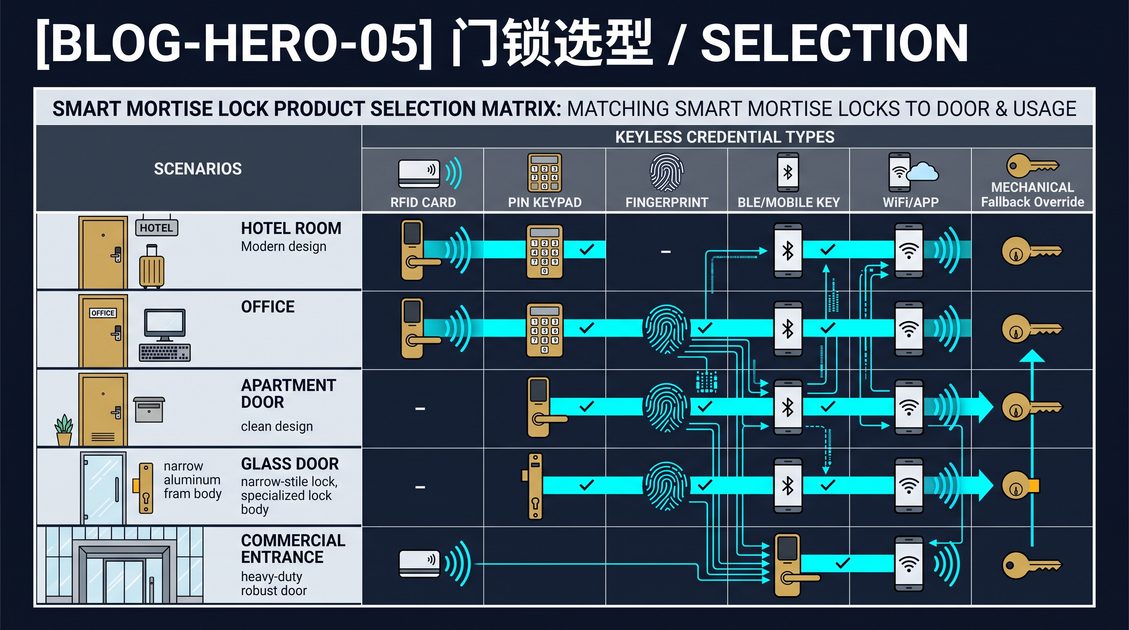
Smart mortise lock adalah kunci elektronik yang case bermotor, latch, bolt, reader, dan pengendalinya terintegrasi ke dalam bodi persegi panjang yang dipasang pada rongga di tepi pintu. Bentuk ini adalah form factor yang dominan untuk pintu komersial, perhotelan, hunian Eropa, dan hunian multifamily karena case mortise menggabungkan latch dan deadbolt dalam satu rakitan serta mendukung set handle lengkap. Panduan teknis ini menjelaskan cara kerja smart mortise lock, dimensi rekayasa yang membedakan perangkat keras yang andal dari sekadar gadget, serta urutan langkah untuk memilih, memasang, melakukan commissioning, dan memeliharanya. Karena smart mortise lock umumnya diterapkan pada banyak pintu dan dioperasikan selama bertahun-tahun, panduan ini memperlakukan kompatibilitas, kredensial, daya, keamanan, integrasi, dan layanan siklus hidup sebagai satu sistem yang saling terhubung, bukan sekadar daftar fitur.
Panduan Teknis Smart Mortise Lock: Case dan Pintu
Sebelum keputusan elektronik mana pun menjadi relevan, smart mortise lock harus cocok dengan bukaan fisiknya. Tinggi, lebar, dan kedalaman case harus sesuai dengan rongga yang dipotong pada tepi pintu; backset, yaitu jarak dari tepi pintu ke pusat handle atau silinder, harus selaras; dan faceplate harus rata dengan tepi pintu. Strike pada rangka harus sejajar dengan latch dan deadbolt saat pintu tertutup, dan handedness pintu harus dapat dikonfigurasi baik secara mekanis maupun melalui perangkat lunak. Kunci yang terlalu besar untuk rongganya, terlalu kecil untuk backset, atau tidak sejajar dengan strike tidak akan beroperasi andal sehandus apa pun elektroniknya.
Proyek pembangunan baru menentukan kunci dan pintu sekaligus, memberikan kebebasan terluas untuk memilih bodi mortise, finishing, set handle, dan strike. Retrofit lebih terbatas: rongga yang sudah ada menentukan apa yang muat, sehingga smart mortise lock elektronik tipe drop-in yang memanfaatkan potongan yang sudah ada adalah peningkatan paling bersih, sementara mengubah form factor memerlukan pemotongan rongga baru dan pekerjaan khusus pada pintu berperingkat atau pintu logam. Sebelum memilih smart mortise lock apa pun, survei ketebalan pintu, rongga, backset, strike, rangka, closer, dan peringkat tahan api, lalu konfirmasikan gambar model yang persis terhadap bukaan yang diukur.
Smart mortise lock adalah kunci elektronik yang case bermotor, latch, bolt, reader, dan pengendalinya terintegrasi ke dalam bodi persegi panjang yang dipasang pada rongga di tepi pintu, form factor yang dominan untuk pintu komersial, perhotelan, hunian Eropa, dan hunian multifamily. Sebelum keputusan elektronik apa pun, kunci harus cocok dengan bukaan: case harus muat pada rongga, backset harus selaras, faceplate harus rata, dan strike harus sejajar dengan latch dan deadbolt. Pembangunan baru menentukan kunci dan pintu sekaligus untuk pilihan terluas, sementara retrofit memanfaatkan rongga yang sudah ada untuk peningkatan drop-in paling bersih. Survei dahulu ketebalan pintu, rongga, backset, strike, rangka, closer, dan peringkat tahan api, lalu konfirmasikan gambar model yang persis terhadap bukaan yang diukur.
Panduan Teknis Smart Mortise Lock: Kredensial dan Reader
Kredensial adalah antarmuka yang dilihat dan disentuh pengguna, dan kombinasi yang tepat bergantung pada pengguna serta kebijakan keamanan. Pilihan yang paling umum adalah keypad PIN, kartu atau fob RFID pada 13.56 MHz, pembaca sidik jari, dan kunci seluler melalui Bluetooth Low Energy atau NFC. Keypad paling murah dan tidak mengharuskan membawa apa pun, tetapi kode dapat dibagikan atau diamati. Kartu RFID cepat, tahan lama, dan dapat dicabut seketika, menjadikannya standar di hotel dan kantor. Sidik jari paling personal dan nyaman bagi pengguna rutin tetapi lebih mahal dan membutuhkan cadangan untuk jari yang kering atau aus. Kunci seluler memungkinkan masuk tanpa kontak dan distribusi kredensial terpusat tetapi bergantung pada ponsel yang terisi daya.
Sebagian besar smart mortise lock yang serius menggabungkan dua kredensial atau lebih agar satu titik gagal tidak menyisakan pengguna terkunci di luar. Kombinasi yang tepat menyesuaikan penerapannya: kunci hotel umumnya menawarkan kartu plus seluler, kantor menawarkan kartu, seluler, dan terkadang sidik jari, sedangkan kunci hunian menawarkan keypad, seluler, dan terkadang sidik jari. Keamanan setiap kredensial bergantung pada implementasinya. Keypad sekuat kebijakan kodenya, kartu RFID sekuat enkripsi dan kunci terdiversifikasi per kartunya, sidik jari sekuat deteksi keaslian dan false-acceptance rate-nya, dan kunci seluler sekuat transport serta autentikasi platformnya.
Kredensial adalah antarmuka yang dilihat dan disentuh pengguna. Pilihan yang umum adalah keypad PIN, kartu atau fob RFID pada 13.56 MHz, pembaca sidik jari, dan kunci seluler melalui Bluetooth Low Energy atau NFC. Keypad paling murah dan tidak mengharuskan membawa apa pun, tetapi kode dapat dibagikan; kartu RFID cepat, tahan lama, dan dapat dicabut seketika serta mendominasi hotel dan kantor; sidik jari paling personal dan nyaman tetapi lebih mahal dan membutuhkan cadangan untuk jari yang kering atau aus; kunci seluler memungkinkan masuk tanpa kontak tetapi bergantung pada ponsel yang terisi daya. Sebagian besar kunci yang serius menggabungkan dua kredensial atau lebih agar tidak ada satu titik gagal yang menyisakan pengguna terkunci di luar, menyesuaikan penerapannya: hotel kartu plus seluler, kantor kartu plus seluler plus sidik jari, hunian keypad plus seluler plus sidik jari. Keamanan bergantung pada implementasi: kebijakan per kode, kunci per kartu terenkripsi, deteksi keaslian, dan transport seluler yang aman.
Panduan Teknis Smart Mortise Lock: Daya dan Akses Darurat
Daya adalah dimensi keandalan, bukan kenyamanan. Smart mortise lock beroperasi dengan baterai, umumnya sel AA, atau dihubungkan kabel ke pengendali atau panel akses. Umur baterai bergantung pada frekuensi pembukaan, jenis reader, penggunaan radio, dan suhu, serta dapat berkisar dari beberapa bulan hingga sekitar dua tahun; kunci yang terhubung WiFi lebih cepat habis daripada model khusus Bluetooth, dan cuaca dingin mempercepat pengosongan. Kunci yang andal melaporkan tingkat baterai dan memberi peringatan berminggu-minggu sebelum gagal, dan untuk penerapan multi-pintu sistem berjaringan melaporkan status baterai secara terpusat sehingga jadwal pemeliharaan mengganti baterai secara terencana alih-alih merespons terkunci di luar.
Akses daruratlah yang membedakan perangkat keras profesional dari mainan. Ketika baterai habis, jaringan gagal, atau ponsel hilang, pengguna tetap harus bisa masuk. Solusi yang umum adalah override kunci mekanis, terminal daya cadangan seperti USB atau 9V di bagian luar kunci, dan kredensial sekunder seperti keypad atau kartu. Smart mortise lock seharusnya mempertahankan setidaknya satu dari opsi ini, idealnya lebih dari satu, agar baterai yang habis tidak pernah menyisakan pengguna terkunci di luar. Untuk penerapan komersial dan sewa, anggarkan penggantian baterai sebagai biaya operasional berulang dan tetapkan jalur akses darurat yang jelas dalam rencana penerapan.
Daya adalah dimensi keandalan. Smart mortise lock beroperasi dengan baterai, umumnya AA, atau dihubungkan kabel ke pengendali atau panel akses; umur baterai bergantung pada frekuensi pembukaan, jenis reader, penggunaan radio, dan suhu serta dapat berkisar dari beberapa bulan hingga sekitar dua tahun, dengan WiFi lebih cepat habis daripada Bluetooth dan cuaca dingin mempercepat pengosongan. Kunci yang andal melaporkan tingkat baterai dan memberi peringatan berminggu-minggu sebelum gagal, dan sistem berjaringan melaporkan status baterai secara terpusat untuk pemeliharaan multi-pintu. Akses darurat membedakan perangkat keras profesional dari mainan: override kunci mekanis, terminal daya cadangan seperti USB atau 9V, dan kredensial sekunder seperti keypad atau kartu memastikan pengguna tetap bisa masuk saat baterai habis, jaringan gagal, atau ponsel hilang. Anggarkan penggantian baterai sebagai biaya operasional berulang dan tetapkan jalur darurat yang jelas.
Panduan Teknis Smart Mortise Lock: Keamanan dan Sertifikasi
Keamanan smart mortise lock diukur dari perangkat keras, enkripsi, dan ketahanan terhadap bypass, yang diverifikasi melalui sertifikasi. Perangkat keras sebaiknya menggunakan mikrokontroler aman dan, idealnya, secure element yang menyimpan kredensial dan kunci dalam penyimpanan tahan perusakan alih-alih memori umum. Komunikasi, baik melalui reader kartu, Bluetooth, WiFi, maupun NFC, sebaiknya dienkripsi agar penyerang tidak dapat memutar ulang atau membacakannya. Dari sisi mekanis, bolt, strike, dan pemasangan harus tahan terhadap pembobolan paksa, dan elektroniknya harus tahan terhadap perusakan serta bypass.
Sertifikasi memberikan pemeriksaan independen atas klaim-klaim ini. CE menunjukkan kesesuaian dengan persyaratan keselamatan Eropa dan kompatibilitas elektromagnetik, FCC mencakup batas emisi radio di Amerika Serikat, dan RoHS membatasi zat berbahaya. Untuk klaim mekanis dan keamanan yang lebih tinggi, peringkat UL atau ANSI/BHMA, atau standar nasional setara, memverifikasi kekuatan dan umur siklus. Pembeli sebaiknya meminta sertifikatnya, memverifikasi bahwa nomornya cocok dengan model yang persis, dan menanyakan bagaimana kredensial disimpan dan dienkripsi, karena kunci yang patut standar tetapi enkripsinya lemah tetap bisa dibobol. Enkripsi layak mendapat perhatian khusus: pilih kunci terdiversifikasi per kredensial alih-alih nomor kartu mentah, dan autentikasi seluler sisi server alih-alih kode sandi statis.
Keamanan menggabungkan perangkat keras, enkripsi, dan ketahanan terhadap bypass, yang diverifikasi melalui sertifikasi. Perangkat keras sebaiknya menggunakan mikrokontroler aman dan idealnya secure element yang menyimpan kredensial dalam penyimpanan tahan perusakan. Komunikasi melalui reader kartu, Bluetooth, WiFi, atau NFC sebaiknya dienkripsi untuk mencegah replay atau pembacaan, dan bolt, strike, serta pemasangan harus tahan pembobolan paksa sementara elektroniknya tahan perusakan. Sertifikasi memberikan verifikasi independen: CE untuk keselamatan dan EMC Eropa, FCC untuk batas radio Amerika Serikat, RoHS untuk zat terbatas, serta peringkat UL atau ANSI/BHMA untuk kekuatan dan umur siklus. Minta sertifikatnya, verifikasi nomornya cocok dengan model yang persis, dan tanyakan bagaimana kredensial disimpan serta dienkripsi. Pilih kunci terdiversifikasi per kredensial alih-alih nomor kartu mentah dan autentikasi seluler sisi server alih-alih kode sandi statis, karena kunci yang patut standar tetapi enkripsinya lemah tetap bisa dibobol.
Panduan Teknis Smart Mortise Lock: Integrasi dan Manajemen
Smart mortise lock biasanya merupakan bagian dari sistem terkelola, bukan perangkat berdiri sendiri. Lapisan manajemen mendaftarkan kunci, mendefinisikan pengguna dan grup, menetapkan masa berlaku serta jadwal, menerbitkan dan mencabut kredensial, dan mencatat jejak audit. Integrasi menghubungkan kunci dengan sistem manajemen properti, PMS hotel, platform kontrol akses, atau manajemen energi agar check-in dan check-out terotomatisasi dan status kamar tetap tersinkron. Kedalaman integrasi bervariasi: minimumnya adalah antarmuka bersama yang meneruskan peristiwa esensial, sementara integrasi lebih dalam meneruskan status housekeeping dan mengaktifkan audit jarak jauh.
Pilihan arsitekturnya adalah standalone versus berjaringan. Kunci standalone menyimpan tabel penggunanya di perangkat, bekerja offline, dan tidak membutuhkan hub atau langganan, tetapi setiap kunci dikelola satu per satu dan data audit tetap lokal. Kunci berjaringan tersinkronisasi ke gateway atau platform cloud untuk pendaftaran, pemberian kredensial, penjadwalan, dan audit terpusat di banyak pintu. Untuk satu rumah, standalone biasanya cukup; untuk kantor, hotel, atau gedung multifamily, manajemen berjaringan adalah alasan memilih sistemnya. Jejak audit hanya berguna pada skala besar jika terpusat, diberi stempel waktu, dan diatribusikan kepada pengguna, jadi tuntut pencatatan di tingkat platform dan uji perangkat lunak manajemen yang sesungguhnya alih-alih percaya pada lembar spesifikasi.
Smart mortise lock biasanya merupakan bagian dari sistem terkelola. Lapisan manajemen mendaftarkan kunci, mendefinisikan pengguna dan grup, menetapkan masa berlaku serta jadwal, menerbitkan dan mencabut kredensial, dan mencatat jejak audit, sementara integrasi menghubungkan kunci dengan sistem manajemen properti, PMS hotel, platform kontrol akses, atau manajemen energi untuk mengotomatisasi check-in dan check-out serta menyinkronkan status kamar. Pilihan arsitekturnya adalah standalone versus berjaringan: standalone menyimpan tabel penggunanya di perangkat, bekerja offline, dan tidak membutuhkan hub tetapi dikelola satu per satu, sementara berjaringan tersinkronisasi ke gateway atau cloud untuk pendaftaran, pemberian kredensial, penjadwalan, dan audit terpusat di banyak pintu. Satu rumah membutuhkan standalone; kantor, hotel, atau gedung multifamily membutuhkan berjaringan. Jejak audit hanya berguna pada skala besar jika terpusat, diberi stempel waktu, dan diatribusikan kepada pengguna, jadi tuntut pencatatan di tingkat platform dan uji perangkat lunak yang sesungguhnya.
Panduan Teknis Smart Mortise Lock: Pemasangan dan Commissioning
Pemasangan adalah tempat proyek smart mortise lock berhasil atau gagal. Pasang bodi kunci ke dalam rongga, pasang faceplate rata, sejajarkan strike, dan pasang handle, reader, serta silinder sebelum mengalirkan daya. Operasikan kunci secara mekanis dengan pintu terbuka: latch dan bolt harus bergerak mulus, handle harus menarik latch kembali, dan pintu harus tertutup tanpa kekuatan berlebih. Jika mekanismenya tersendat, perbaiki rongga atau keselarasan pintu alih-alih mengandalkan gaya motor atau perubahan timing.
Lakukan commissioning pada bukaan lengkapnya, bukan hanya kuncinya. Uji kredensial yang valid, tidak valid, kedaluwarsa, dan dicabut, pelepasan dari dalam, auto-lock jika diaktifkan, override manual, kehilangan daya, kehilangan jaringan, dan deteksi posisi pintu. Untuk peluncuran hotel atau multifamily, uji pintu representatif dari setiap batch perangkat keras alih-alih menyetujui satu sampel. Catat identitas kunci, firmware, administrator, konfigurasi, dan pemilik pemeliharaan, lalu latih orang-orang yang menerbitkan kredensial dan menangani kasus terkunci di luar. Jadwalkan inspeksi tindak lanjut awal karena sekrup bisa mengendur dan keselarasan dapat berubah setelah siklus berulang.
Pemasangan adalah tempat proyek berhasil atau gagal. Pasang bodi kunci ke dalam rongga, pasang faceplate rata, sejajarkan strike, dan pasang handle, reader, serta silinder sebelum mengalirkan daya; operasikan kunci secara mekanis dengan pintu terbuka agar latch dan bolt bergerak mulus dan pintu tertutup tanpa kekuatan berlebih. Jika mekanismenya tersendat, perbaiki rongga atau keselarasan alih-alih mengandalkan gaya motor. Lakukan commissioning pada bukaan lengkapnya, menguji kredensial yang valid, tidak valid, kedaluwarsa, dan dicabut, pelepasan dari dalam, auto-lock, override manual, kehilangan daya, kehilangan jaringan, dan deteksi posisi pintu. Untuk peluncuran hotel atau multifamily, uji pintu representatif dari setiap batch perangkat keras. Catat identitas kunci, firmware, administrator, dan konfigurasi, latih penerbit kredensial dan penangan kasus terkunci, serta jadwalkan inspeksi tindak lanjut awal.
Panduan Teknis Smart Mortise Lock: Spesifikasi untuk Proyek
Untuk proyek multi-pintu, spesifikasi smart mortise lock sebaiknya ditulis sebagai satu sistem, bukan satu produk. Nyatakan jenis pintu dan rangka, dimensi case, kombinasi kredensial, pengaturan daya, antarmuka integrasi, platform manajemen, persyaratan keamanan dan sertifikasi, serta rencana layanan dan suku cadang. Minta gambar dimensi yang persis, informasi kabel atau baterai, template pemasangan, batas lingkungan, dan instruksi pemeliharaan untuk varian yang dipilih, dan jangan berasumsi spesifikasi keluarga produk berlaku untuk setiap model.
Biaya dalam proyek smart mortise lock memiliki beberapa lapisan: perangkat keras per pintu, yang diskalakan oleh case dan reader; pemasangan, yang bergantung pada pembangunan baru atau retrofit; kredensial, yang berulang seiring kartu terpakai atau kunci seluler dilisensikan; dan perangkat lunak, yang sering kali berupa biaya per pintu atau per properti yang berulang. Panduan ini menyarankan menghitung total biaya kepemilikan lima tahun per pintu alih-alih membandingkan hanya harga satuan. Bagi importir dan pembeli OEM, konfirmasikan MOQ untuk kunci standar dan kustomisasi, tetapkan lead time secara tertulis, perjelas syarat pembayaran, dan pahami pasokan suku cadang, karena kunci dipasang sekali dan dioperasikan bertahun-tahun.
Untuk proyek multi-pintu, tetapkan smart mortise lock sebagai satu sistem, menyatakan jenis pintu dan rangka, dimensi case, kombinasi kredensial, pengaturan daya, antarmuka integrasi, platform manajemen, persyaratan keamanan dan sertifikasi, serta rencana layanan dan suku cadang. Minta gambar yang persis, informasi kabel atau baterai, template pemasangan, batas lingkungan, dan instruksi pemeliharaan, dan jangan berasumsi spesifikasi keluarga produk berlaku untuk setiap model. Biaya memiliki beberapa lapisan: perangkat keras per pintu, pemasangan bergantung pada pembangunan baru atau retrofit, biaya kredensial yang berulang, dan biaya perangkat lunak yang berulang. Hitung total biaya kepemilikan lima tahun per pintu. Bagi importir dan pembeli OEM, konfirmasikan MOQ untuk kunci standar dan kustomisasi, tetapkan lead time secara tertulis, perjelas syarat pembayaran, dan pahami pasokan suku cadang, karena kunci dipasang sekali dan dioperasikan bertahun-tahun.
Panduan Teknis Smart Mortise Lock: Siklus Hidup Kredensial dan Administrasi
Administrasi kredensial adalah jantung operasional sistem smart mortise lock, dan sebaiknya dirancang sebelum perangkat keras dipesan. Tetapkan siapa yang dapat mendaftarkan kunci dan pengguna, bagaimana kredensial diterbitkan dan dicabut, bagaimana akses sementara kedaluwarsa, dan bagaimana kartu, ponsel, atau kunci yang hilang ditangani. Untuk hotel, kredensial tamu hanya berlaku selama masa menginap; untuk kantor, kredensial karyawan hanya berlaku selama masa kerja; untuk sewa, kode tamu hanya berlaku selama masa pemesanan. Sistem yang dikelola baik menerbitkan kredensial dengan cakupan yang tepat dan mencabutnya begitu seharusnya tidak lagi berfungsi.
Alur kerja resepsionis atau administrator menentukan kelancaran semua ini. Encoder resepsionis sebaiknya menerbitkan kartu tamu atau kunci seluler dalam hitungan detik saat check-in, kartu yang hilang sebaiknya diterbitkan ulang dengan mencabut kredensial lama dan mengodekan yang baru, dan check-out sebaiknya mencabut akses secara otomatis melalui platform manajemen. Akun pemasang dan administrator sebaiknya dipisahkan dari kredensial pengguna harian, dan sistem sebaiknya mencatat siapa yang menerbitkan atau mencabut kredensial mana pada waktu kapan. Siklus hidup kredensial inilah yang membuat smart mortise lock dapat diskalakan melampaui satu pintu.
Administrasi kredensial adalah jantung operasional sistem smart mortise lock. Tetapkan siapa yang dapat mendaftarkan kunci dan pengguna, bagaimana kredensial diterbitkan dan dicabut, bagaimana akses sementara kedaluwarsa, dan bagaimana kartu, ponsel, atau kunci yang hilang ditangani. Untuk hotel, kredensial tamu hanya berlaku selama masa menginap; untuk kantor, hanya selama masa kerja; untuk sewa, hanya selama masa pemesanan. Alur kerja administrator menentukan kelancarannya: encoder resepsionis menerbitkan kartu tamu atau kunci seluler dalam hitungan detik, kartu yang hilang diterbitkan ulang dengan mencabut dan mengodekan ulang, dan check-out mencabut akses secara otomatis. Pisahkan akun pemasang dan administrator dari kredensial pengguna harian serta catat siapa yang menerbitkan atau mencabut setiap kredensial pada waktu kapan.
Panduan Teknis Smart Mortise Lock: Lingkungan dan Pintu Khusus
Smart mortise lock juga harus sesuai dengan lingkungan dan jenis pintunya. Lokasi luar ruangan dan kelembapan tinggi membutuhkan peringkat proteksi masuk, umumnya IP54 atau lebih tinggi, untuk bertahan terhadap hujan, debu, dan perubahan suhu yang juga memperpendek umur baterai. Dingin ekstrem memengaruhi baterai sekaligus pelumas dan komponen bergerak mekanisme. Kunci pada pintu logam dapat mengganggu sinyal nirkabel dan membutuhkan penempatan antena yang cermat, dan pintu tahan api membutuhkan perangkat keras yang mempertahankan peringkat tahan api serta konfigurasi fail-safe atau fail-secure yang memenuhi persyaratan keselamatan nyawa.
Pintu khusus membutuhkan perangkat keras khusus. Pintu kaca geser dan pintu teras membutuhkan kunci yang dirancang untuk stile sempit panel geser; pintu french membutuhkan mekanisme yang menangani kedua daun pintu, umumnya mortise atau multi-point; dan pintu dalam dengan thumb-turn membutuhkan kunci yang mempertahankan fungsi privasi sekaligus menambahkan kontrol elektronik. Pintu keamanan komersial dan aplikasi keamanan tinggi mungkin membutuhkan electrified mortise lock yang dihubungkan kabel ke panel kontrol akses terpusat. Sesuaikan kunci dengan realitas fisik sebelum menyesuaikannya dengan daftar fitur, dan minta rekomendasi spesifik per jenis pintu dari pemasok alih-alih memilih dari katalog generik.
Smart mortise lock harus sesuai dengan lingkungan dan jenis pintu. Lokasi luar ruangan dan kelembapan tinggi membutuhkan peringkat proteksi masuk, umumnya IP54 atau lebih tinggi, untuk bertahan terhadap hujan, debu, dan perubahan suhu yang juga memperpendek umur baterai; dingin ekstrem memengaruhi baterai serta pelumas dan komponen bergerak. Pintu logam dapat mengganggu sinyal nirkabel dan membutuhkan penempatan antena yang cermat, dan pintu tahan api membutuhkan perangkat keras yang mempertahankan peringkat tahan api serta konfigurasi fail-safe atau fail-secure yang sesuai. Pintu khusus membutuhkan perangkat keras khusus: pintu kaca geser dan pintu teras membutuhkan kunci untuk stile sempit, pintu french membutuhkan mekanisme untuk kedua daun pintu, pintu dalam thumb-turn membutuhkan privasi plus kontrol elektronik, dan pintu keamanan tinggi mungkin membutuhkan electrified mortise lock yang dihubungkan ke panel terpusat.
Panduan Teknis Smart Mortise Lock: Total Biaya Kepemilikan
Total biaya kepemilikan penerapan smart mortise lock adalah yang seharusnya dioptimalkan pembeli, bukan harga satuan. Biaya perangkat keras per pintu diskalakan oleh case, reader kredensial, dan finishing. Biaya pemasangan bergantung pada apakah proyeknya pembangunan baru atau retrofit, dan retrofit pada pintu solid-core atau berperingkat tahan api bisa signifikan. Biaya kredensial berulang seiring kartu terpakai atau lisensi kunci seluler diterbitkan. Biaya perangkat lunak, platform manajemen dan dukungannya, sering berulang per pintu per properti. Tambahkan biaya penggantian baterai, yang merupakan biaya operasional sepanjang masa layanannya.
Untuk satu rumah, smart mortise lock standalone tidak memiliki biaya perangkat lunak berulang, sehingga total biaya kepemilikannya rendah. Untuk penerapan komersial atau hotel multi-pintu, langganan perangkat lunak serta biaya kredensial dan baterai yang mendominasi, dan kunci murah dengan manajemen lemah bisa jauh lebih mahal selama lima tahun daripada kunci berjaringan yang lebih mahal harganya. Panduan ini menyarankan menghitung biaya lima tahun per pintu yang mencakup perangkat keras, pemasangan, kredensial, baterai, dan perangkat lunak, serta meminta model harga perangkat lunak dari pemasok secara tertulis, karena biaya berulang adalah tempat biaya kejutan bersembunyi.
Total biaya kepemilikan penerapan smart mortise lock adalah yang seharusnya dioptimalkan pembeli, bukan harga satuan. Perangkat keras per pintu diskalakan oleh case, reader, dan finishing; pemasangan bergantung pada pembangunan baru atau retrofit; biaya kredensial berulang seiring kartu terpakai atau kunci seluler dilisensikan; dan perangkat lunak, platform manajemen serta dukungannya, sering berulang per pintu atau properti. Tambahkan penggantian baterai sebagai biaya operasional. Untuk satu rumah, kunci standalone tidak memiliki biaya perangkat lunak berulang dan total biayanya rendah. Untuk penerapan multi-pintu, langganan perangkat lunak serta biaya kredensial dan baterai yang mendominasi, dan kunci murah dengan manajemen lemah bisa lebih mahal selama lima tahun daripada kunci berjaringan yang lebih mahal harganya. Hitung biaya lima tahun per pintu dan dapatkan model harga perangkat lunak secara tertulis.
Panduan Teknis Smart Mortise Lock: Pemeliharaan dan Siklus Hidup
Pemeliharaan menjaga smart mortise lock tetap andal sepanjang masa layanannya. Periksa keselarasan, pengikat, handle, strike, seal, status baterai, firmware, dan izin administrator selama kunjungan rutin. Bersihkan reader dan trim dengan bahan yang disetujui pabrikan dan selidiki operasi yang kasar segera, karena pintu yang tersendat dapat memperpendek umur baterai dan membebani aktuator. Siapkan suku cadang, baterai, firmware, dan dokumentasi untuk masa layanan yang direncanakan, dan konfirmasikan model dukungan purna jual, termasuk garansi dan pelatihan.
Perencanaan siklus hidup juga mencakup peningkatan dan akhir masa layanan. Tentukan bagaimana kredensial dimigrasikan ketika pembaruan firmware atau platform terjadi, bagaimana data audit diekspor untuk kepatuhan, dan bagaimana properti diamankan kembali ketika perangkat keras diganti atau penyewa atau staf berpisah. Untuk penerapan komersial atau hotel, pilih pemasok yang bertanggung jawab atas seluruh siklus hidup, karena keandalan terlihat selama bertahun-tahun pengoperasian, bukan pada pesanan pertama.
Pemeliharaan menjaga smart mortise lock tetap andal sepanjang masa layanannya. Periksa keselarasan, pengikat, handle, strike, seal, status baterai, firmware, dan izin administrator selama kunjungan rutin, bersihkan reader dengan bahan yang disetujui pabrikan, dan selidiki operasi yang kasar segera karena pintu yang tersendat dapat memperpendek umur baterai dan membebani aktuator. Siapkan suku cadang, baterai, firmware, dan dokumentasi untuk masa layanan yang direncanakan, dan konfirmasikan model dukungan purna jual, garansi, dan pelatihan. Perencanaan siklus hidup juga mencakup migrasi kredensial selama pembaruan platform, ekspor data audit untuk kepatuhan, dan pengamanan ulang properti ketika perangkat keras diganti atau seseorang berpisah. Pilih pemasok yang bertanggung jawab atas seluruh siklus hidup, karena keandalan terlihat selama bertahun-tahun pengoperasian, bukan pada pesanan pertama.
FAQ: Panduan Teknis Smart Mortise Lock
Apa perbedaan antara smart mortise lock dan smart deadbolt?
Smart mortise lock menggunakan case persegi panjang yang dipasang pada rongga di tepi pintu, menggabungkan latch dan deadbolt dalam satu rakitan serta mendukung set handle lengkap. Kunci ini standar untuk pintu komersial, perhotelan, dan hunian Eropa. Smart deadbolt menggunakan sasis silindris melalui lubang bulat dan khas untuk pintu Amerika Utara.
Apakah smart mortise lock cocok untuk pintu saya yang sudah ada?
Cocok jika dimensi case, backset, faceplate, strike, handedness, dan ketebalan pintu sesuai dengan bukaannya. Pintu dengan rongga mortise yang sudah ada paling baik dilayani oleh smart mortise lock elektronik tipe drop-in yang memanfaatkan potongan yang ada. Ukur pintu dan bandingkan dengan gambar model yang persis sebelum memesan.
Kredensial apa saja yang diterima smart mortise lock?
Pilihan yang umum adalah keypad PIN, kartu atau fob RFID, sidik jari, dan kunci seluler melalui Bluetooth Low Energy atau NFC. Sebagian besar kunci yang serius menggabungkan dua atau lebih agar pengguna tidak pernah terkunci di luar karena kartu hilang, ponsel mati, atau jari kering.
Berapa lama daya tahan baterai dan apa yang terjadi saat baterai habis?
Umur baterai berkisar dari beberapa bulan hingga sekitar dua tahun tergantung frekuensi pembukaan, jenis reader, penggunaan radio, dan suhu. Kunci yang andal melaporkan tingkat baterai dan menyediakan akses darurat melalui kunci mekanis, terminal daya cadangan, atau kredensial sekunder.
Apakah smart mortise lock aman?
Keamanan bergantung pada perangkat keras, enkripsi, dan ketahanan terhadap bypass, yang diverifikasi melalui sertifikasi seperti CE, FCC, RoHS, dan, untuk klaim lebih tinggi, peringkat UL atau ANSI/BHMA. Utamakan enkripsi per kredensial dan penyimpanan secure element, dan minta sertifikat aslinya untuk model yang persis.
Apakah saya membutuhkan platform manajemen?
Untuk satu rumah, kunci standalone dengan aplikasi biasanya cukup. Untuk kantor, hotel, atau gedung multifamily, platform manajemen berjaringan menyediakan pendaftaran, pemberian kredensial, penjadwalan, audit, dan pencabutan seketika terpusat pada skala besar.
Panduan Teknis Smart Mortise Lock: Pemilihan Pemasok dan Risiko
Untuk penerapan multi-pintu, pemasok adalah bagian dari pembelian. Verifikasi kredensial pabrikan, minta referensi pemasangan pada proyek berukuran sebanding, dan konfirmasikan garansi, suku cadang, dokumentasi teknis, serta pelatihan. Pemasok yang bertanggung jawab atas perangkat keras, sertifikasi, dan dukungan dari satu sumber lebih berharga daripada harga unit pertama termurah, dan membeli langsung dari pabrikan smart mortise lock memberikan satu mitra yang bertanggung jawab sepanjang proyek.
Manajemen risiko sebaiknya mencakup mode kegagalan yang diperkenalkan smart mortise lock. Rencanakan untuk baterai habis, ponsel hilang, kode terlupakan, masalah firmware, dan gangguan jaringan, serta dokumentasikan jalur pemulihan untuk masing-masing. Siapkan baterai, kartu, dan suku cadang cadangan, jaga kontak pemulihan yang aktif, dan uji prosedur yang didokumentasikan alih-alih menganggapnya berfungsi. Untuk properti komersial atau hotel, biaya terkunci di luar atau celah keamanan jauh melebihi selisih harga antara sistem yang andal dan yang marginal, sehingga pemilihan sebaiknya lebih menimbang keandalan dan dukungan.
Untuk penerapan multi-pintu, pemasok adalah bagian dari pembelian. Verifikasi kredensial, minta referensi pemasangan pada proyek berukuran sebanding, dan konfirmasikan garansi, suku cadang, dokumentasi teknis, serta pelatihan. Pemasok yang bertanggung jawab atas perangkat keras, sertifikasi, dan dukungan dari satu sumber lebih berharga daripada harga unit pertama termurah, dan membeli langsung dari pabrikan memberikan satu mitra yang bertanggung jawab. Manajemen risiko sebaiknya mencakup mode kegagalan yang diperkenalkan smart mortise lock: baterai habis, ponsel hilang, kode terlupakan, masalah firmware, dan gangguan jaringan, masing-masing dengan jalur pemulihan yang terdokumentasi. Siapkan cadangan, jaga kontak pemulihan yang aktif, dan uji prosedurnya. Biaya terkunci di luar atau celah keamanan jauh melebihi selisih harga antara sistem yang andal dan yang marginal.
Panduan Teknis Smart Mortise Lock: Serah Terima Proyek
Proyek tidak selesai ketika kunci terpasang secara fisik; proyek selesai ketika tim pengoperasian dapat mengelola dan memulihkannya. Serah terima sebaiknya mencakup jadwal pintu akhir, informasi kompatibilitas terukur, identitas kunci dan pengendali, peran kredensial, kepemilikan administrator, catatan firmware, detail kabel atau baterai, dan prosedur darurat yang disetujui. Simpan informasi ini di lokasi terkendali dan berikan akses hanya kepada orang yang bertanggung jawab atas keamanan dan pemeliharaan. Sertakan jalur kontak sederhana untuk kegagalan mendesak agar respons pertama tidak tertunda karena ketidakpastian.
Tim pengoperasian sebaiknya menerima pelatihan praktis, bukan hanya demonstrasi produk. Tunjukkan cara menerbitkan, mengubah, dan mencabut kredensial, menafsirkan peringatan baterai lemah atau posisi pintu, merespons gangguan komunikasi, melakukan pemulihan darurat, dan mengeskalasi dugaan peristiwa keamanan. Uji serah terima dengan meminta operator lain mengikuti prosedur tertulis tanpa bantuan. Setiap ambiguitas yang ditemukan dalam latihan itu adalah cacat commissioning dan sebaiknya diperbaiki sebelum proyek diterima.
Serah terima yang berguna juga mendefinisikan interval tinjauan. Periksa ulang izin setelah perubahan staf, periksa bukaan representatif setelah periode operasi pertama, tinjau retensi log audit, dan uji akses cadangan pada frekuensi yang terdokumentasi. Ketika platform, versi firmware, atau penggunaan pintu berubah, nilai kembali asumsi awalnya. Penutupan yang disiplin ini melindungi investasi dan menjaga sistem smart mortise lock tetap dapat dipahami oleh orang yang harus mengoperasikannya bertahun-tahun setelah pemasangan. Serah terima ini juga sebaiknya mengidentifikasi orang yang menyetujui perubahan konfigurasi, orang yang memelihara bukaan tersebut, dan orang yang menerima notifikasi keamanan. Kepemilikan yang jelas mencegah peringatan yang valid menjadi tanggung jawab tidak seorang pun. Tinjau jadwalnya setiap tahun dan setelah setiap perubahan signifikan pada staf, tata letak, atau platform kontrol akses agar model pengoperasian tidak pernah menyimpang dari yang dimaksudkan.
Kesimpulan: Terapkan Smart Mortise Lock yang Menjalankan Properti Anda
Panduan teknis smart mortise lock ini telah membahas case dan pintu, kredensial, daya, keamanan, integrasi, pemasangan, spesifikasi, siklus hidup, pemilihan pemasok, dan serah terima proyek. Smart mortise lock adalah perangkat keras hasil rekayasa yang diterapkan pada banyak pintu dan dioperasikan selama bertahun-tahun, sehingga proses yang disiplin lebih penting daripada satu fitur tunggal. Rekomendasi pemersikanya adalah menyesuaikan kunci dengan bukaan fisik, menggabungkan kredensial dengan cadangan yang andal, merencanakan daya dan akses darurat, memverifikasi keamanan dan sertifikasi, dan memilih arsitektur manajemen yang dapat diskalakan ke penerapannya.
Terapkan panduan ini sebagai spesifikasi. Survei pintu dan konfirmasikan gambar casenya, pilih kombinasi kredensial untuk penggunanya, rencanakan baterai dan akses darurat, verifikasi enkripsi dan sertifikasi, integrasikan dengan sistem manajemen dan properti, dan hitung total biaya kepemilikan sepanjang masa layanannya. Smart mortise lock yang dipilih dengan baik adalah fondasi kontrol akses yang tahan lama untuk hotel, kantor, atau properti multifamily. Tinjau sistemnya setelah commissioning dan awetkan dokumentasinya sepanjang siklus operasi lengkapnya.
Sebagian konten artikel ini dihasilkan oleh AI dan dioptimalkan untuk akurasi profesional serta keterbacaan. A smart mortise lock is an electronic lock whose motorized case, latch, bolt, reader, and controller are integrated into a rectangular body fitted into a pocket in the door edge. It is the dominant form factor for commercial, hospitality, European residential, and multifamily doors because the mortise case combines a latch and deadbolt in one assembly and supports a full handle set. This technical guide explains how a smart mortise lock works, the engineering dimensions that separate reliable hardware from a gadget, and the sequence for selecting, installing, commissioning, and maintaining one. Because a smart mortise lock is typically deployed across many doors and operated for years, the guide treats compatibility, credentials, power, security, integration, and lifecycle service as a connected system rather than a list of features.
Smart Mortise Lock Technical Guide: The Case and the Door
A smart mortise lock must match the physical opening before any electronic decision matters. The case height, width, and depth must fit the pocket cut into the door edge; the backset, the distance from the door edge to the center of the handle or cylinder, must align; and the faceplate must sit flush against the edge. The strike in the frame must line up with the latch and deadbolt when the door closes, and the handedness of the door must be configurable either mechanically or in software. A lock that is too large for the pocket, too small for the backset, or misaligned with the strike will not operate reliably no matter how capable the electronics are.
A new-build project specifies the lock and the door together, giving the widest freedom to choose the mortise body, finish, handle set, and strike. A retrofit is more constrained: the existing pocket determines what fits, so a drop-in electronic mortise lock that reuses the cutout is the cleanest upgrade, while changing form factor requires cutting a new pocket and specialist work on a rated or metal door. Before selecting any smart mortise lock, survey the door thickness, pocket, backset, strike, frame, closer, and fire rating, and confirm the exact model drawing against the measured opening.
A smart mortise lock is an electronic lock whose motorized case, latch, bolt, reader, and controller are integrated into a rectangular body fitted into a pocket in the door edge, the dominant form factor for commercial, hospitality, European residential, and multifamily doors. Before any electronic decision, the lock must match the opening: the case must fit the pocket, the backset must align, the faceplate must sit flush, and the strike must line up with the latch and deadbolt. New build specifies the lock and door together for the widest choice, while retrofit reuses an existing pocket for the cleanest drop-in upgrade. Survey door thickness, pocket, backset, strike, frame, closer, and fire rating first, and confirm the exact model drawing against the measured opening.
Smart Mortise Lock Technical Guide: Credentials and Readers
The credential is the interface a user sees and touches, and the right mix depends on the users and the security policy. The most common options are the PIN keypad, the RFID card or fob at 13.56 MHz, the fingerprint reader, and the mobile key over Bluetooth Low Energy or NFC. A keypad is the least expensive and requires nothing to carry, but a code can be shared or observed. An RFID card is fast, durable, and instantly revocable, making it the standard in hotels and offices. A fingerprint is the most personal and convenient for frequent users but costs more and needs a fallback for dry or worn fingers. A mobile key enables contactless entry and central credential delivery but depends on a charged phone.
Most serious smart mortise locks combine two or more credentials so that no single failure strands a user. The right combination matches the deployment: a hotel lock typically offers card plus mobile, an office offers card, mobile, and sometimes fingerprint, and a residential lock offers keypad, mobile, and sometimes fingerprint. The security of each credential depends on implementation. A keypad is as strong as its code policy, an RFID card as strong as its encryption and per-card diversified keys, a fingerprint as strong as its liveness detection and false-acceptance rate, and a mobile key as strong as its transport and platform authentication.
The credential is the interface a user sees and touches. The common options are the PIN keypad, the RFID card or fob at 13.56 MHz, the fingerprint reader, and the mobile key over Bluetooth Low Energy or NFC. A keypad is least expensive and requires nothing to carry, but a code can be shared; an RFID card is fast, durable, and instantly revocable and dominates hotels and offices; a fingerprint is most personal and convenient but costs more and needs a fallback for dry or worn fingers; a mobile key enables contactless entry but depends on a charged phone. Most serious locks combine two or more credentials so no single failure strands a user, matching the deployment: hotel card plus mobile, office card plus mobile plus fingerprint, residential keypad plus mobile plus fingerprint. Security depends on implementation, per-code policy, encrypted per-card keys, liveness detection, and secure mobile transport.
Smart Mortise Lock Technical Guide: Power and Emergency Access
Power is a reliability dimension, not a convenience one. A smart mortise lock runs on batteries, commonly AA cells, or is wired to a controller or access panel. Battery life depends on unlock frequency, reader type, radio use, and temperature, and can range from several months to about two years; a WiFi-connected lock drains faster than a Bluetooth-only model, and cold weather accelerates discharge. A reliable lock reports battery level and warns weeks before failure, and for a multi-door deployment a networked system reports battery status centrally so maintenance schedules replacement instead of reacting to a lockout.
Emergency access is what separates professional hardware from toys. When the battery dies, the network fails, or a phone is lost, the user must still get in. The common solutions are a mechanical key override, a backup power terminal such as USB or 9V on the outside of the lock, and a secondary credential such as a keypad or card. A smart mortise lock should preserve at least one of these and ideally more than one, so a dead battery never strands a user. For commercial and rental deployments, budget for battery replacement as a recurring operating cost and specify a clear emergency-access path in the deployment plan.
Power is a reliability dimension. A smart mortise lock runs on batteries, commonly AA, or is wired to a controller or access panel; battery life depends on unlock frequency, reader type, radio use, and temperature and can range from several months to about two years, with WiFi draining faster than Bluetooth and cold weather accelerating discharge. A reliable lock reports battery level and warns weeks before failure, and a networked system reports battery status centrally for multi-door maintenance. Emergency access separates professional hardware from toys: a mechanical key override, a backup power terminal such as USB or 9V, and a secondary credential such as a keypad or card ensure a user can enter when a battery dies, the network fails, or a phone is lost. Budget battery replacement as recurring operating cost and specify a clear emergency path.
Smart Mortise Lock Technical Guide: Security and Certification
The security of a smart mortise lock is measured by hardware, encryption, and bypass resistance, verified by certification. Hardware should use a secure microcontroller and, ideally, a secure element storing credentials and keys in tamper-resistant storage rather than in general memory. Communication, whether over the card reader, Bluetooth, WiFi, or NFC, should be encrypted so an attacker cannot replay or decode it. On the mechanical side, the bolt, strike, and mounting must resist forced entry, and the electronics must resist tampering and bypass.
Certification gives an independent check on these claims. CE indicates conformity with European safety and electromagnetic compatibility requirements, FCC covers radio emission limits in the United States, and RoHS restricts hazardous substances. For higher mechanical and security claims, UL or ANSI/BHMA grades, or equivalent national standards, verify strength and cycle life. A buyer should request the certificates, verify the number matches the exact model, and ask how credentials are stored and encrypted, because a compliant lock with weak encryption can still be bypassable. Encryption deserves special attention: prefer per-credential diversified keys over raw card numbers and server-side mobile authentication over static passcodes.
Security combines hardware, encryption, and bypass resistance, verified by certification. Hardware should use a secure microcontroller and ideally a secure element storing credentials in tamper-resistant storage. Communication over the card reader, Bluetooth, WiFi, or NFC should be encrypted to prevent replay or decoding, and the bolt, strike, and mounting must resist forced entry while the electronics resist tampering. Certification gives independent verification: CE for European safety and EMC, FCC for US radio limits, RoHS for restricted substances, and UL or ANSI/BHMA grades for strength and cycle life. Request certificates, verify the number matches the exact model, and ask how credentials are stored and encrypted. Prefer per-credential diversified keys over raw card numbers and server-side mobile authentication over static passcodes, because a compliant lock with weak encryption can still be bypassed.
Smart Mortise Lock Technical Guide: Integration and Management
A smart mortise lock is usually part of a managed system rather than a standalone device. The management layer enrolls locks, defines users and groups, sets validity and schedules, issues and revokes credentials, and records an audit trail. Integration connects the lock to the property-management system, a hotel PMS, an access-control platform, or energy management so check-in and check-out are automated and room status stays in sync. The depth of integration varies: the minimum is a shared interface passing essential events, while deeper integration passes housekeeping status and enables remote audit.
The architecture choice is standalone versus networked. A standalone lock keeps its user table on-device, works offline, and needs no hub or subscription, but each lock is managed individually and audit data stays local. A networked lock syncs to a gateway or cloud platform for central enrollment, credentialing, scheduling, and audit across many doors. For a single home, standalone is usually enough; for an office, a hotel, or a multifamily building, networked management is the reason to choose the system. Audit trails are only useful at scale when centralized, timestamped, and attributed to a user, so require platform-level logging and test the actual management software rather than trusting a spec sheet.
A smart mortise lock is usually part of a managed system. The management layer enrolls locks, defines users and groups, sets validity and schedules, issues and revokes credentials, and records an audit trail, while integration connects the lock to a property-management system, hotel PMS, access-control platform, or energy management to automate check-in and check-out and sync room status. The architecture choice is standalone versus networked: standalone keeps its user table on-device, works offline, and needs no hub but is managed individually, while networked syncs to a gateway or cloud for central enrollment, credentialing, scheduling, and audit across many doors. A single home needs standalone; an office, hotel, or multifamily building needs networked. Audit trails are only useful at scale when centralized, timestamped, and attributed to a user, so require platform-level logging and test the real software.
Smart Mortise Lock Technical Guide: Installation and Commissioning
Installation is where a smart mortise lock project succeeds or fails. Fit the lock body into the pocket, mount the faceplate flush, align the strike, and fit the handle, reader, and cylinder before applying power. Operate the lock mechanically with the door open: the latch and bolt should move smoothly, the handle should retract the latch, and the door should close without excessive force. If the mechanism binds, correct the pocket or door alignment rather than relying on motor force or timing changes.
Commission the complete opening, not just the lock. Test valid, invalid, expired, and revoked credentials, inside release, auto-lock if enabled, manual override, power loss, network loss, and door-position sensing. For a hotel or multifamily rollout, test representative doors from each hardware batch rather than approving one sample. Record the lock identifier, firmware, administrator, configuration, and maintenance owner, and train the people who issue credentials and respond to lockouts. Schedule an early follow-up inspection because screws settle and alignment can change after repeated cycles.
Installation is where a project succeeds or fails. Fit the lock body into the pocket, mount the faceplate flush, align the strike, and fit the handle, reader, and cylinder before applying power; operate the lock mechanically with the door open so the latch and bolt move smoothly and the door closes without excessive force. If the mechanism binds, correct the pocket or alignment rather than relying on motor force. Commission the complete opening, testing valid, invalid, expired, and revoked credentials, inside release, auto-lock, manual override, power loss, network loss, and door-position sensing. For a hotel or multifamily rollout, test representative doors from each hardware batch. Record the lock identifier, firmware, administrator, and configuration, train credential issuers and lockout responders, and schedule an early follow-up inspection.
Smart Mortise Lock Technical Guide: Specifying for Projects
For a multi-door project, the smart mortise lock specification should be written as a system, not a single product. State the door and frame type, the case dimensions, the credential mix, the power arrangement, the integration interface, the management platform, the security and certification requirements, and the service and spare-part plan. Request the exact dimensional drawing, wiring or battery information, installation template, environmental limits, and maintenance instructions for the selected variant, and do not assume a product-family specification applies to every model.
Cost in a smart mortise lock project has several layers: the hardware per door, which scales with the case and readers; the installation, which depends on new build or retrofit; the credentials, which recur as cards are consumed or mobile keys licensed; and the software, often a recurring per-door or per-property fee. This guide recommends calculating a five-year total cost of ownership per door rather than comparing only the unit price. For importers and OEM buyers, confirm the MOQ for the standard and customized lock, commit the lead time in writing, clarify payment terms, and understand the spare-parts supply, because a lock is deployed once and operated for years.
For a multi-door project, specify a smart mortise lock as a system, stating the door and frame type, case dimensions, credential mix, power arrangement, integration interface, management platform, security and certification requirements, and service and spare-part plan. Request the exact drawing, wiring or battery information, installation template, environmental limits, and maintenance instructions, and do not assume a product-family specification applies to every model. Cost has several layers: hardware per door, installation depending on new build or retrofit, recurring credential costs, and recurring software fees. Calculate a five-year total cost of ownership per door. For importers and OEM buyers, confirm the MOQ for standard and customized locks, commit lead time in writing, clarify payment terms, and understand spare-parts supply, because a lock is deployed once and operated for years.
Smart Mortise Lock Technical Guide: Credential Lifecycle and Administration
Credential administration is the operational heart of a smart mortise lock system, and it should be designed before hardware is ordered. Define who can enroll locks and users, how credentials are issued and revoked, how temporary access expires, and how a lost card, phone, or key is handled. For a hotel, a guest credential is valid only for the stay; for an office, an employee credential is valid only for employment; for a rental, a guest code is valid only for the booking. A well-run system issues credentials with the correct scope and revokes them the moment they should no longer work.
The front-desk or administrator workflow determines how smoothly this runs. A front-desk encoder should issue a guest card or mobile key in seconds at check-in, a lost card should be reissued by revoking the old credential and encoding a new one, and check-out should revoke access automatically through the management platform. Installer and administrator accounts should be kept separate from daily user credentials, and the system should record who issued or revoked which credential at which time. This credential lifecycle is what makes a smart mortise lock scalable beyond a single door.
Credential administration is the operational heart of a smart mortise lock system. Define who can enroll locks and users, how credentials are issued and revoked, how temporary access expires, and how a lost card, phone, or key is handled. For a hotel, a guest credential is valid only for the stay; for an office, only for employment; for a rental, only for the booking. The administrator workflow determines smoothness: a front-desk encoder issues a guest card or mobile key in seconds, a lost card is reissued by revoking and re-encoding, and check-out revokes access automatically. Keep installer and administrator accounts separate from daily user credentials and record who issued or revoked each credential at which time.
Smart Mortise Lock Technical Guide: Environmental and Specialty Doors
A smart mortise lock must also suit the environment and the door type. Outdoor and high-moisture locations require an ingress-protection rating, commonly IP54 or higher, to survive rain, dust, and temperature swings, which also shorten battery life. Extreme cold affects both batteries and the lubricants and moving parts of the mechanism. A lock on a metal door can interfere with wireless signals and needs careful antenna placement, and a fire door requires hardware that preserves the fire rating and a fail-safe or fail-secure configuration that meets the life-safety requirement.
Specialty doors need specialized hardware. Sliding glass and patio doors require a lock designed for the narrow stile of the sliding panel; french doors need a mechanism that handles both leaves, usually mortise or multi-point; and interior thumb-turn doors need a lock that preserves the privacy function while adding electronic control. Commercial security doors and high-security applications may require an electrified mortise lock wired to a central access-control panel. Match the lock to the physical reality before matching it to a feature list, and ask suppliers for door-specific recommendations rather than choosing from a generic catalog.
A smart mortise lock must suit the environment and door type. Outdoor and high-moisture locations require an ingress-protection rating, commonly IP54 or higher, to survive rain, dust, and temperature swings, which also shorten battery life; extreme cold affects batteries and the lubricants and moving parts. A metal door can interfere with wireless signals and needs careful antenna placement, and a fire door requires hardware that preserves the fire rating and a compliant fail-safe or fail-secure configuration. Specialty doors need specialized hardware: sliding glass and patio doors need a lock for the narrow stile, french doors need a mechanism for both leaves, interior thumb-turn doors need privacy plus electronic control, and high-security doors may need an electrified mortise lock wired to a central panel.
Smart Mortise Lock Technical Guide: Total Cost of Ownership
The total cost of ownership of a smart mortise lock deployment is what a buyer should optimize, not the unit price. Hardware cost per door scales with the case, the credential readers, and the finish. Installation cost depends on whether the project is new build or retrofit, and retrofit on a solid-core or fire-rated door can be significant. Credential costs recur as cards are consumed or mobile-key licenses are issued. Software cost, the management platform and its support, is often recurring per door per property. Add the cost of battery replacement, which is an operating expense over the service life.
For a single home, a standalone smart mortise lock has no recurring software fee, so its total cost of ownership is low. For a multi-door commercial or hotel deployment, the software subscription and the credential and battery costs dominate, and a cheap lock with weak management can be far more expensive over five years than a pricier networked lock. This guide recommends calculating a five-year cost per door that includes hardware, installation, credentials, batteries, and software, and asking the supplier for the software pricing model in writing, because recurring fees are where surprise costs hide.
The total cost of ownership of a smart mortise lock deployment is what a buyer should optimize, not the unit price. Hardware per door scales with the case, readers, and finish; installation depends on new build or retrofit; credential costs recur as cards are consumed or mobile keys licensed; and software, the management platform and support, is often recurring per door or property. Add battery replacement as an operating expense. For a single home, a standalone lock has no recurring software fee and a low total cost. For a multi-door deployment, the software subscription and credential and battery costs dominate, and a cheap lock with weak management can be more expensive over five years than a pricier networked one. Calculate a five-year cost per door and get the software pricing model in writing.
Smart Mortise Lock Technical Guide: Maintenance and Lifecycle
Maintenance keeps a smart mortise lock reliable over its service life. Check alignment, fasteners, handles, strikes, seals, battery status, firmware, and administrator permissions during regular visits. Clean the reader and trim with materials approved by the manufacturer and investigate rough operation promptly, because a binding door can shorten battery life and strain the actuator. Keep spare parts, batteries, firmware, and documentation available for the planned service life, and confirm the after-sales support model, including warranty and training.
Lifecycle planning also covers upgrade and end-of-service. Decide how credentials are migrated when a firmware or platform update occurs, how audit data is exported for compliance, and how a property is re-secured when hardware is replaced or a tenant or staff member departs. For a commercial or hotel deployment, select a supplier accountable for the full lifecycle, because reliability shows up over years of operation rather than on the first order.
Maintenance keeps a smart mortise lock reliable over its service life. Check alignment, fasteners, handles, strikes, seals, battery status, firmware, and administrator permissions during regular visits, clean the reader with manufacturer-approved materials, and investigate rough operation promptly because a binding door can shorten battery life and strain the actuator. Keep spare parts, batteries, firmware, and documentation available for the planned service life, and confirm the after-sales support model, warranty, and training. Lifecycle planning also covers credential migration during platform updates, audit-data export for compliance, and re-securing a property when hardware is replaced or a person departs. Select a supplier accountable for the full lifecycle, because reliability shows up over years of operation rather than on the first order.
FAQ: Smart Mortise Lock Technical Guide
What is the difference between a smart mortise lock and a smart deadbolt?
A smart mortise lock uses a rectangular case fitted into a pocket in the door edge, combining a latch and deadbolt in one assembly and supporting a full handle set. It is standard for commercial, hospitality, and European residential doors. A smart deadbolt uses a cylindrical chassis through a round hole and is typical of North American doors.
Will a smart mortise lock fit my existing door?
It fits if the case dimensions, backset, faceplate, strike, handing, and door thickness match the opening. A door with an existing mortise pocket is best served by a drop-in electronic mortise lock that reuses the cutout. Measure the door and compare to the exact model drawing before ordering.
What credentials does a smart mortise lock accept?
The common options are a PIN keypad, an RFID card or fob, a fingerprint, and a mobile key over Bluetooth Low Energy or NFC. Most serious locks combine two or more so a user is never locked out by a lost card, dead phone, or dry finger.
How long do the batteries last and what happens when they die?
Battery life ranges from several months to about two years depending on unlock frequency, reader type, radio use, and temperature. A reliable lock reports battery level and provides emergency access via a mechanical key, a backup power terminal, or a secondary credential.
Are smart mortise locks secure?
Security depends on hardware, encryption, and bypass resistance, verified by certification such as CE, FCC, RoHS, and, for higher claims, UL or ANSI/BHMA grades. Prefer per-credential encryption and secure-element storage, and request the actual certificates for the exact model.
Do I need a management platform?
For a single home, a standalone lock with an app is usually enough. For an office, hotel, or multifamily building, a networked management platform provides central enrollment, credentialing, scheduling, audit, and instant revocation at scale.
Smart Mortise Lock Technical Guide: Supplier Selection and Risk
For a multi-door deployment, the supplier is part of the purchase. Verify the manufacturer's credentials, request reference installations at projects of comparable size, and confirm warranty, spare parts, technical documentation, and training. A supplier accountable for the hardware, the certification, and the support from a single source is worth more than the lowest first-unit price, and buying directly from a manufacturer of smart mortise locks gives a single accountable partner across the project.
Risk management should cover the failure modes that a smart mortise lock introduces. Plan for depleted batteries, a lost phone, a forgotten code, a firmware issue, and a network outage, and document the recovery path for each. Keep spare batteries, cards, and parts available, maintain a current recovery contact, and test the documented procedures rather than assuming they work. For a commercial or hotel property, the cost of a lockout or a security gap far exceeds the price difference between a reliable system and a marginal one, so selection should be weighted toward reliability and support.
For a multi-door deployment, the supplier is part of the purchase. Verify credentials, request reference installations at projects of comparable size, and confirm warranty, spare parts, technical documentation, and training. A supplier accountable for hardware, certification, and support from a single source is worth more than the lowest first-unit price, and buying directly from a manufacturer gives a single accountable partner. Risk management should cover the failure modes a smart mortise lock introduces: depleted batteries, a lost phone, a forgotten code, a firmware issue, and a network outage, each with a documented recovery path. Keep spares available, maintain a current recovery contact, and test the procedures. The cost of a lockout or security gap far exceeds the price difference between a reliable system and a marginal one.
Smart Mortise Lock Technical Guide: Project Handover
A project is not complete when the lock is physically mounted; it is complete when the operating team can manage and recover it. Handover should include the final door schedule, measured compatibility information, lock and controller identifiers, credential roles, administrator ownership, firmware records, wiring or battery details, and the approved emergency procedure. Store this information in a controlled location and give access only to the people responsible for security and maintenance. Include a simple contact path for urgent failures so the first response is not delayed by uncertainty.
The operating team should receive practical training, not only a product demonstration. Show how to issue, change, and revoke credentials, interpret low-battery or door-position alerts, respond to a communication outage, perform emergency recovery, and escalate a suspected security event. Test the handover by asking a different operator to follow the written procedure without assistance. Any ambiguity found during that exercise is a commissioning defect and should be corrected before the project is accepted.
A useful handover also defines review intervals. Recheck permissions after staff changes, inspect representative openings after the first operating period, review audit-log retention, and test backup access at a documented frequency. When a platform, firmware version, or door use changes, reassess the original assumptions. This disciplined closeout protects the investment and keeps a smart mortise lock system understandable to the people who must operate it years after installation. It should also identify the person who approves configuration changes, the person who maintains the opening, and the person who receives security notifications. Clear ownership prevents a valid alert from becoming nobody’s responsibility. Review the schedule annually and after any significant change to staff, layout, or the access-control platform so the operating model never drifts from the intended one.
Conclusion: Deploy a Smart Mortise Lock That Runs Your Property
This smart mortise lock technical guide has covered the case and door, credentials, power, security, integration, installation, specification, lifecycle, supplier selection, and project handover. A smart mortise lock is engineered hardware deployed across many doors and operated for years, so a disciplined process matters more than a single feature. The unifying recommendation is to match the lock to the physical opening, combine credentials with a reliable fallback, plan power and emergency access, verify security and certification, and select a management architecture that scales to the deployment.
Apply this guide as a specification. Survey the door and confirm the case drawing, choose the credential mix for the users, plan battery and emergency access, verify encryption and certification, integrate with the management and property systems, and calculate total cost of ownership across the service life. A well-chosen smart mortise lock is a durable access-control foundation for a hotel, office, or multifamily property. Review the system after commissioning and preserve its documentation throughout the complete operating lifecycle.
Part of this article content is generated by AI and optimized for professional accuracy and readability.
blog.inArticleCta.title
blog.inArticleCta.description
nextStep.blog.title
nextStep.blog.description
- nextStep.blog.points.one
- nextStep.blog.points.two
- nextStep.blog.points.three