Panduan Spesifikasi Kunci Mortise Elektrik Lengkap
Panduan spesifikasi kunci mortise elektrik yang mencakup daya, perilaku fail-safe, kesesuaian pintu, integrasi kontrol akses, pengkabelan, komisioning, dan perawatan.
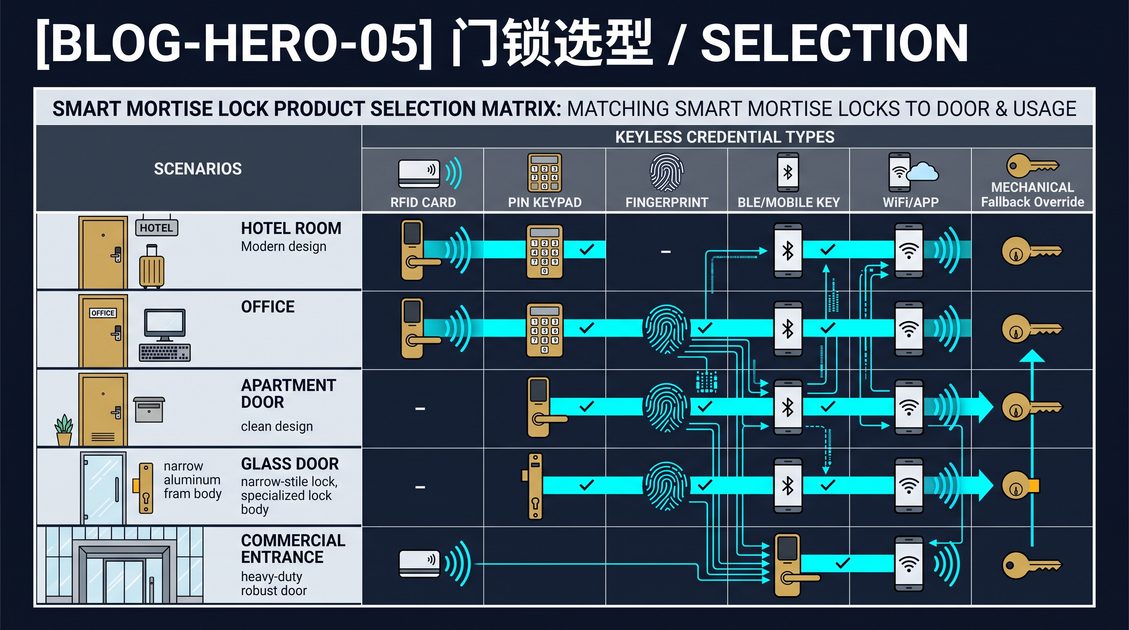
Kunci mortise elektrik adalah bodi kunci mortise yang melepaskan atau mengamankan latch dan bautnya melalui sinyal listrik dari reader, controller, access panel, atau sistem manajemen gedung. Berbeda dengan smart lock yang hanya mengandalkan baterai, kunci ini biasanya merupakan bagian dari arsitektur kontrol akses berkabel, sehingga spesifikasinya harus mencakup kesesuaian mekanis, input daya, perilaku pelepasan, jalur pengkabelan, antarmuka controller, dan operasi darurat. Panduan spesifikasi kunci mortise elektrik ini menjelaskan informasi yang perlu diminta oleh pembeli atau integrator sebelum memilih perangkat keras, tanpa berasumsi bahwa satu tegangan, arus, atau mode fail yang sama berlaku untuk setiap model.
Panduan Spesifikasi Kunci Mortise Elektrik: Kesesuaian Mekanis
Mulailah dari pintu dan rangkanya. Konfirmasikan tinggi, lebar, dan kedalaman bodi kunci, backset, faceplate, susunan latch dan baut, tinggi handle, orientasi handing, serta geometri strike. Lubang tempat kunci harus mampu menampung bodi secara utuh dan strike harus sejajar saat pintu tertutup. Kunci berbasis motor atau solenoid tidak dapat mengoreksi secara andal pintu yang bengkok, segel yang terlalu rapat, atau strike yang tidak sejajar.
Catat apakah bukaan pintu merupakan konstruksi baru atau retrofit, apakah pintu memiliki rating tertentu, serta apakah keberadaan door closer, panic device, panel kaca, atau konstruksi logam memengaruhi pemasangan. Gambar teknis bodi kunci yang tepat lebih penting daripada label keluarga produk. Minta dokumentasi mekanis dan elektrik terkini dari produsen untuk varian yang dipilih.
Panduan Spesifikasi Kunci Mortise Elektrik: Daya dan Mode Pelepasan
Spesifikasi elektrik harus menyatakan rentang input, arus normal dan puncak, tipe konektor, persyaratan kabel, serta perilaku saat kehilangan daya. Jangan menyimpulkan nilai-nilai ini dari kunci atau controller lain. Sebuah sistem dapat bersifat fail-safe, yaitu melepaskan kunci saat daya hilang, atau fail-secure, yaitu tetap terkunci dari luar saat daya diputus; perilaku yang benar bergantung pada bukaan pintu, aturan keselamatan jiwa, dan otoritas yang berwenang.
Tentukan cara kerja pelepasan dari sisi dalam dan pastikan evakuasi darurat tetap bersifat mekanis serta langsung. Catu daya harus terlindungi, berkapasitas sesuai kebutuhan saat start-up, dan diuji dalam kondisi normal maupun terputus. Cadangan baterai mungkin diperlukan untuk menjamin kontinuitas, tetapi tidak dapat menggantikan desain pelepasan darurat yang sesuai standar.
Panduan Spesifikasi Kunci Mortise Elektrik: Integrasi
Kunci mortise elektrik dapat menerima sinyal dari keypad, RFID reader, biometric reader, controller mobile access, atau access panel terpusat. Tetapkan antarmuka dan logikanya: perangkat mana yang mengotorisasi pelepasan, berapa lama pelepasan berlangsung, bagaimana posisi pintu dideteksi, dan di mana peristiwa dicatat. Untuk sistem berbasis jaringan, dokumentasikan fungsi apa saja yang tetap bekerja saat controller atau jaringan tidak tersedia.
Pengkabelan memerlukan jalur terlindungi melalui pintu, strain relief, dan akses servis yang jelas. Jauhkan konduktor dari baut dan spindle yang bergerak, serta beri label pada kedua ujungnya. Berita acara komisioning harus mencakup identitas kunci, port controller, sumber daya, mode pelepasan, administrator, dan prosedur darurat.
Panduan Spesifikasi Kunci Mortise Elektrik: Pengujian dan Layanan
Uji keseluruhan bukaan pintu dengan kredensial yang valid dan tidak valid, gangguan daya, kegagalan controller, kehilangan jaringan, posisi pintu, evakuasi dari sisi dalam, override manual, serta siklus berulang. Pastikan pintu tertutup tanpa tenaga berlebih dan latch serta baut terpasang sepenuhnya. Uji pintu perwakilan saat sebuah proyek menggunakan beberapa batch perangkat keras yang berbeda.
Perawatan mencakup pemeriksaan keselarasan, strike, pengencang, kabel, seal, log controller, izin akses, dan daya cadangan. Panduan spesifikasi kunci mortise elektrik ini bersifat informasi umum; dapatkan tinjauan dari pihak yang kompeten terkait persyaratan kebakaran, aksesibilitas, kelistrikan, privasi, bangunan, dan evakuasi darurat sebelum pengadaan.
Panduan Spesifikasi Kunci Mortise Elektrik: Dokumentasi Pengkabelan
Spesifikasi yang baik mencatat rangkaian lengkap, bukan hanya nama kuncinya. Identifikasi sumber daya, perangkat pelindung, jalur kabel, konektor, output controller, input request-to-exit, input posisi pintu, dan catu daya cadangan apa pun. Tandai kedua ujung setiap konduktor dan simpan diagram pengkabelan bersama catatan pintu. Hal ini membuat penelusuran masalah lebih aman dan mencegah pemasang di kemudian hari menebak sirkuit mana yang mengendalikan pelepasan.
Petugas komisioning harus memverifikasi tegangan dan arus pada kunci dalam operasi normal maupun saat peristiwa start aktuator, menggunakan peralatan dan prosedur yang sesuai untuk pemasangan tersebut. Jangan mengganti catu daya dengan yang belum terverifikasi karena output yang tampak serupa dapat menyebabkan pelepasan yang tidak andal atau kerusakan. Catatan akhir harus menyatakan nilai mana yang diukur langsung dan mana yang diberikan oleh produsen.
Panduan Spesifikasi Kunci Mortise Elektrik: Kebijakan Operasional
Perilaku elektrik kunci harus sesuai dengan kebijakan operasional gedung. Tentukan apakah pintu harus tetap aman selama gangguan komunikasi, pemutusan daya lokal, atau peristiwa alarm kebakaran, dan koordinasikan keputusan tersebut dengan profesional keselamatan yang bertanggung jawab. Tetapkan siapa yang dapat mengeluarkan perintah pelepasan, berapa lama pelepasan berlangsung, dan bagaimana pengguna dari sisi dalam dapat keluar tanpa kredensial. Dokumentasikan metode pemulihan manual dan ujilah dengan sistem dalam setiap kondisi yang relevan.
Untuk penerapan banyak pintu, gunakan satu pintu percontohan untuk memvalidasi controller, door closer, jalur kabel, dan peristiwa pemantauan sebelum mengulang pemasangan secara luas. Spesifikasi yang jelas menghubungkan perilaku elektrik dengan orang-orang dan prosedur yang mengoperasikan gedung.
Sebagian konten artikel ini dihasilkan oleh AI dan dioptimalkan untuk akurasi profesional serta keterbacaan. An electrified mortise lock is a mortise lock body that releases or secures its latch and bolt through an electrical signal from a reader, controller, access panel, or building-management system. Unlike a battery-only smart lock, it is normally part of a wired access-control architecture, so its specification must cover the mechanical case, power input, release behavior, wiring route, controller interface, and emergency operation. This electrified mortise lock specification guide explains the information a buyer or integrator should request before selecting hardware, without assuming that one voltage, current, or fail mode applies to every model.
Electrified Mortise Lock Specification Guide: Mechanical Fit
Start with the door and frame. Confirm the case height, width, depth, backset, faceplate, latch and bolt arrangement, handle height, handing, and strike geometry. The pocket must accept the complete body and the strike must align when the door closes. A motorized or solenoid-driven lock cannot reliably correct a warped door, a tight seal, or an offset strike.
Record whether the opening is a new build or retrofit, whether it is rated, and whether a closer, panic device, glass panel, or metal construction changes the installation. The exact body drawing matters more than a product-family label. Request the manufacturer’s current mechanical and electrical documentation for the selected variant.
Electrified Mortise Lock Specification Guide: Power and Release Mode
The electrical specification should state input range, normal and peak current, connector type, cable requirements, and behavior during power loss. Do not infer these values from another lock or controller. A system may be fail-safe, releasing on power loss, or fail-secure, remaining locked from the outside when power is removed; the correct behavior depends on the opening, life-safety rules, and the authority having jurisdiction.
Define how the inside release works and whether emergency egress remains mechanical and immediate. Power supplies should be protected, sized for startup demand, and tested under normal and interrupted conditions. Battery backup may be required for continuity, but it does not replace a compliant emergency-release design.
Electrified Mortise Lock Specification Guide: Integration
An electrified mortise lock may receive a signal from a keypad, RFID reader, biometric reader, mobile-access controller, or central access panel. Specify the interface and logic: which device authorizes release, how long the release lasts, how door position is sensed, and where events are recorded. For networked systems, document what remains functional if the controller or network is unavailable.
Wiring needs a protected route through the door, strain relief, and clear service access. Keep conductors away from moving bolts and spindles, and label both ends. A commissioning record should include the lock identifier, controller port, power source, release mode, administrator, and emergency procedure.
Electrified Mortise Lock Specification Guide: Testing and Service
Test the complete opening with valid and invalid credentials, power interruption, controller failure, network loss, door position, inside egress, manual override, and repeated cycles. Confirm that the door closes without excessive force and that the latch and bolt fully engage. Test representative doors when a project uses several hardware batches.
Maintenance includes inspecting alignment, strike, fasteners, cables, seals, controller logs, permissions, and backup power. This electrified mortise lock specification guide is general information; obtain qualified review for fire, accessibility, electrical, privacy, building, and emergency-egress requirements before procurement.
Electrified Mortise Lock Specification Guide: Wiring Documentation
A useful specification records the complete circuit rather than only the lock name. Identify the power source, protective device, cable route, connector, controller output, request-to-exit input, door-position input, and any backup supply. Mark both ends of each conductor and preserve the wiring diagram with the door record. This makes troubleshooting safer and prevents a later installer from guessing which circuit controls release.
Commissioners should verify the voltage and current at the lock under normal operation and during the actuator’s start event, using equipment and procedures appropriate for the installation. Do not substitute an unverified power supply because an apparently similar output can create unreliable release or damage. The final record should state which values were measured and which were supplied by the manufacturer.
Electrified Mortise Lock Specification Guide: Operating Policy
The lock’s electrical behavior must match the building’s operating policy. Decide whether the door should remain secure during a communications outage, a local power interruption, or a fire-alarm event, and coordinate that decision with the responsible safety professionals. Define who can issue release commands, how long a release lasts, and how the inside user exits without a credential. Document the manual recovery method and test it with the system in each relevant state.
For a multi-door deployment, use a pilot opening to validate the controller, door closer, cable route, and monitoring events before repeating the installation. A clear specification connects electrical behavior to the people and procedures that operate the building.
Belum yakin sensor mana yang cocok untuk proyek Anda?
Bicaralah dengan insinyur aplikasi mmWave kami untuk konsultasi gratis.
Rinci proyek hotel Anda bersama insinyur kami
Kirimkan jumlah kamar, jenis plafon, dan preferensi protokol Anda. Kami akan mengirimkan rencana sampel dan penawaran dalam 24 jam kerja.
- Beralih dari panduan umum ke diskusi produk atau aplikasi.
- Gunakan RFQ saat harga, gambar teknis, MOQ, atau jadwal peluncuran membutuhkan struktur.
- Jaga jalur kontak langsung tetap terlihat untuk klarifikasi cepat dan serah terima.