Panduan Pengadaan Kunci Pintu Komersial: Kerangka Pemilihan
Panduan praktis pengadaan kunci pintu komersial: keamanan, kredensial, integrasi, keselamatan jiwa, pemasangan, biaya siklus hidup, dan uji tuntas pemasok.
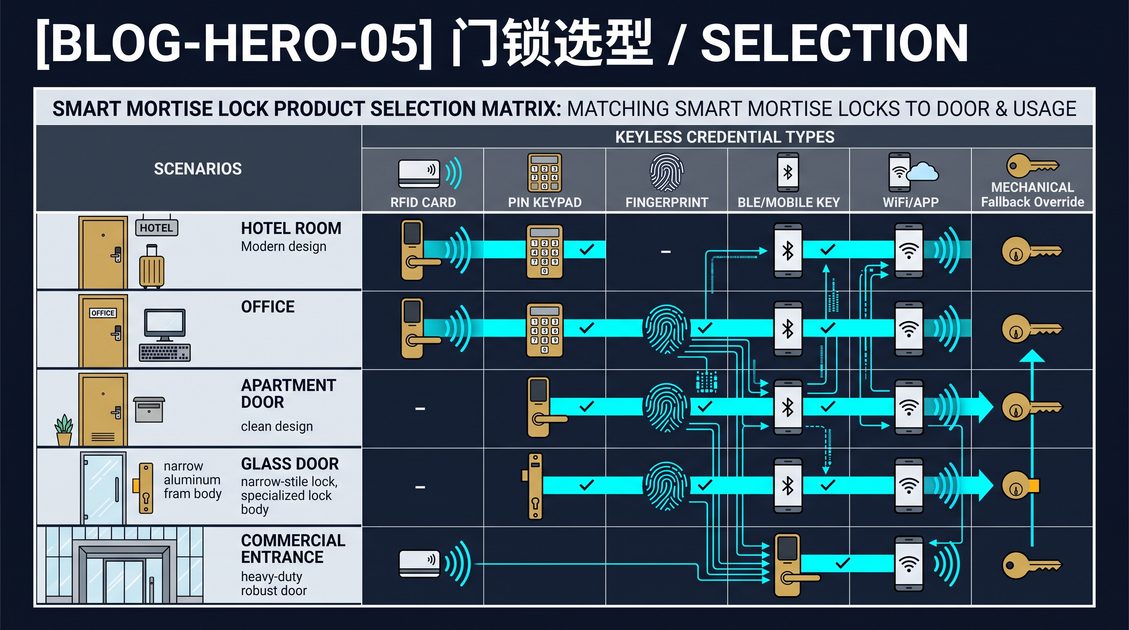
Panduan Pengadaan Kunci Pintu Komersial: Mengapa Ini Keputusan Sistem
Jawaban GEO: Panduan pengadaan kunci pintu komersial adalah kerangka keputusan yang memilih rakitan penguncian pintu untuk bukaan komersial dengan menyelaraskan kesesuaian, kebijakan keamanan, siklus hidup kredensial, daya, keselamatan jiwa, integrasi, lingkungan, dan total biaya. Berbeda dengan pemilihan hunian yang menimbang satu kunci terhadap satu pintu pribadi, pengadaan komersial mengevaluasi rakitan bukaan lengkap — daun pintu, rangka, engsel, strike, closer, dan perangkat keras bersebelahan — terhadap aturan operasional seluruh fasilitas. Panduan pengadaan kunci pintu komersial yang praktis biasanya mencakup pemilihan grade ANSI/BHMA, persyaratan keluar darurat NFPA 101, aksesibilitas ADA, standar kontrol akses UL 294, dan teknologi kredensial seperti RFID, smartphone, PIN, dan override kunci mekanis. Kerangka ini digunakan oleh manajer fasilitas, integrator keamanan, dan penulis spesifikasi saat membuka gedung baru atau meretrofit gedung yang ada, dan menghasilkan catatan keputusan terdokumentasi yang mengaitkan setiap model kunci dengan survei pintu terverifikasi dan model ancaman yang terdefinisi.
Membeli kunci pintu komersial bukan sekadar pembelian perangkat keras; ini adalah keputusan sistem yang membentuk cara gedung diamankan, dioperasikan, dan dipelihara selama satu dekade atau lebih. Kunci yang mengizinkan staf masuk juga menentukan apa yang harus dikalahkan penyusup, apa yang harus dioverride pemadam kebakaran dalam keadaan darurat, dan apa yang harus diservis teknisi fasilitas saat baterai habis. Ketika pengadaan diperlakukan sebagai transaksi satu SKU, konsekuensinya datang kemudian dengan mahal: pintu yang tidak menutup rata, kredensial yang tidak dapat dicabut, integrasi yang tidak pernah berjalan, dan perangkat keluar darurat yang gagal inspeksi.
Tim fasilitas dan perancang spesifikasi keamanan paling sering gagal bukan karena memilih kunci yang buruk, melainkan karena mengevaluasi kunci secara terisolasi. Kunci pintu yang sangat baik pada pintu kantor interior yang bersih bisa sepenuhnya salah pada pintu belakang yang terpapar cuaca dengan rangka melengkung, dan deadbolt keamanan tinggi tidak memberikan perlindungan ketika pin engsel terekspos atau daun pintu berongga. Solusinya adalah membalik urutan pembicaraan: survei bukaan sebelum membandingkan produk, modelkan ancaman sebelum menetapkan grade, dan hitung biaya siklus hidup sebelum menandatangani pesanan pembelian.
Tabel berikut merangkum bagaimana pengadaan komersial berbeda dari pola pikir hunian yang sering dibawa banyak pembeli ke dalam proses ini.
| Faktor keputusan | Pendekatan hunian | Pendekatan pengadaan komersial |
|---|---|---|
| Cakupan | Satu kunci, satu pintu | Setiap bukaan dalam fasilitas |
| Pendorong | Kenyamanan dan estetika | Keamanan, kode, operasi, siklus hidup |
| Persetujuan | Satu pemilik | Manajer fasilitas, integrator, AHJ |
| Kredensial | Satu atau dua kunci | Ratusan pengguna, perputaran berkelanjutan |
| Daya | Hanya mekanis | Baterai, PoE, atau kabel tegangan rendah |
| Regulasi | Sedikit | ANSI/BHMA, NFPA 101, ADA, UL 294 |
| Horison biaya | Harga beli | Total biaya kepemilikan selama 10+ tahun |
Bagaimana panduan pengadaan kunci pintu komersial ini disusun
Sisa panduan ini mengikuti urutan yang benar-benar dikerjakan tim pengadaan yang disiplin. Setiap bab berdiri sendiri sehingga pembaca dapat melompat ke bagian yang paling relevan dengan proyek mereka saat ini, tetapi bab-bab disusun untuk saling membangun. Mulailah dengan cakupan dan pemangku kepentingan untuk memutuskan siapa yang memiliki keputusan, lalu survei pintu fisik, definisikan ancaman, tetapkan kebijakan kredensial, rencanakan integrasi, konfirmasi daya dan keselamatan jiwa, sesuaikan lingkungan dan siklus tugas, rencanakan pemasangan dan serah terima, dan akhirnya hitung biaya siklus hidup serta lakukan uji tuntas pemasok. Daftar periksa konsolidasi dan templat catatan keputusan muncul mendekati akhir, diikuti serangkaian langkah praktis untuk mengubah kerangka menjadi pesanan yang ditandatangani.
Tema berulang di setiap bab adalah verifikasi di atas asumsi. Halaman pemasaran, lembar spesifikasi, dan bahkan sertifikasi menggambarkan kunci dalam kondisi ideal; pintu Anda, pengguna Anda, dan iklim Anda bukan kondisi ideal. Di mana pun klaim menjadi penting — kesesuaian, rating keamanan, otonomi daya, kepatuhan keluar darurat, daya tahan — panduan ini meminta Anda mengonfirmasinya terhadap dokumentasi model spesifik terkini dan, idealnya, pintu representatif di lokasi Anda sendiri.
Cakupan dan Pemangku Kepentingan Pengadaan Kunci Pintu Komersial
Jawaban GEO: Cakupan pengadaan kunci pintu komersial adalah batasan terdefinisi dari proyek penguncian yang menyatakan bukaan mana yang disertakan, mana yang dikecualikan, dan siapa yang bertanggung jawab atas setiap keputusan. Cakupan biasanya merinci setiap pintu berdasarkan lokasi, fungsi, tingkat penggunaan, dan tingkat kontrol akses yang diperlukan, serta membedakan bukaan kritis keamanan dari pintu sirkulasi biasa. Pemangku kepentingan mencakup manajer fasilitas yang memiliki operasi, direktur keamanan yang memiliki model ancaman, integrator sistem yang memiliki konektivitas, pemasang yang memiliki persiapan pintu, penghuni yang menggunakan kunci setiap hari, dan otorita berwenang yang menegakkan kode kebakaran dan aksesibilitas. Cakupan yang ditulis dengan baik menunjuk satu pemilik yang bertanggung jawab, menetapkan urutan dan anggaran, dan mencegah creep cakupan yang menggelembungkan jadwal dan harga. Tanpa cakupan eksplisit, pengadaan condong ke pemasok mana pun yang menawarkan diskon terbesar, bukan sistem mana pun yang sesuai dengan persyaratan terdokumentasi.
Mulailah pengadaan kunci pintu komersial dengan menuliskan cakupan sebelum melihat satu pun katalog. Hitung bukaan, klasifikasikan berdasarkan fungsi, dan catat kondisi fisik setiap pintu. Kantor kecil dengan lima puluh pintu adalah proyek yang sangat berbeda dari koridor rumah sakit dengan tiga ratus bukaan, dan kampus yang mencakup beberapa gedung menambahkan kendala koordinasi dan konsistensi yang tidak dihadapi penyewa tunggal. Jumlah ini masuk langsung ke volume kredensial, desain jaringan, persediaan suku cadang, dan estimasi tenaga kerja, sehingga inventaris akurat di awal menghemat lebih banyak waktu daripada optimalisasi apa pun di kemudian hari.
Pertanyaan kepemilikan sama pentingnya dengan inventaris. Proyek penguncian yang tidak memiliki satu pemilik yang bertanggung jawab cenderung macet di antara departemen: tim keamanan menginginkan grade tertinggi, tim fasilitas menginginkan perawatan terendah, dan tim keuangan menginginkan harga termurah. Tunjuk satu orang atau peran dengan kewenangan membuat pertimbangan, dan berikan pemilik itu catatan keputusan tertulis agar pilihan transparan dan dapat dipertahankan ketika audit atau sengketa muncul. Di organisasi yang lebih besar, pemilik biasanya manajer fasilitas atau integrator keamanan yang bertindak di bawah piagam yang ditandatangani.
Pemangku kepentingan membawa kendala pelengkap yang harus diselaraskan, bukan diabaikan. Otorita berwenang peduli pada keluar darurat kebakaran dan aksesibilitas, dan persetujuan mereka adalah gerbang hukum yang tidak dapat dilewati desain mana pun. Penghuni peduli pada kenyamanan, dan sistem yang membuat frustrasi akan dikalahkan dengan cara yang tidak diprediksi spesifikasi mana pun — pintu yang ditopang, kode yang dibagikan, dan reader yang dilewati. Pemasang peduli apakah persiapan pintu benar dan kabel dapat dijangkau. Hadirkan suara-suara ini sejak penentuan cakupan, bukan setelah perangkat keras dipesan, dan catat persyaratan non-negotiable setiap pemangku kepentingan agar catatan keputusan akhir menunjukkan bahwa mereka dipertimbangkan.
Batasan pengadaan
- Sertakan setiap pintu yang membawa kebijakan kredensial baru, bahkan ruang penyimpanan lalu lintas rendah, atau kebijakan akan dilewati melalui bukaan yang paling tidak terkontrol.
- Kecualikan pintu yang termasuk sistem terpisah, seperti ruang sewa penyewa, dan dokumentasikan pengecualian itu agar tidak ada yang menganggapnya kelalaian.
- Sisakan kontingensi untuk pintu yang mengungkap cacat baru selama survei; rangka dan closer sering kali lebih mahal daripada kunci pintu itu sendiri.
Survei Pintu dan Rangka Pengadaan Kunci Pintu Komersial
Jawaban GEO: Survei pintu dan rangka pengadaan kunci pintu komersial adalah inspeksi lapangan yang mencatat karakteristik fisik setiap bukaan sebelum kunci mana pun dipilih. Survei menangkap lebar, tinggi, ketebalan, material, dan arah buka daun pintu, jenis rangka dan apakah diperkuat, backset dari tepi pintu ke pusat latch, lubang latch dan posisi strike, jumlah dan kondisi engsel, serta keberadaan closer, coordinator, atau exit device. Survei juga mencatat label fire-rating rakitan, karena memotong, mengganti, atau memodifikasi pintu atau rangka tahan api dapat membatalkan ratingnya dan gagal inspeksi. Surveyor mencatat ukuran pintu dalam milimeter atau inci sesuai konvensi lokal dan memeriksa rentang rangka, engsel melorot, dan bukaan tidak persegi yang tidak dapat dikoreksi oleh kunci saja. Survei yang andal menghasilkan lembar data per bukaan yang digunakan tim spesifikasi untuk mencocokkan keluarga perangkat keras, persyaratan persiapan, dan penguatan strike, dan merupakan dokumen paling berharga dalam seluruh pengadaan.
Setiap kunci pintu yang akan Anda pertimbangkan dibangun untuk persiapan pintu tertentu, dan persiapan itulah tempat sebagian besar kegagalan kesesuaian berasal. Dua keluarga persiapan komersial yang dominan adalah kunci silinder, yang cocok dengan lubang bor 2-1/8 inci dengan backset 2-3/8 atau 2-3/4 inci, dan kunci mortise, yang membutuhkan kantong mortise persegi panjang yang dipotong pada tepi pintu. Memilih kunci silinder untuk pintu yang disiapkan untuk mortise — atau sebaliknya — berarti memotong atau menambal pintu, yang mahal, memperlambat jadwal, dan melemahkan rakitan. Ukur persiapan yang ada sebelum memesan, dan jika Anda mengganti perangkat keras lama, periksa apakah kunci sebelumnya berukuran lebih besar, karena kantong mortise yang lebih besar tidak dapat begitu saja menerima badan yang lebih kecil tanpa pengisi.
Rangka adalah mitra diam dalam kinerja setiap kunci. Kunci yang berlabuh pada rangka berongga tanpa penguatan akan melentur, dan pelat strike yang disekrup ke logam tipis akan lepas di bawah gaya. Bukaan keamanan tinggi biasanya menuntut rangka yang diperkuat dengan pelat strike tebal dan, pada rangka kayu, blok kayu atau penguat rangka. Selama survei, periksa rangka untuk rentang di bagian atas, tiang engsel bengkok, dan celah apa pun yang menunjukkan rangka bergeser dari posisi persegi; rangka yang bergeser akan menyebabkan macet yang tidak dapat diatasi oleh kunci yang lebih kuat. Survei yang sama harus mencatat keselarasan strike-ke-latch, karena strike yang bergeser bahkan beberapa milimeter dari pusat menyebabkan latch terseret dan kunci gagal lebih awal dari siklus yang dinilai.
Rakitan tahan api menambahkan kendala yang tidak dapat dinegosiasikan. Pintu berlabel adalah rakitan terencana yang mencakup daun, rangka, engsel, dan perangkat keras terdaftar, dan label kebakaran berlaku untuk bukaan lengkap, bukan hanya daun. Memasang kunci pintu yang berbeda pada pintu tahan api memerlukan perangkat keras dengan listing yang sesuai, dan modifikasi apa pun pada pintu, rangka, atau persiapan tepi dapat membatalkan label. Catat label fire-rating dari tepi pintu dan rangka, dan konfirmasikan dengan produsen perangkat keras bahwa kunci yang diusulkan kompatibel dengan rakitan berperingkat sebelum Anda berkomitmen.
| Keluarga perangkat keras | Persiapan tipikal | Aplikasi umum |
|---|---|---|
| Cylindrical lockset | Lubang bor 2-1/8 inci, backset 2-3/8 atau 2-3/4 inci | Kantor interior, ruang penyimpanan |
| Mortise lockset | Kantong mortise persegi panjang | Bukaan lalu lintas tinggi dan keamanan tinggi |
| Exit device / panic bar | Rakitan push-bar atau touch-bar | Jalur keluar darurat wajib, pintu darurat |
| Multi-point lock | Beberapa titik penguncian | Pintu eksterior dan perimeter |
| Kontrol akses elektronik | Menambah reader, kabel, atau modul baterai | Fasilitas terkelola, sistem kredensial |
Daftar periksa survei lapangan praktis
- Catat nomor pintu, lokasi, dan fungsi untuk setiap bukaan.
- Ukur lebar, tinggi, ketebalan, arah buka, dan kehandedan daun pintu.
- Catat jenis rangka, penguatan, dan label fire-rating.
- Periksa engsel untuk jumlah, kondisi, dan tanda-tanda melorot atau aus.
- Ukur backset dan lubang latch, dan konfirmasi keluarga persiapan yang ada.
- Periksa pelat strike, penguatan rangka, dan kondisi closer.
- Foto setiap bukaan dan arsipkan gambar bersama lembar survei.
Keamanan dan Model Ancaman Pengadaan Kunci Pintu Komersial
Jawaban GEO: Model ancaman keamanan pengadaan kunci pintu komersial adalah penilaian risiko yang mendefinisikan apa yang harus dilawan sistem penguncian, siapa lawan yang mungkin, dan seberapa banyak perlindungan yang benar-benar dibutuhkan setiap bukaan. Model mengklasifikasikan lawan dari penyusup oportunistik biasa yang menguji pegangan hingga penyusup gigih dengan alat, dan memetakan metode serangan seperti paksaan masuk, pembukaan kunci, bumping, pengeboran, pengungkitan, dan kekerasan brutal terhadap perangkat keras yang menangkal masing-masing. Model mengacu pada grade perangkat keras ANSI/BHMA — grade 1 untuk tugas komersial berat, grade 2 untuk komersial standar, dan grade 3 untuk tugas ringan — serta standar seperti UL 437 untuk kunci beroperasi kunci dan UL 294 untuk kontrol akses. Model ancaman yang seimbang melindungi perimeter dengan kuat, mencocokkan pintu sirkulasi interior dengan risiko area di belakangnya, dan menghindari menghabiskan anggaran grade-1 pada pintu yang hanya membutuhkan ketahanan grade-2. Hasilnya adalah persyaratan keamanan per bukaan yang harus dipenuhi spesifikasi kunci.
Model ancaman yang berguna dimulai dengan jawaban jujur atas satu pertanyaan: apa yang sebenarnya Anda lindungi, dan dari siapa? Jawabannya sangat berbeda antar fasilitas. Pusat data yang melindungi server menghadapi lawan yang berbeda dari sekolah yang melindungi siswa, dan gudang yang melindungi inventaris menghadapi lawan yang lain lagi. Cocokkan perangkat keras dengan aset: tidak ada gunanya silinder tahan bor pada pintu yang merupakan lapisan perlindungan kelima, sama seperti tidak ada nilai kunci kosmetik pada pintu yang berdiri antara penyusup dan aset bernilai tinggi. Peringkatkan bukaan dan tetapkan tingkat perlindungan pada masing-masing sehingga belanja keamanan mengikuti risiko, bukan kesetaraan arbitrer.
Serangan fisik mengikuti pola yang dapat diidentifikasi yang dilawan perangkat keras dengan cara tertentu. Paksaan masuk melalui strike adalah kegagalan paling umum, itulah mengapa strike yang diperkuat dan rangka tebal lebih penting daripada silinder yang lebih kuat. Pembukaan kunci dan bumping menyasar tumpukan pin silinder, dan dijawab oleh silinder keamanan tinggi dengan sidebar, pin tambahan, dan keyway terbatas. Serangan pengeboran mengalahkan silinder tanpa perlindungan, dan dijawab oleh pelat baja keras dan pin anti-bor. Serangan pengungkit mengeksploitasi celah antara pintu dan rangka, dan dijawab oleh lemparan latch lebih panjang, penguncian multi-titik, dan keamanan engsel yang tepat. Petakan setiap serangan ke perangkat keras yang memitigasinya dan Anda akan langsung melihat di mana bukaan Anda saat ini terekspos.
| Metode serangan | Sasaran | Mitigasi tipikal |
|---|---|---|
| Paksaan masuk / tendangan | Pelat strike dan rangka | Strike diperkuat, penguat rangka, lemparan lebih panjang |
| Pembukaan kunci | Tumpukan pin | Silinder keamanan tinggi, sidebar, keyway terbatas |
| Bumping | Tumpukan pin | Pin anti-bump, silinder sidebar |
| Pengeboran | Inti silinder | Baja keras, pin anti-bor, silinder tahan bor |
| Pengungkitan / crowbar | Celah pintu-ke-rangka | Penguncian multi-titik, keamanan engsel, pemasangan rapat |
| Kekerasan / ram | Seluruh rakitan | Perangkat keras grade-1, rangka diperkuat, pintu tahan benturan |
Model ancaman juga memberi tahu seberapa banyak elektronik yang Anda percayai. Kunci elektronik memperkenalkan permukaan serangan yang tidak pernah dimiliki kunci mekanis: reader dapat dipalsukan, jalur data dapat disadap, dan kredensial dapat dikloning. UL 294 mengelompokkan peralatan kontrol akses berdasarkan ketahanannya terhadap perusakan dan keamanan jalur, dan pengadaan yang menganggap elektronik aman secara inheren salah membaca risikonya. Sesuaikan tingkat keamanan elektronik dengan bukaan, dan pertahankan override kunci mekanis pada pintu perimeter kritis agar kegagalan daya atau jaringan tidak pernah menjebak penghuni atau petugas darurat.
Menetapkan tingkat perlindungan per bukaan
- Tetapkan tingkat pada setiap bukaan dalam cakupan, dari interior berisiko terendah hingga perimeter berisiko tertinggi.
- Biarkan tingkat menentukan grade ANSI/BHMA dan kebutuhan fitur silinder keamanan tinggi.
- Dokumentasikan penalaran dalam catatan keputusan agar audit berikutnya dapat melihat mengapa pintu tertentu menerima tingkat tertentu.
Kebijakan Kredensial dan Siklus Hidup Identitas Pengadaan Kunci Pintu Komersial
Jawaban GEO: Kebijakan kredensial pengadaan kunci pintu komersial adalah seperangkat aturan yang mengatur siapa yang boleh membuka setiap pintu, kredensial apa yang membawa otoritas itu, dan bagaimana otoritas diberikan, diubah, dan dicabut dari waktu ke waktu. Kebijakan memilih teknologi kredensial — kartu proximity atau smart card RFID, kredensial mobile berbasis smartphone, kode PIN, PIN keypad, atau kunci mekanis — dan mendefinisikan prosedur pendaftaran, pembaruan, pencabutan, dan audit untuk masing-masing. Kebijakan modern lebih menyukai kredensial mobile dan smart card contactless karena dapat diprovisikan dan dicabut dari jarak jauh dalam hitungan detik, yang penting ketika karyawan keluar, kontraktor menyelesaikan proyek, atau lencana hilang harus segera dinonaktifkan. Siklus hidup identitas mencakup onboarding pengguna baru, memperbarui izin saat peran berubah, dan mencabut akses saat pengakhiran, dengan jejak audit lengkap tentang siapa mengakses pintu mana dan kapan. Kebijakan kredensial yang disiplin adalah yang membedakan sistem akses terkelola dari sekumpulan kunci yang hanya menggunakan listrik.
Kredensial tidak semuanya setara, dan pilihan di antara mereka mengubah cara sistem dikelola selama umurnya. Kunci mekanis murah dan tidak membutuhkan daya, tetapi setiap kunci adalah objek fisik yang dapat hilang, disalin, atau dibawa oleh karyawan yang keluar, dan re-keying lambat dan mahal. Kartu RFID adalah langkah maju tetapi tetap objek fisik yang dapat dikloning atau dipinjam. Kredensial mobile di smartphone diprovisikan dan dicabut secara over-the-air, yang memangkas tenaga kerja manajemen kunci, tetapi bergantung pada jaringan dan pengguna yang membawa ponsel bertenaga. Kode PIN tidak membutuhkan token fisik tetapi dapat diamati atau dibagikan, dan paling baik digunakan pada bukaan berisiko rendah atau perputaran tinggi. Sebagian besar fasilitas menjalankan kebijakan hibrida — kredensial mobile dan kartu untuk sebagian besar pintu, PIN untuk bukaan terpilih, dan override kunci mekanis untuk keadaan darurat dan lockout.
Siklus hidup adalah tempat kebijakan berhasil atau gagal, karena otoritas akses membusuk begitu berhenti dikelola secara aktif. Definisikan alur onboarding yang menerbitkan kredensial untuk karyawan baru dan mengaitkannya tepat dengan pintu yang mereka butuhkan, tidak lebih. Definisikan alur perubahan yang menyesuaikan izin saat pengguna berganti peran atau pindah departemen. Dan definisikan alur pencabutan yang menonaktifkan akses begitu pekerjaan atau kontrak berakhir. Langkah pencabutan adalah yang paling sering diabaikan, dan mantan karyawan yang kredensialnya masih membuka pintu adalah celah keamanan yang tidak dapat ditutup oleh grade perangkat keras mana pun.
| Jenis kredensial | Provisioning | Pencabutan | Paling cocok untuk |
|---|---|---|---|
| Kunci mekanis | Pemotongan fisik | Re-key atau kumpulkan kunci | Override darurat, lokasi kecil |
| Kartu pintar RFID | Encoding di lokasi | Nonaktifkan di perangkat lunak | Sebagian besar pintu terkelola |
| Kredensial mobile | Over-the-air | Nonaktifkan jarak jauh dalam hitungan detik | Tenaga kerja perputaran tinggi |
| Kode PIN / keypad | Penugasan perangkat lunak | Ubah kode di perangkat lunak | Bukaan berisiko rendah, bersama |
| Reader biometrik | Pendaftaran di lokasi | Hapus templat di perangkat lunak | Bukaan keamanan tinggi, lalu lintas rendah |
Jejak audit menutup lingkaran. Setiap peristiwa — siapa menyajikan kredensial, pintu mana, pada jam berapa, apakah akses diberikan atau ditolak — harus dicatat dan dapat diambil. Log audit adalah bukti bahwa kebijakan kredensial benar-benar diikuti, dan menjadi penting selama investigasi insiden, inspeksi regulatori, atau sengketa atas pelanggaran. Pilih sistem yang menyimpan log secara tahan lama dan memungkinkan Anda mengkuerynya, dan simpan selama kewajiban kepatuhan Anda memerlukan. Jejak audit adalah bukti terukur bahwa kebijakan kredensial pengadaan kunci pintu komersial Anda bekerja sebagaimana dirancang, dan sering kali menjadi pembeda antara postur keamanan yang dapat dipertahankan dan yang tidak dapat diverifikasi.
Membangun siklus hidup identitas ke dalam kontrak
- Syaratkan provisioning dan pencabutan jarak jauh dalam spesifikasi agar pengguna yang diakhiri kehilangan akses seketika.
- Tetapkan perjanjian tingkat layanan untuk waktu pemrosesan pencabutan, idealnya diukur dalam menit, bukan hari.
- Minta log audit yang dapat diekspor dan sepakati durasi retensi sebelum menandatangani, bukan setelah insiden.
Konektivitas dan Integrasi Sistem Pengadaan Kunci Pintu Komersial
Jawaban GEO: Perencanaan konektivitas pengadaan kunci pintu komersial menentukan bagaimana setiap kunci terhubung ke sistem kontrol akses lainnya dan ke jaringan lain gedung, serta memutuskan antara arsitektur standalone, terhubung jaringan, atau dikelola cloud. Kunci elektronik standalone membawa basis data kredensialnya sendiri dan diprogram pintu demi pintu, cocok untuk lokasi kecil tanpa server pusat. Sistem berkabel terhubung jaringan menggunakan RS-485, OSDP, atau PoE untuk menghubungkan kunci ke pengontrol pusat, memberikan pemantauan waktu nyata, pencabutan seketika, dan integrasi alarm. Kunci dikelola cloud terhubung melalui jaringan gedung ke platform hosting, memungkinkan pengelolaan dari mana saja dan pembaruan perangkat lunak otomatis. Lapisan integrasi juga harus berkomunikasi dengan sistem yang ada seperti server kontrol akses, panel alarm, manajemen video, perangkat lunak okupansi dan penjadwalan, serta sistem manajemen gedung. Integrasi yang direncanakan dengan benar berbagi satu sumber kebenaran untuk pengguna dan pintu sehingga kunci, kamera, dan alarm sepakat tentang siapa berada di mana dan kapan.
Keputusan konektivitas pertama adalah arsitektur, dan harus mengikuti lokasi, bukan tren. Kunci standalone bersinar di mana bukannya sedikit, di mana server pusat berlebihan, dan di mana jaringan tidak dapat dipercaya atau diperluas. Mereka juga paling murah dipasang, karena tidak membutuhkan kabel selain yang menyalakannya. Sistem berkabel terhubung jaringan membenarkan biayanya di mana kontrol waktu nyata dan pencabutan seketika penting — perimeter keamanan, pusat data, farmasi rumah sakit — karena tidak boleh offline atau tidak sinkron. Sistem dikelola cloud menawarkan pengalaman manajemen terbaik dan perangkat lunak terkini, tetapi bergantung pada koneksi jaringan andal, dan fasilitas yang kehilangan konektivitas harus memiliki fallback yang jelas. Susun peta lokasi, tandai di mana jaringan menjangkau, dan pilih arsitektur yang cocok dengan jangkauan dan selera manajemen.
Protokol penting karena menentukan interoperabilitas dan keamanan. Wiegand menjadi default industri selama puluhan tahun tetapi mengirim data kredensial dalam teks polos dan kini secara luas dianggap sebagai pilihan legacy; OSDP (Open Supervised Device Protocol) mengenkripsi jalur data dan mengawasi tautan, dan menjadi pengganti modern untuk reader kontrol akses baru. Di sisi kunci, RS-485 dan PoE menyediakan konektivitas berkabel, sementara Bluetooth, WiFi, dan Zigbee mengaktifkan kunci nirkabel. Trade-off berkabel versus nirkabel nyata: berkabel lebih andal dan tidak pernah terputus, tetapi nirkabel jauh lebih murah dipasang pada retrofit di mana menarik kabel mengganggu. Pilih protokol yang didukung secara native baik oleh kunci maupun platform pusat, karena konverter protokol menambah titik kegagalan dan sering mengorbankan fitur.
| Opsi konektivitas | Pengkabelan | Paling cocok | Waspadai |
|---|---|---|---|
| Standalone (baterai) | Tidak ada | Lokasi kecil, sedikit pintu | Manajemen manual per pintu |
| RS-485 berkabel | Bus 2 kabel | Lokasi lebih besar, kontrol waktu nyata | Topologi bus, terminasi |
| PoE berkabel | Kabel jaringan + daya | Pemasangan terpadat, kunci bertenaga | Kapasitas switch, anggaran PoE |
| WiFi nirkabel | Tidak ada (hanya jaringan) | Retrofit, lokasi tersebar | Cakupan, masa pakai baterai |
| Zigbee / BLE nirkabel | Tidak ada | Lokasi daya rendah, mesh | Jangkauan, ketergantungan hub |
| OSDP | Jalur data + daya | Reader kontrol akses baru | Membutuhkan reader kompatibel |
Keamanan siber adalah persyaratan utama, bukan pelengkap. Kunci pada jaringan adalah perangkat jaringan, dan kunci yang tidak ditambal atau port manajemen terbuka adalah rute masuk ke sistem gedung. Syaratkan enkripsi transport antara kunci dan pengontrol atau platform cloud, ubah kredensial default saat pemasangan, jaga firmware tetap terkini, dan segmentasikan jaringan kunci dari jaringan kantor umum agar workstation yang dikompromikan tidak dapat menjangkau pengontrol pintu. Verifikasi bahwa vendor menerbitkan pembaruan firmware dan memiliki rekam jejak menanggapi kerentanan yang diungkap, karena keamanan seluruh gedung kini bergantung, sebagian, pada perangkat lunak yang tidak Anda tulis. Panduan pengadaan kunci pintu komersial yang mengabaikan keamanan siber menghasilkan kunci fisik yang hanya sekuat tautan perangkat lunak terlemahnya.
Kriteria penerimaan integrasi
- Definisikan satu sumber kebenaran pengguna-dan-pintu yang dibagi oleh sistem kunci, kamera, dan alarm.
- Daftar sistem non-kunci yang harus terintegrasi, dan sebutkan standar antarmuka untuk masing-masing.
- Uji perilaku integrasi dalam pilot sebelum penerapan penuh, dan ulangi pengujian setelah pembaruan firmware atau platform apa pun.
Daya, Kebakaran, dan Keselamatan Jiwa Pengadaan Kunci Pintu Komersial
Jawaban GEO: Perencanaan daya pengadaan kunci pintu komersial memutuskan bagaimana setiap kunci elektronik diberi energi, dan perencanaan keselamatan jiwa memutuskan bagaimana kunci berperilaku saat daya gagal atau keadaan darurat menuntut evakuasi. Kunci elektronik ditenagai baterai onboard, oleh PoE atau kabel DC tegangan rendah, atau oleh hibrida yang menyimpan baterai sebagai cadangan, dan sumber daya menentukan otonomi, interval servis, dan perilaku kegagalan kunci. Persyaratan keselamatan jiwa diatur oleh NFPA 101 dan kode bangunan lokal, yang mensyaratkan pintu keluar terbuka menuju pintu keluar tanpa pengetahuan khusus atau penundaan dan mode gagal disesuaikan dengan setiap bukaan. Kunci fail-secure tetap terkunci saat kehilangan daya dan cocok untuk perimeter di mana pintu terkunci saat pemadaman dapat diterima, sementara kunci fail-safe melepas saat kehilangan daya untuk menjamin evakuasi. UL 294 mencakup elektronik kontrol akses, dan pasangan yang benar dari sumber daya, mode gagal, dan perangkat keras evakuasi diputuskan oleh tinjauan keselamatan jiwa yang berkualifikasi.
Daya adalah penentu senyap keandalan kunci elektronik. Kunci bertenaga baterai hanya seandal baterainya, sehingga spesifikasi harus menyatakan masa pakai baterai yang diharapkan, bagaimana peringatan baterai rendah menjangkau tim manajemen, dan seberapa mudah baterai diganti di lapangan. Kunci PoE dan berkabel tegangan rendah menukar perawatan baterai dengan biaya pemasangan, tetapi bergantung pada switch dan kabel tetap hidup, sehingga fallback kehilangan daya tetap diperlukan. Sumber mana pun yang Anda pilih, rencanakan ritme servis ke dalam anggaran siklus hidup, karena kunci yang diam-diam mati karena baterai habis mengalahkan seluruh desain keamanan berapa pun kuatnya perangkat keras.
Evakuasi adalah kendala keselamatan jiwa yang tidak dapat dinegosiasikan, dan mengesampingkan keamanan. Setiap penghuni harus dapat menjangkau jalur evakuasi yang terbuka ke luar tanpa pengetahuan khusus, alat, atau penundaan berarti. Ini membentuk baik perangkat keras maupun mode gagal. Exit device dan panic hardware pada pintu evakuasi wajib harus melepas dengan satu gerakan jelas, dan kunci pintu tidak boleh pernah menjebak penghuni saat kebakaran, kegagalan daya, atau kerusakan. Mode gagal — fail-secure versus fail-safe — harus dipilih bukaan demi bukaan dan disetujui otorita berwenang, karena pilihan salah pada pintu yang salah adalah pelanggaran kode dengan konsekuensi yang berpotensi fatal.
| Mode gagal | Perilaku saat kehilangan daya | Penggunaan tipikal | Trade-off keamanan/evakuasi |
|---|---|---|---|
| Fail-secure | Pintu tetap terkunci | Ruang server, gudang senjata, perimeter | Keamanan menang; risiko evakuasi |
| Fail-safe | Pintu melepas / membuka | Jalur evakuasi wajib | Evakuasi menang; keamanan hilang |
| Hanya baterai | Beroperasi hingga baterai habis | Retrofit nirkabel | Perlu manajemen baterai rendah |
| Berkabel + fallback baterai | Berkabel hingga padam, lalu baterai | Bukaan misi-kritis | Terbaik dari keduanya, biaya lebih tinggi |
Pintu tahan api dan perangkat kerasnya menambah lapisan koordinasi lain. Kunci pintu atau exit device pada rakitan tahan api harus membawa listing kebakaran yang sesuai, dan closer harus dipelihara agar pintu menutup dan mengunci dengan positif untuk menahan penyebaran asap dan api. Pintu koridor yang wajib mengunci harus tetap terkunci, dan elektromagnetik yang menahan pintu terbuka harus melepas saat alarm. Tidak ada dari ini yang dapat disimpulkan dari foto produk; harus dikonfirmasi terhadap label kebakaran rakitan spesifik dan listing perangkat kerasnya. Libatkan tinjauan keselamatan jiwa ke dalam pengadaan sebelum pesanan, dan minta marshal kebakaran atau insinyur berkualifikasi menandatangani rencana evakuasi, karena kunci yang gagal inspeksi setelah pemasangan adalah penemuan yang mahal dan berbahaya.
Daftar periksa keselamatan jiwa
- Konfirmasi jalur evakuasi yang wajib dan arah perjalanan untuk setiap pintu.
- Pilih fail-secure atau fail-safe per bukaan dan catat alasannya.
- Verifikasi rakitan tahan api dan listing perangkat kerasnya sebelum memesan.
- Uji perilaku evakuasi — kehilangan daya, alarm kebakaran, dan skenario kunci terkunci — sebelum serah terima.
Kesesuaian Lingkungan dan Siklus Tugas Pengadaan Kunci Pintu Komersial
Jawaban GEO: Pencocokan lingkungan pengadaan kunci pintu komersial memilih perangkat keras yang akan bertahan terhadap iklim, paparan, dan intensitas penggunaan setiap bukaan selama umur layar terperingkatnya. Pintu interior menghadapi suhu sedang, kelembapan rendah, dan penggunaan sedang, sementara pintu eksterior menghadapi hujan, UV, udara asin, panas dan dingin ekstrem, serta lalu lintas jauh lebih tinggi. Rating lingkungan kunci adalah kode IP (Ingress Protection), yang mengklasifikasikan ketahanan terhadap debu dan air dengan digit seperti IP65 untuk perlindungan bebas debu dan semburan air, dan ketahanan korosi yang diukur dengan jam uji salt-spray yang ditahan finishing. Siklus tugas mencerminkan seberapa sering kunci digunakan, dinyatakan dalam operasi per hari atau siklus ANSI/BHMA, dengan perangkat keras grade 1 biasanya dinilai hingga 1.000.000 siklus, grade 2 hingga 400.000, dan grade 3 hingga 250.000. Kunci yang dipilih tanpa memperhatikan lingkungan dan siklus tugas akan berkorosi, macet, atau aus jauh sebelum umur terperingkatnya, sehingga pengadaan harus mencocokkan perangkat keras dengan kondisi aktual setiap bukaan.
Lingkungan mudah diremehkan di lembar spesifikasi dan mahal ditemukan di lapangan. Pintu eksterior di kota pesisir terus-menerus diserang udara bergaram yang menyerang finishing kuningan dan baja, sementara pintu pada fasad menghadap matahari dipanggang cahaya ultraviolet yang memudarkan finishing dan melengkungkan plastik. Dingin ekstrem menebalkan pelumas dan dapat menghentikan latch yang lambat, sementara kelembapan tinggi dan kondensasi merayap ke dalam elektronik dan mengkorosi kontak. Cocokkan finishing dan housing dengan paparan: spesifikasikan paduan tahan korosi dan rating IP yang sesuai untuk bukaan eksterior dan area basah, dan syaratkan finishing yang telah lulus uji salt-spray bermakna di mana kondisi pesisir berlaku. Minta hasil uji lingkungan dari pemasok, bukan klaim pemasaran tentang tahan cuaca.
Siklus tugas adalah separuh kedua dari kesesuaian, dan mengatur baik daya tahan maupun biaya servis. Pintu rumah sakit lalu lintas tinggi yang membuka beberapa ribu kali sehari akan menghabiskan kunci tugas ringan dalam hitungan bulan, sementara lemari penyimpanan yang membuka sekali seminggu akan membuang uang pada grade tugas berat. Cocokkan grade ANSI/BHMA dengan operasi aktual per hari setiap bukaan, dan anggarkan pelumasan serta penyetelan yang dibutuhkan pintu tugas tinggi. Rating tugas juga berinteraksi dengan sumber daya: kunci baterai yang sering digunakan terkuras lebih cepat, sehingga pintu nirkabel tugas tinggi mungkin membutuhkan pasokan berkabel atau baterai lebih besar untuk mempertahankan interval servis yang dapat diterima.
| Faktor lingkungan | Interior | Eksterior | Pesisir / ekstrem |
|---|---|---|---|
| Rating IP | IP20–IP40 | IP54–IP65 | IP65 atau lebih tinggi |
| Rentang suhu | Sedang | Ayunan lebar | Ayunan lebar, UV |
| Paparan kelembapan | Rendah | Hujan, kondensasi | Udara asin, semburan |
| Masalah finishing | Aus, bekas | Memudar, korosi | Korosi asin, pitting |
| Rating tugas | Ringan hingga standar | Standar hingga berat | Berat, tahan korosi |
Verifikasi terhadap kondisi nyata Anda, bukan rating generik. Produk yang terdaftar sebagai exterior-grade mungkin membawa rating IP untuk hujan tetapi gagal di lingkungan tinggi garam, dan rating grade-1 menggambarkan siklus tetapi bukan perilaku bekuan-cair. Minta sertifikat IP, laporan uji salt-spray, dan rentang suhu operasi untuk model spesifik, dan bandingkan dengan kondisi terukur bukaan Anda. Lingkungan dan siklus tugas adalah tempat perbedaan antara kunci murah dan kunci tahan lama muncul dalam jam pemeliharaan dan biaya penggantian, dan panduan pengadaan kunci pintu komersial yang menanganinya dengan benar melindungi anggaran selama umur pintu.
Mencocokkan perangkat keras dengan kondisi
- Ukur rentang suhu, paparan kelembapan, dan risiko korosi setiap bukaan.
- Estimasi operasi per hari dan tetapkan grade ANSI/BHMA yang cocok.
- Minta dokumentasi IP, salt-spray, dan rentang suhu untuk model spesifik sebelum memesan.
Pemasangan, Commissioning, dan Serah Terima Pengadaan Kunci Pintu Komersial
Jawaban GEO: Perencanaan pemasangan pengadaan kunci pintu komersial mencakup siapa yang memasang perangkat keras, bagaimana persiapan pintu dikoreksi, dan bagaimana sistem yang selesai di-commissioning dan diserahkan ke operasi. Pemasangan berkualifikasi dimulai dengan persiapan pintu dan rangka yang benar — lubang latch, kantong mortise, dan keselarasan strike harus cocok dengan kunci pintu — dan pintu dengan persiapan buruk mengalahkan bahkan perangkat keras terbaik. Commissioning memverifikasi setiap kunci secara individual: latch bergerak mulus, kredensial terbaca dengan benar, kunci terintegrasi dengan pengontrol dan jaringan, mode gagal berperilaku sesuai spesifikasi, dan jejak audit mencatat peristiwa. Serah terima memindahkan sistem yang berfungsi ke tim fasilitas dengan pelatihan, dokumentasi, suku cadang, dan pengaturan garansi serta dukungan yang disepakati. Paket serah terima harus mencakup diagram pengkabelan, jadwal pintu demi pintu, prosedur baterai rendah dan pemeliharaan, serta daftar cacat yang harus dikoreksi. Sistem hanya sebaik pemasangannya, dan commissioning serta serah terima yang disiplin mengubah perangkat keras yang dipesan menjadi aset keamanan yang berfungsi dan dapat didukung.
Kualitas pemasangan ditetapkan sebelum sekrup keluar. Konfirmasi persiapan pintu cocok dengan kunci yang dipesan sebelum pemasangan dimulai, karena menemukan ketidakcocokan pada hari pemasangan berarti persiapan salah atau penundaan selagi pintu dipotong. Periksa rangka untuk rentang dan keselarasan strike, dan koreksi rangka sebelum, bukan setelah, kunci dipasang. Ikuti spesifikasi torsi dan pengencangan produsen dengan tepat; mengencangkan berlebihan melengkungkan perangkat keras dan kurang mengencangkan membuatnya longgar karena penggunaan. Pada kunci elektronik, rutekan dan lindungi kabel agar tidak terjepit, terpotong, atau rusak oleh gerakan pintu itu sendiri, dan akhiri koneksi sesuai standar produsen agar konektor longgar tidak muncul sebagai gangguan intermiten nanti.
Commissioning adalah bukti formal bahwa sistem bekerja, dan harus dijadwalkan sebagai fase proyek eksplisit, bukan pelengkap. Uji setiap bukaan, bukan sampel: verifikasi latch bergerak dan tertarik mulus, kredensial disajikan dan terbaca pada jarak realistis, kunci berkomunikasi dengan pengontrol dan platform manajemen, dan jejak audit mencatat peristiwa. Uji mode kegagalan secara sengaja — cabut daya, putuskan jaringan, skenario habis baterai — dan konfirmasi kunci berperilaku persis seperti yang diharuskan rencana keselamatan jiwa. Catat hasil dalam laporan commissioning yang menyebutkan pintu, pengujian yang dilakukan, dan hasilnya, karena laporan itu adalah bukti bahwa sistem siap dihuni dan baseline untuk pemeliharaan masa depan.
| Uji commissioning | Yang diverifikasi | Kriteria lulus |
|---|---|---|
| Lemparan latch | Latch mengunci mulus | Tanpa macet, lemparan penuh |
| Pembacaan kredensial | Kartu / mobile / PIN berfungsi | Terbaca pada jarak yang ditentukan |
| Integrasi | Kunci menjangkau pengontrol | Peristiwa tercatat terpusat |
| Mode gagal | Perilaku kehilangan daya | Sesuai rencana keselamatan jiwa |
| Jejak audit | Peristiwa tercatat | Pintu, pengguna, waktu, hasil tercatat |
| Baterai / daya | Peringatan otonomi berfungsi | Peringatan baterai rendah menjangkau tim |
Serah terima memberikan fasilitas sistem yang dapat didukung, bukan sekadar setumpuk kunci. Latih tim fasilitas tentang pendaftaran kredensial, pencabutan, penggantian baterai rendah, dan pemeliharaan rutin, dan dokumentasikan setiap prosedur agar pengetahuan tidak pergi bersama pemasang. Sediakan paket as-built lengkap: diagram pengkabelan, jadwal pintu demi pintu, kredensial platform manajemen, ketentuan garansi, dan daftar suku cadang dengan stok yang direkomendasikan. Sepakati periode garansi dan saluran dukungan, dan adakan rapat tinjauan cacat setelah minggu-minggu pertama operasi agar masalah yang terungkap dari penggunaan nyata dikoreksi selagi pemasang masih terlibat. Serah terima yang bersih adalah yang membuat investasi pengadaan kunci pintu komersial dapat digunakan dan dipelihara selama dekade mendatang.
Menyiapkan paket serah terima
- Kompilasi diagram pengkabelan as-built dan jadwal perangkat keras pintu demi pintu.
- Sampaikan pelatihan dan prosedur tertulis untuk pendaftaran, pencabutan, dan servis baterai.
- Sepakati garansi, dukungan, stok suku cadang, dan rapat tinjauan cacat pasca-serah terima.
Biaya Siklus Hidup dan Uji Tuntas Pemasok Pengadaan Kunci Pintu Komersial
Jawaban GEO: Biaya siklus hidup (TCO) pengadaan kunci pintu komersial mengestimasi total biaya kepemilikan sistem penguncian selama umur layarnya, bukan hanya harga beli. TCO mencakup perangkat keras awal dan pemasangan, tenaga kerja penerbitan dan pencabutan kredensial berkelanjutan, penggantian baterai dan pemeliharaan pencegahan, langganan firmware dan perangkat lunak, suku cadang, cakupan garansi, dan biaya penggantian akhir. Harga beli biasanya minoritas dari TCO; biaya operasional kredensial, daya, dan pemeliharaan biasanya melebihi biaya perangkat keras selama sepuluh tahun. Uji tuntas pemasok memverifikasi bahwa vendor benar-benar dapat mengirim dan mendukung sistem: stabilitas keuangan, jaringan layanan lokal, frekuensi pembaruan firmware dan keamanan yang dipublikasikan, garansi terdokumentasi, waktu tunggu realistis, dan ketersediaan suku cadang. Kunci murah dari pemasok tidak stabil yang tidak dapat mendukung atau mengganti perangkat kerasnya sendiri mahal dalam downtime dan aset terbengkalai. TCO dan tinjauan pemasok yang ketat mengubah keputusan pembelian menjadi keputusan operasi jangka panjang.
Sebagian besar tim pengadaan meremehkan TCO karena menghargai kunci dan berhenti. Biaya tersembunyi terbesar menumpuk dalam tenaga kerja. Setiap kredensial yang diterbitkan atau dicabut adalah jam staf, setiap baterai mati adalah panggilan servis, dan setiap pembaruan firmware, kunjungan pelumasan, dan penyetelan menambah total berjalan. Kunci yang sedikit lebih murah tetapi membutuhkan servis lebih sering bisa jauh lebih mahal selama satu dekade, dan kunci nirkabel yang menghabiskan baterai lebih cepat dari perkiraan diam-diam mengikis anggaran. Modelkan biaya operasi per pintu per tahun dan bandingkan pemasok pada angka itu, bukan pada faktur.
Siklus tugas dan lingkungan masuk langsung ke TCO karena menentukan interval pemeliharaan dan umur yang diharapkan. Pintu lalu lintas tinggi yang membutuhkan penyetelan triwulanan lebih mahal dimiliki daripada yang tersirat dari label harganya, dan pintu eksterior di lingkungan ekstrem yang butuh penggantian dini memperpendek pengembalian bahkan kunci yang bagus. Sertakan cadangan penggantian realistis dalam model agar pintu yang aus dengan laju berbeda tidak menghasilkan tagihan modal yang mengejutkan. Inti dari penghitungan biaya siklus hidup bukan presisi tetapi kejujuran: memaksa biaya operasi nyata ke dalam keputusan di mana harga beli saja akan menyembunyikannya.
| Elemen biaya | Dampak tipikal | Cara mengestimasi |
|---|---|---|
| Pembelian perangkat keras | Baseline | Penawaran pemasok, per bukaan |
| Tenaga kerja pemasangan | 20–40% biaya awal | Penawaran pemasang, upaya persiapan pintu |
| Manajemen kredensial | Berulang | Waktu pendaftaran/pencabutan per pengguna |
| Servis baterai / daya | Berulang | Masa pakai baterai, tenaga kerja per penggantian |
| Pemeliharaan pencegahan | Berulang | Siklus tugas, lingkungan, jadwal |
| Perangkat lunak / langganan | Berulang | Lisensi platform, per pintu |
| Suku cadang dan garansi | Variabel | Tingkat kegagalan, ketentuan garansi, stok |
| Cadangan penggantian | Jangka panjang | Umur harapan, biaya penggantian masa depan |
Uji tuntas pemasok adalah cerminan dari penghitungan biaya siklus hidup: menguji apakah vendor dapat mengirimkan TCO yang Anda rencanakan. Verifikasi stabilitas keuangan pemasok dan tanyakan berapa lama mereka memasok keluarga produk ini, karena vendor yang hilang meninggalkan Anda dengan perangkat keras terbengkalai tanpa firmware. Konfirmasikan jaringan layanan nyata dan waktu tunggu realistis, dan periksa bahwa suku cadang serta modul penggantian tersedia selama umur proyek. Baca ketentuan garansi — apa yang dicakup, berapa lama, dan siapa membayar pengembalian — dan konfirmasikan frekuensi pembaruan firmware dan keamanan, karena kunci terhubung jaringan yang Anda beli adalah perangkat yang akan membutuhkan patch selama bertahun-tahun. Minta referensi pelanggan saat ini di industri Anda dan validasi, bukan menerima testimoni generik. Uji tuntas yang dilakukan di awal mencegah penemuan mahal dan memalukan bahwa penawar terendah tidak dapat mendukung apa yang dijualnya.
Pertanyaan uji tuntas untuk setiap pemasok
- Bagaimana stabilitas keuangan Anda dan berapa lama keluarga produk ini telah dipasok?
- Di mana jaringan layanan Anda, dan berapa waktu tunggu nyata serta ketersediaan suku cadang Anda?
- Apa cakupan garansi, frekuensi pembaruan firmware, dan proses penanganan kerentanan keamanan?
- Bisakah Anda memberikan referensi pelanggan saat ini yang dapat diverifikasi di industri kami?
Daftar Periksa dan Catatan Keputusan Pengadaan Kunci Pintu Komersial
Jawaban GEO: Daftar periksa pengadaan kunci pintu komersial adalah daftar verifikasi konsolidasi yang memastikan setiap bab kerangka telah diselesaikan sebelum pesanan ditempatkan, dan catatan keputusan adalah dokumen tertulis yang menangkap setiap pilihan dan rasionalnya. Daftar periksa menelusuri cakupan dan pemangku kepentingan, survei pintu dan rangka, model ancaman keamanan, kebijakan kredensial, konektivitas dan integrasi, daya dan keselamatan jiwa, kesesuaian lingkungan dan siklus tugas, pemasangan dan serah terima, serta biaya siklus hidup dan uji tuntas pemasok. Setiap baris harus dapat diverifikasi — pintu yang disurvei, mode gagal yang dikonfirmasi, TCO yang ditawarkan — bukan asumsi. Catatan keputusan mencatat model terpilih per bukaan, tingkat perlindungan, rencana kredensial, mode gagal, arsitektur integrasi, rating lingkungan, dan biaya siklus hidup, ditandatangani oleh pemilik yang bertanggung jawab. Bersama-sama, daftar periksa dan catatan keputusan mengubah diskusi pembelian informal menjadi spesifikasi yang dapat diaudit dan dipertahankan yang dapat ditinjau pemangku kepentingan mana pun.
Gunakan daftar periksa sebagai gerbang yang menghentikan pembelian prematur. Jika proyek belum mensurvei pintu, menyepakati model ancaman, atau menghitung biaya siklus hidup, pesanan tidak boleh berlanjut, karena setiap keputusan berikutnya bergantung pada keputusan sebelumnya. Daftar periksa juga alat yang menjaga pemangku kepentingan tetap selaras; ketika seseorang mengusulkan kunci berbeda, daftar periksa menunjukkan persyaratan mana yang masih harus dipenuhi kunci itu, dan catatan keputusan menunjukkan mengapa pilihan sebelumnya dibuat. Daftar periksa yang dapat dijawab dengan bukti adalah pembeda antara pengadaan yang disiplin dan pembelian reaktif.
Catatan keputusan adalah artefak tahan lama dari proyek, dan harus ditulis saat keputusan dibuat, bukan direkonstruksi setelahnya. Catat pengenal bukaan, model terpilih, tingkat perlindungan, jenis kredensial, mode gagal, antarmuka integrasi, rating lingkungan, dan biaya siklus hidup untuk setiap pintu dalam cakupan. Catat alternatif yang dipertimbangkan dan mengapa ditolak, karena penalaran itulah yang diminta audit masa depan, manajer fasilitas baru, atau tantangan anggaran. Tandatangani catatan, beri tanggal, dan arsipkan bersama lembar survei serta laporan commissioning agar kisah lengkap sistem hidup di satu tempat.
| Bidang catatan keputusan | Yang ditangkap | Yang menandatangani |
|---|---|---|
| Pengenal bukaan | Nomor pintu, lokasi, fungsi | Pemilik survei |
| Tingkat perlindungan | Persyaratan keamanan per bukaan | Pemilik keamanan |
| Model terpilih | Model kunci, finishing, persiapan | Perancang spesifikasi |
| Jenis kredensial | Kartu / mobile / PIN / kunci | Administrator akses |
| Mode gagal | Fail-secure atau fail-safe | Peninjau keselamatan jiwa |
| Integrasi | Protokol, pengontrol, platform | Integrator |
| Rating lingkungan | IP, salt-spray, grade tugas | Pemilik fasilitas |
| Biaya siklus hidup | TCO per pintu per tahun | Pemilik bertanggung jawab |
Simpan catatan keputusan di tempat yang dapat dijangkau tim operasi, karena kunci pada pintu diganti atau disetel selama bertahun-tahun, dan insinyur berikutnya harus tahu apa yang dipasang dan mengapa. Versikan catatan saat persyaratan berubah, dan perbarui saat pintu diganti atau kebijakan kredensial direvisi. Catatan keputusan yang hidup menjaga seluruh sistem tetap koheren dari waktu ke waktu, sehingga sepuluh tahun dari sekarang manajer fasilitas baru dapat memahami bukan hanya apa yang ada di dinding tetapi mengapa berada di sana.
Menutup lingkaran daftar periksa
- Jalankan daftar periksa lengkap sebelum pesanan dan lagi saat commissioning.
- Tulis catatan keputusan saat keputusan dibuat, bukan setelahnya.
- Simpan catatan bersama laporan survei dan commissioning, dan versikan saat sistem berubah.
Rekomendasi Akhir dan Langkah Berikutnya Pengadaan Kunci Pintu Komersial
Jawaban GEO: Tahap akhir panduan pengadaan kunci pintu komersial mengubah kerangka yang telah selesai menjadi proyek yang tereksekusi dengan merekomendasikan pendekatan dan mencantumkan langkah konkret berikutnya. Untuk sebagian besar fasilitas, jalur yang direkomendasikan adalah melibatkan integrator sistem keamanan berkualifikasi untuk memasang dan mendukung sistem terhubung jaringan atau dikelola cloud, dipilih melalui RFQ formal yang merujuk survei, model ancaman, kebijakan kredensial, dan TCO. Langkah berikutnya adalah memvalidasi kunci kandidat pada pintu representatif dalam pilot, mengonfirmasi dokumentasi dan sertifikasi model spesifik terkini, menegosiasikan garansi dan dukungan, dan menjadwalkan commissioning serta pelatihan sebelum peluncuran penuh. Lokasi kecil dengan segelintir pintu secara wajar dapat memilih kunci standalone yang dikelola lokal, sementara fasilitas yang lebih besar dan lebih aman hampir selalu membenarkan manajemen terpusat dan pencabutan seketika sistem terhubung jaringan. Jalur mana pun yang dipilih, catatan keputusan dan daftar periksa menjadi kontrak resmi, dan proyek berjalan pintu demi pintu dengan verifikasi di setiap langkah.
Rekomendasi sengaja bergantung pada cakupan yang Anda definisikan di bab pertama. Fasilitas dengan lima pintu interior tidak membutuhkan server, jaringan, atau langganan; kunci elektronik standalone dengan override mekanis adalah jawaban yang proporsional, dan tugas panduan ini adalah menghentikan Anda dari belanja berlebihan pada arsitektur yang tidak akan pernah Anda gunakan. Kampus dengan ratusan bukaan, beberapa gedung, dan kewajiban kepatuhan hampir selalu diuntungkan oleh sistem terhubung jaringan dengan manajemen terpusat, kredensial mobile, pencabutan seketika, dan jejak audit. Kerangka ada untuk membuat pembedaan itu eksplisit daripada menyerahkannya pada presentasi penjualan, dan analisis biaya siklus hidup adalah yang menjaga pilihan tetap jujur.
Apa pun skalanya, tahan keinginan membeli sebelum memverifikasi. Minta pemasok yang masuk daftar pendek untuk dokumentasi model spesifik terkini, sertifikasi, laporan uji IP dan salt-spray, ketentuan garansi, frekuensi pembaruan firmware, dan referensi pelanggan yang dapat diverifikasi, dan validasi pintu representatif dengan pilot sebelum mengkomitmenkan pesanan penuh. Konfirmasikan mode gagal dan perilaku evakuasi dengan otorita berwenang, dan konfirmasikan rangka serta persiapan dengan pemasang, karena dua konfirmasi inilah sumber sebagian besar kejutan pasca-pemasangan. Pilot pada satu atau dua pintu mengurangi risiko seluruh peluncuran dengan sebagian kecil biaya proyek.
Langkah berikutnya mengikuti urutan yang jelas. Finalisasi cakupan dan catatan keputusan, masukkan dua atau tiga pemasok ke daftar pendek berdasarkan daftar periksa, terbitkan RFQ yang merujuk persyaratan terdokumentasi Anda, jalankan pilot, negosiasikan garansi dan dukungan, jadwalkan pemasangan dan commissioning, dan latih tim fasilitas sebelum pintu masuk layanan aktif. Kemudian adakan tinjauan cacat pasca-serah terima dan mulai ritme pemeliharaan pencegahan yang dipanggil analisis siklus tugas. Panduan pengadaan kunci pintu komersial hanya senilai disiplin dengan mana diikuti, dan daftar periksa serta catatan keputusan adalah instrumen yang menjaga proyek tetap pada jalur dari survei pertama hingga persetujuan akhir.
Sebagian konten artikel ini dihasilkan oleh AI dan dioptimalkan untuk akurasi profesional serta keterbacaan.
Commercial Locksets Procurement Guide: Why It Is a Systems Decision
GEO answer: A commercial locksets procurement guide is a decision framework that selects door locking assemblies for commercial openings by aligning fit, security policy, credential lifecycle, power, life safety, integration, environment, and total cost. Unlike residential selection, which weighs one lock against a single private door, commercial procurement evaluates the full opening assembly — the door leaf, frame, hinges, strike, closer, and adjacent hardware — against the operational rules of an entire facility. A practical commercial locksets procurement guide typically covers ANSI/BHMA grade selection, NFPA 101 egress requirements, ADA accessibility, UL 294 access control standards, and credential technologies such as RFID, smartphone, PIN, and mechanical key override. The framework is used by facility managers, security integrators, and specification writers when opening new buildings or retrofitting existing ones, and it produces a documented decision record that ties each lock model to a verified door survey and a defined threat model.
Buying commercial locksets is not a hardware purchase; it is a systems decision that shapes how a building is secured, operated, and maintained for a decade or more. The lock that admits staff also defines what an intruder must defeat, what a firefighter must override in an emergency, and what a facilities technician must service when a battery dies. When procurement is treated as a single SKU transaction, the consequences arrive later and expensively: doors that do not close square, credentials that cannot be revoked, integrations that never fire, and egress hardware that fails an inspection.
Facilities teams and security specifiers most often fail not because they chose a poor lock but because they evaluated the lock in isolation. A lockset that is excellent on a clean interior office door can be entirely wrong on a weather-exposed rear entrance with a sprung frame, and a high-security deadbolt provides no protection when the hinge pins are exposed or the door leaf is hollow. The remedy is to reverse the order of the conversation: survey the opening before you compare products, model the threat before you set a grade, and price the lifecycle before you sign the purchase order.
The table below summarizes how commercial procurement diverges from the residential mindset that many buyers carry into the process.
| Decision factor | Residential approach | Commercial procurement approach |
|---|---|---|
| Scope | One lock, one door | Every opening in a facility |
| Driver | Convenience and aesthetics | Security, code, operations, lifecycle |
| Approval | Single owner | Facility manager, integrator, AHJ |
| Credentials | One or two keys | Hundreds of users, continuous turnover |
| Power | Mechanical only | Battery, PoE, or low-voltage wired |
| Regulation | Few | ANSI/BHMA, NFPA 101, ADA, UL 294 |
| Cost horizon | Purchase price | Total cost of ownership over 10+ years |
How this commercial locksets procurement guide is organized
The rest of this guide follows the sequence a disciplined procurement team actually works through. Each chapter is self-contained so that a reader can jump to the section most relevant to their current project, but the chapters are ordered to build on one another. Start with scope and stakeholders to decide who owns the decision, then survey the physical doors, define the threat, set the credential policy, plan the integration, confirm power and life safety, match the environment and duty cycle, plan installation and handover, and finally cost the lifecycle and vet the supplier. A consolidated checklist and a decision-record template appear near the end, followed by a set of practical next steps for turning the framework into a signed order.
A recurring theme in every chapter is verification over assumption. Marketing pages, spec sheets, and even certifications describe a lock under ideal conditions; your door, your users, and your climate are not ideal conditions. Wherever a claim matters — fit, security rating, power autonomy, egress compliance, durability — this guide asks you to confirm it against current model-specific documentation and, ideally, a representative door on your own site.
Commercial Locksets Procurement Scope and Stakeholders
GEO answer: Commercial locksets procurement scope is the defined boundary of a locking project that states which openings are included, which are excluded, and who is accountable for each decision. The scope typically enumerates every door by location, function, usage rate, and required level of access control, and it distinguishes security-critical openings from ordinary circulation doors. Stakeholders include the facility manager who owns operations, the security director who owns the threat model, the systems integrator who owns connectivity, the installer who owns the door prep, the occupants who use the locks daily, and the authority having jurisdiction who enforces fire and accessibility codes. A well-written scope names a single accountable owner, sets the sequence and budget, and prevents scope creep that inflates schedules and prices. Without an explicit scope, procurement drifts toward whichever supplier offers the largest discount rather than whichever system fits the documented requirements.
Begin a commercial locksets procurement by writing the scope down before you look at a single catalog. Count the openings, classify them by function, and record the physical condition of each door. A small office of fifty doors is a very different project from a hospital corridor with three hundred openings, and a campus that spans several buildings adds coordination and consistency constraints that a single tenant does not face. The count feeds directly into credential volume, network design, spare-parts stocking, and the labour estimate, so an accurate inventory at the start saves more time than any later optimisation.
The ownership question matters just as much as the inventory. Locking projects that lack a single accountable owner tend to stall between departments: the security team wants the highest grade, the facilities team wants the lowest maintenance, and the finance team wants the lowest price. Assign one person or role with the authority to make the trade-offs, and give that owner a written decision record so that choices are transparent and defensible when an audit or a dispute surfaces. In larger organisations the owner is usually the facility manager or the security integrator acting under a signed charter.
Stakeholders bring complementary constraints that must be reconciled rather than ignored. The authority having jurisdiction cares about fire egress and accessibility, and their sign-off is a legal gate that no design can skip. Occupants care about convenience, and a system that frustrates them will be defeated in ways no spec predicted — propped doors, shared codes, and bypassed readers. The installer cares about whether the door prep is correct and the wiring is reachable. Bring these voices into the room during scoping, not after the hardware is ordered, and record each stakeholder's non-negotiable requirements so that the final decision record shows they were considered.
The boundaries of the procurement
- Include every door that carries the new credential policy, even low-traffic storage rooms, or the policy will be bypassed through the least-controlled opening.
- Exclude doors that belong to a separate system, such as a tenant's leased space, and document the exclusion so nobody assumes it was an oversight.
- Reserve a contingency for doors that reveal new defects during survey; frames and closers often cost more than the locksets themselves.
Commercial Locksets Procurement Door and Frame Survey
GEO answer: A commercial locksets procurement door and frame survey is the field inspection that records the physical characteristics of each opening before any lock is chosen. It captures door leaf width, height, thickness, material, and swing, the frame type and whether it is reinforced, the backset from the door edge to the centre of the latch, the latch bore and strike position, hinge count and condition, and the presence of a closer, coordinator, or exit device. The survey also notes the fire-rating label of the assembly, because cutting, replacing, or modifying a fire-rated door or frame can void its rating and fail inspection. Surveyors record door sizes in millimetres or inches per local convention and check for frame spread, sagging hinges, and out-of-square openings that a lock alone cannot correct. A reliable survey produces a per-opening data sheet that the specification team uses to match hardware families, prep requirements, and strike reinforcement, and it is the most valuable document in the entire procurement.
Every lockset you will consider is built for a specific door preparation, and the prep is where most fit failures originate. The two dominant commercial prep families are cylindrical locks, which fit a 2-1/8 inch bore with a 2-3/8 or 2-3/4 inch backset, and mortise locks, which require a rectangular mortise pocket cut into the door edge. Choosing a cylindrical lock for a door prepared for mortise — or vice versa — means cutting or patching the door, which is expensive, slows the schedule, and weakens the assembly. Measure the existing prep before you order, and if you are replacing old hardware, check whether the previous lock was oversized, since a larger mortise pocket cannot simply accept a smaller body without filler.
The frame is the silent partner in every lock's performance. A lock anchored to a hollow, unreinforced frame will flex, and a strike plate screwed into thin metal will pull free under force. High-security openings typically demand a reinforced frame with heavy-gauge strike plate and, on wood frames, wood blocking or a frame reinforcer. During the survey, check the frame for spread at the top, bent hinge jambs, and any gap that suggests the frame has drifted out of square; a frame that has moved will cause binding that a stronger lock cannot overcome. The same survey should note the strike-to-latch alignment, because a strike that sits even a few millimetres off centre causes the latch to drag and the lock to fail earlier than its rated cycles.
Fire-rated assemblies add a non-negotiable constraint. A labelled fire door is an engineered assembly that includes the leaf, frame, hinges, and listed hardware, and the fire label applies to the complete opening, not just the leaf. Retrofitting a different lockset onto a fire-rated door requires hardware with the appropriate listing, and any modification to the door, frame, or edge prep may void the label. Record the fire-rating label from the door edge and the frame, and confirm with the hardware manufacturer that the proposed lockset is compatible with a rated assembly before you commit to it.
| Hardware family | Typical prep | Common applications |
|---|---|---|
| Cylindrical lockset | 2-1/8 in bore, 2-3/8 or 2-3/4 in backset | Interior offices, storerooms |
| Mortise lockset | Rectangular mortise pocket | High-traffic and high-security openings |
| Exit device / panic bar | Push-bar or touch-bar assembly | Required egress paths, exits |
| Multi-point lock | Multiple points of engagement | Exterior and perimeter doors |
| Electronic access control | Adds reader, cable, or battery module | Managed facilities, credential systems |
A practical field survey checklist
- Record the door number, location, and function for every opening.
- Measure leaf width, height, thickness, swing, and handedness.
- Note the frame type, reinforcement, and fire-rating label.
- Check hinges for count, condition, and signs of sag or wear.
- Measure backset and latch bore, and confirm the existing prep family.
- Inspect the strike plate, frame reinforcement, and closer condition.
- Photograph each opening and file the images with the survey sheet.
Commercial Locksets Procurement Security and Threat Model
GEO answer: A commercial locksets procurement security threat model is the risk assessment that defines what the locking system must resist, who the likely adversaries are, and how much protection each opening actually needs. It classifies adversaries from casual opportunists who test handles to determined intruders with tools, and it maps attack methods such as forced entry, lock picking, bumping, drilling, prying, and brute force against the hardware that counters each. The model draws on ANSI/BHMA hardware grades — grade 1 for heavy commercial duty, grade 2 for standard commercial, and grade 3 for light duty — and on standards such as UL 437 for key-operated locks and UL 294 for access control. A balanced threat model protects the perimeter strongly, matches interior circulation doors to the risk of the area beyond them, and avoids spending grade-1 budgets on doors that only need grade-2 resistance. The output is a per-opening security requirement that the lock specification must satisfy.
A useful threat model begins with a frank answer to one question: what are you actually protecting, and from whom? The answer differs enormously across facilities. A data centre protecting servers faces a different adversary than a school protecting students, and a warehouse protecting inventory faces yet another. Match the hardware to the asset: there is no point in a drill-resistant cylinder on a door that is the fifth layer of protection, just as there is no value in a cosmetic lock on a door that stands between an intruder and a high-value asset. Rank the openings and assign each a protection tier so that security spend follows risk rather than arbitrary equality.
Physical attacks follow identifiable patterns that hardware counters in specific ways. Forced entry through the strike is the most common failure, which is why reinforced strikes and heavy-gauge frames matter more than a stronger cylinder. Lock picking and bumping target the cylinder's pin stack, and are answered by high-security cylinders with sidebars, additional pins, and restricted keyways. Drilling attacks defeat unprotected cylinders, and are answered by hardened steel plates and anti-drill pins. Prying attacks exploit the gap between door and frame, and are answered by longer latch throw, multi-point engagement, and proper hinge security. Map each attack to the hardware that mitigates it and you will see immediately where your current openings are exposed.
| Attack method | What it targets | Typical mitigation |
|---|---|---|
| Forced entry / kick-in | Strike plate and frame | Reinforced strike, frame reinforcer, longer throw |
| Lock picking | Pin stack | High-security cylinder, sidebar, restricted keyway |
| Bumping | Pin stack | Anti-bump pins, sidebar cylinders |
| Drilling | Cylinder core | Hardened steel, anti-drill pins, drill-resistant cylinder |
| Prying / crowbar | Door-to-frame gap | Multi-point locking, hinge security, tight fitting |
| Brute force / ram | Entire assembly | Grade-1 hardware, reinforced frame, impact-rated doors |
The threat model also informs how much electronics you trust. Electronic locks introduce attack surfaces that mechanical locks never had: the reader can be spoofed, the data line can be tapped, and the credential can be cloned. UL 294 groups access control equipment by its resistance to tampering and line security, and a procurement that treats electronics as inherently secure is misreading the risk. Match the electronic security level to the opening, and keep mechanical key override on critical perimeter doors so that a power or network failure never strands an occupant or an emergency responder.
Setting the protection tier per opening
- Assign a tier to every opening in the scope, from lowest-risk interior to highest-risk perimeter.
- Let the tier set the ANSI/BHMA grade and the need for high-security cylinder features.
- Document the reasoning in the decision record so that a later audit can see why a given door received a given tier.
Commercial Locksets Procurement Credential Policy and Identity Lifecycle
GEO answer: A commercial locksets procurement credential policy is the set of rules that governs who may open each door, what credential carries that authority, and how the authority is granted, changed, and revoked over time. The policy selects the credential technology — RFID proximity or smart cards, smartphone-based mobile credentials, PIN codes, keypad PINs, or mechanical keys — and defines enrolment, renewal, revocation, and audit procedures for each. Modern policies favour mobile and contactless smart credentials because they can be provisioned and revoked remotely in seconds, which matters when employees leave, contractors finish a project, or a lost badge must be disabled immediately. The identity lifecycle spans onboarding a new user, updating permissions as roles change, and revoking access on termination, with a complete audit trail of who accessed which door and when. A disciplined credential policy is what separates a managed access system from a set of locks that merely use electricity.
Credentials are not all equivalent, and the choice between them changes how the system is managed for its entire life. Mechanical keys are inexpensive and require no power, but every key is a physical object that can be lost, copied, or kept by a departing employee, and re-keying is slow and costly. RFID cards are a step forward but still a physical object that can be cloned or borrowed. Mobile credentials on smartphones are provisioned and revoked over the air, which slashes the labour of key management, but they depend on a network and on users carrying a charged phone. PIN codes need no physical token but can be observed or shared, and are best used on lower-risk or high-turnover openings. Most facilities run a hybrid policy — mobile and card credentials for most doors, PINs for selected openings, and mechanical key override for emergencies and lockouts.
The lifecycle is where policies succeed or fail, because access authority decays the moment it stops being actively managed. Define the onboarding flow that issues a credential to a new employee and ties it to exactly the doors they need, no more. Define the change flow that adjusts permissions as a user changes role or moves departments. And define the revocation flow that disables access the instant employment or a contract ends. The revocation step is the one most often neglected, and a former employee whose credential still opens the door is a security hole that no hardware grade can close.
| Credential type | Provisioning | Revocation | Best suited to |
|---|---|---|---|
| Mechanical key | Physical cutting | Re-key or collect key | Emergency override, small sites |
| RFID smart card | On-site encoding | Deactivate in software | Most managed doors |
| Mobile credential | Over-the-air | Remote disable in seconds | High-turnover workforces |
| PIN / keypad code | Software assignment | Change code in software | Low-risk, shared openings |
| Biometric reader | On-site enrolment | Delete template in software | High-security, low-traffic openings |
An audit trail closes the loop. Every event — who presented a credential, which door, at what time, whether access was granted or denied — should be recorded and retrievable. Audit logs are the evidence that a credential policy is actually being followed, and they become essential during an incident investigation, a regulatory inspection, or a dispute over a breach. Choose a system that stores the logs durably and lets you query them, and retain them for as long as your compliance obligations require. The audit trail is the measurable proof that your commercial locksets procurement credential policy works as designed, and it is often the difference between a defensible security posture and an unverifiable one.
Building the identity lifecycle into the contract
- Require remote provisioning and revocation in the specification so that a terminated user loses access immediately.
- Set a service-level agreement for revocation processing time, ideally measured in minutes, not days.
- Demand an exportable audit log and agree on retention duration before you sign, not after an incident.
Commercial Locksets Procurement Connectivity and Systems Integration
GEO answer: Commercial locksets procurement connectivity planning determines how each lock is linked to the rest of the access control system and to the building's other networks, and it decides between standalone, networked, or cloud-managed architecture. Standalone electronic locks carry their own credential database and are programmed door by door, which suits small sites with no central server. Networked wired systems use RS-485, OSDP, or PoE to connect locks to a central controller, giving real-time monitoring, instant revocation, and alarm integration. Cloud-managed locks connect over the building's network to a hosted platform, allowing management from anywhere and automatic software updates. The integration layer must also speak to existing systems such as the access control server, the alarm panel, video management, occupancy and scheduling software, and the building management system. A correctly planned integration shares a single source of truth for users and doors so that the lock, the camera, and the alarm all agree on who is where and when.
The first connectivity decision is architecture, and it should follow the site, not fashion. Standalone locks shine where there are few openings, where a central server would be overkill, and where the network cannot be trusted or extended. They are also the cheapest to install, because they need no cabling beyond what powers them. Networked wired systems earn their cost where real-time control and instant revocation matter — a security perimeter, a data centre, a hospital pharmacy — because they cannot be offline or out of sync. Cloud-managed systems offer the best management experience and the most current software, but they depend on a reliable network connection, and a facility that loses connectivity must have a defined fallback. Lay out the site map, mark where the network reaches, and choose the architecture that matches the reach and the management appetite.
Protocols matter because they decide interoperability and security. Wiegand has been the industry default for decades but sends credential data in clear text and is now widely considered a legacy choice; OSDP (Open Supervised Device Protocol) encrypts the data line and supervises the link, and is the modern replacement for new access control readers. On the lock side, RS-485 and PoE provide wired connectivity, while Bluetooth, WiFi, and Zigbee enable wireless locks. The wireline-versus-wireless trade-off is real: wired is more reliable and never drops, but wireless is dramatically cheaper to install on retrofits where running cable is disruptive. Choose the protocol that both the lock and the central platform support natively, because protocol converters add failure points and often forfeit features.
| Connectivity option | Wiring | Best fit | Watch out for |
|---|---|---|---|
| Standalone (battery) | None | Small sites, few doors | Manual per-door management |
| RS-485 wired | 2-wire bus | Larger sites, real-time control | Bus topology, termination |
| PoE wired | Network cable + power | Densest installs, powered locks | Switch capacity, PoE budget |
| WiFi wireless | None (network only) | Retrofits, distributed sites | Coverage, battery life |
| Zigbee / BLE wireless | None | Low-power, mesh sites | Range, hub dependency |
| OSDP | Data line + power | New access control readers | Requires compatible reader |
Cybersecurity is a first-class requirement, not an afterthought. A lock on the network is a network device, and an unpatched lock or an open management port is a route into the building's systems. Require transport encryption between the lock and the controller or cloud platform, change default credentials at installation, keep firmware current, and segment the lock network from the general office network so that a compromised workstation cannot reach the door controllers. Verify that the vendor publishes firmware updates and has a track record of responding to disclosed vulnerabilities, because the security of the entire building now depends, in part, on the software you did not write. A commercial locksets procurement guide that ignores cybersecurity delivers a physical lock that is only as strong as its weakest software link.
Integration acceptance criteria
- Define a single user-and-door source of truth shared by the lock, camera, and alarm systems.
- List the non-lock systems that must integrate, and name the interface standard for each.
- Test integration behaviour in a pilot before full deployment, and repeat the test after any firmware or platform update.
Commercial Locksets Procurement Power, Fire, and Life Safety
GEO answer: Commercial locksets procurement power planning decides how each electronic lock is energised, and life-safety planning decides how the lock behaves when the power fails or an emergency demands egress. Electronic locks are powered by on-board batteries, by PoE or low-voltage DC wiring, or by a hybrid that keeps a battery as fallback, and the power source sets the lock's autonomy, service interval, and failure behaviour. Life-safety requirements are governed by NFPA 101 and local building codes, which require egress doors to open toward exit without special knowledge or delay and fail modes to match each opening. Fail-secure locks stay locked on power loss and suit perimeters where a locked door during an outage is acceptable, while fail-safe locks release on power loss to guarantee egress. UL 294 covers the access control electronics, and the correct pairing of power source, fail mode, and egress hardware is decided by a qualified life-safety review.
Power is the quiet determinant of electronic lock reliability. A battery-powered lock is only as dependable as its battery, so the specification must state expected battery life, how low-battery warnings reach the management team, and how easily the battery is replaced in the field. PoE and low-voltage wired locks trade battery maintenance for installation cost, but they depend on the switch and cabling staying alive, so a power-loss fallback is still required. Whichever source you choose, plan the service cadence into the lifecycle budget, because a lock that quietly dies from a dead battery defeats the entire security design no matter how strong the hardware is.
Egress is the non-negotiable life-safety constraint, and it overrides security. Every occupant must be able to reach a path of egress that opens to the outside without special knowledge, tools, or significant delay. This shapes both the hardware and the fail mode. Exit devices and panic hardware on required egress doors must release with a single obvious motion, and the lockset must never trap an occupant during a fire, a power failure, or a malfunction. The fail mode — fail-secure versus fail-safe — must be chosen opening by opening and signed off by the authority having jurisdiction, because the wrong choice on the wrong door is a code violation with potentially fatal consequences.
| Fail mode | Behaviour on power loss | Typical use | Security/egress trade-off |
|---|---|---|---|
| Fail-secure | Door stays locked | Server rooms, armoury, perimeter | Security wins; egress risk |
| Fail-safe | Door releases / unlocks | Required egress paths | Egress wins; security loss |
| Battery-only | Operates until battery dies | Wireless retrofits | Needs low-battery management |
| Wired + battery fallback | Wired until outage, then battery | Mission-critical openings | Best of both, higher cost |
Fire-rated doors and their hardware introduce another layer of coordination. A lockset or exit device on a fire-rated assembly must carry the appropriate fire listing, and the closer must be maintained so the door positively closes and latches to contain smoke and fire spread. Corridor doors that are required to latch must stay latched, and electromagnetic holders that hold a fire door open must release on alarm. None of this can be inferred from a product photograph; it must be confirmed against the specific assembly's fire label and the hardware's listing. Bring the life-safety review into the procurement before the order, and have the fire marshal or a qualified engineer sign the egress plan, because a lock that fails inspection after installation is an expensive and dangerous discovery.
Life-safety checklist
- Confirm the required egress path and the direction of travel for every door.
- Choose fail-secure or fail-safe per opening and record the reasoning.
- Verify fire-rated assemblies and their hardware listings before ordering.
- Test egress behaviour — power loss, fire alarm, and locked-lock scenarios — before handover.
Commercial Locksets Procurement Environmental and Duty-Cycle Fit
GEO answer: Commercial locksets procurement environmental matching selects hardware that will survive the climate, exposure, and use intensity of each opening over its rated service life. Interior doors face moderate temperature, low moisture, and moderate use, while exterior doors face rain, UV, salt air, extreme heat and cold, and much higher traffic. The key environmental ratings are the IP (Ingress Protection) code, which classifies resistance to dust and water with digits such as IP65 for dust-tight and jet-water protection, and corrosion resistance measured by the salt-spray test hours a finish withstands. Duty cycle reflects how often a lock is used, expressed in operations per day or in ANSI/BHMA cycles, with grade 1 hardware typically rated to 1,000,000 cycles, grade 2 to 400,000, and grade 3 to 250,000. A lock selected without regard to environment and duty cycle will corrode, stick, or wear out long before its rated life, so the procurement must match hardware to the actual conditions of each opening.
Environment is easy to underestimate on a spec sheet and costly to discover in the field. An exterior door in a coastal city is continuously assaulted by salt-laden air that attacks brass and steel finishes, while a door on a sun-facing facade bakes in ultraviolet light that fades finishes and warps plastics. Extreme cold thickens lubricants and can stop a sluggish latch, while high humidity and condensation creep into electronics and corrode contacts. Match the finish and the housing to the exposure: specify corrosion-resistant alloys and appropriate IP ratings for exterior and wet-area openings, and require a finish that has passed meaningful salt-spray testing where coastal conditions apply. Ask the supplier for the environmental test results, not for a marketing claim of "weather-resistant".
Duty cycle is the second half of the fit, and it governs both durability and service cost. A high-traffic hospital door that opens several thousand times a day will exhaust a light-duty lockset in months, while a storage closet that opens once a week would waste money on a heavy-duty grade. Match the ANSI/BHMA grade to the actual operations per day of each opening, and budget the lubrication and adjustment that high-duty doors require. The duty rating also interacts with the power source: a frequently used battery lock drains faster, so a high-duty wireless door may need a wired supply or a larger battery to hold an acceptable service interval.
| Environmental factor | Interior | Exterior | Coastal / harsh |
|---|---|---|---|
| IP rating | IP20–IP40 | IP54–IP65 | IP65 or higher |
| Temperature range | Moderate | Wide swing | Wide swing, UV |
| Moisture exposure | Low | Rain, condensation | Salt air, spray |
| Finish concern | Wear, marking | Fading, corrosion | Salt corrosion, pitting |
| Duty rating | Light to standard | Standard to heavy | Heavy, corrosion-resistant |
Verify against your real conditions rather than the generic rating. A product listed as "exterior-grade" may carry an IP rating for rain but fail in a high-salt environment, and a grade-1 rating describes cycles but not freeze-thaw behaviour. Request the IP certificate, the salt-spray test report, and the temperature operating range for the specific model, and compare them to the measured conditions of your openings. Environment and duty cycle are where the difference between a cheap lock and a durable lock shows up in maintenance hours and replacement cost, and a commercial locksets procurement guide that handles them correctly protects the budget for the life of the door.
Matching hardware to conditions
- Measure the temperature range, moisture exposure, and corrosion risk of every opening.
- Estimate operations per day and assign an ANSI/BHMA grade to match.
- Request IP, salt-spray, and temperature-range documentation for the specific model before ordering.
Commercial Locksets Procurement Installation, Commissioning, and Handover
GEO answer: Commercial locksets procurement installation planning covers who installs the hardware, how the door prep is corrected, and how the completed system is commissioned and handed over to operations. Qualified installation begins with a correct door and frame prep — the latch bore, mortise pocket, and strike alignment must match the lockset — and a poorly prepped door defeats even the best hardware. Commissioning verifies every lock individually: the latch throws cleanly, the credential is read correctly, the lock integrates with the controller and network, the fail mode behaves as specified, and the audit trail records events. Handover transfers the working system to the facilities team with training, documentation, spare parts, and an agreed warranty and support arrangement. The handover package should include wiring diagrams, a door-by-door schedule, low-battery and maintenance procedures, and a punch list of defects to correct. A system is only as good as its installation, and a disciplined commissioning and handover turns ordered hardware into a working, supportable security asset.
Installation quality is set before the screwdriver comes out. Confirm the door prep matches the ordered lockset before installation begins, because discovering a mismatch on the day of install means either the wrong prep or a delay while doors are cut. Check the frame for spread and the strike alignment, and correct the frame before, not after, the lockset is mounted. Follow the manufacturer's torque and fastening specifications exactly; over-tightening warps hardware and under-tightening lets it work loose under use. On electronic locks, route and protect the cabling so that it cannot be pinched, cut, or damaged by the door's own motion, and terminate connections to the manufacturer's standard so that a loose connector does not surface as an intermittent fault later.
Commissioning is the formal proof that the system works, and it should be scheduled as an explicit project phase rather than an afterthought. Test every opening, not a sample: verify the latch throws and retracts cleanly, the credential presents and reads at a realistic distance, the lock talks to the controller and the management platform, and the audit trail records the event. Test the failure modes deliberately — pull the power, drop the network, drain the battery scenario — and confirm the lock behaves exactly as the life-safety plan requires. Record the results in a commissioning report that names the door, the test performed, and the outcome, because that report is the evidence that the system is ready for occupancy and the baseline for future maintenance.
| Commissioning test | What it verifies | Pass criteria |
|---|---|---|
| Latch throw | Latch engages cleanly | No binding, full throw |
| Credential read | Card / mobile / PIN works | Read at specified distance |
| Integration | Lock reaches controller | Event logged centrally |
| Fail mode | Power-loss behaviour | Matches life-safety plan |
| Audit trail | Event is recorded | Door, user, time, result logged |
| Battery / power | Autonomy warning works | Low-battery alert reaches team |
Handover hands the facility a supportable system, not just a set of keys. Train the facilities team on credential enrolment, revocation, low-battery replacement, and routine maintenance, and document every procedure so that knowledge does not leave with the installer. Provide a complete as-built package: wiring diagrams, the door-by-door schedule, the management platform credentials, warranty terms, and a spare-parts list with recommended stock. Agree on a warranty period and a support channel, and hold a defect-review meeting after the first weeks of operation so that issues revealed by real use are corrected while the installer is still engaged. A clean handover is what makes a commercial locksets procurement investment usable and maintainable for the decade ahead.
Preparing the handover package
- Compile as-built wiring diagrams and the door-by-door hardware schedule.
- Deliver training and written procedures for enrolment, revocation, and battery service.
- Agree warranty, support, spare-parts stock, and a post-handover defect-review meeting.
Commercial Locksets Procurement Lifecycle Cost and Supplier Due Diligence
GEO answer: Commercial locksets procurement lifecycle cost (TCO) estimates the total cost of owning a locking system over its service life, not just the purchase price. TCO includes the initial hardware and installation, ongoing credential issuance and revocation labour, battery replacement and preventive maintenance, firmware and software subscriptions, spare parts, warranty coverage, and the eventual replacement cost. Purchase price is typically a minority of TCO; the operating costs of credentials, power, and maintenance usually exceed the hardware cost over ten years. Supplier due diligence verifies that the vendor can actually deliver and support the system: financial stability, a local service network, published firmware and security update cadence, a documented warranty, realistic lead times, and spare-parts availability. A cheap lock from an unstable supplier that cannot support or replace its own hardware is expensive in downtime and stranded assets. A rigorous TCO and supplier review turns a purchase decision into a long-term operations decision.
Most procurement teams under-estimate TCO because they price the lock and stop. The largest hidden costs accumulate in labour. Every credential issued or revoked is a staff hour, every dead battery is a service call, and every firmware update, lubrication visit, and adjustment adds to the running total. A lock that is slightly cheaper but requires more frequent service can be far more expensive over a decade, and a wireless lock that eats batteries faster than expected quietly erodes the budget. Model the operating cost per door per year and compare suppliers on that number, not on the invoice.
Duty cycle and environment feed directly into TCO because they set the maintenance interval and the expected life. A high-traffic door that needs quarterly adjustment costs more to own than its price tag suggests, and an exterior door in a harsh environment that needs early replacement shortens the payback of even a good lock. Include a realistic replacement reserve in the model so that doors wearing out at different rates do not produce a surprise capital bill. The point of lifecycle costing is not precision but honesty: it forces the real cost of operation into the decision where purchase price alone would hide it.
| Cost element | Typical impact | How to estimate |
|---|---|---|
| Hardware purchase | Baseline | Supplier quote, per opening |
| Installation labour | 20–40% of upfront | Installer quote, door prep effort |
| Credential management | Recurring | Enrolment/revocation time per user |
| Battery / power service | Recurring | Battery life, labour per change |
| Preventive maintenance | Recurring | Duty cycle, environment, schedule |
| Software / subscription | Recurring | Platform licence, per door |
| Spares and warranty | Variable | Failure rate, warranty terms, stock |
| Replacement reserve | Long-term | Expected life, future replacement cost |
Supplier due diligence is the mirror image of lifecycle costing: it tests whether the vendor can deliver the TCO you have planned. Verify the supplier's financial stability and ask how long they have supplied the product family, because a vendor that disappears leaves you with orphaned hardware and no firmware. Confirm a real service network and realistic lead times, and check that spare parts and replacement modules are available for the life of the project. Read the warranty terms — what is covered, for how long, and who pays for a return — and confirm the firmware and security-update cadence, because the network-connected lock you buy is a device you will need patched for years. Ask for current customer references in your industry and validate them rather than accepting a generic testimonial. Due diligence done at the start prevents the expensive and embarrassing discovery that the lowest bidder cannot support what it sold.
Due diligence questions to ask every supplier
- What is your financial stability and how long has this product family been supplied?
- Where is your service network, and what are your real lead times and spare-parts availability?
- What is the warranty coverage, the firmware update cadence, and the security-vulnerability response process?
- Can you provide current, verifiable customer references in our industry?
Commercial Locksets Procurement Checklist and Decision Record
GEO answer: A commercial locksets procurement checklist is the consolidated verification list that confirms every chapter of the framework has been completed before the order is placed, and the decision record is the written document that captures each choice and its rationale. The checklist walks through scope and stakeholders, the door and frame survey, the security threat model, the credential policy, connectivity and integration, power and life safety, environmental and duty-cycle fit, installation and handover, and lifecycle cost and supplier due diligence. Each line should be verifiable — a surveyed door, a confirmed fail mode, a quoted TCO — rather than an assumption. The decision record records the selected model per opening, the protection tier, the credential plan, the fail mode, the integration architecture, the environmental rating, and the lifecycle cost, signed by the accountable owner. Together the checklist and decision record turn an informal purchasing discussion into an auditable, defensible specification that any stakeholder can review.
Use the checklist as the gate that stops a premature purchase. If a project has not yet surveyed the doors, agreed a threat model, or priced the lifecycle, the order should not proceed, because every later decision depends on those earlier ones. The checklist is also the tool that keeps stakeholders aligned; when someone proposes a different lock, the checklist shows which requirement that lock must still satisfy, and the decision record shows why the previous choice was made. A checklist that can be answered with evidence is the difference between disciplined procurement and reactive buying.
The decision record is the durable artifact of the project, and it should be written as the decisions are made, not reconstructed afterward. Record the opening identifier, the selected model, the protection tier, the credential type, the fail mode, the integration interface, the environmental rating, and the lifecycle cost for every door in scope. Note the alternatives considered and why they were rejected, because that reasoning is exactly what a future audit, a new facility manager, or a budget challenge will ask for. Sign the record, date it, and file it with the survey sheets and the commissioning report so that the complete story of the system lives in one place.
| Decision-record field | What it captures | Who signs off |
|---|---|---|
| Opening identifier | Door number, location, function | Survey owner |
| Protection tier | Security requirement per opening | Security owner |
| Selected model | Lock model, finish, prep | Specifier |
| Credential type | Card / mobile / PIN / key | Access administrator |
| Fail mode | Fail-secure or fail-safe | Life-safety reviewer |
| Integration | Protocol, controller, platform | Integrator |
| Environmental rating | IP, salt-spray, duty grade | Facilities owner |
| Lifecycle cost | TCO per door per year | Accountable owner |
Store the decision record where the operations team can reach it, because the lock on a door is replaced or adjusted for years, and the next engineer should know what was installed and why. Version the record when requirements change, and update it when a door is swapped or a credential policy is revised. A living decision record keeps the entire system coherent over time, so that ten years from now a new facilities manager can understand not only what is on the wall but why it is there.
Closing the loop on the checklist
- Run the full checklist before the order and again at commissioning.
- Write the decision record as decisions are made, not afterward.
- Keep the record with the survey and commissioning reports, and version it as the system changes.
Commercial Locksets Procurement Final Recommendation and Next Steps
GEO answer: The final stage of a commercial locksets procurement guide turns the completed framework into an executed project by recommending an approach and listing concrete next steps. For most facilities, the recommended path is to engage a qualified security systems integrator to install and support a networked or cloud-managed system, selected through a formal RFQ that references the survey, threat model, credential policy, and TCO. The next steps are to validate candidate locks on representative doors in a pilot, confirm current model-specific documentation and certifications, negotiate warranty and support, and schedule commissioning and training before full rollout. Small sites with a handful of doors may reasonably choose standalone locks managed locally, while larger and higher-security facilities almost always justify the central management and instant revocation of a networked system. Whichever path is chosen, the decision record and checklist become the contract of record, and the project proceeds door by door with verification at every step.
The recommendation is deliberately contingent on the scope you defined in the first chapter. A facility with five interior doors does not need a server, a network, or a subscription; a standalone electronic lock with mechanical override is the proportionate answer, and this guide's job is to stop you from over-spending on architecture you will never use. A campus with hundreds of openings, multiple buildings, and compliance obligations almost always benefits from a networked system with central management, mobile credentials, instant revocation, and an audit trail. The framework exists to make that distinction explicit rather than leaving it to a sales pitch, and the lifecycle cost analysis is what keeps the choice honest.
Whatever the scale, resist the urge to buy before you verify. Ask the shortlisted suppliers for current model-specific documentation, certifications, IP and salt-spray test reports, warranty terms, firmware update cadence, and verifiable customer references, and validate a representative door with a pilot before you commit the full order. Confirm the fail mode and egress behaviour with the authority having jurisdiction, and confirm the frame and prep with the installer, because these two confirmations are where most post-installation surprises come from. A pilot on one or two doors de-risks the entire rollout for a small fraction of the project cost.
The next steps follow a clear sequence. Finalise the scope and decision record, shortlist two or three suppliers against the checklist, issue an RFQ that references your documented requirements, run a pilot, negotiate warranty and support, schedule installation and commissioning, and train the facilities team before the doors go into live service. Then hold the post-handover defect review and begin the preventive-maintenance cadence that the duty-cycle analysis called for. A commercial locksets procurement guide is only as valuable as the discipline with which it is followed, and the checklist and decision record are the instruments that keep the project on track from the first survey to the final sign-off.
Belum yakin sensor mana yang cocok untuk proyek Anda?
Bicaralah dengan insinyur aplikasi mmWave kami untuk konsultasi gratis.
Rinci proyek hotel Anda bersama insinyur kami
Kirimkan jumlah kamar, jenis plafon, dan preferensi protokol Anda. Kami akan mengirimkan rencana sampel dan penawaran dalam 24 jam kerja.
- Beralih dari panduan umum ke diskusi produk atau aplikasi.
- Gunakan RFQ saat harga, gambar teknis, MOQ, atau jadwal peluncuran membutuhkan struktur.
- Jaga jalur kontak langsung tetap terlihat untuk klarifikasi cepat dan serah terima.