Serrures de porte à reconnaissance faciale : guide
Comment fonctionnent les serrures à reconnaissance faciale, comment évaluer précision et confidentialité, et si ce type de serrure convient à votre porte.
Une serrure de porte à reconnaissance faciale est une serrure électronique qui se déverrouille lorsqu'elle reconnaît un visage enregistré, grâce à une caméra et à un logiciel de reconnaissance faciale qui identifient l'utilisateur sans clé, carte ni code. C'est la version mains libres de la serrure à empreinte digitale, offrant l'accès le plus pratique possible car il n'y a rien à porter ni à toucher. Ce guide explique comment fonctionnent une serrure de porte à reconnaissance faciale et, plus largement, les serrures à reconnaissance faciale, comment comparer précision et confidentialité, et si une serrure électronique à reconnaissance faciale est le bon choix pour votre porte.
Comment fonctionne la reconnaissance faciale sur une serrure de porte
Une serrure de porte à reconnaissance faciale utilise une caméra à l'extérieur de la serrure pour capturer un visage, le convertit en gabarit facial, puis le compare aux gabarits enregistrés pour authentifier l'utilisateur avant d'actionner le pêne. Lorsqu'un utilisateur enregistré s'approche, la serrure reconnaît le visage et se déverrouille automatiquement, ce qui est à l'origine de son confort mains libres. La reconnaissance s'exécute sur le processeur de l'appareil ; une serrure dotée d'un algorithme rapide et précis se déverrouille en douceur, tandis qu'un modèle faible hésite ou se trompe.
La reconnaissance faciale diffère d'une empreinte digitale sur un point clé : elle fonctionne à distance et sans contact. L'utilisateur s'approche, est identifié et la porte s'ouvre, sans rien avoir à présenter. Cela rend une serrure de porte à reconnaissance faciale extrêmement pratique pour les utilisateurs fréquents. Les contreparties sont qu'une caméra et du matériel de traitement coûtent plus cher et consomment plus d'énergie qu'un capteur d'empreinte digitale, et qu'un visage peut être affecté par l'éclairage, les lunettes, les chapeaux ou un changement A face recognition door lock is an electronic lock that unlocks when it recognizes an enrolled face, using a camera and facial-recognition software to identify the user without a key, card, or code. It is the hands-free cousin of the fingerprint door lock, offering the most convenient possible access because there is nothing to carry or touch. This guide explains how a face recognition door lock and the wider facial recognition lock category work, what to compare for accuracy and privacy, and whether a face-recognition electronic lock is the right choice for your door.
How Face Recognition Works on a Door Lock
A face recognition door lock uses a camera on the outside of the lock to capture a face, converts it into a facial template, and compares it against enrolled templates to authenticate the user before driving the bolt. When a registered user approaches, the lock recognizes the face and unlocks automatically, which is the source of its hands-free convenience. The recognition runs on the device's processor, and a lock with a fast, accurate algorithm unlocks smoothly, while a weak one hesitates or misreads.
Facial recognition differs from a fingerprint in a key way: it works at a distance and without contact. A user walks up, is identified, and the door opens, with nothing to present. This makes a face recognition door lock extremely convenient for frequent users. The trade-offs are that a camera and processing hardware cost more and draw more power than a fingerprint sensor, and that a face can be affected by lighting, glasses, hats, or changed appearance, so good locks enroll multiple angles and handle varied conditions well.
Accuracy, Speed, and Privacy
The key technical criteria for a facial recognition lock are recognition accuracy, speed, and privacy. Accuracy is expressed by the false-acceptance rate, the chance an unenrolled face is wrongly accepted, and the false-rejection rate, the chance an enrolled face is wrongly rejected; a good lock keeps false acceptance very low and false rejection acceptably low. Speed is the time from approach to unlock, which must be fast enough to feel seamless. Recognition should be reliable across lighting, poses, and accessories.
Privacy is the dimension unique to facial recognition. A face is sensitive biometric data, so a face recognition door lock should store templates encrypted on-device, never transmit raw facial images to an uncontrolled service, and process recognition locally where possible. Because a face cannot be changed like a password, template protection and local processing are essential to avoid an irreversible compromise. A buyer should ask where the facial template is stored, whether it is encrypted, and whether the device operates offline, before choosing.
Comparing Face Recognition Lock Selection
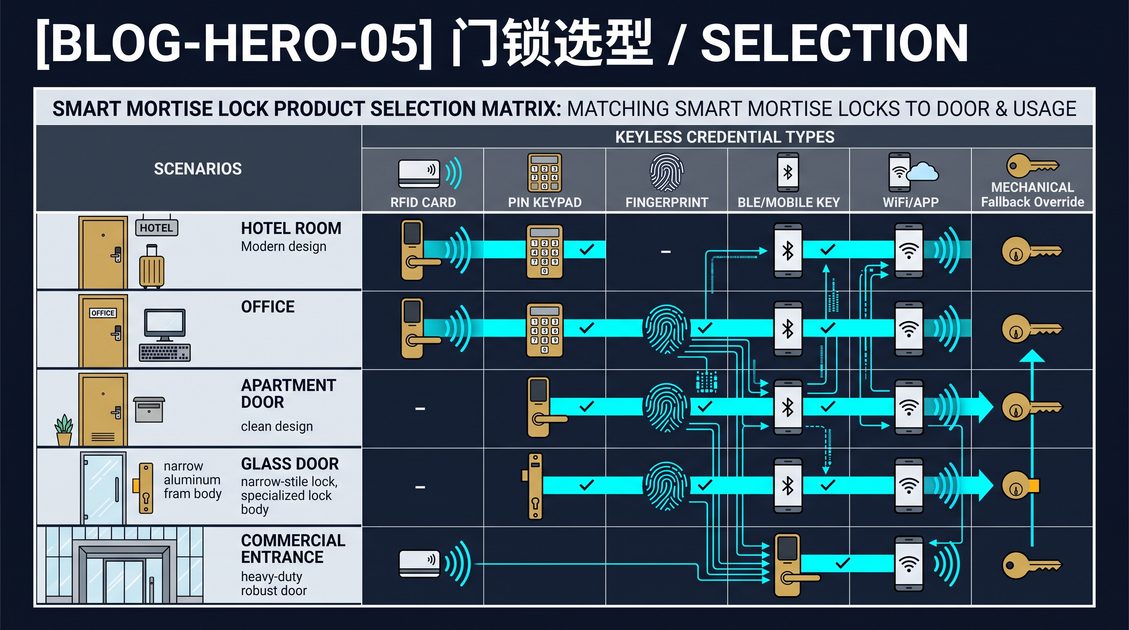
When comparing a face recognition door lock, combine the recognition criteria with the fundamentals of any electronic lock. Confirm the form factor fits the door, whether mortise or cylindrical. Confirm a fallback credential, such as a keypad, fingerprint, card, or mechanical key, because a user in changed appearance, poor lighting, or with a covered face needs another way in. Confirm the power arrangement, because a camera and processor draw more power than a simpler sensor, and require battery reporting. Confirm certification, such as CE, FCC, and RoHS, and, where available, biometric-specific standards.
A face recognition door lock is the right choice when hands-free convenience matters most and the user is almost always an enrolled person, such as a home resident or a staff door. It is less clearly right for a door with many occasional or unenrolled users, where a code, card, or fingerprint serves better and costs less. Match the sophistication to the door, require a fallback, local and encrypted template storage, and certification, and a face recognition lock will deliver the most seamless access of any door lock available.
Evaluate a facial recognition lock in the actual conditions of the doorway before committing, because lighting, distance, and surrounding movement affect recognition more than a datasheet reveals. Confirm the enrollment process for each household member, the behavior in low light, and the fallback for a covered face or a visiting guest who is not enrolled. Keep the stored face data protected and local, and publish who can view recognition events so the convenience does not come at an unexamined privacy cost.
Vous ne savez pas quel capteur choisir ?
Parlez à nos ingénieurs d’application mmWave pour une consultation gratuite.
Spécifiez votre projet hôtelier avec nos ingénieurs
Indiquez le nombre de chambres, le type de plafond et votre préférence de protocole. Nous renverrons un plan d'échantillon et un devis sous 24 heures ouvrées.
- Passez d'une guidance générale à une discussion produit ou application.
- Utilisez la RFQ quand le prix, les plans, le MOQ ou le calendrier de lancement nécessitent de la structure.
- Gardez une voie de contact direct visible pour les clarifications rapides et le transfert.