Contrôle d'accès biométrique : fonctionnement et choix
Fonctionnement d'un contrôle d'accès biométrique, biométries utiles, précision, sécurité et choix pour une porte commerciale ou d'immeuble résidentiel.
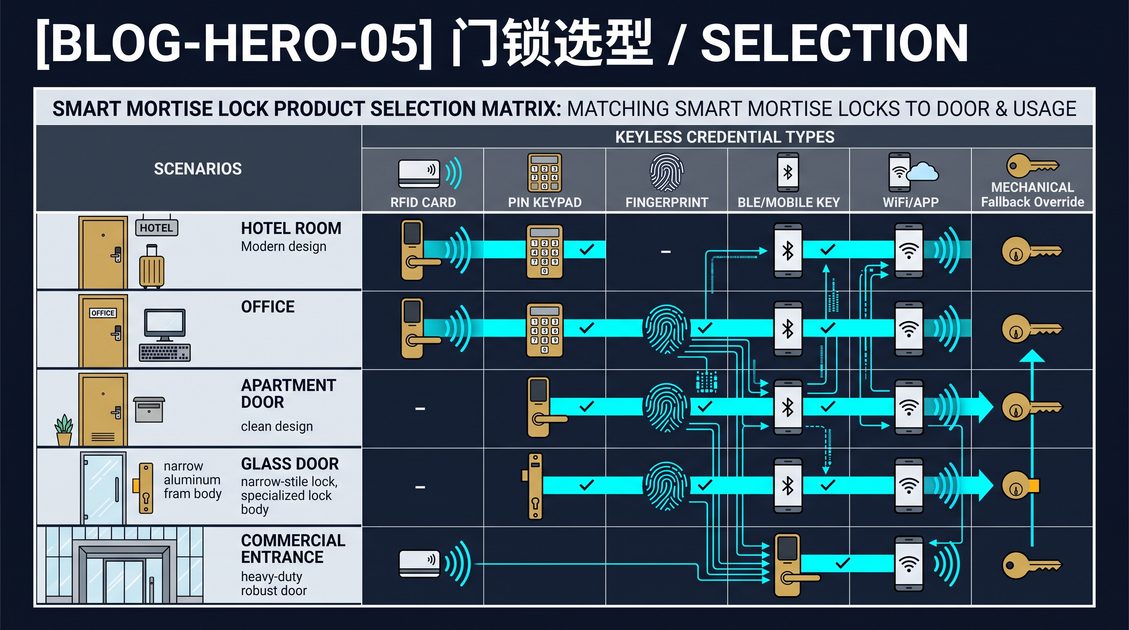
Un système de contrôle d'accès biométrique utilise un trait biologique d'une personne, le plus souvent une empreinte digitale ou un visage, comme identifiant pour contrôler l'entrée par une porte, remplaçant les clés, cartes et codes par quelque chose que l'on est. C'est le plus robuste des trois facteurs d'authentification et il est largement utilisé lorsqu'une porte doit identifier un individu précis et ne peut pas dépendre d'un élément pouvant être perdu ou partagé. Ce guide explique comment fonctionne un système de contrôle d'accès biométrique, les types de biométrie importants, la précision et la sécurité, ainsi que le choix d'un système pour une porte commerciale, de bureau ou d'immeuble résidentiel.
Fonctionnement d'un système de contrôle d'accès biométrique
Un système de contrôle d'accès biométrique comporte trois parties : un capteur qui capture l'échantillon biométrique, un processeur qui extrait un gabarit de l'échantillon et un comparateur qui compare le gabarit aux gabarits autorisés enregistrés. Lorsqu'un utilisateur présente une empreinte digitale ou un visage, le système extrait les caractéristiques, les compare à l'ensemble enregistré et déverrouille la porte en cas de correspondance. Le même système peut gérer de nombreuses portes et de nombreux utilisateurs de manière centralisée, en enregistrant, mettant à jour et révoquant les identifiants biométriques et en maintenant un journal d'audit indiquant qui est entré par quelle porte et à quel moment.
Le type de biométrie détermine le capteur. Un lecteur d'empreintes capture un motif de crêtes et de vallées, que ce soit par un capteur optique ou à semi-conducteur, et constitue l'option la plus courante et la plus économique. Un lecteur de visage capture un visage pour la reconnaissance ; il est plus coûteux et plus énergivore, mais il est mains libres. Chaque biométrie est évaluée en termes de précision, et un bon système d'empreintes maintient un taux de fausse acceptation très bas tout en conservant un taux de faux rejet assez faible pour que les utilisateurs légitimes ne soient pas bloqués.
Précision, sécurité et gestion
La sécurité d'un système de contrôle d'accès biométrique comporte deux dimensions : la précision de la correspondance et la protection du gabarit. La précision s'exprime par les taux de fausse acceptation et de faux rejet ; un système qui accepte trop de personnes non autorisées est faible, tandis qu'un système qui rejette trop de personnes autorisées est frustrant. La protection du gabarit est importante car une donnée biométrique ne peut pas être modifiée comme un mot de passe ; un bon système stocke donc les gabarits chiffrés dans un élément sécurisé et traite la reconnaissance localement, sans jamais transmettre d'échantillons biométriques bruts à un service non contrôlé.
La gestion transforme une porte biométrique en système de contrôle d'accès. La plateforme enregistre les utilisateurs, attribue les portes et les horaires auxquels chaque personne peut accéder, révoque l'accès lorsqu'une personne part et tient un journal d'audit centralisé. Comme une identité biométrique A biometric access control system uses a person's biological trait, most commonly a fingerprint or a face, as the credential to control entry through a door, replacing keys, cards, and codes with something-you-are. It is the strongest of the three authentication factors and is widely used where a door must identify a specific individual and cannot rely on something that can be lost or shared. This guide explains how a biometric access control system works, the biometric types that matter, how accuracy and security are measured, and how to choose a system for a commercial, office, or multifamily door.
How a Biometric Access Control System Works
A biometric access control system has three parts: a sensor that captures the biometric sample, a processor that extracts a template from the sample, and a matcher that compares the template against enrolled authorized templates. When a user presents a fingerprint or face, the system extracts the features, compares them against the enrolled set, and unlocks the door on a match. The same system can manage many doors and many users centrally, enrolling, updating, and revoking biometric credentials and maintaining an audit log of who entered which door at which time.
The biometric type determines the sensor. A fingerprint reader captures a ridge-and-valley pattern, whether by an optical or a semiconductor sensor, and is the most common and most economical. A face reader captures a face for recognition and is more expensive and power-hungry but hands-free. Each biometric is measured by accuracy, and a good fingerprint system drives the false-acceptance rate very low while keeping false rejection acceptably low so legitimate users are not locked out.
Accuracy, Security, and Management
The security of a biometric access control system has two dimensions: the accuracy of the match and the protection of the template. Accuracy is expressed by false-acceptance and false-rejection rates; a system that accepts too many unauthorized people is weak, while one that rejects too many authorized people is frustrating. Template protection matters because a biometric cannot be changed like a password, so a good system stores templates encrypted in a secure element and processes recognition locally, never transmitting raw biometric samples to an uncontrolled service.
Management turns a biometric door into an access control system. The platform enrolls users, assigns which doors and schedules each person can access, revokes access when someone leaves, and maintains a centralized audit log. Because a biometric credential is tied to a person, it clarifies who has access and simplifies revocation. For an office, a hotel, or a multifamily building, a biometric access control system with central management provides the audit and control that a key or password system cannot.
Choosing a Biometric Access Control System
When choosing a biometric access control system, apply the full framework: biometric type, accuracy, template security, form factor, fallback, management, and scalability. Match the biometric to the users; choose the form factor that fits the door, whether a standalone biometric lock or a biometric reader plus an electronic mortise lock; require a fallback, such as a card, keypad, or mechanical key, because a dry finger or changed appearance must not cause a lockout; confirm the management platform scales to your door count; and verify certification and local, encrypted template storage.
A biometric access control system is the right choice when you must authenticate a specific individual and prevent sharing of credentials, which matters for offices, hotels, multifamily buildings, and any door protecting valuables or people. The trade-off is cost, sensor sensitivity, and the privacy responsibility of handling biometric data, so require a fallback, secure templates, and a reliable management platform. Apply these criteria, and a biometric access control system will deliver the strongest, most accountable access control available.
A reliable implementation also depends on enrollment quality and user expectations. Enroll each person in controlled light or conditions, record the approved fingers or face angles, and tell users how to recover when the sensor rejects them. In an office or multifamily setting, publish a simple procedure for access disputes and keep the false-rejection rate low enough that legitimate users are not locked out, because a biometric system that annoys its users gets bypassed.
Part of this article content is generated by AI and optimized for professional accuracy and readability.
Vous ne savez pas quel capteur choisir ?
Parlez à nos ingénieurs d’application mmWave pour une consultation gratuite.
Spécifiez votre projet hôtelier avec nos ingénieurs
Indiquez le nombre de chambres, le type de plafond et votre préférence de protocole. Nous renverrons un plan d'échantillon et un devis sous 24 heures ouvrées.
- Passez d'une guidance générale à une discussion produit ou application.
- Utilisez la RFQ quand le prix, les plans, le MOQ ou le calendrier de lancement nécessitent de la structure.
- Gardez une voie de contact direct visible pour les clarifications rapides et le transfert.