Serrure de porte automatique : fonctionnement
Découvrez le fonctionnement d’une serrure de porte automatique, les critères de fiabilité et son intérêt pour sécuriser votre logement ou entreprise.
Une serrure de porte automatique est une serrure intelligente qui se verrouille dès que la porte se ferme. La porte n’est ainsi jamais laissée déverrouillée, que ce soit par accident ou parce qu’un utilisateur a oublié de la verrouiller. Il s’agit d’un comportement spécifique de nombreuses serrures électroniques, appelé verrouillage automatique ou auto-verrouillage. C’est l’une des fonctions de sûreté et de sécurité les plus utiles qu’une serrure puisse offrir, car elle élimine le risque d’erreur humaine lié à une porte laissée ouverte. Ce guide explique le fonctionnement d’une serrure de porte automatique, les critères de fiabilité à comparer et l’intérêt d’un verrouillage automatique pour un logement ou une entreprise.
Fonctionnement d’une serrure de porte automatique
Une serrure de porte automatique engage le pêne dès que la porte se ferme, sans que l’utilisateur ait besoin d’appuyer sur un bouton. La serrure détecte la fermeture, généralement au moyen d’un capteur ou d’un déclencheur mécanique, puis entraîne le pêne dans la gâche afin de sécuriser la porte. Sur la plupart des serrures, ce comportement est configurable : vous pouvez définir un délai après la fermeture, choisir si la serrure doit toujours se verrouiller automatiquement et, sur certains modèles, décider si elle se verrouille à chaque fermeture ou uniquement lorsqu’elle est armée.
L’intérêt d’une serrure de porte automatique réside dans sa fiabilité et sa sécurité. Elle garantit que la porte est verrouillée, ce qui est essentiel pour une porte d’entrée, une porte arrière ou une porte An auto door lock is a smart door lock that locks itself after the door closes, so the door is never left unlocked, whether by accident or by a user who forgot to lock it. It is a specific behavior of many electronic locks, called auto-lock or self-locking, and it is one of the most valuable safety and security features a lock can offer because it removes the human error of leaving a door unlocked. This guide explains how an auto door lock works, what to compare for reliability, and whether an automatic locking door is the right choice for a home or a business.
How an Auto Door Lock Works
An auto door lock automatically engages the bolt when the door closes, without the user pressing a button. The lock detects that the door has closed, typically through a sensor or a mechanical trigger, and then drives the bolt into the strike to secure the door. The behavior is configurable on most locks: you can set a delay after closing, choose whether the lock always auto-locks, and, on some models, decide whether it locks on every close or only when armed.
The value of an auto door lock is reliability and safety. It guarantees the door is locked, which matters for a front door, a back door, or a commercial door where an unlocked door is a genuine security hole. For a home, it removes the worry of leaving the door open. For a rental or a business, it ensures the door is secured at the end of the day without depending on the last person to remember. An automatic locking door is a defense against the most common lock failure of all, the human one.
Comparing Auto Locking Reliability
When comparing an auto door lock, the key criteria are detection reliability, configurable behavior, emergency access, and battery. Detection reliability is whether the lock reliably knows the door has closed; a lock that triggers on a partially closed door or fails to trigger when the door closes quietly creates a false lockout or a security gap. Configurable behavior matters because not everyone wants an auto-lock on every close, especially in a home with children or frequent traffic. Emergency access and battery work as with any smart lock, but an auto lock that engages repeatedly draws power, so battery reporting is important.
An auto lock must never create a lockout. If the door closes and auto-locks while a user is outside without a credential, the user is stranded, so a well-designed auto door lock always preserves a fallback, such as a keypad, card, fingerprint, mobile key, or mechanical key. This guide recommends choosing an auto door lock with reliable closure detection, configurable auto-lock, a clear emergency-access path, and central battery reporting for multi-door deployments, so the convenience of automatic locking never becomes a reliability problem.
When Auto Locking Is Right for You
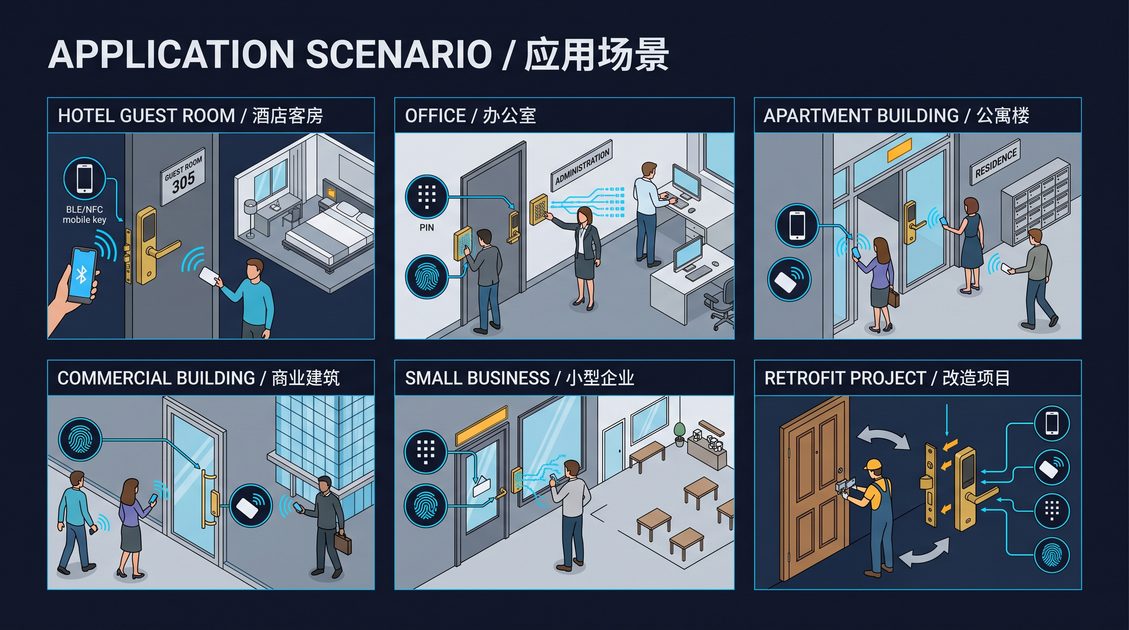
An auto door lock is a strong choice when an unlocked door is a real risk, which is most front doors, rear doors, and commercial entrances. For a home, auto-lock is a peace-of-mind feature that guarantees the door is secured. For a rental or short-term property, auto-lock ensures a guest cannot leave the door open and that the unit is secure after check-out. For a business, auto-lock secures the entrance at the end of the day without relying on the last person to lock up.
The trade-off is the dependence on detection reliability and the small power cost of repeated auto-locking. A well-made auto door lock with configurable behavior and a reliable fallback is a genuine security upgrade; a poorly made one can lock out users or leave the door open. Apply the same framework as any keyless entry decision, require reliable closure detection and a fallback, and an auto door lock will be one of the most useful features on your door.
Part of this article content is generated by AI and optimized for professional accuracy and readability.
Vous ne savez pas quel capteur choisir ?
Parlez à nos ingénieurs d’application mmWave pour une consultation gratuite.
Spécifiez votre projet hôtelier avec nos ingénieurs
Indiquez le nombre de chambres, le type de plafond et votre préférence de protocole. Nous renverrons un plan d'échantillon et un devis sous 24 heures ouvrées.
- Passez d'une guidance générale à une discussion produit ou application.
- Utilisez la RFQ quand le prix, les plans, le MOQ ou le calendrier de lancement nécessitent de la structure.
- Gardez une voie de contact direct visible pour les clarifications rapides et le transfert.